
For Black folks, collective bargaining means equality in the workplace.
Now, this basic right is under attack in Wisconsin — and across the country.
Support the workers who are fighting back.
There was once a time in this country when Black folks would work 12-hour days for less money than their White co-workers who worked only eight. The key to leveling the playing field for Black workers was collective bargaining — and now Republicans around the country are attacking this basic right.
The right of workers to negotiate as a group for better wages, benefits and working conditions has been important for everyone, but it’s been especially meaningful for Black Americans. Before we could collectively bargain, we had little control over our working conditions and no protection from racial discrimination in the workplace.
That’s why it’s critical that we stand with the workers in Wisconsin, Ohio, New Jersey, and everywhere else collective bargaining is coming under attack. Please join us in sending a message of support to all those fighting this battle on the front lines. It takes only a moment:
http://act.colorofchange.org/go/778?akid=1932.1174326.mkhRBj&t=3
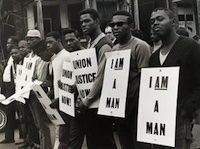
In Memphis in 1968, Black sanitation workers worked in dangerous, inhumane conditions under abusive White supervisors for little pay. After two workers were crushed to death by a malfunctioning city garbage truck, the city’s Black sanitation workers sought to unionize. They demanded better wages, safer working conditions, and the right to collectively bargain for these things. They took to the streets of Memphis bearing signs that read, “I am a man.” During the strike, police attacked and jailed Black workers for peaceful protest. Months later, Dr. Martin Luther King, Jr., who said that “all labor has dignity,” joined these workers on the front lines. He was assassinated while leading the effort to win collective bargaining rights for these workers.1
Collective bargaining has helped Black workers vulnerable to workplace discrimination win needed on-the-job protections. “Black workers have an interest in unions as all workers do, because they give them power in the labor market to improve working conditions, and allow them due process and fairness on the job,” says labor scholar Stephen Pitts. “Any sort of institution that allows due process procedures and reduces arbitrary behavior in decision making is positive for black folks.”2
More than just protection from discrimination, collective bargaining has won Black workers fairness in pay and advancement, access to health insurance and retirement savings, and basic worker safety protections.3 This is especially true for Black public-sector workers. Twenty-five percent of all Black college graduates work in the public sector, and government work is second only to health and education services in concentration of Black workers.4 As scholar Michael Honey points out, “The one toe-hold many black and minority workers (and especially women among them) still have in the economy is in unionized public employment.5
Now, Republicans in state legislatures around the country are attacking public employees’ collective bargaining rights. The battle began in Wisconsin, when Republican Governor Scott Walker offered a bill that would strip public employees of their collective bargaining rights. In response, thousands of regular people filled the state capitol in protest — with many camping out there for days or even weeks. To stop the bill and force Republicans to negotiate, 14 Democratic state senators left Wisconsin, (preventing Republicans from voting on the bill). Despite the overwhelming public opposition to the bill, Republicans were eventually able to pass the law using procedural tricks late last week.6 But the protesters in Wisconsin drew the world’s attention to this fight, and exposed the attack on collective bargaining rights as hugely unpopular and politically motivated. And right now they’re working to hold Republicans accountable in powerful ways.
Wisconsin is one of many states where collective bargaining is under attack. Republicans in Ohio just passed a law similar to Wisconsin’s, and states from Indiana to New jersey are prepared to follow suit.
Republicans say that their effort to roll back collective bargaining rights is necessary to curb spending in times of economic hardship, but that just doesn’t square with the facts. In no state are public employees’ salaries or pension benefits a major cause of their current financial problems.7 The Republican efforts are part of a strategy to attack public employees’ unions, which overwhelmingly give money to Democratic interests. Without the strength of the unions, many expect that President Obama and other Democrats will have a tougher time raising funds for the 2012 election.8
DePaul University law professor Terry Smith says that, “Dismantling bargaining rights will disproportionately affect African Americans.”9 This right has played a vitally important role in Black Americans’ move into the middle class. For Republicans, the economic well-being of Black folks (and all workers) is only collateral damage in a political battle. It’s shameful.
That’s why it’s important that we stand with the brave workers around the country fighting to preserve the right to collectively bargain in their states. They’re on the front lines, and your message of support will help them keep going even as circumstances get tougher. Please join us in telling these workers that you stand with them, and then ask your friends and family to do the same.
http://act.colorofchange.org/sign/workers
Thanks and Peace,
— James, Gabriel, William, Dani, Matt, Natasha and the rest of the ColorOfChange.org team
March 15th, 2011
Help support our work. ColorOfChange.org is powered by YOU — your energy and dollars. We take no money from lobbyists or large corporations that don’t share our values, and our tiny staff ensures your contributions go a long way. You can contribute here:
http://act.colorofchange.org/go/205?akid=1932.1174326.mkhRBj&t=6
References:
1. “How Unions Helped Bring Economic Justice to Black Workers,” AlterNet, 2-25-2011
http://act.colorofchange.org/go/785?akid=1932.1174326.mkhRBj&t=8
2. See Reference 1
3. “Gutting Unions Hurts the Black Middle Class,” The Root, 3-11-2011
http://act.colorofchange.org/go/779?akid=1932.1174326.mkhRBj&t=10
4. “Black Workers Central to National Union Battle,” ColorLines, 3-1-2011
http://act.colorofchange.org/go/780?akid=1932.1174326.mkhRBj&t=12
5. “It’s 1968 All Over Again and King’s Fight for Unions Is Still Essential,”
http://act.colorofchange.org/go/781?akid=1932.1174326.mkhRBj&t=14
6. “Wisconsin Union Law to Take Effect on March 26,” Wall Street Journal, 3-14-2011
http://act.colorofchange.org/go/782?akid=1932.1174326.mkhRBj&t=16
7.“Unions aren’t to blame for Wisconsin’s budget,” The Washington Post, 2-18-2011
http://act.colorofchange.org/go/783?akid=1932.1174326.mkhRBj&t=18
8. “WI Senate GOP Leader Admits On-Air That His Goal Is To Defund Labor Unions, Hurt Obama’s Reelection Chances,” Think Progress, 3-9-2011
http://act.colorofchange.org/go/784?akid=1932.1174326.mkhRBj&t=20
9. See Reference 3






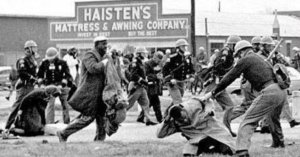 ugly March of death for the right to vote called, “Bloody Sunday”.






You must be logged in to post a comment.