Tag Archives: vote

In Memory …. Langston Hughes – Black History


Langston Hughes

Image result for langston hughes. Size: 202 x 200. Source: blogs.cofc.edu

19021967, Joplin, MO

James Mercer Langston Hughes was born February 1, 1902, in Joplin, Missouri. His parents divorced when he was a young child, and his father moved to Mexico. He was raised by his grandmother until he was thirteen, when he moved to Lincoln, Illinois, to live with his mother and her husband, before the family eventually settled in Cleveland, Ohio. It was in Lincoln that Hughes began writing poetry. After graduating from high school, he spent a year in Mexico followed by a year at Columbia University in New York City. During this time, he held odd jobs such as assistant cook, launderer, and busboy. He also travelled to Africa and Europe working as a seaman. In November 1924, he moved to Washington, D. C. Hughes’s first book of poetry, The Weary Blues, (Knopf, 1926) was published by Alfred A. Knopf in 1926. He finished his college education at Lincoln University in Pennsylvania three years later. In 1930 his first novel, Not Without Laughter, (Knopf, 1930) won the Harmon gold medal for literature.

Hughes, who claimed Paul Lawrence Dunbar, Carl Sandburg, and Walt Whitman as his primary influences, is particularly known for his insightful, colorful portrayals of black life in America from the twenties through the sixties. He wrote novels, short stories and plays, as well as poetry, and is also known for his engagement with the world of jazz and the influence it had on his writing, as in his book-length poem Montage of a Dream Deferred (Holt, 1951). His life and work were enormously important in shaping the artistic contributions of the Harlem Renaissance of the 1920s. Unlike other notable black poets of the period—Claude McKay, Jean Toomer, and Countee Cullen—Hughes refused to differentiate between his personal experience and the common experience of black America. He wanted to tell the stories of his people in ways that reflected their actual culture, including both their suffering and their love of music, laughter, and language itself.

The critic Donald B. Gibson noted in the introduction to Modern Black Poets: A Collection of Critical Essays (Prentice Hall, 1973) that Hughes “differed from most of his predecessors among black poets . . . in that he addressed his poetry to the people, specifically to black people. During the twenties when most American poets were turning inward, writing obscure and esoteric poetry to an ever decreasing audience of readers, Hughes was turning outward, using language and themes, attitudes and ideas familiar to anyone who had the ability simply to read . . . Until the time of his death, he spread his message humorously—though always seriously—to audiences throughout the country, having read his poetry to more people (possibly) than any other American poet.”

Langston Hughes died of complications from prostate cancer in May 22, 1967, in New York City. In his memory, his residence at 20 East 127th Street in Harlem has been given landmark status by the New York City Preservation Commission, and East 127th Street has been renamed “Langston Hughes Place.”

In addition to leaving us a large body of poetic work, Hughes wrote eleven plays and countless works of prose, including the well-known “Simple” books: Simple Speaks His Mind, (Simon & Schuster, 1950); Simple Stakes a Claim, (Rinehart, 1957); Simple Takes a Wife, (Simon & Schuster, 1953); and Simple’s Uncle Sam (Hill and Wang, 1965). He edited the anthologies The Poetry of the Negro and The Book of Negro Folklore, wrote an acclaimed autobiography, The Big Sea (Knopf, 1940), and cowrote the play Mule Bone (HarperCollins, 1991) with Zora Neale Hurston.


Selected Bibliography

Poetry

Collected Poems of Langston Hughes (Knopf, 1994)
The Panther and the Lash: Poems of Our Times (Knopf, 1967)
Ask Your Mama: 12 Moods for Jazz (Knopf, 1961)
Montage of a Dream Deferred (Holt, 1951)
One-Way Ticket (Knopf, 1949)
Fields of Wonder (Knopf, 1947)
Freedom’s Plow (Musette Publishers, 1943)
Shakespeare in Harlem (Knopf, 1942)
The Dream Keeper and Other Poems (Knopf, 1932)
Scottsboro Limited (The Golden Stair Press, 1932)
Dear Lovely Death (Troutbeck Press, 1931)
Fine Clothes to the Jew (Knopf, 1927)
The Weary Blues (Knopf, 1926)

Prose

Remember Me to Harlem: The Letters of Langston Hughes and Carl Van Vechten, 1925-1964 (Knopf, 2001)
The Arna Bontemps-Langston Hughes Letters (Dodd, Mead, 1980)
Good Morning, Revolution: Uncollected Social Protest Writings by Langston Hughes (Hill, 1973)
Simple’s Uncle Sam (Hill and Wang, 1965)
Something in Common and Other Stories (Hill and Wang, 1963)
Tambourines to Glory (John Day, 1958)
Simple Stakes a Claim (Rinehart, 1957)
I Wonder as I Wander (Rinehart, 1956)
Laughing to Keep From Crying (Holt, 1952)
Simple Takes a Wife (Simon & Schuster, 1953)
Simple Speaks His Mind (Simon & Schuster, 1950)
The Ways of White Folks (Knopf, 1934)
Not Without Laughter (Knopf, 1930)

Drama

Collected Works of Langston Hughes, vol. 5: The Plays to 1942: Mulatto to The Sun Do Move (University of Missouri Press, 2000)
The Political Plays of Langston Hughes (Southern Illinois University Press, 2000)
Mule Bone (HarperCollins, 1991)
Five Plays by Langston Hughes (Indiana University Press, 1963)

Poetry in Translation

Cuba Libre (Anderson & Ritchie, 1948)
Selected Poems of Gabriela Mistral (Indiana University Press, 1957)

Translation

Masters of the Dew (Reynal & Hitchcock, 1947)

On this Day … Moby Dick Published


On this day in 1851, Moby-Dick, a novel by Herman Melville about the voyage of the whaling ship Pequod, is published by Harper & Brothers in New York. Moby-Dick is now considered a great classic of American literature and contains one of the most famous opening lines in fiction: “Call me Ishmael.” Initially, though, the book about Captain Ahab and his quest for a giant white whale was a flop.

Herman Melville was born in New York City in 1819 and as a young man spent time in the merchant marines, the U.S. Navy and on a whaling ship in the South Seas. In 1846, he published his first novel, Typee, a romantic adventure based on his experiences in Polynesia. The book was a success and a sequel, Omoo, was published in 1847. Three more novels followed, with mixed critical and commercial results. Melville’s sixth book, Moby-Dick, was first published in October 1851 in London, in three volumes titled The Whale, and then in the U.S. a month later. Melville had promised his publisher an adventure story similar to his popular earlier works, but instead, Moby-Dick was a tragic epic, influenced in part by Melville’s friend and Pittsfield, Massachusetts, neighbor, Nathaniel Hawthorne, whose novels include The Scarlet Letter.

After Moby-Dick‘s disappointing reception, Melville continued to produce novels, short stories (Bartleby) and poetry, but writing wasn’t paying the bills so in 1865 he returned to New York to work as a customs inspector, a job he held for 20 years.

Melville died in 1891, largely forgotten by the literary world. By the 1920s, scholars had rediscovered his work, particularly Moby-Dick, which would eventually become a staple of high school reading lists across the United States. Billy Budd, Melville’s final novel, was published in 1924, 33 years after his death.

history.com

National Minority Health Month


Dept. of Health & Human Services

National Minority Health Month | CPSC.gov

Every April, the U.S. Department of Health and Human Services (HHS) Office of Minority Health (OMH) observes National Minority Health Month to highlight the importance of improving the health of racial and ethnic minority and American Indian/Alaska Native (AI/AN) communities and reducing health disparities.

OMH is proud to announce the theme for National Minority Health Month 2023: Better Health Through Better Understanding.

This year’s theme focuses on improving health outcomes for racial and ethnic minorities and AI/AN communities by providing them with culturally and linguistically competent healthcare services, information, and resources. When patients are provided with culturally and linguistically appropriate information, they are empowered to create healthier outcomes for themselves and their communities.

minorityhealth.hhs.gov

Rashad Robinson, ColorOfChange.org :::::: He broke his own neck?


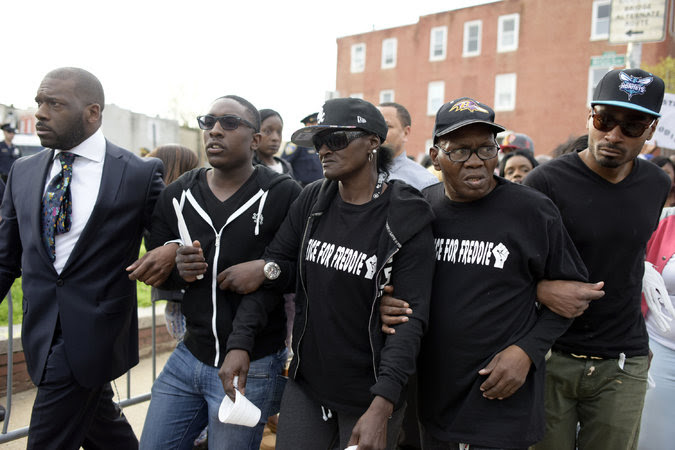
In memory… Freddie Gray

It looks like Baltimore police are trying to blame Freddie Gray for his own death.

Police and prosecutors are refusing to officially release information about the investigation into Freddie Gray’s death. But at the same time, someone just leaked a police document that quotes a prisoner who rode in the same van as Gray, saying that Gray “was intentionally trying to injure himself.”1This anonymous leak almost certainly came from someone in the Baltimore police department.

It’s despicable. And it’s exactly the same type of victim-blaming we saw years ago when Baltimore police gave another Baltimore resident a “rough ride,” paralyzing him and eventually killing him in a hauntingly similar case.2

We’ve seen time and time again what happens when police are given the authority and political cover to police themselves. No transparency. No accountability. No prosecution. Unless Governor Hogan brings independent oversight to this case, we can expect the same familiar miscarriage of justice.3,4

Will you join nearly 40,000 ColorOfChange member in urging Governor Hogan to appoint Attorney General Frosh to assist the case against Freddie Gray’s killers?

Freddie Gray's family marches for justice

The prisoner quoted in this leak was separated from Gray by a metal barrier, so he couldn’t have seen Gray. According to the leaked document, he claims he heard Gray banging on the walls, and that he thinks Gray was trying to hurt himself. But if Gray was banging on the walls, it could be because he was desperately trying to get help.5We already know that he had been requesting medical attention, and those requests were ignored.

And Gray might not have been banging on the walls at all. According to other versions of the story, Gray was unresponsive by the time the second person was loaded into the van.6Whatever happened, what’s clear is that this leak is an attempt to shape the story in a way that absolves police of responsibility — at a time when law enforcement is refusing to release other information about the case.

Nearly 40,000 ColorOfChange members are urging Governor Hogan to send Attorney General Frosh to support the investigation and prosecution of Freddie Gray’s death. This leak makes it clear that the current investigation cannot be trusted. Baltimore police and State’s Attorney Marilyn Mosby are heading down the same path of denied justice that has allowed Baltimore’s crisis of discriminatory police violence to flourish for years.

In 2014, 100% of people killed by Baltimore Police were Black. And almost none of those officers have ever been held accountable.7 Over the past 5 years, Baltimore police have paid millions to people injured and paralyzed by police “rough rides.”8 Freddie Gray was killed. And his family, Baltimore, and America have the right to an independent investigation that gets to the bottom of what happened and ensures the greatest measure of justice.

Take action to escalate pressure on Governor Hogan and build the widespread support we will need to win.

Thanks and peace,

— Rashad, Matt, Arisha, Lyla, Shani, and the rest of the ColorOfChange team

April 30th, 2015

References

1. “Prisoner in van said Freddie Gray was ‘trying to injure himself,’ document says,” Washington Post 4-29-2015
http://act.colorofchange.org/go/4783?t=5&akid=4326.1174326.ll2mw6

2. “Freddie Gray not the first to come out of Baltimore police van with serious injuries,” The Baltimore Sun Post 04-23-2015
http://act.colorofchange.org/go/4784?t=7&akid=4326.1174326.ll2mw6

3. “Police Kill Black Women All The Time, Too — We Just Don’t Hear About It,” Bustle 12-08-2014
http://act.colorofchange.org/go/4785?t=9&akid=4326.1174326.ll2mw6

4. “Why I Don’t Trust Baltimore Prosecutors with Freddie Gray Case,” Legal Speaks 4-22-2015
http://act.colorofchange.org/go/4769?t=11&akid=4326.1174326.ll2mw6

5. “Prisoner Was Wrong: Freddie Gray Didn’t Kill Himself,” Daily Beast, 4-30-2015
http://act.colorofchange.org/go/4789?t=13&akid=4326.1174326.ll2mw6

6. “Baltimore Cop’s Relative Claims Freddie Gray Was Injured Before He Got In Van,” Daily Beast, 4-30-2015
http://act.colorofchange.org/go/4790?t=15&akid=4326.1174326.ll2mw6

7. BaltimoreUprising.org
http://act.colorofchange.org/go/4788?t=17&akid=4326.1174326.ll2mw6

8. “Baltimore’s “rough rides”: the city has paid out millions to people injured in police vans,” Vox, 04-28-2015
http://act.colorofchange.org/go/4786?t=19&akid=4326.1174326.ll2mw6

The Rick Scott Squeeze … repost! Remember when he was a gov. remember what he did and compare contrast this to gov desantis


By CAP Action War Room

Rick Scott’s Policies Are Failing Floridians, And They’re Not Happy

Ahead of Florida’s first gubernatorial debate on Friday, Governor Rick Scott is on the hot seat.

From failing to expand Medicaid and opposing an increase to the minimum wage, to ignoring climate change as a central threat to his state, Scott has hurt the lives and livelihoods of millions of Floridians—many of whom are from communities of color. A new Center for American Progress Action Fund report details Scott’s failure to act on behalf of his state’s residents. Accompanying the report, a new survey shows how Floridians disagree with his harmful positions.

The CAP Action report highlights several ways that Gov. Scott is failing Floridians:

  • Gov. Scott has opposed raising the minimum wage, even though 55 percent of Floridians support raising it to $10.10 per hour and a whopping 79 percent don’t think they could support their family on the current minimum wage. His opposition to raising the wage to $10.10 means that 1.7 million Floridians—including 357,000 African Americans and 536,000 Hispanics—are being denied fair wages. While Scott says efforts to raise the minimum wage make him “cringe,” workers are losing out on $2.1 billion in wages and Florida forgoes $1.3 billion in economic growth. Additionally, raising the minimum wage would save the state money. By putting more money into the pockets of working Floridians, 195,000 people would no longer need food stamps, saving the state $295.1 million each year.
  • Gov. Scott also now refuses to expand access to health coverage for Floridians through Medicaid, despite the facts that Florida has the third-highest uninsured rate in the nation. Gov. Scott’s failure to act means 764,000 working Floridians fall into the Medicaid coverage gap, including 214,000 African Americans and 200,000 Hispanics. This failure is costing the state 63,000 jobs, $66 billion in additional federal funds, and $20 billion in Florida taxpayer money that is going to other states to fund their expanded Medicaid programs.
  • Gov. Scott refuses to address climate change. Initially a climate denier, Gov. Scott now says he is “not a scientist,” a new talking point for conservatives who are trying to skirt the issue. This is despite the fact that Florida is one of the most at-risk states from the damaging effects of climate change and Florida voters are less likely to support a candidate who denies that man-made climate change is real. His failure to act means most of South Florida will be completely washed away by the end of the century, according to current forecasts, and risks $9 billion in lost tourism by 2025 and $40 billion by 2050. Hispanics in particular will feel the effects of climate change, since about half of the state’s Hispanic population lives in South Florida counties.

Floridians are recognizing these failures. By a 12-point margin in the latest survey, voters are less likely to vote to for Scott because of his position opposing a minimum wage increase. Voters are less likely to support Scott by an 11-point margin based on his refusal to expand Medicaid to cover the state’s 1 million low- and moderate-income Floridians. And by a 16-point margin, Florida voters are less likely to vote for a candidate — like Scott — who denies that man-made climate change is real.

BOTTOM LINE: Florida Governor Rick Scott’s policies on the minimum wage, Medicaid expansion, and climate change are failing to create an economy that works for every Floridian, not just the wealthiest. Voters in the state disagree with these positions, and they are taking notice.

Like CAP Action on Facebook and follow us on Twitter!