Tag Archives: Wal-Mart

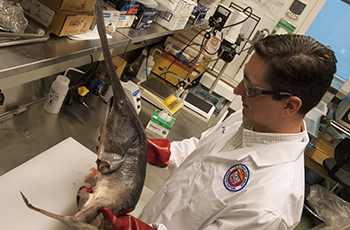
Keep Supporting Jonathan Deeds, Ph.D., ~is working to assure that U.S. seafood is both safe and accurately labeled


WordPressWhatFishIsThat
04/21/2014 01:00 PM EDT
Using some of the technology used in mapping the human genome, FDA scientists are working to create DNA barcodes for fish.
The high-tech effort is aimed to preventing fraud, including the substitution of a cheap fish for an expensive one, and preventing illness.

FDA Logo

Make Food Safety Part of Your Father’s Day


FoodSafety.gov

Still looking for a Father’s Day gift? Consider getting a food thermometer, perfect for safe grilling during the warm months.

When using a food thermometer, remember these three easy steps to cook like a PRO:

1. Place the thermometer

2. Read the temperature

3. Off the Grill!

Read more about how to cook like a PRO.

=======================================================================================

Infographic

FISH … Wild or Farmed …do you know what to look for? reminder


How to

Identify

Sustainable Seafood

Know the label to look for when shopping for fish.

by Virginia Sole-Smith – 2010

This international nonprofit organization uses independent certifying agencies to make sure fisheries are catching their fish in the most environmentally friendly way possible. The label now appears on more than 180 frozen, fresh, and smoked-fish products sold in grocery stores across the country, including Whole Foods and Target,Wal-Mart has committed to buying all its store-brand fish products from MSC-certified fisheries within the next two to four years. For more information, visit  eng.msc.org  

Please ask your grocer if they buy and sell certified Sustainable fish … Nativegrl77

 facts about MSC

       Our vision is of the world’s oceans teeming with life, and seafood supplies safeguarded for this and future generations

Our mission is to use our ecolabel and fishery certification program to contribute to the health of the world’s oceans by recognising and rewarding sustainable fishing practises, influencing the choices people make when buying seafood, and working with our partners to transform the seafood market to a sustainable basis.
MSC vision and mission

  1. The MSC is a global program with fisheries participating from all the world’s oceans

    We have a staff of 100 spread across the HQ in London and regional offices in the Netherlands, USA, Australia, Baltic region, France, Germany, Japan, South Africa, and Spain, where our multilingual staff can be contacted to answer questions.
    MSC offices and staff

  2. The MSC program assesses wild capture fisheries only

    The MSC assessment program is used to certify wild capture freshwater and marine species. Our program does not assess fish farming (aquaculture), although some forms of enhanced fishery may be eligible for assessment.
    Why MSC doesn’t certify aquaculture fisheries

  3. We do not certify fisheries, we set standards

    To maintain impartiality, the MSC operates a ‘third-party’ certification program. This means that MSC itself does not assess fisheries or decide if they are sustainable. Instead certificates are issued by certifiers who are independently accredited to be able to perform assessments of fisheries and decide if they meet the MSC’s standards.
    Third party certification

  4. The market for certified sustainable seafood creates an incentive for fishery improvements

    Most fisheries say MSC certification helps them retain existing markets and gain access to new ones. For example the Germany North Sea saithe fishery used to rely entirely on fresh fish sales, but is now winning contracts for frozen fillets because its customers are requesting MSC certified products. This presents a powerful incentive for other fisheries to demonstrate their sustainability or to make improvements so that they can be eligible for certification too.
    Benefits of MSC certification (PDF, 8.2 mb)

  5. Fisheries in the MSC program can influence fishery policies

    An example from the South Africa hake fishery illustrates how fisheries in the MSC program can influence government policy. The fishery introduced tori lines (streamers flown from boats to keep birds away) in response to one MSC condition. These are now mandatory on all trawling vessels in South Africa.
    Net benefits report (PDF, 8.2 mb)

  6. The MSC program has delivered environmental improvements in fishery management

    For example the MSC assessment process for the Ekofish Group plaice fishery led to a voluntary agreement with NGOs to close certain sensitive areas for this bottom-trawl fishery, and to take part in scientific research on the impact fishing gear has on habitats and the seabed.
    Find out about other environmental benefits resulting from the MSC program

  7. The MSC program uses the best available science

    MSC certification is a robust scientific process, which draws on scientific expertise from marine scientists worldwide as well as contributing to improving scientific understanding through the fishery assessment process.
    MSC standards and methodologies

  8. Every MSC certified fishery has demonstrated that it maintains sustainable fish stocks, minimises environmental impacts and is effectively managed

    These are the three MSC environmental principles that every fishery in the program must prove it meets. Measurable environmental benefits that have occurred in MSC certified fisheries include the recovery of the New Zealand hoki fishery‘s historically low stock levels, due to a raft of management measures including a stock rebuilding plan.

  9. The MSC program is transparent

    Information from each step of the assessment process is available on the MSC website to make it easier for stakeholders to contribute. We also invite stakeholders to participate in key improvement projects and publish progress online.
    Consultations

  10. We work collaboratively with stakeholders around the world

    The input that stakeholders provide during a fishery’s assessment is key to ensuring a thorough assessment and a credible outcome. For this reason, certifiers are required to carefully consider all comments received, and justify and document their responses. The MSC also has an objections procedure which provides a mechanism for any disagreement with the assessment of the fishery to be reviewed and resolved. The MSC is continually improving its program, and stakeholders are invited to contribute to its development through regular meetings of the Stakeholder Council and public consultations.
    Have your say

  11. We work with fisheries in developing countries to ensure there is equal access to the benefits of certification

    The MSC program is open to all fisheries regardless of size, scale, location and intensity. To promote equal accessibility to its ecolabelling program, the MSC works with stakeholders and fisheries from all over the world. Through the MSC’s Developing World Program, the MSC seeks to promote increased participation of developing country fisheries in certification.
    Developing World Program

  12. We are a non-profit organisation

    The MSC is a registered charity and non-profit (501c3) and to a great extent relies on financial support from donors with an interest in protecting sustainable fishing. The majority of this income is received in the form of grants from private foundations, as well as some more limited support from governments, companies, other NGOs and individual supporters. Additional revenue is also generated from MSC International (the trading arm of the MSC) which administers a fee structure for use of the MSC eco-label, helping the MSC to become more financially independent and reduce its dependence on charitable donations.
    Make a donation

  13. We meet best practice for ecolabels and setting social and environmental standards

    The MSC has the only seafood ecolabel in the world that is consistent with the ISEAL Code of Good Practice for Setting Social and Environmental Standards and the United Nations Food and Agriculture Organisation’s guidelines for ecolabelling of fish products.
    How we meet best practice

  14. MSC certification helps to safeguard livelihoods and sustain communities

    Encouraging responsible fisheries management improves security for the livelihoods of communities who depend on them, especially for smaller scale artisanal fisheries. In the Net Benefits report there are many examples, such as in the American Albacore Fishing Association Pacific tuna fishery which in 2005 had unstable incomes and lack of resources to invest in repairing vessels. After certification, the fishery found new buyers in Switzerland, Germany, France and the United Kingdom – and, confident of a market, was able to set its own price for the first time in its history. Now fishing is a reliable industry for the future of the community.
    Net benefits report
    (PDF, 8.2 mb)

  15. Buying MSC labelled fish makes a difference

    To remain MSC certified, fisheries must continually meet requirements for maintaining fish populations, so your favourite fish can still be enjoyed in years to come.
    Where to buy sustainable seafood

  16. You can be sure that all fish with the MSC ecolabel can be traced back to a certified sustainable fishery

    MSC-labelled seafood is traceable through the whole supply chain. When a product is sold with the MSC ecolabel, each business in the chain must have a Chain of Custody certificate, proving they have demonstrated to independent auditors that MSC certified fish comes from a certified supplier and is kept separate from non MSC-certified fish.
    MSC chain of custody certification

  17. 23% of shoppers across markets around the world recognise the MSC ecolabel

    2010 research carried out in the USA, Canada, UK, Germany, France, and Japan shows that across these regions, 23% of the adult population is now aware of the MSC ecolabel – up from 9% in 2008.
    Find out more about the research

  18. Consumers respond positively to the promotion of certified sustainable seafood

    When promoted as part of a campaign called ‘Les Jours Bleus’ (Blue Days), the MSC ecolabel helped increase sales for MSC Partners. Findus increased their market share for breaded fish in Carrefour stores by 30% in volume. Sales of Connétable products were multiplied by 10 compared to their average annual sales throughout the year.
    Les Jours Bleus campaign

  19. Our ‘Fish & Kids’ project teaches the next generation why seafood matters

    By working with education caterers, schools and children, the MSC is bringing sustainable seafood to over 4000 (roughly 20%) of primary schools in the UK. The project teaches children about sustainable seafood issues and helps schools source MSC fish for school meals. In 2010 the project was also launched in 60 schools in Sweden.
    Fish & Kids website

  20. The MSC is widely recognised as the leader in the sustainable seafood labelling field

    Independent comparisons of seafood labelling programs routinely place the MSC at the top of the list and recognise the MSC as having the most robust and scientific standards of all seafood ecolabelling programs.
    MSC standards and methodologies

Visit certified sustainable fisheries on the map and find out more about them.

Fisheries on the map

Support our work

Financial support is critical to our success. Find out how you can help.

Donate now

Orcas … a repost


orca whales facing high levels of pollution and endangerment

A brutal combination of pollution, global warming, declining prey and heavy boat traffic is sending the Puget Sound orca population to new lows ~ 2006

SEEING KILLER WHALES ply the waters of Washington State’s Puget Sound has long been a great thrill for Seattle-area residents. No other U.S. urban community can boast of resident orcas a few miles from downtown. Whale watching there is a multi-million-dollar tourist draw. As one orca expert puts it, “Everybody wants a kiss from a killer whale.”

But the thrill may soon be gone.

Three orca pods living in Puget Sound from May through October, known as the southern resident killer whale population, were declared federally endangered late last year by the National Marine Fisheries Service (NMFS), the federal agency responsible for protecting marine species. Scientists believe the decline of wild chinook salmon–a major orca food source–as well as global warming, toxic pollution and vessel noise could eliminate this orca population, which ranges beyond Puget Sound into the San Juan Islands and Georgia Strait. “They are teetering,” says Ken Balcomb, senior scientist at the Center for Whale Research in Friday Harbor, Washington. It is “highly likely,” Balcomb adds, that this population of killer whales will be extinct within 100 years if conditions do not improve for both whales and salmon.

“The Puget Sound is our backyard,” adds James Schroeder, an NWF senior environmental policy specialist. “If it’s unhealthy for killer whales because the water is polluted, the sediments are laced with toxins and the food web has collapsed, it’s ultimately uninhabitable for humans.”

The largest members of the dolphin family, orcas weigh about 400 pounds at birth. Adults can measure more than 25 feet long, weigh more than 8 tons and sport a 6-foot dorsal fin. Females can live into their eighties.

Orcas are found in every ocean and, next to humans, are the most widely distributed mammal in the world. Two distinct types of killer whales travel the seas–transients and residents–which are distinguished by differences in genetics, language and food preference. They do not interbreed or even mingle. Transients live in small pods of three to seven and often travel far out to sea, subsisting on marine mammals such as seals, sea lions, dolphins and whales. Residents live closer to shore in pods of 10 to 20, are known for their jumping and splashing and eat only fish, which they sometimes stun with tail slaps. Transients rarely jump or splash and even use sonar less often, behaviors probably designed to avoid alerting the marine mammals they hunt.

Orcas on the Edge - Magazine Layout - Orcas Jumping

Individual orcas can be identified by distinct gray swaths on their backs and flanks near their dorsal fins, called saddle patches. Using these patches, biologists have named each of Puget Sound’s approximately 87 killer whales, which are part of a population that has been carefully studied since 1970, making them some of the best-known orcas in the world. All indications are that the southern resident population and the nearby British Columbia, or northern, resident orcas live primarily on chinook salmon, which are preferred probably because they are the largest salmon, have the highest fat content and are available year-round.

When West Coast wild chinook stocks plummeted in the mid-1990s, the southern resident orca population dropped from 99 in 1995 to about 80 in 2001. The northern resident population went from 219 to 202 during roughly the same time period. “Mortality in some years was 300 percent greater than we expected,” says John K.B. Ford of Fisheries and Oceans Canada–Canada’s lead federal manager of oceans and inland waters–who has studied killer whales for 30 years.

West Coast waters once were rich with wild salmon. The Columbia and Snake Rivers alone produced between 10 million and 16 million salmon yearly, the majority of them chinook. Overfishing in the late 1800s and early 1900s, followed by decades of dam building, logging and other salmon-habitat destruction have reduced wild salmon to a fraction of their original abundance. Today, Columbia and Snake River wild fish runs number only in the tens of thousands. “Perhaps the single greatest change in food availability for resident killer whales since the late 1800s has been the decline of salmon in the Columbia River basin,” according to the NMFS draft orca recovery plan. Even British Columbia’s resident killer whales, declared threatened by Canada in 2001, feed on Columbia and Snake River salmon. “In order to save our orcas, we need to save the salmon runs that sustain them,” Schroeder says.

Beleaguered salmon populations are now further jeopardized by a new challenge, global warming, which is heating some rivers and streams to temperatures lethal to fish. The average temperature of British Columbia’s Fraser River, for example, increased about 1.8 degrees F from 1953 to 1998, yielding a 50-percent mortality rate among the river’s sockeye salmon. “The higher river temperatures are largely due to global warming, as opposed to dams and other significant human-caused problems,” says Patty Glick, an NWF global warming specialist. The Canadian Ministry of Environment agrees. Citing the fact that the climate is warming, the ministry declared in a 2002 report that logging, agriculture and industrial factors have small impact on river temperature “in comparison to the impact of climate change.”

Warming oceans pose another problem–they produce less food for salmon and other fish. Oceans also absorb carbon dioxide, a greenhouse gas produced by burning coal and other fossil fuels. This absorption changes the acidity of seawater, which could have catastrophic consequences for marine life. In addition, global warming is expected to alter the timing and amount of precipitation that keeps water flowing in the rivers and streams where salmon spawn. As rain and snowfall patterns change, chinook runs that now occur throughout the year could be confined to just a few of the wetter months–leaving Puget Sound orcas without salmon for long periods of time.

Salmon scarcity actually hits orcas with a one-two punch. The decline in food is a problem on the one hand, while the toxicity of the fish is a problem on the other. Puget Sound is steeped in toxics from pulp and paper mills, oil refineries, ports, boatyards and storm-water runoff. Salmon and other fish store in their bodies toxic pollutants they absorb from this environment. As a result of eating these contaminated fish, Puget Sound killer whales have some of the highest concentrations of highly carcinogenic polychlorinated biphenyls (PCBs) of any marine mammal in the world, says Gary Wiles, a wildlife biologist with the Washington Department of Fish and Wildlife. They also have high levels of polybrominated diphenyl ethers, which are toxic fire retardants.

As salmon numbers dwindle, killer whales burn blubber to survive, transferring toxics from blubber to vital organs. “When orcas metabolize fat that’s 1,000 parts per million PCBs, it’s phenomenally toxic,” Balcomb says. “Even trace amounts of PCBs disrupt the orcas’ endocrine systems, adversely affecting reproduction and their immune systems. We have seen whales become emaciated and disappear. And lots of reproduction-age females are not reproducing.”

Noise from the thousands of aquatic vessels cruising orca range may compound the food scarcity problem. Puget Sound is teeming with ferries, naval flotillas, whale-watching boats and other noisy craft that interfere with sonar, the clicking sounds orcas use like radar to find salmon. “There’s probably a lot of synergistic interactions between these stressors,” Ford says. “When there are fewer salmon, the whales have to work harder to find food. More noise may make it harder to find those fewer fish. The increased nutritional stress may lead to immuno-suppression and make the orcas more susceptible to disease.”

Orcas on the Edge - Magazine Layout - Killer Whale Pod

Saving Puget Sound orcas will require cleaning up toxic waste sites, stemming storm-water pollution and stopping global warming. The most critical step, however, is restoring salmon runs so orcas have enough to eat. “The Snake River basin once produced more than a third of all the chinook in the Columbia River basin,” Schroeder says. “If the federal government would take out the four outdated lower Snake River dams, it would go a long way toward recovering endangered Columbia River salmon and Puget Sound killer whales.”

A measure the government actually is taking also is likely to help the orcas. NMFS in June proposed new restrictions on development in about 2,500 square miles of inland waters, from Olympia, Washington, north to the Canadian border. The proposal, which covers almost all of Puget Sound, could be final as early as November, requiring any projects using federal funds or conducted under federal permits to include orca protections.

In the end, orca conservation is about a lot more than saving the Puget Sound’s magnificent killer whales. “We ignore this looming environmental problem at our own peril,” Balcomb says. “The orcas are the ultimate indicator of the health of the marine ecosystem. And that ecosystem is two-thirds of our planet.”

Washington journalist Ken Olsen wrote about farmers restoring sage grouse habitat in the April/May issue.


Killer: It’s a Name, Not an Accusation
In recent years, the killer whale has been more commonly called “orca” to avoid the negative connotations of “killer” and perhaps to avoid calling this dolphin species a whale. Nevertheless, most biologists still treat “killer whale” as the accepted common name. It is derived from the name Basque whalers gave the species: ballena asesina–“whale killer”–an appropriate moniker for a predator that hunts and eats whales. The scientific name is Orcinus orca, derived from the Latin word for “vat,” apparently a reference to the animal’s barrel-shaped body.

NWF at Work: Saving Puget Sound Wildlife
Through partnerships with various government agencies, Indian tribes, industries and other conservation organizations, NWF’s Western Natural Resource Center in Seattle is focusing on the protection and recovery of threatened and endangered species in the Puget Sound area, including Pacific salmon and orcas; toxic pollution; habitat fragmentation; global warming and other issues. NWF nationally is working with U.S. policymakers and engaging concerned citizens such as hunters, anglers and bird-watchers to advance regional and national strategies to reduce global warming pollution and to help wildlife survive a rapidly changing environment. For more information on NWF’s efforts to restore the health of Puget Sound, go to What We Do.

    Meeting global air quality guidelines could prevent 2. 1 million deaths per year

Resource:

Environmental Chemistry USD  from echemusd.blogspot.com 2010

sciencedaily.com

nwf.org

The State of Social Security and Medicare ~ a repost 2015


a repost

By

What You Need To Know From The Latest Social Security Trustees Annual Report

The latest annual report from the trustees for Social Security and Medicare came out today. It provided some very good news on the health care front: the report extended Medicare’s solvency by four years from 2026 to 2030. This improved financial health can be attributed in part to the Affordable Care Act, which is helping to reduce costs.

Just a few years ago, before the Affordable Care Act was fully implemented, the trustees predicted that the Medicare trust fund would run out by 2016. Another reason to be thankful for the ACA.

On the Social Security front, some news reports are focusing on the financial shortfall that the program faces in the next 75 years. But it is both expected and manageable. Here are the four key takeaways, from a post by Center for American Progress experts Rebecca Vallas and Christian E. Weller:

1. Social Security can continue to pay all promised benefits for the next two decades. As was the case in last year’s report, the Trustees continue to estimate that Social Security will be able to pay all scheduled retirement, disability, and survivorship benefits through 2033. Social Security has two trust funds: one for the retirement and survivorship benefit programs, and one for the much smaller Disability Insurance (DI) program (although experts generally consider the two funds together due to the interrelated nature of Social Security’s programs). Individually, the Old Age and Survivors Insurance (OASI) trust fund is projected to deplete its reserves in 2035, and the DI trust fund will do so in 2016. After 2033, the Trustees project that Social Security income from payroll taxes will be sufficient to cover 77 percent of promised benefits after 2033, unless policymakers implement changes before then.

2. Social Security’s shortfall is modest. The Trustees project that the entire Social Security shortfall for the next 75 years will be about 1 percent of GDP, or 2.88 percent of taxable payroll. The bulk of this shortfall, 2.55 percent of payroll or 88.5 percent of the entire shortfall, is attributed to OASI. The Trustees have long projected both the OASI and DI shortfalls. While an aging population is frequently discussed as the driving factor, recent analysis by Monique Morrissey at the Economic Policy Institute finds that as much as half of the shortfall is attributable to rising inequality and wage growth that has lagged behind gains in productivity.

3. The fact that action will soon be needed to address Disability Insurance’s finances has long been expected. As with last year’s report, this year the Trustees continue to project that the DI trust fund will be exhausted in 2016—something that has been expected for nearly 20 years.

4. A routine step would ensure that Social Security can pay all benefits in full through 2033. Rebalancing—an adjustment in the share of payroll taxes allocated to each of the trust funds—has occurred in a bipartisan manner 11 times in the program’s history to account for demographic shifts or other changes. About half the time funds have been reallocated toward OASI, and about half the time toward DI.

BOTTOM LINE: The trustees for Social Security and Medicare brought the good news that Medicare’s financial health is better than expected. And the predictions it makes for Social Security are both expected and manageable–permitting our elected officials can take action to strengthen this program that is a bedrock of economic security for working Americans.