Tag Archives: white people

Cinco de mayo ~~ May 5, 1862 Battle of Puebla


So, today is Cinco de Mayo; the history behind why Americans celebrate May 5th had me thinking about how a small group of people definitely living in a different era took a stand and while there are many stories of how people in our past stood up; such as John Lewis, MLK,Dorothy Height  and others , who most often marched  … Peacefully — maybe we in the 21st Century should gain strength from these stories of how these great people stood up f  themselves, had the courage to challenge laws rules and legislation that clearly perpetuated discriminatory behavior …

We the People of the 21st Century need to stand up stand tall and stand together against the people that seemingly want to take the rights away from a select few… Gotta say just considering a move toward or anything that is even remotely close to stripping our citizens rights away makes me scratch my head …whatever happened to being innocent until proven guilty? maybe not in this era of trump

As we all hear politicians hawk their claim to fame or what they will do for you. The media is going through their poll numbers spreading their collective rhetoric. I don’t know about you, but polls mean nothing when my vote hasn’t be included though the fact is … most democrats do show up to national elections more often and to be sure the day that Barack Obama became President was the day that MIDTERMS became just  as important and as the midterm races begin, hopefully a shift in reality will be to a hard left.  Americans need to be reminded that midterms matter so vote for a member  for Congress that will have courage to put Politics aside and do the work of the People to correct the years of questionable behavior on both sides of the aisle … If you want to live in a 21st Century America as most of us do, that means telling the 1%  your trickle down solution for the middle and lower class stopped working a long time ago. While republicans say cutting slashing and eliminating social programs is good because it will make folks more self-sufficient ask yourself how many of your members of Congress or their family needed help is on Medicare/caid Social Security or has had to deal with that donut hole that actually hurt our Seniors. Republicans in Congress are in it to win off the backs and at a cost to you your family least we talk about civil human  reproductive rights and our earth!

speaking of which …

Our environment has been put on the back burner since the trump admin came to power and now it is in serious jeopardy. The Obama Administration had environmental challenges and this admin needs to demand in-depth evaluations on the way BP ,Massey mining were handled while getting ready for more natural ones. The BP oil spill was a warning to Oil Corporations, who side stepped protocol and safety practices.  In the of case BP it was obvious … at least to most, that in the event of a spill  … a safety procedure should be deployed immediately, not made and put in place after the fact. We owe our children and the next generation a chance to breathe, live/have infrastructure for 21st Century living.

Americans want and need Congress to have the courage to regulate big Corporations! We need a complete overhaul on how oil drilling and transportation is handled in the future…

The Battle of Puebla took place on May 5th, 1862, near the city of Puebla during the French intervention in Mexico. The battle ended in a victory for the Mexican Army over the occupying French forces.

4,000 Mexican soldiers smashed the French and traitor Mexican army of 8,000 at Puebla, Mexico, 100 miles east of Mexico City on the morning of May 5 1862.  For more info:  history.com

In the Library: “Einstein on Race and Racism” by Jerome and Taylor


TumblrAlbertEnsteina0630a335c22bfc39dac14f5bdde1dfd Did Einstein speak about racism at Lincoln University?

Here is the text of the email:   Here’s something you probably don’t know about Albert Einstein.

In 1946, the Nobel Prize-winning physicist traveled to Lincoln University in Pennsylvania, the alma mater of Langston Hughes and Thurgood Marshall and the first school in America to grant college degrees to blacks.

At Lincoln, Einstein gave a speech in which he called racism “a disease of white people,” and added, “I do not intend to be quiet about it.” He also received an honorary degree and gave a lecture on relativity to Lincoln students.
In fact, many significant details are missing from the numerous studies of Einstein’s life and work, most of them having to do with Einstein’s opposition to racism and his relationships with African Americans.

Einstein continued to support progressive causes through the 1950s, when the pressure of anti-Communist witch hunts made it dangerous to do so. Another example of Einstein using his prestige to help a prominent African American occurred in 1951, when the 83-year-old W.E.B. Du Bois, a founder of the NAACP, was indicted by the federal government for failing to register as a “foreign agent” as a consequence of circulating the pro-Soviet Stockholm Peace Petition. Einstein offered to appear as a character witness for Du Bois, which convinced the judge to drop the case.
In the wake of the monumental effort to digitize Einstein’s life and genius for the masses, let’s hope that more of us will acknowledge Einstein’s greatness as a champion of human and civil rights for African-Americans as one of his greatest contributions to the world.

Origins:   The e-mail reproduced above is an excerpt from a 2007 Harvard University Gazette article about a talk given by Fred Jerome and Rodger Taylor, authors of the 2006 book Einstein on Race and Racism. As related in that article, Jerome and Taylor undertook their effort in order to “recognize and correct many significant details missing from the numerous studies of Einstein’s life and work, most of them having to do with Einstein’s opposition to racism and his relationships with African Americans:

Nearly fifty years after his death, Albert Einstein remains one of America’s foremost cultural icons. A thicket of materials, ranging from scholarly to popular, have been written, compiled, produced, and published about his life and his teachings. Among the ocean of Einsteinia — scientific monographs, biographies, anthologies, bibliographies, calendars, postcards, posters, and Hollywood films — however, there is a peculiar void when it comes to the connection that the brilliant scientist had with the African American community. Virtually nowhere is there any mention of his relationship with Paul Robeson, despite Einstein’s close friendship with him, or W.E.B. Du Bois, despite Einstein’s support for him.
This unique book is the first to bring together a wealth of writings by Einstein on the topic of race. Although his activism in this area is less well known than his efforts on behalf of international peace and scientific cooperation, he spoke out vigorously against racism both in the United States and around the world.

In May 1946, Einstein made a rare public appearance outside of Princeton, New Jersey (where he lived and worked in the latter part of his life), when he traveled to the campus of Pennsylvania’s Lincoln University, the United States’ first degree-granting black university, to take part in a ceremony conferring upon him the honorary degree of doctor of laws. Prior to accepting that degree, he delivered a ten-minute speech to the assembled audience in which he called upon the United States to take a leading role in preventing another world war and denounced the practice of segregation. Because mainstream U.S. newspapers reported little or nothing about the event, a full transcript of Einstein’s speech that day does not exist — the only existing record of his words is a few excerpts pieced together from quotes reproduced in coverage by the black press:

The only possibility of preventing war is to prevent the possibility of war. International peace can be achieved only if every individual uses all of his power to exert pressure on the United States to see that it takes the leading part in world government.
The United Nations has no power to prevent war, but it can try to avoid another war. The U.N. will be effective only if no one neglects his duty in his private environment. If he does, he is responsible for the death of our children in a future war.
My trip to this institution was in behalf of a worthwhile cause.

There is a separation of colored people from white people in the United States. That separation is not a disease of colored people. It is a disease of white people. I do not intend to be quiet about it.
The situation of mankind today is like that of a little child who has a sharp knife and plays with it. There is no effective defense against the atomic bomb … It can not only destroy a city but it can destroy the very earth on which that city stood.

As the authors of “Einstein on Race and Racism” noted, Einstein’s comments about segregation at Lincoln University reflected his own experiences in both his native Germany and his adopted home in the United States and were part of a pattern of his attempting to ameliorate the effects of discrimination:

According to Jerome and Taylor, Einstein’s statements at Lincoln were by no means an isolated case. Einstein, who was Jewish, was sensitized to racism by the years of Nazi-inspired threats and harassment he suffered during his tenure at the University of Berlin. Einstein was in the United States when the Nazis came to power in 1933, and, fearful that a return to Germany would place him in mortal danger, he decided to stay, accepting a position at the recently founded Institute for Advanced Study in Princeton, N.J. He became an American citizen in 1940.

But while Einstein may have been grateful to have found a safe haven, his gratitude did not prevent him from criticizing the ethical shortcomings of his new home.
“Einstein realized that African Americans in Princeton were treated like Jews in Germany,” said Taylor. “The town was strictly segregated. There was no high school that blacks could go to until the 1940s.”
Einstein’s response to the racism and segregation he found in Princeton (Paul Robeson, who was born in Princeton, called it “the northernmost town in the South”) was to cultivate relationships in the town’s African-American community. Jerome and Taylor interviewed members of that community who still remember the white-haired, disheveled figure of Einstein strolling through their streets, stopping to chat with the inhabitants, and handing out candy to local children.
One woman remembered that Einstein paid the college tuition of a young man from the community. Another said that he invited Marian Anderson to stay at his home when the singer was refused a room at the Nassau Inn.

Audubon day … April 26


Birds of America
April 26 is
Audubon daymockingbird

by Slayer

John James Audubon (1785-1851) was America’s foremost ornithological illustrator. After studying drawing in Paris under the French painter Jacques Louis David, Audubon struggled for many years to make a living from his art, shuttling back and forth between Europe and the United States and supplementing his income by giving drawing lessons, turning out portraits, playing the flute or violin at local dances, and at one time running a general store.

In 1820 he began a flatboat excursion down the Mississippi River to seek out new varieties of birds to paint. Eventually he had enough bird portraits to publish in book form. Birds of America, produced with the help of engraver Robert Havell, Jr., contains 435 hand-colored plates and was published in “elephant folio” format to accommodate the life-sized portrayals of birds on which Audubon insisted.

After his death in 1851, Audubon’s wife Lucy returned to teaching to support herself. One of her students, George Bird Grinnell, became the editor of Forest and Stream magazine and in 1886 organized the Audubon Society for the study and protection of birds. Today there are many branches of this organization, known as the National Audubon Society, and it remains dedicated to the conservation of wildlife and natural resources. Its members honor Audubon on his birthday, April 26. In some states, Audubon Day and Arbor Day are celebrated together by planting trees in bird sanctuaries.

Read more: http://www.answers.com/topic/audubon-day#ixzz1t9SHCcAV

News from … April 4 2015- things to remember!


World

7 San Francisco officers suspended over racist texts Associated Press

**********

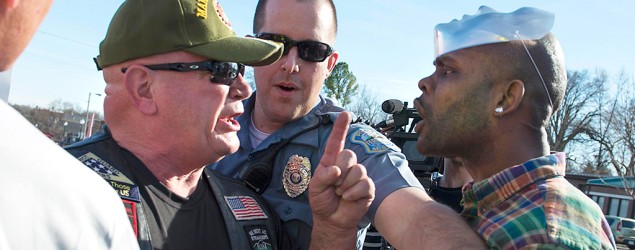
A police officer tries to separate a supporter of Michael Brown from a Ferguson police supporter. (Reuters)

Contents of racist Ferguson emails released

One of the messages compares black welfare recipients to mixed-breed dogs. 

Several references to President Obama »

**********

Here’s What Happens When Pregnant Women Lose Their Rights

Purvi Patel’s case is just the latest miscarriage of justice.

**********

Bethann Hardison on Winning Over the Battle of Versailles  Crowd

“I knew I nailed it.”

**********

A total lunar eclipse is coming Saturday morning. Don’t miss this “blood moon.”

**********

 Water, Cuts and Allocation of Pain
Critics of the historic drought restrictions announced this week by Gov. Jerry Brown want to know why he didn’t bring the hammer down on California farmers.

**********

On this day: March 31, 1889


ParisOriginally intended as a temporary installation, the Eiffel Tower has become one of the most enduring symbols of France and the industrial age.

On March 31, 1889, the Eiffel Tower is dedicated in Paris in a ceremony presided over by Gustave Eiffel, the tower’s designer, and attended by French Prime Minister Pierre Tirard, a handful of other dignitaries, and 200 construction workers.

In 1889, to honor of the centenary of the French Revolution, the French government planned an international exposition and announced a design competition for a monument to be built on the Champ-de-Mars in central Paris. Out of more than 100 designs submitted, the Centennial Committee chose Eiffel’s plan of an open-lattice wrought-iron tower that would reach almost 1,000 feet above Paris and be the world’s tallest man-made structure. Eiffel, a noted bridge builder, was a master of metal construction and designed the framework of the Statue of Liberty that had recently been erected in New York Harbor.

Eiffel’s tower was greeted with skepticism from critics who argued that it would be structurally unsound, and indignation from others who thought it would be an eyesore in the heart of Paris. Unperturbed, Eiffel completed his great tower under budget in just two years. Only one worker lost his life during construction, which at the time was a remarkably low casualty number for a project of that magnitude. The light, airy structure was by all accounts a technological wonder and within a few decades came to be regarded as an architectural masterpiece.

The Eiffel Tower is 984 feet tall and consists of an iron framework supported on four masonry piers, from which rise four columns that unite to form a single vertical tower. Platforms, each with an observation deck, are at three levels. Elevators ascend the piers on a curve, and Eiffel contracted the Otis Elevator Company of the United States to design the tower’s famous glass-cage elevators.

The elevators were not completed by March 31, 1889, however, so Gustave Eiffel ascended the tower’s stairs with a few hardy companions and raised an enormous French tricolor on the structure’s flagpole. Fireworks were then set off from the second platform. Eiffel and his party descended, and the architect addressed the guests and about 200 workers. In early May, the Paris International Exposition opened, and the tower served as the entrance gateway to the giant fair.

The Eiffel Tower remained the world’s tallest man-made structure until the completion of the Chrysler Building in New York in 1930. Incredibly, the Eiffel Tower was almost demolished when the International Exposition’s 20-year lease on the land expired in 1909, but its value as an antenna for radio transmission saved it. It remains largely unchanged today and is one of the world’s premier tourist attractions.

http://www.history.com