Guyot was born in Pass Christian, Miss., on July 17, 1939. He became active in civil rights while attending Tougaloo College in Mississippi, and graduated in 1963. Guyot received a law degree in 1971 from Rutgers University, and then moved to Washington, where he worked to elect fellow Mississippian and civil rights activist Marion Barry as mayor in 1978.
“When he came to Washington, he continued his revolutionary zeal,” Barry told The Washington Post on Friday. “He was always busy working for the people.”
D.C. Delegate Eleanor Holmes Norton told The Post in 2007 that she first met Guyot within days of his beating at a jail in Winona, Miss. “Because of Larry Guyot, I understood what it meant to live with terror and to walk straight into it,” she told the newspaper. On Friday, she called Guyot “an unsung hero” of the civil rights movement.
“Very few Mississippians were willing to risk their lives at that time,” she said. “But Guyot did.”
In recent months, his daughter said he was concerned about what he said were Republican efforts to limit access to the polls. As his health was failing, he voted early because he wanted to make sure his vote was counted, he told the AFRO newspaper.
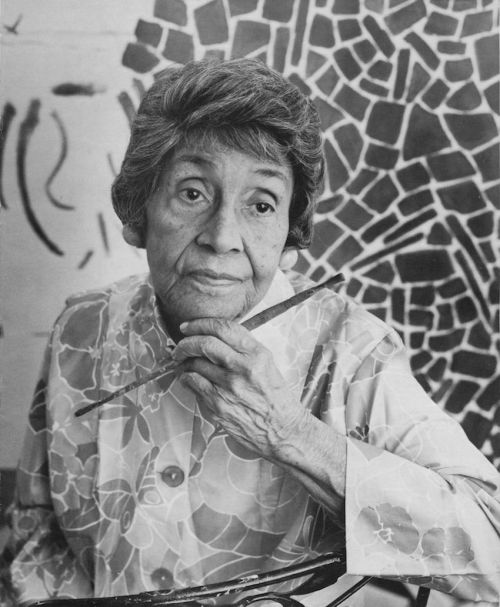
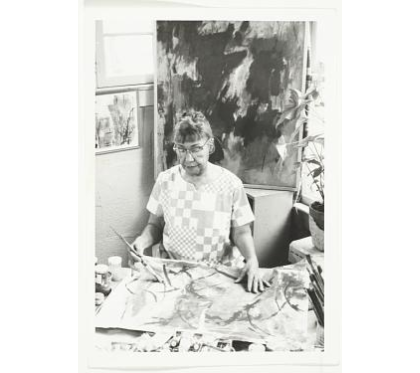
Alma Woodsey Thomas was born in Columbus, Georgia in 1891. The Thomas family moved to Washington, D.C. in 1907 to seek refuge from racial violence in the South and to give their children better educational opportunities. In 1924, she was the first graduate of Howard University’s School of Fine Arts. After graduating, she became an art teacher at Shaw Junior High School until her retirement in 1960.
The Eclipse, Alma W Thomas, 1970, acrylic on canvas
After her retirement, she was able to dedicate herself to what she referred to as more “serious painting.” Thomas developed her true voice as an artist at the age of 70. Her early art had been realistic and while in this new discovery her signature style of colorful abstraction arose.
Thomas was the first African American woman to have a solo exhibition at the Whitney Museum of American Art in New York. In 1978, Thomas passed away at the age of eighty-six. Posthumously, a retrospective exhibition of her work was held at the Smithsonian Institution’s National Museum of American Art. Her paintings have been exhibited at the White House three times and today her work can be found in many major museums.
“Through color, I have sought to concentrate on beauty and happiness, rather than on man’s inhumanity to man.” ― Alma Woodsey Thomas, Alma W. Thomas: A Retrospective of the Paintings
1944 Lieutenant Jackie Robinson of the U.S. Army, while riding a civilian bus from Camp Hoo, Texas, refuses to give up his seat to a white man.
Jackie Robinson in military uniform, 1945
He was a lieutenant in the Army of the United States: he saw no reason to sit in the back of the bus
The Court-Martial of Jackie Robinson
ON JULY 6, 1944, Jackie Robinson, a twenty-five-year-old lieutenant, boarded an Army bus at Fort Hood, Texas. Sixteen months later he would be tapped as the man to break baseball’s color barrier, but in 1944 he was one of thousands of blacks thrust into the Jim Crow South during World War II. He was with the light-skinned wife of a fellow black officer, and the two walked half the length of the bus, then sat down, talking amiably. The driver, gazing into his rear-view mirror, saw a black officer seated in the middle of the bus next to a woman who appeared to be white. “Hey, you, sittin’ beside that woman,” he yelled. “Get to the back of the bus.”
Lieutenant Robinson ignored the order. The driver stopped the bus, marched back to where the two passengers were sitting, and demanded that the lieutenant “get to the back of the bus where the colored people belong.” Robinson refused, and so began a series of events that led to his arrest and court-martial and, finally, threatened his entire career.
Jackie Robinson was already a national celebrity in 1944. During a spectacular athletic career a the University of California at Los Angeles, he had starred in basketball, football, track, and baseball. He was drafted in April 1942, and during the following year a study of blacks in the Army singled him out. “Social Intercourse between the races has been discouraged, ” it was reported in Jim Crow Joins Up, “yet Negro athletes such as Joe Louis, the prizefighter, and Jack Robinson, the All-American football star … are today greatly admired in the army.”
Initially, Robinson had been assigned to a cavalry unit at Fort Riley, Kansas, where he applied for Officers’ Candidate School. Official Army policy provided for the training of black officers in integrated facilities; in reality, however, few blacks had yet gained access to OCS. At Fort Riley, Robinson was rejected and told, off the record, that blacks were excluded from OCS because they lacked leadership ability.





 Be a Seed for Change
You must be logged in to post a comment.