from Mon, Feb 10, 6:00 PM PST to Wed, Feb 12, 10:00 AM PST
What
Very cold wind chills as low as 10 to 20 degrees.
Where
Bellevue and Vicinity, Bremerton and Vicinity, Everett and Vicinity, Seattle and Vicinity, and Tacoma Area.
When
From 6 PM Monday to 10 AM PST Wednesday.
Impacts
Very cold temperatures can lead to hypothermia with prolonged exposure and will impact vulnerable populations such as the homeless, pets, and those without adequate access to heating.
Summary
Keep pets indoors as much as possible. Make frequent checks on older family, friends, and neighbors. Ensure portable heaters are used correctly. Do not use generators or grills inside.
Modern slavery is hidden in plain sight and is deeply intertwined with life in every corner of the world.
Each day, people are tricked, coerced, or forced into exploitative situations that they cannot refuse or leave. Each day, we buy the products or use the services they have been forced to make or offer without realising the hidden human cost.
An estimated 50 million people were living in modern slavery on any given day in 2021, an increase of 10 million people since 2016.
Walk Free’s flagship report, the Global Slavery Index (GSI) provides national estimates of modern slavery for 160 countries. Our estimates draw on thousands of interviews with survivors collected through nationally representative household surveys across 75 countries and our assessment of national-level vulnerability.
With the exception of contributions from external authors, the Global Slavery Index is produced by Walk Free. We are solely responsible for the contents of this report.
Each day, people are tricked, coerced, or forced into exploitative situations that they cannot refuse or leave. Each day, we buy the products or use the services they have been forced to make or offer without realising the hidden human cost.
An estimated 50 million people were living in modern slavery on any given day in 2021, an increase of 10 million people since 2016.
Walk Free’s flagship report, the Global Slavery Index (GSI) provides national estimates of modern slavery for 160 countries. Our estimates draw on thousands of interviews with survivors collected through nationally representative household surveys across 75 countries and our assessment of national-level vulnerability.
With the exception of contributions from external authors, the Global Slavery Index is produced by Walk Free. We are solely responsible for the contents of this report.
NASA astronaut Bernard Harris becomes the first Black man to walk in space. His mission contributes to a burgeoning collaboration between the United States and Russia in space exploration.
The Space Race
Bernard Harris stepped out of the space shuttle Discovery in orbit on February 9, 1995. He first embarked on the unlikely journey toward his historic spacewalk as a child, inspired by stargazing in his home state of Texas. Harris described his determination to become an astronaut as a “big leap of faith” at a time when the Apollo 11 moon landing shared headlines with the struggle for civil rights. “The main challenge was the color of my skin.”
Harris earned his medical degree and completed a residency at the Mayo Clinic before joining NASA as a flight surgeon. As an M.D. at NASA, Harris researched how human bone reacts to space flight, and he designed medical devices to help astronauts’ bodies adapt. In 1990, NASA selected him as part of its 13th astronaut class. In his career as an astronaut, Harris spent 18 days in space—and about five hours on his historic spacewalk. He recalled the awe of floating in space, seeing “this blue and white planet…against this backdrop of stars that I initially saw from Earth, and now see in space… Everything had its place. I have a greater sense of belonging, of the connectedness of all of us.” Throughout his NASA career, he traveled more than 7.2 million miles in space.
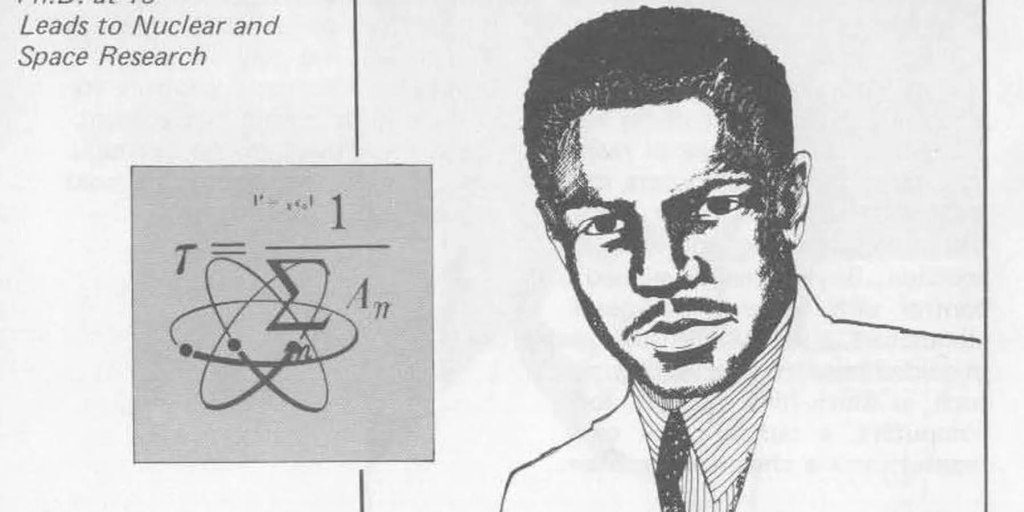
At least 12 Black chemists and physicists worked as primary researchers on the team that developed the technology behind the atomic bomb.
ZURI SWIMMER/ALAMY STOCK PHOTO
During the height of World War II between 1942 and 1945, the U.S. government’s top-secret program to build an atomic bomb, code-named the Manhattan Project, cumulatively employed some 600,000 people, including scientists, technicians, janitors, engineers, chemists, maids, and day laborers.
While rarely acknowledged, African American men and women were among them—their ranks bolstered by greater wartime employment opportunities and President Franklin D. Roosevelt’s Executive Order 8802 of 1941 outlawing racial discrimination in the defense industries.
At the project’s rural production sites in Oak Ridge, Tennessee, and Hanford, Washington, Black workers were relegated to mostly menial jobs like janitors, cooks, and laborers, regardless of education or experience. But in the project’s urban research centers—the Chicago Metallurgical Laboratory and at Columbia University in New York—several Black scientists were able to play key roles in the development of the two atomic bombs that were released on Hiroshima and Nagasaki in August 1945, effectively ending the war.






You must be logged in to post a comment.