
| Nelson Mandela Born: July 18, 1918 Age: 94 years old Birthplace: Transkei, South AfricaOccupation: World Leader, Journalist
On February 11, 1990, Nelson Mandela was freed after 27 years in captivity. “No one is born hating another person because of the color of his skin, or his background, or his religion. People must learn to hate, and if they can learn to hate, they can be taught to love, for love comes more naturally to the human heart than its opposite.” – Nelson Mandela Last year we announced a $1.25 million grant to the Nelson Mandela Centre of Memory to help preserve and digitize thousands of archival documents, photographs and videos about Nelson Mandela. Based in Johannesburg, South Africa, the Nelson Mandela Centre of Memory (NMCM) is committed to documenting the life and times of one of the world’s greatest statesmen and spreading his story to promote social justice throughout the world.
Today, the Mandela archive has become a reality. Along with historians, educationalists, researchers, activists and many others around the world, you can access a wealth of information and knowledge about the life and legacy of this extraordinary African leader. The new online multimedia archive includes Mandela’s correspondence with family, comrades and friends, diaries written during his 27 years of imprisonment, and notes he made while leading the negotiations that ended apartheid in South Africa. The archive will also include the earliest-known photo of Mr. Mandela and never-before seen drafts of Mr. Mandela’s manuscripts for the sequel to his autobiography Long Walk to Freedom.
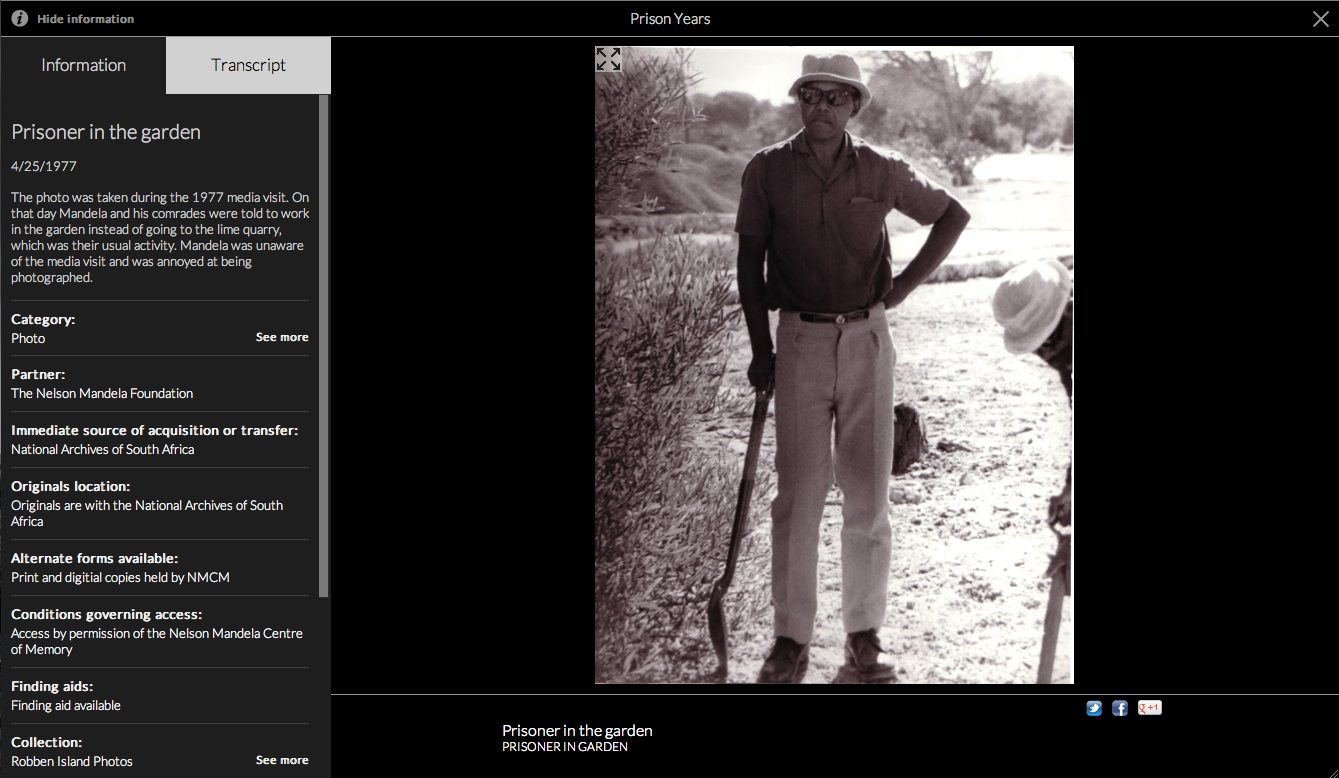 We’ve worked closely with the NMCM to create an interactive online experience which we hope will inspire you as much as us. You can search and browse the archives to explore different parts of Mandela’s life and work in depth: Early Life, Prison Years, Presidential Years, Retirement, Books for Mandela, Young People and My Moments with a Legend.  From there, you might want to see all the letters held by the archive, and click “See more” in the letters category, where you can discover all personal letters or use the time filter to explore his diaries and calendars written between 1988 and 1998, where you can see that in the last page of the last diary, he met with President Yoweri Kaguta Museveni of Uganda to exchange ideas about the situation in northern Uganda. If you were a researcher, you can search through various fragments of Madiba’s memory that relate to Ahmed Kathrada, his long-time comrade, politician and anti-apartheid activist, where you can find photos, videos, manuscripts and letters that relate to him. 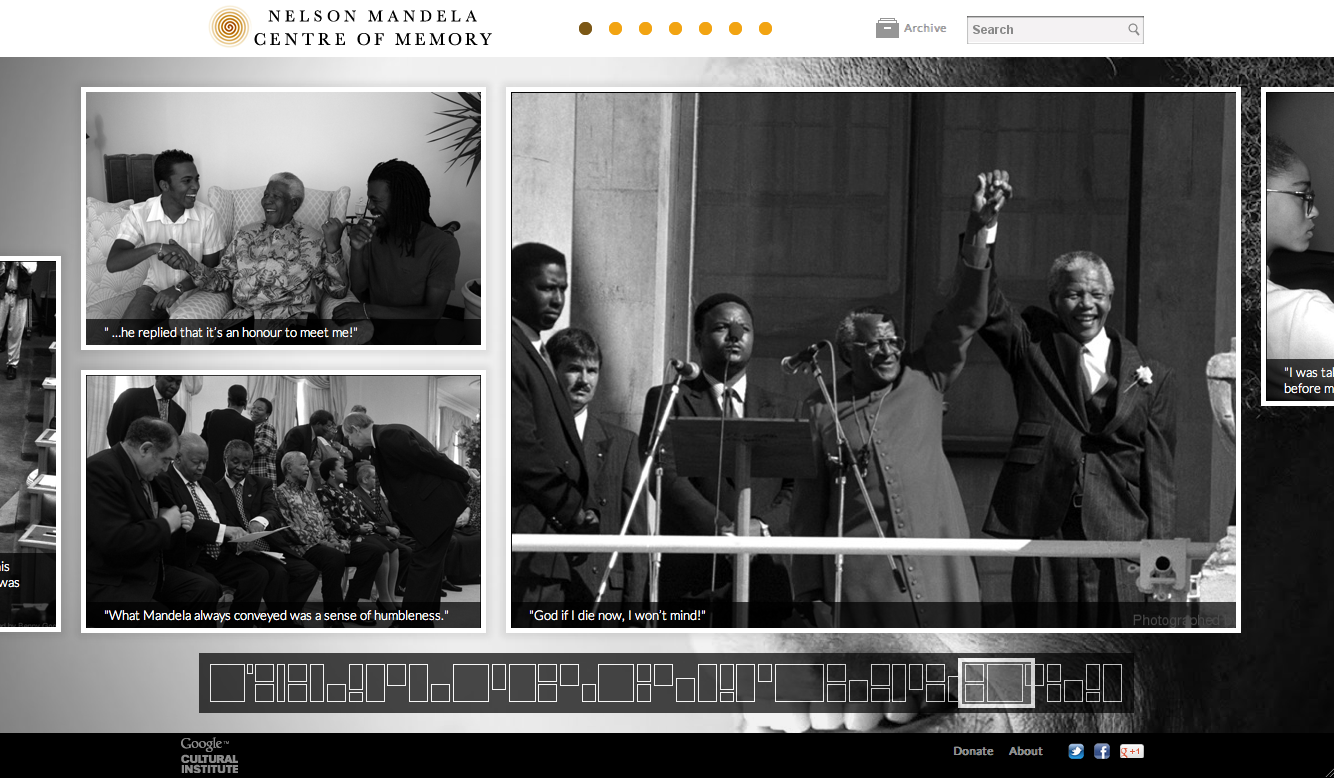 The Nelson Mandela Digital Archive project is an initiative by the Nelson Mandela Centre of Memory and the Google Cultural Institute, which helps to preserve and promote our diverse cultural and historical heritage. Some of our other initiatives include the Art Project, digitizing the Dead Sea Scrolls and bringing the Yad Vashem Holocaust materials online. |
Category Archives: ~ Culture & History


Fashion tips … Handbags
7 Tricks to Ensure Your Handbags Will Last for Years
By Allyson Payer
We’re more willing to splurge on a beautiful designer handbag than on any other wardrobe component, justifying our purchase by saying, “Well, this’ll last me for years,” which brings us to today’s subject: learning how to preserve and properly care for these investment items. Luckily, there are a few simple steps you can take to ensure that your precious satchels are kept in mint condition for years to come.
Scroll down to see our tips, and to shop gorgeous investment bags that you’ll want to protect!
1. Protect The Material: The Blonde Salad
Want to shield your new bag from spills and dirt before they happen? Scotchgard Fabric will do the trick for fabric panels, while Scotchgard Suede and Nubuck is a great water and oil repellant for suede. Both Collonil and Chamberlain’s make great leather-protecting products. Apply product with a clean white cotton cloth, followed by a dry cotton cloth to buff. Use products regularly on heavily used bags. With any products, test a small patch on the bag to make sure it doesn’t cause discoloration.

Collonil Leather Gel

Chamberlain’s Leather Milk
2. Store Them Properly:

Le 21eme
Do your bags get tossed onto a haphazard heap at the bottom of your closet? They’ll last longer if stored the right way, ideally in an upright position in their dust bags or a cotton pillowcase. Never store them in plastic or vinyl, which traps moisture inside. Stuff your bags with scarves, sweaters, or acid-free tissue paper, or use a handbag insert made for this purpose. Cross the handles over each other to avoid wear on the bag and unclip any removable straps for long-term storage.
Related: The ONE Mistake Every Handbag Owner Makes

The Container Store Quilted Handbag Shapers

The Container Store Linen Handbag Storage Bin
3. Remove Stains the Right Way:

Athens Streetstyle
The first step is to know what type of stain you’re dealing with, as that will dictate the removal method. See specific techniques below!
Food stains: Crush white chalk and let it sit on the stain overnight. Brush off with a clean cloth in the morning.
Oil stains: Put cornstarch on the stain immediately, rubbing it in to create heat from friction, which will help the oil absorb. Brush the powder off with a clean cloth after you’ve rubbed it in—don’t let it sit on the stain.
Ink stains: If the stain is fresh, use a white eraser to immediately erase the spot, without applying too much pressure so that the color doesn’t come off. If the ink is already set, you’ll need a professional (see tip #7). An eraser also works for dirt stains.
Water stains: Blot water stains, let them dry naturally, and bring your bag to a professional for removal.
Odor removal: Keep a plastic bag filled with baking soda inside your handbag. Zip the handbag or place it in a larger bag that seals if it doesn’t zip. Keep the baking soda in the bag for one or two days to absorb the odor. Another option? Place a couple of dryer sheets in the bag for a few days.
Related: Heavy Purse? 5 Smart Ways to Lighten Your Load
4. Protect the Lining:

A Love is Blind
Use pouches to store cosmetics and liquids, which will protect the handbag lining from spills and keep you organized to boot. Avoid click pens at all cost, opting for pens with caps instead. Better yet, put those in your pouch too, in case of dreaded ink leaks.

Comme des Garçons Star Embossed Small Pouch
5. Keep Metal Hardware Shiny:

A Love is Blind
Do your best to keep away jewelry and zippers that could scratch your bag’s metal hardware. A go-to household item, Mr. Clean’s Magic Erasers, do a great job of cleaning up tarnished and grimy hardware.
Related: 14 Items Every Woman Should Have In Her Purse
6. Practice Routine Maintenance:

Athens Streetstyle
Here are a few best practices when it comes to daily handbag maintenance:
1. Avoid handling your bag if your hands are dirty or have lotion or cream on them.
2. Keep your bag out of direct sunlight.
3. Rotate which handbag you carry regularly so that they don’t wear out too quickly.
4. Use a suede brush to clean and revive suede.
5. Regular use of a leather moisturizer will keep the leather supple and free of cracks.
6. Wipe your bag down on a weekly basis (when in use) with a soft cloth.
7. Take It to a Professional:

A Love is Blind
For stains and wear and tear beyond your handbag maintenance skill set, take it to a handbag repair professional. Most shoe repair professionals also work on handbags. They’ll treat it for you, clean it, and restore color as needed. If your bag doesn’t have metal feet on the bottom, it’s wise to have those installed, as they’ll protect it from scratches and dirt.
Related: Your Ultimate Guide to Fall’s Must-Have It-Bags
Shop Investment Handbags:

A.P.C. Edith Leather Shoulder Bag
A structured black bag will take you from day to night. Bonus points for sleek gold hardware.

Chloe Large Drew Grained Leather Shoulder Bag
All the cool girls are wearing this It-bag with a cool yet classic vibe.
Related: Is THIS The New It-Bag for Fall?

M2Malletier Memento Mori Bag
This slightly larger version of M2Malletier’s popular clutch style is perfect for everyday wear.
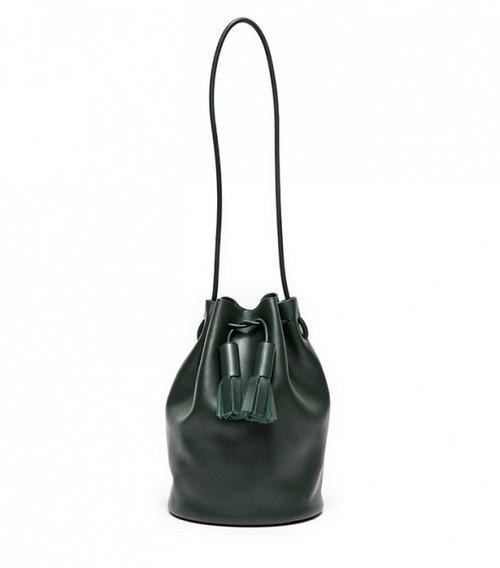
Building Block Bucket Bag
Buttery forest green leather and oversized tassels join forces to create a perfectly quirky bucket bag for fall.

Mark Cross Laura Leather Shoulder Bag
Boxy shapes are in for fall, so tap into the trend with this structured Mark Cross version.

Rag & Bone Haircalf Bradbury Small Flap Hobo
This leopard calf-hair bag makes a subtle statement and gives a luxe feel to any outfit.
Share this:

The Story of the Horse
 In any discussion of the history of humankind, it becomes quickly apparent that this narrative would be utterly different without the inclusion of horses.
In our July/August 2015 issue, executive editor Jarrett A. Lobell and online editor Eric A. Powell bring us a special section, “The Story of the Horse,” in which they explore the unique roles that this animal has played in diverse areas of the human experience, and the evolving relationship we have had with horses across the millennia.
to get the complete article click on the link above!
Share this:

June Solstice 11 things to know …June: 20,21,22
June 21, 2018, is the longest day of the year in most time zones in the Northern Hemisphere. Here are 11 facts you might not know about the June solstice.
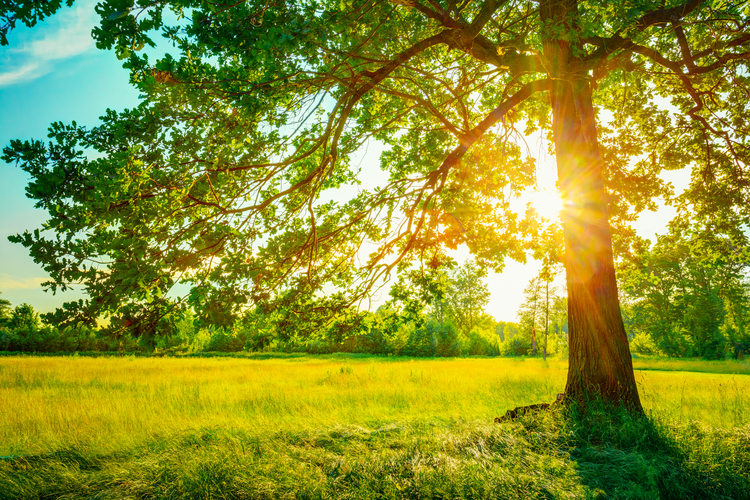
June solstice is also called summer solstice.
©bigstockphoto.com/Grisha Bruev
1. Summer & Winter Solstice
In the Northern Hemisphere, where it is the longest day of the year in terms of daylight, the June solstice is also called the summer solstice. In the Southern Hemisphere, on the other hand, it is the shortest day of the year and is known as the winter solstice.
2. First Solstice of the Year
Solstices happen twice a year – in June and December. The June solstice happens around June 21, when the Sun is directly overhead the Tropic of Cancer. The December solstice takes place around December 21. On this day, the Sun is precisely over the Tropic of Capricorn.
3. When the Sun Seems to Stand Still

Solstice comes from the Latin words sol, meaning Sun and sistere, meaning to come to a stop or stand still. On the day of the June solstice, the Sun reaches its northernmost position, as seen from the Earth. At that moment, its zenith does not move north or south as during most other days of the year, but it stands still at the Tropic of Cancer. It then reverses its direction and starts moving south again.
The opposite happens during the December solstice. Then, the Sun reaches its southernmost position in the sky – Tropic of Capricorn – stands still, and then reverses its direction towards the north.
Ten Things About the December Solstice
4. It Occurs at the Same Time…
…all over the world. Technically, the June solstice is the exact instant of time when the Sun is directly overhead the Tropic of Cancer. In 2018, this will happen on June 21 at 11:07 UTC.
2018 June solstice in your local time
5. It Can be on June 20, 21, or 22
Even though most people consider June 21 as the date of the June solstice, it can happen anytime between June 20 and June 22. June 22 solstices are rare – the last June 22 solstice in UTC time took place in 1975 and there won’t be another one until 2203.
6. It’s the First Day of Summer…
…depending on who you ask. Astronomers and scientists use the date of the June solstice to mark the beginning of summer in the Northern Hemisphere and winter in the Southern Hemisphere. For meteorologists, on the other hand, summer began almost three weeks ago, on June 1.
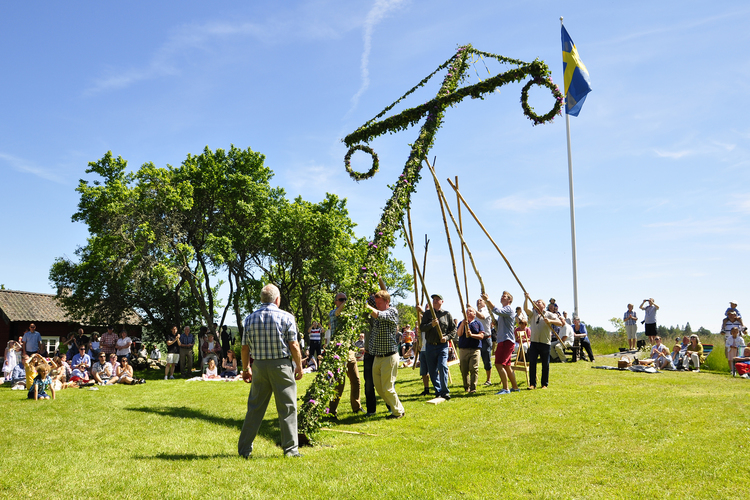
In many Northern Hemisphere cultures, the day is traditionally considered to be the mid-point of the summer season. Midsummer celebrations on or around the Northern summer solstice are common in many European countries.
7. The Earth is Farthest from the Sun
One might think that since it is summer in the Northern Hemisphere, the Earth is closest to the Sun during the June solstice. But it’s the opposite. The Earth is actually farthest from the Sun during this time of the year. In fact, the Earth will be on its Aphelion a few weeks after the June solstice.

The Earth’s distance from the Sun has very little effect over the Seasons on Earth. Instead, it the tilt of Earth’s rotational axis, which is angled at around 23.4 degrees, that creates seasons.
The direction of Earth’s tilt does not change as the Earth orbits the Sun – the two hemispheres point towards the same direction in space at all times. What changes as the Earth orbits around the Sun is the position of the hemispheres in relation to the Sun – the Northern Hemisphere faces towards the Sun during the June solstice, thus experiencing summer. The Southern Hemisphere tilts away from the Sun and therefore enjoys winter during this time.
8. The Earliest Sunrise of the Year Doesn’t Happen on This Day

Even though the June solstice is the longest day of the year in the Northern Hemisphere, most places do not see the earliest sunrise of the year on this day. The earliest sunrise happens a few days before, and the latest sunset takes place a few days after, the June solstice.
Sunrise and Sunset timings in your city
In the Southern Hemisphere, where this day marks the winter solstice, the earliest sunset happens a few days before the solstice, and the latest sunrise occurs a few days after it.
This happens because of the imbalance between time measured using clocks and time measured by a sundial. Read more
9. Not Usually the Hottest Day of the Year
In fact, the hottest day of the year in the Northern Hemisphere usually comes a few weeks or sometimes months after the solstice. This is because it takes time for the oceans and landmasses to warm up, which again allows for higher air temperatures. This phenomenon is called the delay or lag of the seasons.
10. The Arctic Circle has 24 Hours of Daylight

The June solstice is the only day of the year when all locations inside the Arctic Circle experience a continuous period of daylight for 24 hours. Due to atmospheric refraction, however, the midnight sun is visible for a few days before and on the June solstice from areas as far as 60 miles (97 kilometers) south of the Arctic Circle. As one moves further north of the Arctic Circle, the number of days with the Midnight Sun increase.
On the Antarctic Circle, there are 24 hours of nighttime on the June solstice. Just as with the Northern Hemisphere, any location south of the Antarctic Circle has Polar Night several days before the June solstice.
11. It’s Celebrated Around the World
The June solstice holds a special place of celebration in many cultures. People around the world celebrate the day with feasts, picnics, dance, and music.
source: timeanddate.com
Share this:

The Origin of Redskin ~ a repost
March 26, 2006
Posted by Bill Poser
The controversy over the Washington Redskins trademark has attracted considerable attention, here and elsewhere. We have had quite a few previous posts about this. It began with a petition by seven American Indian activists led by Suzan Harjo in 1992 to the Trademark Trial and Appeal Board of the US Department of Commerce requesting cancellation of the trademark on the grounds that the word redskin
was and is a pejorative, derogatory, denigrating, offensive, scandalous, contemptuous, disreputable, disparaging and racist designation for a Native American person
In 1998 the Trademark Trial and Appeal Board decided in favor of the petitioners and cancelled the trademark. Pro Football, Inc. appealed to the United States District Court, which in 2003 overturned the decision of the Trademark Trial and Appeal Board and reinstated the trademark. It gave several grounds for its decision:
- that there was an absence of evidence that the term redskin is disparaging in the particular context of the name of the sports team;
- that the TTB did not sufficiently articulate its inferences and explain how it decided between competing pieces of evidence. In particular, the District Court was critical of the fact that the TTB ruled on the basis “of the entirety of the evidence” but did not review that evidence in any detail and made few findings of fact;
- that the petitioners’ claim was barred by the doctrine of laches, which provides that a right or claim should not be enforced if the long delay in asserting it puts the respondent at an unreasonable disadvantage. In this case, the Court held that opposition to the mark should have been asserted when the mark was issued in 1967 or shortly thereafter and that the delay of twenty-five years was unreasonable.
The case was appealed to the Court of Appeal for the District of Columbia Circuit. In its 2005 decision, the Court of Appeal held that the doctrine of laches did not in principle bar the suit of one of the petitioners, Mateo Romero, the youngest, because he was only one year old in 1967 when the trademark was registered. (In US federal law, the clock for laches starts when the petitioner reaches the age of 18.) It therefore returned the case to the District Court for further consideration of whether laches should bar the suit on the part of Mateo Romero.¹ The Court of Appeal did not address the question of whether there was sufficient evidence that redskin is disparaging in the context of the name of the sports team because there is no need to decide that question if the suit is barred by laches.²
Although the main topic I want to discuss is a linguistic one, I’ve reviewed the legal history because I think that much of the discussion of the case has been rather misleading. To a large extent the decisions of the courts have focussed on the “technicality” of laches, not on the question of whether redskin is disparaging. The District Court did not simply ignore overwhelming evidence as some commentators suggest. Indeed, even in its holdings on the disparagement issue, the District Court’s criticisms of the TTB were that it did not sufficiently address the question of whether redskin is disparaging in the context of the name and that the TTB did not make sufficient findings of fact. And in overturning the District Court, the Court of Appeal made no judgment whatever as to whether redskin is disparaging. Its decision dealt exclusively with laches. In short, the decisions of the courts have been concerned largely with technical questions, not with the linguistic issues.
I think that it is well established that redskin is taken by most people today to be disparaging. What is more interesting is whether it has always been so, as Harjo et al., as well as various others, claim. One interesting piece of evidence is the origin of the name Washington Redskins. In 1933, George Preston Marshall, the owner of the team, which was then located in Boston, renamed it the Boston Redskins in honor of the head coach, William “Lone Star” Dietz, an American Indian.³ When the team moved to Washington in 1937 it was renamed the Washington Redskins. George Marshall clearly did not consider the name disparaging.
The term redskin of course goes much farther back than 1933. The details of this history have recently been explored by Ives Goddard of the Smithsonian Institution, in a paper conveniently available on-line. Some of the evidence is available in greater detail on Goddard’s web site. You can read speeches by the Meskwaki chief Black Thunder and the Omaha chief Big Elk in which the expression redskin is used, and early nineteenth century examples of the Meskwaki usage of terms meaning redskin and whiteskin.
I won’t review the evidence in detail because Goddard’s paper is short enough and accessible enough that if you are interested you should read it yourself. I’ll just summarize it. Goddard shows that the term redskin is a translation from native American languages of a term used by native Americans for themselves. Harjo’s claim that it “had its origins in the practice of presenting bloody red skins and scalps as proof of Indian kill for bounty payments” is unsupported by any evidence.⁴ The term entered popular usage via the novels of James Fenimore Cooper. In the early- to mid-nineteenth century the term was neutral, not pejorative, and indeed was often used in contexts in which whites spoke of Indians in positive terms. Goddard concludes:
Cooper’s use of redskin as a Native American in-group term was entirely authentic, reflecting both the accurate perception of the Indian self-image and the evolving respect among whites for the Indians’ distinct cultural perspective, whatever its prospects. The descent of this word into obloquy is a phenomenon of more recent times.
The response to Goddard’s paper is disappointing. Other than reiterating the unsubstantiated and implausible theory that the term owes its origin to scalping, Harjo and others have merely waved their hands, asserting that as Indians they know differently without presenting any evidence whatsoever. A typical example is found in this Native Village article, which quotes Harjo as follows:
I’m very familiar with white men who uphold the judicious speech of white men. Europeans were not using high-minded language. [To them] we were only human when it came to territory, land cessions and whose side you were on.
The only point here that even resembles an argument is the bald assertion that Europeans never spoke of Indians other than disparagingly. This is not true. Evidence to the contrary is explicitly cited by Goddard. What is more disturbing is that Harjo’s primary response to Goddard is ad hominem: that as a white man what he says is not credible. Whether he is white, red, or green is of course utterly irrelevant, as thinking people have known since at least the Middle Ages. Goddard presents his evidence in detail, with citations to the original sources. You can evaluate it yourself, and you need not rely on his statements of fact but can, if you are willing to devote some time and effort, check out the sources yourself. Furthermore, without the slightest evidence Harjo imputes to Goddard not merely bias but racism, a charge which, based, as her own words reveal, entirely on racial stereotyping, merely reflects back on herself.
So, there you have it. On the one hand an utterly unsubstantiated and implausible theory advocated by Suzan Harjo, who exhibits no knowledge of the history of English usage of redskin, of American Indian languages, or of the early history of relations between Indians and Europeans. On the other hand a detailed account with numerous explicit citations to original documents by Ives Goddard, who has dedicated his entire life to the study of American Indian languages and the documentation thereof. It is always possible that some new evidence will be brought to bear, but for the present I don’t think that there can be any ambiguity as to which is the more credible account.
Notes:
¹ The District Court held that Romero’s suit was not barred by laches simply as a matter of the length of time that had elapsed since the cancellation petition was filed only seven years from the date of his majority, but might nonetheless be barred by laches if the delay of seven years put Pro Football at an unreasonable disadvantage. For this reason it is important to understand that laches is distinct from the doctrine of statute of limitations. A suit is barred by the statute of limitations if there is legislation setting such a time limit. In contrast, laches is an equitable doctrine and is based on the principle that too long a delay is unfair to the respondent, not on any particular time limit.
² Similarly, the District Court never addressed Pro Football’s arguments that section 2(a) of the Lanham act, under which Harjo et al. sued, is an unconstitutional violation of the First Amendment right of free speech and the Fifth Amendment right of due process because it overturned the TTB’s decision on other, non-constitutional, grounds.
³ Harjo et al. question this story of the origin of the name, but as the Circuit Court noted (p. 13, footnote 6), they provide no evidence whatever to the contrary and give no convincing reason to disbelieve the primary source, a newspaper article presenting the account by Marshall’s grand-daughter. Some authors have also claimed that Dietz was not an American Indian. The articles cited, however, do not cite their sources, so it is difficult to evaluate their claims. It is, however, undisputed that Dietz presented himself as an American Indian and that George Marshall publicly presented him as one. George Marshall surely thought that Dietz was an American Indian, which is really what counts here.
⁴ A point that has not, as far as I know, been mentioned in this context is that scalps or other body parts presented as evidence of kills would not, in general, have been red. As I can attest from personal experience with the processing of animals killed by hunters, mammalian blood is bright red when fresh but darkens quickly as it oxidizes. When dried it retains a dark red tinge if thin but in any thickness is black. Under most circumstances bounty hunters did not present their trophies for payment until days or weeks after the kill, by which time the blood would have been more black than red. The suggestion that such trophies would give a primary impression of red is due either to a false idea that they would usually have been presented when fresh or to a lack of familiarity with dried blood. A further difficulty with Harjo’s hypothesis is that, although whites did indeed collect Indian trophies as evidence of kills, the popular image of scalping was and is that it was an activity engaged in primarily by Indians who mutilated the corpses of their white victims. There was therefore no reason to associate bloody trophies, red or not, with Indians. If anything, the association would have been with the white victims of scalping.
Posted by Bill Poser at March 26, 2006 06:42 PM

 Be a Seed for Change
You must be logged in to post a comment.