Category Archives: ~ Culture & History

Lawrence Guyot : a Civil Rights Leader, in memory of – Black History


WASHINGTON November 25, 2012 (AP)

Guyot was born in Pass Christian, Miss., on July 17, 1939. He became active in civil rights while attending Tougaloo College in Mississippi, and graduated in 1963. Guyot received a law degree in 1971 from Rutgers University, and then moved to Washington, where he worked to elect fellow Mississippian and civil rights activist Marion Barry as mayor in 1978.

“When he came to Washington, he continued his revolutionary zeal,” Barry told The Washington Post on Friday. “He was always busy working for the people.”

Image result for lawrence guyot

D.C. Delegate Eleanor Holmes Norton told The Post in 2007 that she first met Guyot within days of his beating at a jail in Winona, Miss. “Because of Larry Guyot, I understood what it meant to live with terror and to walk straight into it,” she told the newspaper. On Friday, she called Guyot “an unsung hero” of the civil rights movement.

“Very few Mississippians were willing to risk their lives at that time,” she said. “But Guyot did.”

In recent months, his daughter said he was concerned about what he said were Republican efforts to limit access to the polls. As his health was failing, he voted early because he wanted to make sure his vote was counted, he told the AFRO newspaper.

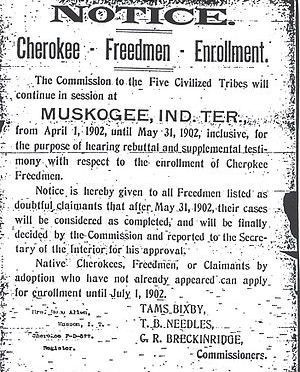
Cherokee Freedmen Facts – by Marilyn Vann – Black History


Cherokee Freedmen Facts – by Marilyn Vann – President – Descendants of Freedmen

www.freedmen5tribes.com

1) Who are Cherokee freedmen and their descendants?
Cherokee freedmen are people of African descent who have rights to Cherokee citizenship since 1866 (and in some cases
prior) based under a treaty between the US government and the Cherokee nation, the amended 1839 constitution and the
present 1976 constitution. The freedmen were either former slaves of the Cherokees or were free mixed black Cherokees who
generally did not have citizenship rights prior to 1866.

******
2) Who has the right to Cherokee citizenship now?
All persons who were listed on the Dawes Rolls and their descendants, during the early 1900s have the right to Cherokee
citizenship based on the 1976 constitution. The Dawes rolls of the Cherokee nation have several sections – Delaware,
Cherokee by blood, Cherokee Freedmen, etc.

******
3) Didn’t the Freedmen lose their tribal membership and voting rights for a few years?
In 1983, the freedmen people were voting against Chief Swimmer, the registrar sent out letters canceling their tribal
membership cards and the freedmen were blocked from voting at the polls. In 1988, under Chief Mankiller, the tribal council
approved the registration policy of requiring all tribal members to have a CDIB card to keep tribal membership. A tribal
court in 2006 ruled that the tribal council could not pass additional requirements to bar any segment of Dawes enrollees from
receiving tribal membership cards or voting.

******
4) If most of the freedmen have Cherokee blood, why cant they get a cdib card?
The current BIA policy is to only give the card based on the blood degree listed on the Dawes Rolls. The Dawes
Commissioners had the sole authority to place people on any part of the Dawes rolls they wanted to. Because Congress had
decided that people listed as Freedmen would have unrestricted allotments, Commissioners were encouraged to list as many
people as possible as Freedmen with no blood degrees listed rather than as Cherokees with blood degrees even if the person
was listed on previous rolls as blood Cherokee or received payments earlier from the US government as a Cherokee by
blood. An example was Perry Ross who had a Cherokee mother and black father. Perry Ross, was listed on the 1852 Drennan
Roll proving Cherokee by blood, received a 1908 Guion Miller payment for having Cherokee blood, but yet was listed as a
freedmen citizen on the Dawes Rolls. Some Freedmen did get CDIB cards in the past based on other records, but they
stopped giving them out. The tribe never kept degrees of blood records and anything on the Dawes Roll is just guesswork so
far as a true degree of blood. To determine blood degrees for freedmen one must look at Dawes testimony and other records.

******
5) Chief Smith and Councilman Jackie Bob Martin have called for a special election to see if the freedmen people
should keep their tribal membership rights. What’s wrong with that?
Whats right about it? There something wrong about trying to take away the rights of people who have had them for more than
100 years. The court held that the people had been wronged, and now, instead of accepting that, these people are to be more
wronged? Would you not fight a president who wanted to put the US citizenship rights of Cherokee people on a ballot to the
people? Whose next to lose rights? Also, the people who are being asked to vote on the freedmen citizenship rights are not
being told that the freedmen have had rights since at least 1866, have served on the tribal council, generally have Cherokee
blood, and voted between 1971 and 1983 (between 1907 and 1971 there were no elections at all). When did Cherokee people
ever kick people out of the tribe? And why kick out only freedmen who came before Delaware and Shawnee – all 3 have
treaty rights to citizenship? Does anyone sitting here wonder if the movement to kick out the freedmen is fear that they may
not vote for some people now serving in office? Hardly any freedmen will be able to vote in such election because of the
slow process to register tribal members and even freedmen people with old 1970s membership cards must reregister. Is this
justice? Is it right for Cherokee leaders to break the promises made to these people by previous chiefs such as Lewis
Downing and WP Ross – just as the whites have broken their word to the Cherokee people time after time? What if the white
people say, if the Cherokees can break their treaty at will, we will do so too and demand back the Arkansas Riverbed money?

******
6) Won’t the freedmen take away from the rest of the Cherokees so far as benefits?
The Chief and the tribal council can request additional funds from the US government and supposedly are working hard on
economic development. Stop and think – Would you want your US citizenship rights to be taken away because white people
don’t want you to have rental assistance or such the same as them? Freedmen wont cancel medical insurance to go to I H S.

******

7) Did Freedmen get the same rights as Cherokees by blood previously?
Yes, all citizens including freedmen received 110 acres of tribal land equivalent when tribal lands were allotted, they received
the 1912 payroll, and the per capita payment given out in 1962. Freedmen held office between 1866 and 1907 – One
freedman Frank Vann even served with Redbird Smith on the council. Another freedmen councilman was Stick Ross.

The Smithsonian & The Right’s Culture Wars …a message from Michael Keegan


So, this popped up … Things that should not be forgotten and btw he is now a former Sec of the Smithsonian but has Emeritus status at the GA Institue of Technology! ugh

The article below is revelant though mr Keegan posted it in 2011 …

I just posted the following piece to The Huffington Post and thought you might be interested:

The Battle over the Smithsonian and the Right’s New Culture Wars

This week, protesters marched on the National Mall to demand that the Smithsonian’s Board of Regents dismiss Smithsonian Secretary Wayne Clough for his role in removing a work of art from one of the institution’s museums and his continual bungling of the institution’s response in the two months since its removal. Although one Smithsonian regent openly implied that removing the art was a mistake, the board ultimately declined to rebuke Clough, effectively closing the door on the possibility of undoing the damage done by the censorship. But the bigger fight that the Smithsonian debate represented–over the efforts of a small and vocal group on the Right to define American values for us all–is just beginning.

As the newly empowered House GOP gears up to start culture wars on issues from reproductive rights for women to religious freedom for American Muslims, there’s an important lesson to be learned from what happened this winter at the Smithsonian. Institutions and individuals will continue to come under attack from the Right’s powerful extremist-to-media-to-politician echo chamber. But, as the Smithsonian’s experience showed once again, there is little to be gained by caving in to this loud and usually dishonest bullying. Clough’s attempt at compromise–instantly removing a work of art from an important exhibit–only drew louder threats to censor the exhibit as a whole, while causing some of the Smithsonian’s strongest supporters to lose trust in the institution. Despite what most might hope, the Right is not going to stop its culture war campaigns anytime soon. The only thing the rest of us can do is aggressively tell the truth, unapologetically stand on principle, and refuse to back down.

In a report last year, People For the American Way profiled what we call “the new McCarthyism“–a type of demagoguery that hinges on the idea that America and all it stands for is being destroyed by enemies within. This new McCarthyism–in full display in the paranoid tirades of Glenn Beck, in the widespread fear that President Obama is an un-American imposter–has a new foothold in Congress, where Rep. Peter King plans to hold hearings investigating American Muslims and prominent lawmakers spread myths about immigrant “anchor babies” in order to replace real efforts at immigration reform with unfounded fears about immigrants. The House GOP’s fit over “anti-Christian” and -gasp!–gay art in the Smithsonian was a small but powerful example of this dynamic in action. GOP leaders, encouraged by far-right activists, created a narrow definition of what it means to be truly American–straight and a certain type of Christian–and in doing so framed the rest of us as impostors.

The Right’s so-called “culture wars” are more than just a sideline distraction–even manufactured controversies can do real harm. The Smithsonian controversy was a flashy and media-ready story, but it set the tone for the many manufactured battles to come. In coming months, we must be ready to step up and make just as strong a defense of women’s health organizations; of American Muslims; of gays and lesbians; of judicial nominees; of science and history; and yes, of our national museums. Not all of these issues are as exciting and easily categorized as that of censorship in our nation’s capital. But it will be just as important that we all stand up to attempts to narrow the definition of what it means to be American.

It’s disappointing that the Smithsonian’s secretary and board were so quick to give in to the Right’s demagoguery and bluster. Clough’s succumbing to censorship left a stain on his record at the head of the Smithsonian and unfortunately seems to have damaged the credibility of the institution. Cloughs’s two months of virtual silence followed by the board’s effective endorsement of his action have only made it worse. But the Smithsonian’s decision is not the final word on the power of the Right’s new-found zeal for culture wars. Instead, it’s a reminder of how important it is to stand up to those who, in attempting to root out an imaginary enemy within, threaten the vibrant diversity and individual liberties of our democracy.

By The WaY – more information on Mr Clough

Gerald Wayne Clough is President Emeritus of the Georgia Institute of Technology and former Secretary of the Smithsonian Institution. A graduate of Georgia Tech in civil engineering, he was the first alumnus to serve as President of the Institute

In this era of Covid19 ,  Racist Hate and Death to unarmed Black Brown men and Women …

We are the Change we seek- Obama

  • Nativegrl77

When will Farmers get their $1.25 billion settlement for African Americans … long overdue – Reminder


WASHINGTON, April 22, 2010

(UPI) — Black U.S. farmers UpDATE

are frustrated waiting for Congress to pay a class-action settlement over racial prejudice in farm loans, a farmers group head said.

“We spend a billion dollars on a jet to go bomb somebody. We’re talking about a billion dollars to help feed our country, and I just don’t see why Congress and the president can’t go ahead and find (the money). It is an emergency,” Black Farmers and Agriculturalists Association President Gary Grant said.

The class-action lawsuit against the U.S. Department of Agriculture established a pattern of racial discrimination in the department’s allocation of farm loans and assistance from 1983-97.

The lawsuit, Pigford vs. Glickman, ended with a settlement in which the Agriculture Department agreed to pay some 80,000 African-American farmers $50,000 each if they had tried to get USDA loans or assistance but failed, despite meeting qualifications.

U.S. Agriculture Secretary Tom Vilsack said the farmers could also seek up to $250,000 for actual damages from the bias, CNN reported.

U.S. President Barack Obama asked Congress to provide $1.15 billion to pay the claims but a March 31 deadline to appropriate the money passed and Congress now says it will come up with a plan by the end of May.

U.S. Rep. G.K. Butterfield, D-N.C., said Democratic lawmakers had a “total commitment” to ensuring the settlement is paid. But he said they needed to work out how to pay for the settlement under the congressional PAYGO rule, requiring the money be available rather than borrowed.

Another option would be to designate the settlement an emergency, which would make it exempt from PAYGO, Butterfield said.

The farmers have until May 31 to withdraw from the proposed settlement and pursue independent claims against the USDA.


*******************************************************

Landmark Settlement … Dan Glickman

Following nearly a decade of litigation, a $1.25 billion agreement has been struck between the USDA and a class consisting of black farmers. Congress is now being asked to provide the needed funds and several prominent farm-state politicians seem keen to do so.

“I am pleased that a settlement has been reached between USDA and African American farmers,” said Arkansas Sen. Blanche Lincoln in a statement. “As chairman of the Senate Agriculture Committee, I am committed to ensuring that every farmer in America receives equal access and treatment in the delivery of USDA’s programs and services. I look forward to working with my colleagues in Congress to help provide the compensation owed to African American farmers who have been victims of discrimination.”

The current deal comes after the original 1990s Pigford v. Glickman settlement that cost taxpayers some $1 billion. In the original settlement, roughly 22,000 claims were filed and 16,000 claimants received funds.

Saying they’d been left out of the earlier suit, the current class claims USDA’s widespread discriminatory loan-lending practices harmed tens of thousands of black farmers.

“Today’s announcement moves us an important step closer to a just resolution of the black farmers cases,” said John Boyd, president of the National Black Farmers Association. “President Obama, (USDA) Secretary Vilsack and the administration have shown leadership in getting us to this moment. Next week, another black farmer will lose his farm. Others are at risk of not living to see justice. These farmers have waited for years, and simply cannot wait any longer for final resolution.”

In contrast to Boyd’s muted approval of the agreement, the tone at the Thursday USDA/Department of Justice press conference announcing the deal was buoyant.

“This is a great day for the USDA and the many thousands of African American farmers it serves,” said Thomas Perrelli, DOJ associate attorney general. “This litigation has gone on for many years and has stood in the way of what should be a productive, cooperative relationship. The settlement we’re announcing is possible because Secretary Vilsack was, and is, committed to changing that relationship.”

The second round of Pigford litigation “has lasted through the terms of several previous (USDA secretaries) but Secretary Vilsack was determined from Day One to be the one who turned the page. He’s been personally involved, making sure the deal was done in a way that was right by the farmers and was responsible for the government.”

The $1.25 billion — $100 million of which is accounted for in the 2008 farm bill — was included in President Obama’s latest budget and will “completely resolve the claims that arose out of the original litigation, addressing the claims of late filers,” continued Perrelli.

“Once we have that appropriation, we’ll seek approval from the court where interested parties will have an opportunity to review the settlement and make any comments for the court to consider. If the court approves it … class members will have six months to submit claims.”

Perrelli noted several other settlement criteria:

• The class consists of anyone who, prior to the passage of the 2008 farm bill, submitted a late claim in the original Pigford litigation and hasn’t had his discrimination complaint heard.

• The process for participating will be similar to the one used in the original case.

Acknowledging major complaints from both sides in earlier cases, Perrelli vowed this time would be “a much, much more streamlined process.”

• As in the earlier cases, farmers who submit claims will choose between two tracks.

“Track A provides for a simplified claims process designed to provide quick relief of up to $50,000 plus debt relief. Track B will be a more rigorous process but will permit successful claimants an opportunity to receive actual damages up to $250,000.”

• The actual amount any claimant will receive depends on how many successful claimants there are.

So, Track A awards of $50,000 could end up being much less if there are too many successful claimants?

“I don’t want to put a particular number on it,” said Perrelli. “But, like I said, it could be up to $50,000. It could be lower if there are significantly more plaintiffs.”

The process “will take time. But we feel we’ve learned, over the last decade, how to make it more streamlined and efficient. And we hope the $1.25 billion will be distributed quickly and appropriately.”

• If funds aren’t appropriated by Congress by the end of March, plaintiffs have the opportunity to walk away from the agreement.

One problem: last year, Congress didn’t approve a similar budget request and amount. Why will it approve the $1.25 billion this time?

In refusing the earlier request, “one of the concerns Congress expressed was the lack of signed settlement agreement in which there was an acknowledgement by the plaintiffs that this would be a sufficient amount to resolve the dispute and would be a structure they’d be satisfied with,” said Vilsack. “We now have a signed settlement agreement. … Our hope and belief is Congress will pass this appropriation expeditiously and allow us to begin the process of getting folks paid.”

To ensure the settlement funding, Vilsack pledged to “focus all my time, attention and resources. … I think there’s bipartisan support for this. One of the senators I talked to about this recently … is (Republican) Charles Grassley from Iowa.”

Indeed, in a statement, Grassley said he’d “originally hoped that the Pigford v. Glickman settlement would take care of the injustice that had been left untouched for decades. Unfortunately, many people were shut out of the process. When it became apparent that the USDA would not act, we took further steps and introduced legislation to right the wrongs. We finally got something included in the last farm bill and now, with today’s announcement, African American farmers who were wronged by the USDA are one step closer to a full resolution and well-deserved justice.”

Such statements are unlikely to placate farmers who claim it isn’t only blacks who have had trouble with the USDA through the years. And Vilsack did himself no favors during the press conference when asked for the “most egregious example” of USDA’s racial bias.

“Here’s an example: you had two farmers — one white, one black — go into Farm Service Agency in state ‘X,’” said Vilsack. “The white farmer applied for an operating loan, had it processed rapidly, had it approved and had the resources available so he could put a crop in. The black farmer was either denied the operating loan without due diligence to determine if he could repay the loan or he was strung out for such a long time that he didn’t get the operating loan in a timely (manner). That compromised (the black farmers’) capacity to put a crop in the ground and therefore made it more difficult to make payments and keep their farming operation. The result was either people got deeply in debt or, in some cases, they lost the farm.”

If that is the most “egregious” example Vilsack can find, Congress will surely be reluctant to fund such a settlement. In coming weeks, there will be plenty of people pointing Congress to the fact that for years numerous U.S. farmers, of all racial make-ups, received late operating loans. In fact, lawsuits similar to Pigford have been filed by other ethnicities, including whites. A class made up of Native Americans has already been certified.

In addition, Vilsack dodged questions about potential fraud, the possibility that more than $1.25 billion will be needed, and the number of potential claimants. “I’m not going to get into hypothetical circumstances,” he said. “There are numbers all over the place in terms of this. … I don’t know how many claims there will be. I don’t know if it’ll be 75,000 or 10,000. I don’t know if it’ll be 28,000 or 42,000.”

What about class attorney fees? Fees for “a lengthy list” of class attorneys “are part of the settlement negotiation,” said Perrelli. “It is a relatively complicated set of attorney fee provisions because it includes both prior work and a significant amount of future work with (Track A and Track B cases). There are also provisions that attempt to address both payments to class counsel as well as payments to non-class counsel. That’s because we want to ensure the maximum amount of funds actually reach individual farmers.

“The broad outline is … that the party will put before the court the issue of attorney fees. We’ll litigate between a range of potentially 4.1 percent and 7.4 percent of the total funds made available. That puts (attorney fees between) $49 million and $89 million.”

Gov’t offers $680 million for Indian farmers …as reported by AP – Reminder


By MARY CLARE JALONICK, AP

WASHINGTON — The government is offering American Indian farmers who say they were denied farm loans a $680 million settlement.

Unlike a second round of the black farmers suit that is now pending in Congress, the American Indian money would not need legislative action to be awarded.

The two sides agreed on the deal after more than 10 months of negotiations. The government and the Indian plaintiffs met in federal court Tuesday to present the settlement to U.S. District Judge Emmet Sullivan.

The agreement also includes $80 million in farm debt forgiveness for the Indian plaintiffs and a series of initiatives to try and alleviate racism against American Indians and other minorities in rural farm loan offices. Individuals who can prove discrimination could receive up to $250,000.

A hearing on preliminary approval of the deal is set for Oct. 29. Sullivan indicated he was pleased with the agreement, calling it historic and coming down off his bench to shake hands with lawyers from both sides.

Assistant Attorney General Tony West and Joseph Sellers, lead attorney for the plaintiffs, both said they were encouraged by the judge’s positive reaction.

“Based on the court’s comments, we’re optimistic,” West said after the hearing adjourned.

The lawsuit filed in 1999 contends Indian farmers and ranchers lost hundreds of millions of dollars over several decades because they were denied USDA loans that instead went to their white neighbors. The government settled a similar lawsuit filed by black farmers more than a decade ago.

“Today’s settlement can never undo wrongs that Native Americans may have experienced in past decades, but combined with the actions we at USDA are taking to address such wrongs, the settlement will provide some measure of relief to those who have been discriminated against,” Agriculture Secretary Tom Vilsack said in a statement.

Claryca Mandan of North Dakota’s Three Affiliated Tribes, a plaintiff in the case, stopped ranching after she and her husband were denied loans in the early 1980s. She said she was pleased with the settlement.

“This is a culmination of 30 years of struggle,” she said

And Republicans continue to interfere and hurt POC who own land