

on this day … 10/14
 1066 – The Battle of Hastings occurred in England. The Norman forces of William the Conqueror defeated King Harold II of England.
1879 – Thomas Edison signed an agreement with Jose D. Husbands for the sale of Edison telephones in Chile.
1887 – Thomas Edison and George E. Gouraud reached an agreement for the international marketing rights for the phonograph.
1888 – In England, Louis Le Prince filmed the experimental film “Roundhay Garden Scene.” It is the oldest surviving motion picture.
1912 – Theodore Roosevelt was shot while campaigning in Milwaukee, WI. Roosevelt’s wound in the chest was not serious and he continued with his planned speech. William Schrenk was captured at the scene of the shooting.
1922 – Lieutenant Lester James Maitland set a new airplane speed record when he reached a speed of 216.1 miles-per-hour.
1926 – The book “Winnie-the-Pooh,” by A.A. Milne, made its debut.
1930 – Ethel Merman debuted on Broadway in “Girl Crazy.”
1933 – Nazi Germany announced that it was withdrawing from the League of Nations.
1934 – “Lux Radio Theater” began airing on the NBC Blue radio network.
1936 – The first SSB (Social Security Board) office opened in Austin, TX. From this point, the Board’s local office took over the assigning of Social Security Numbers.
1943 – The Radio Corporation of America finalized the sale of the NBC Blue radio network. Edward J. Noble paid $8 million for the network that was renamed American Broadcasting Company.
1944 – German Field Marshal Erwin Rommel committed suicide rather than face execution after being accused of conspiring against Adolf Hitler and the execution that would follow.
1944 – During World War II, the Second British Parachute Brigade liberated the city of Athens.
1947 – Over Rogers Dry Lake in Southern California, pilot Chuck Yeager flew the Bell X-1 rocket plane and became the first person to break the sound barrier.
1954 – C.B. DeMille’s “The Ten Commandments”, starring Charlton Heston, began filming in Egypt. The epic had a cast of 25,000 people.
1960 – U.S. presidential candidate John F. Kennedy first suggested the idea of a Peace Corps.
1961 – “How to Succeed in Business without Really Trying” opened on Broadway.
1962 – The Cuban Missile Crisis began. It was on this day that U.S. intelligence personnel analyzing data discovered Soviet medium-range missile sites in Cuba. On October 22 U.S. President John F. Kennedy announced that he had ordered the naval “quarantine” of Cuba.
1964 – Dr. Martin Luther King, Jr. was awarded the Nobel Peace Prize for his non-violent resistance to racial prejudice in America. He was the youngest person to receive the award.
1968 – The first live telecast to come from a manned U.S. spacecraft was transmitted from Apollo 7.
1970 – Anwar el-Sadat became president of Egypt following the death of President Nasser.
1972 – In Iraq, oil was struck for the first time just north of Kirkuk.
1984 – George ‘Sparky’ Anderson became the first baseball manager to win 100 games and a World Series in both leagues. (MLB)
1986 – Soviet leader Mikhail S. Gorbachev charged that the U.S. wanted to “bleed the Soviet Union economically” with the arms race in space.
1987 – Jessica McClure, 18 months old, fell down an abandoned well in Midland, TX. The rescue took 58 hours.
2001 – Toys “R” Us introduced the new version of Geoffrey the giraffe in a 60-second commercial before WABC-TV aired Disney’s “The Emperor’s New Groove.”
Disney movies, music and books
2002 – Britain stripped power from the Catholic and Protestant politicians of Northern Ireland. Britain resumed sole responsibility for running Northern Ireland.
Share this:

Indigenous People’s Day … October 13th
Indigenous Peoples’ Day is celebrated each year on the second Monday of October.
This year, the federal holiday falls on Monday, October 13th.
What is Indigenous Peoples’ Day?
Indigenous Peoples’ Day is a federal holiday that celebrates the culture and contributions of Indigenous communities in America. The holiday serves as a day to reflect on Native Americans’ long history in the United States. – USA Today
Central Jersey museum celebrates Indigenous Peoples Day, new exhibit. The exhibit, which will run through Dec. 30, includes works form the 1960s through the 1990s, and is divided into three thematic sections:

Source: nj.com/entertainment
INDIGENOUS PEOPLES’ DAY TIMELINE
May 1763
Pontiac’s Rebellion
A group of Native American tribes from Illinois, Great Lakes, and Ohio successfully persuade the British to change policies in favor of the Native Americans.
************************************
April 5, 1838
Trail of Tears
The Cherokee tribe is ordered to leave their tribal lands by President Andrew Jackson, taking the path now called the Trail of Tears.
********************************
January 1, 1899
Ghost Dance
Wovoka, a Native American, has a mystical experience and makes others join him in a ghost dance ritual for peace and prosperity.
******************************
June 2, 1924
Indian Citizenship Act
Native Americans in the U.S. are granted U.S. citizenship.
Source: nationalday.com
Share this:

7 Things to Know About Redistricting ~ a reminder
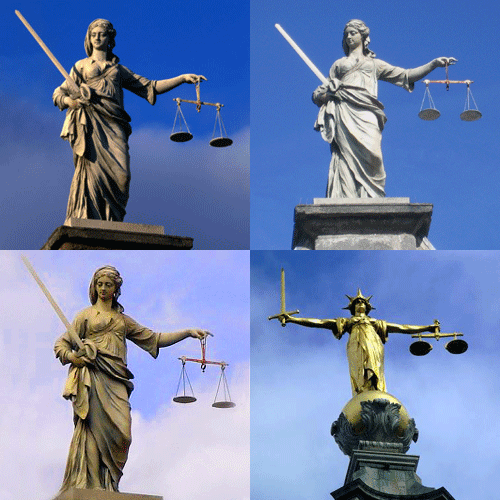
Originally posted on October 28, 2013
The recent government shutdown and struggle over raising the debt ceiling were the result of many factors. Big money in politics, congressional dysfunction, and geographical self-sorting by like-minded voters all played a role. So did redistricting. For those unfamiliar with redistricting, below are some common questions and answers.
Also see our Citizen’s Guide to Redistricting.
What is redistricting?
Members of Congress, state legislators, and many county and municipal offices are elected by voters grouped into districts. At least once per decade, usually after a Census, district lines are redrawn, block by block. Populations change. Some districts gain residents, some lose them. Some districts increase the numbers of minorities, some districts lose them. District boundaries are redrawn to ensure each district has about the same number of people and to fulfill the constitutional guarantee that each voter has an equal say. Based on the 2010 census, each Congressional district has an average population of about 711,000, which is nearly a 10 percent increase from the 2000 census, when each district had an average of 647,000 people. In 2010, some states lost congressional seats and others gained them. For example, Texas gained four districts and New York lost two.
Who draws the lines?
Each state decides. In most states, the line drawers are politicians along with hired consultants. Often, state legislators draw the map, which the governor can veto. Some states have special commissions that advise legislators on drawing the map, or that serve as backup mapmakers if the legislature deadlocks. A few states have independent commissions so politicians and public officials cannot directly draw their own districts. Some states try to prevent a single political party from controlling the process. Some do not, providing one party a major advantage if it controls the state legislature. In other states, politicians from both parties simply work together to draw districts that often protect incumbents.
Why does redistricting matter?
Redistricting affects political power. It determines which party controls Congress and state and local governments across the country. Even when the population is divided equally, drawing the lines one way can reward Democrats and punish Republicans or vice versa. Some line-drawing can protect incumbents. Some line-drawing can guarantee they will face a potent challenger, either from their own party or the opposite party. Consequently, redistricting has a direct bearing on what matters a legislature chooses to tackle, and which to ignore.
How should the lines be drawn?
A good redistricting process should help a community secure meaningful representation. Other than meeting the constitutional requirement that all votes should count equally, there is no magic formula. Many states consider “communities of interest” when drawing their districts. That’s just a term for groups of people who share common social, cultural, racial, economic, geographic, or other concerns. These groups are likely to have similar legislative interests as well, and that means they can benefit from common representation in the government. This goes much deeper than Republican or Democrat. A district of farmers, say, and a district of city dwellers will probably elect representatives that reflect differing histories, priorities, and aspirations. Other redistricting goals — like keeping a district compact or within county borders — are usually proxies for keeping communities intact. A good redistricting process will be open and transparent, allowing communities to ask questions and give input. This participation is important, since communities are the basic units of well-designed districts.
What is gerrymandering?
Gerrymandering refers to the manipulation of district lines to protect or change political power. Any change in district lines affects politics. But a gerrymander is a deliberate and, according to opponents, unfair attempt to draw district lines to increase the likelihood of a particular political result. Incumbents, for example, have an incentive to create districts that are likely to re-elect them, sometimes dividing communities among one or more districts when a single district containing the entire community would better represent their interests.
Did redistricting affect the government shutdown?
Republicans gained 43 seats in the House of Representatives in the 2010 election and regained majority control, the largest swing in any midterm election since 1938. Many experts believe the newly-elected Republicans won their seats as a result of gerrymandering, which created districts with more conservative electorates. More than 50 House Republicans belong to the Tea Party Caucus, the main proponent of the government shutdown and the confrontation over the debt ceiling. This minority of the majority party drove many of the recent decisions regarding whether the House would consider legislation to continue funding the government. Some experts think these lawmakers were likely more willing to shut down the government because they did not fear being voted out of office. Others say gerrymandering did not have an effect because it actually reduces the number of extremely safe districts.
When is the next redistricting cycle, and what can you do now?
The next redistricting will be after the 2020 census. You can hold the line drawers accountable by paying attention and speaking up. Call your state legislators and tell them you want a fair redistricting process. Lawmakers will propose redistricting reform measures in the next few years. Track those developments and make your voice heard.
Share this:

on this day … 10/12 1998 – The U.S. House of Representatives passed the Online Copyright Bill.
1492 –
1792 –
1810 – Bavarian Crown Prince Ludwig married Princess Therese of Saxony-Hildburghausen. The royalty invited the public to attend the event which became an annual celebration that later became known as Oktoberfest.
1892 – In celebration of the 400th anniversary of the Columbus landing the original version of the Pledge of Allegiance was first recited in public schools.
1895 – In Newport, RI, the first amateur golf tournament was held.
1915 – Former U.S. President Theodore Roosevelt criticized U.S. citizens who identified themselves by dual nationalities.
1920 – Construction of the Holland Tunnel began. It opened on November 13, 1927. The tunnel links Jersey City, NJ and New York City, NY.
1933 – The U.S. Department of Justice acquired Alcatraz Island from the U.S. Army.
1937 – “Mr. Keen, Tracer of Lost Persons” debuted on radio.
1938 – Production began on “The Wizard of Oz.”
1942 – During World War II, Attorney General Francis Biddle announced that Italian nationals in the United States would no longer be considered enemy aliens.
1945 – Private First Class Desmond T. Doss was presented with the Congressional Medal of Honor for outstanding bravery as a medical corpsman. He was the first conscientious objector in American history to win the award.
1960 – Soviet premier Nikita Khrushchev pounded a shoe on his desk during a dispute at a U.N. General Assembly.
1961 – The first video memoirs by a U.S. president were made. Walter Cronkite interviewed Dwight D. Eisenhower.
1964 – The Soviet Union launched Voskhod 1 into orbit around the Earth. It was the first space flight to have a multi-person crew and the first flight to be performed without space suits.
1972 – During the Vietnam War, a racial brawl broke out aboard the U.S. aircraft carrier Kitty Hawk. Nearly 50 sailors were injured.
1976 – China announced that Hua Guo-feng was named to succeed the late Mao Tse-tung as chairman of the Communist Party.
1988 – Federal prosecutors announced that the Sundstrand Corp. would pay $115 million dollars to settle with the Pentagon for overbilling airplane parts over a five-year period.
1989 – The U.S. House of Representatives approved a statutory federal ban on the destruction of the American flag.
1993 – The play “Mixed Emotions” opened at the John Golden Theatre.
1994 – Haitian military leader Raoul Cedras was granted political asylum by Panama.
1994 – The Magellan space probe ended its four-year mission to Venus for the purpose of mapping.
1997 – The St. Francis Basilica and 15th-century bell tower above Foligno city hall in Italy were damaged by 3 earthquakes.
1998 – The U.S. House of Representatives passed the Online Copyright Bill.
1999 – In Pakistan, Pervez Musharraf seized power in a bloodless coup that toppled Prime Minister Nawaz Sharif. The Supreme Court ruled that the coup was legal but insisted that a civilian government be restored within three years.
2001 – A special episode of America’s Most Wanted was aired that focused on 22 wanted terrorists. The show was specifically requested by U.S. President George W. Bush.
2006 – The Dow Jones industrial average advanced over 11,900 for the first time.
2015 – It was announced that Dell was buying EMC for around $67 billion

 Be a Seed for Change
You must be logged in to post a comment.