on this day 6/5


1595 – Henry IV’s army defeated the Spanish at the Battle of Fontaine-Francaise.

1752 – Benjamin Franklin flew a kite for the first time to demonstrate that lightning was a form of electricity.

1794 – The U.S. Congress prohibited citizens from serving in any foreign armed forces.

1827 – Athens fell to the Ottomans.

1851 – Harriet Beecher Stow published the first installment of “Uncle Tom’s Cabin” in “The National Era.”

1865 – The first safe deposit vault was opened in New York. The charge was $1.50 a year for every $1,000 that was stored.

1884 – U.S. Civil War General William T. Sherman refused the Republican presidential nomination, saying, “I will not accept if nominated and will not serve if elected.”

1917 – American men began registering for the World War I draft.

1924 – Ernst F. W. Alexanderson transmitted the first facsimile message across the Atlantic Ocean.

1927 – Johnny Weissmuller set two world records in swimming events. Weissmuller set marks in the 100-yard, and 200-yard, free-style swimming competition.

1933 – President Roosevelt signed the bill that took the U.S. off of the gold standard.

1940 – During World War II, the Battle of France began when Germany began an offensive in Southern France.

1942 – In France, Pierre Laval congratulated French volunteers that were fighting in the U.S.S.R. with Germans.

1944 – The first B-29 bombing raid hit the Japanese rail line in Bangkok, Thailand.

1946 – The first medical sponges were first offered for sale in Detroit, MI.

1947 – U.S. Secretary of State George C. Marshall gave a speech at Harvard University in which he outlined the Marshall Plan.

1956 – Premier Nikita Khrushchev denounced Josef Stalin to the Soviet Communist Party Congress.

1967 – The National Hockey League (NHL) awarded three new franchises. The Minnesota North Stars (later the Dallas Stars), the California Golden Seals (no longer in existence) and the Los Angeles Kings.

1967 – The Six Day War between Israel and Egypt, Syria and Jordan began.

1973 – The first hole-in-one in the British Amateur golf championship was made by Jim Crowford.

1975 – Egypt reopened the Suez Canal to international shipping, eight years after it was closed because of the 1967 war with Israel.

1981 – In the U.S., the Center for Disease Control and Prevention reported that five men in Los Angeles were suffering from a rare pneumonia found in patients with weakened immune systems. They were the first recognized cases of what later became known as AIDS.

1986 – A federal jury in Baltimore convicted Ronald W. Pelton of selling secrets to the Soviet Union. Pelton was sentenced to three life prison terms plus 10 years.

1987 – Ted Koppel and guests discussed the topic of AIDS for four hours on ABC-TV’s “Nightline”.

1998 – A strike began at a General Motors Corp. parts factory near Detroit, MI, that closed five assembly plants and idled workers across the U.S. for seven weeks.

1998 – Volkswagen AG won approval to buy Rolls-Royce Motor Cars for $700 million, outbidding BMW’s $554 million offer.

1998 – A strike at a General Motors parts factory began. It lasted for seven weeks.

2001 – Amazon.com announced that it would begin selling personal computers later in the year.

2004 – The U.S.S. Jimmy Carter was christened in the U.S. Navy in Groton, CT.

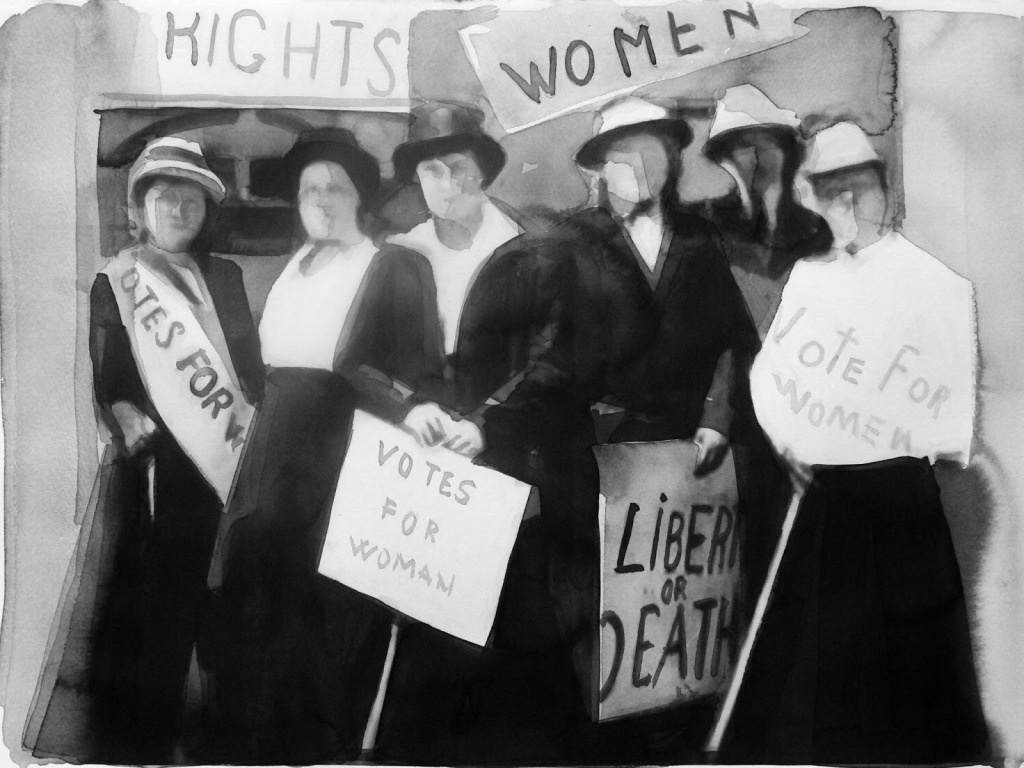
1919 – Congress passes the 19th Amendment, giving Women the right to vote


On May 21, 1919, the House again passes what would become the 19th Amendment, popularly known as the Susan B. Anthony Amendment.

The Senate follows suit on June 4 by a narrow margin (just over the two-thirds requirement), and it goes to the states to be ratified. Ratification requires 36 states, or three-quarters of those in the Union at the time.

The 19th Amendment to the U.S. Constitution, granting women the right to vote, was passed by Congress and sent to the states for ratification.

The women’s suffrage movement was founded in the mid-19th century by women who had become politically active through their work in the abolitionist and temperance movements.

In July 1848, 240 woman suffragists, including Elizabeth Cady Stanton and Lucretia Mott, met in Seneca Falls, New York, to assert the right of women to vote. Female enfranchisement was still largely opposed by most Americans, and the distraction of the North-South conflict and subsequent Civil War precluded further discussion. During the Reconstruction Era, the 15th Amendment was adopted, granting African American men the right to vote, but the Republican-dominated Congress failed to expand its progressive radicalism into the sphere of gender.

Source: history.com

The Senate Passes the Woman Suffrage Amendment


Maud Younger

June 4, 1919

Throughout its history the Senate has cast many crucial votes that have broken a deadlock to bring about legislative success. On June 4, 1919, the Senate cast one such vote when it approved the Woman Suffrage Amendment, clearing the way for state ratification of the Nineteenth Amendment. That success did not come easily. It took years of activism by suffragists, and some brilliant maneuvering by one particular female lobbyist, to gain Senate support for a woman’s right to vote.

One of the suffragists’ first campaigns in the Senate came in 1913. The so-called “Siege of the Senate” brought to Washington hundreds of female activists who arrived in a parade of automobiles and carried petitions for voting rights signed by more than 200,000 women. “We want action now,” chanted the suffragists as they marched into the Capitol. Opponents called the siege a cheap advertising trick, but as the women filled halls and committee rooms, armed with banners, picket signs, and lengthy petitions, senators paid attention.

Senators who supported suffrage rights quickly took the floor and introduced petitions for women of their home states. Giving women the vote, Reed Smoot of Utah observed reassuringly, “has made no daughter less beautiful, no wife less devoted, no mother less inspiring.” Senators opposed to female suffrage, feeling pressure from the lady lobbyists, also participated. “I wish to say that I am opposed to the passage of the amendment,” explained John Thornton of Louisiana, before obediently submitting a petition. Joseph Johnston of Alabama explained that his petition came “at the request of one lady,” then left to speculation the identity of that singular suffragist. “Whatever may be my personal view on this matter,” James Martine of New Jersey confessed, “I would be a veritable coward [should] I not present this petition.”

As years passed, and the Senate remained a barrier to reform, the activists intensified their efforts. Leading the way was a savvy operator named Maud Younger. Although Younger employed a variety of tactics, her most effective strategy was the use of a “congressional card index,” a voluminous collection of index cards on which she recorded every detail, public and private, that she learned about each member of Congress. No detail was overlooked. If the cards noted that a senator always arrived at his office at 7:30 a.m., Younger had a suffragist there at 7:29. If a senator smoked cigars, she sought support among his state’s cigar-makers, or his lodge members, or the family doctor, or anyone else who might influence his vote. She found it especially useful to collect information about the senators’ mothers. Some men, she explained, “listen to their mothers more than to their wives.” By 1919 the tide of Senate opinion was shifting, prompting Maud Younger to boast: “Twenty-two senators have changed their position since I came to Washington.”

On June 4, 1919, 37 Republican senators joined 19 Democrats to pass the amendment. In quick succession, states then ratified the amendment, with Tennessee becoming the necessary 36th state to approve on August 18, 1920. Once again, a Senate vote had provided the crucial bridge to success. In reviewing the tactics that helped bring about that successful Senate vote, the New York Times paid special tribute to Maud Younger and her sister lobbyists. “In the hands of determined women,” concluded the Times, “a full card index is even mightier than pen or sword.”

1989~June 4 ~ Tiananmen Square


June 4, 1989 – The Chinese government ordered its troops to open fire on unarmed protesters in Tiananmen Square in Beijing. The protest had started on April 16 as about 1,000 students marched to mourn the death of Hu Yaobang, a pro-reform leader within the Chinese government. Despite government warnings, pro-reform and pro-democracy demonstrations continued for a month drawing ever-larger crowds of young people, eventually totaling over a million persons. On May 13, three thousand students began an eight-day hunger strike. The government imposed martial law on May 20 and brought in troops. On June 2, in their first clash with the People’s Army, demonstrators turned back an advance of unarmed troops. However, in the pre-dawn hours of June 4, the People’s Army, using tanks, machine-guns, clubs and tear gas, opened fire on the unarmed protesters. Armored personnel carriers then rolled into the square crushing students still sleeping in their tents. The Chinese government later claimed only 300 died in the attack. U.S. estimates put the toll at over 3,000. Following the massacre, over 1,600 demonstrators were rounded up and jailed, with 27 being executed.

1924 The Indian Citizenship Act ~ June 2


With Congress’ passage of the Indian Citizenship Act, the government of the United States confers citizenship on all Native Americans born within the territorial limits of the country.

Before the Civil War, citizenship was often limited to Native Americans of one-half or less Indian blood. In the Reconstruction period, progressive Republicans in Congress sought to accelerate the granting of citizenship to friendly tribes, though state support for these measures was often limited.

In 1888, most Native American women married to U.S. citizens were conferred with citizenship, and in 1919 Native American veterans of World War I were offered citizenship.

The Indian Citizenship Act of 1924, an all-inclusive act, was passed by Congress. The privileges of citizenship, however, were largely governed by state law, and the right to vote was often denied to Native Americans in the early 20th century.

… no words for this, sigh

politics,pollution,petitions,pop culture & purses