

Your Rights as a Federal Employee Enforced by the U.S. Office of Special Counsel (OSC)

Prohibited Personnel Practices
Prohibited personnel practices (PPPs) are employment-related activities that are banned in the federal workforce because they violate the merit
system through some form of employment discrimination, whistleblower retaliation, improper hiring practices, or failure to adhere to laws,
rules, or regulations that directly concern the merit system principles. Under 5 U.S.C. § 2302(b)(1)-(b)(14) a federal employee authorized to
take, direct others to take, recommend or approve any personnel action may not:
Discriminate (including discrimination based on
marital status and political affiliation).
Ex: Supervisor Joe refuses to promote Employee Jane
because Jane is a registered Republican; or his refusal is
because she is single. NOTE: OSC does not generally
investigate Title VII discrimination. 5 U.S.C. §
2302(b)(1)
Solicit or consider employment recommendations
based on factors other than personal knowledge or
records of job-related abilities or characteristics.
Ex: Selecting Official Joe hires Applicant Jack based on
Senator Smith’s recommendation that Jack be hired
because Jack is a constituent. 5 U.S.C. § 2302(b)(2)
Coerce the political activity of any person or take
action against any employee as reprisal for refusing
to engage in political activity. Ex: Supervisor Jane
takes away significant job duties of Employee Jack
because Jack will not make a contribution to Jane’s
favorite candidate. 5 U.S.C. § 2302(b)(3)
Deceive or willfully obstruct any person from
competing for employment. Ex: Supervisor Joe,
located in Headquarters, orders that no vacancy
announcements be posted in the field office where
Employee Jack works because he does not want Jack to
get hired for a job in Headquarters. 5 U.S.C. §
2302(b)(4)
Influence any person to withdraw from competition
for a position to improve or injure the employment
prospects of any other person. Ex: Supervisor Jane, in
an effort to hire Employee Joe, tells Employee Jack that
he should not apply for a position because he is not
qualified and will never be selected. Employee Jack is
qualified. 5 U.S.C. § 2302(b)(5)
Give an unauthorized preference to a person to
improve or injure the employment prospects of any
particular employee or applicant. Ex: Supervisor Jane
specifies that Spanish-speaking skills are necessary for
a vacant position, for the purpose of selecting
Employee Jack, who speaks fluent Spanish. The
position, however, does not require Spanish-speaking
skills. 5 U.S.C. § 2302(b)(6)
Engage in nepotism: Ex: Second-level Supervisor Jane
asks First-level Supervisor Joe to hire or promote her
son. Supervisor Denise serves as the first-line
supervisor for her uncle Anthony. 5 U.S.C. § 2302(b)(7)
Take, fail to take, or threaten (to take or fail to take)
a personnel action against an employee for making
protected disclosures. Ex: Supervisor Joe directs the
geographic reassignment of Employee Jill after Jill
reported a gross waste of funds to the Office of Internal
Affairs. 5 U.S.C. § 2302(b)(8)
Take, fail to take, or threaten (to take or fail to take)
a personnel action against an employee for engaging
in protected activity. Ex: Supervisor Jack terminates
Employee John after learning that John reported a gross
waste of funds to the Office of Inspector General; or for
refusing to obey an order that would require John to
violate agency regulations. 5 U.S.C. § 2302(b)(9)
Discriminate against an employee on the basis of
conduct, which does not adversely affect the
performance of the employee. Ex: Jack’s employment
is terminated because he attended a “Gay Pride” march;
or he attended a “Pro-Life” event; or he attended an
animal rights rally; or he attended a gun-owners’ rights
meeting. 5 U.S.C. § 2302(b)(10)
Take or fail to take a personnel action, if such action
would violate a veterans’ preference requirement.
Ex: Supervisor Jane hired Employee Jack, without
considering Veteran Jennifer, who was included on the
list of eligible employees. NOTE: OSC’s jurisdiction is
limited to disciplinary actions only; the Dept. of Labor
has jurisdiction to investigate for corrective actions.
5 U.S.C. § 2302(b)(11)
Take a personnel action against an employee which
violates a law, rule, or regulation which implements
a merit systems principle. Ex: Supervisor Joe
terminates the probationary appointment of Employee
Jack because of Jack’s letter to the editor criticizing
affirmative action – a valid exercise of First amendment
rights, a law implementing a merit system principle.
5 U.S.C. § 2302(b)(12)
Implement or enforce a nondisclosure agreement or
policy lacking notification of whistleblower rights.
Ex: A manager Issues a policy to all employees in his
program that prohibits the employees from discussing
the program in any way and fails to notify employees of
protected channels for making disclosures. 5 U.S.C. §
2302(b)(13)
Access the medical record of an employee or
applicant, as part of, or in furtherance of any of the
above-listed prohibitions. Ex: An employee expresses
interest in an open position to a hiring official, who
wants to hire another applicant. The hiring official
accesses the employee’s medical records provided
under a reasonable accommodation (RA) request and
attempts to influence the employee to withdraw from
competition by telling her that the stress of the new
position will worsen a medical condition noted in her
RA medical records. 5 U.S.C. § 2302(b)(14)
WHAT CAN YOU DO IF YOU BELIEVE THAT A PPP HAS BEEN COMMITTED?
OSC is a federal investigative and prosecutorial agency. Current and former federal employees, including probationary employees, and applicants
for federal employment can submit a complaint electronically to OSC at https://osc.gov. OSC will review the allegations to determine jurisdiction
and investigate allegations of prohibited personnel practices. In complaints where OSC finds a violation, OSC has the authority to seek corrective
and/or disciplinary action and/or file complaints with the Merit Systems Protection Board, where appropriate. 5 U.S.C. §§ 1212, 2302(b)(1)
(b)(14). You can learn more about prohibited personnel practices by watching these short videos.
WHAT CAN YOU DO IF YOU WANT TO REPORT GOVERNMENT WRONGDOING?
Current and former federal employees and applicants can confidentially report information evidencing a violation of any law, rule, or regulation,
gross mismanagement, a gross waste of funds, an abuse of authority, a substantial and specific danger to public health or safety, or censorship
related to scientific integrity or research to OSC. OSC has the authority to require the head of the agency concerned to investigate the matter.
While OSC does not have independent investigative authority in these cases, Congress has given OSC an important oversight role in reviewing
government investigations of potential wrongdoing.
HOW DOES OSC ENFORCE THE HATCH ACT?
The Hatch Act Unit (HAU) enforces compliance with the Hatch Act, which limits certain political activities of federal executive branch
employees. All employees, except for the President and Vice President, are prohibited from: (1) using their official authority or influence to affect
the result of an election; (2) soliciting, accepting, or receiving political contributions from any person; (3) being candidates in partisan elections;
(4) soliciting or discouraging the political activity of persons with business pending before their employing office; and (5) engaging in political
activity while on duty or in the federal workplace. See 5 U.S.C. §§ 7323-7324. HAU investigates complaints to determine whether a Hatch Act
violation has occurred. In cases where HAU concludes that an employee has violated this law, it will either issue a warning letter or seek
disciplinary action by negotiating a settlement or prosecuting the case before the Merit Systems Protection Board. HAU also is responsible for a
nation-wide program that provides federal, state, and local employees, as well as the public at large, with legal advice on the Hatch Act, enabling
individuals to determine their coverage under the Act and whether their contemplated activities are permitted under the Act. To further its
advisory and enforcement role, HAU is very active in OSC’s outreach program and operates a hotline and dedicated email address for individuals
to request and receive timely Hatch Act advice. In addition, HAU launched its own webinar series tailored to various audiences to address
specific Hatch Act topics. You can learn more about the Hatch Act’s prohibitions by watching these short videos.
For more information on filing a complaint or making a disclosure: 202-804-7000, 800-872-9855, or submit a question at info@osc.gov.
Please note that OSC may not provide advice regarding merit of a complaint or whether the allegation meets the statutory definitions.
Updated and detailed information on OSC and its procedures can be found on OSC’s website at https://osc.gov.
For information about training and the 2302c Certification Program please contact OSC’s Outreach Unit via email at certification@osc.gov.
Source: the PDF/Word copied and pased here
Share this:

1645 – American Indians and the Dutch made a peace treaty at New Amsterdam. New Amsterdam later became known as New York.

USDA~ FSN ~ FDA ~ August 2025 -Recalls – Food Safety Alerts – Previous Month & last day of prior month updates
** BETHLEHEM, PA – August 19, 2025 – B. Braun Medical Inc. (B. Braun) is voluntarily recalling two lots of Lactated Ringers Injection USP 1000 mL,and 0.9% Sodium Chloride Injection USP 1000 mL to the hospital level due to the presence of particulate matter inside the container.
B. Braun has identified through complaints the potential for the product to contain particulate matter in solution. To date there have been no reports of serious injury, death or other adverse events associated with this issue. If the particulate matter is observed before use, a minor delay could occur while obtaining a replacement product. If the particulate matter is loose and the container is used on a patient, there is a potential for the particulate to be infused into the circulatory system. This could lead to patient harm that may require additional medical intervention and/or lead to permanent impairment or death.

** Viva Raw LLC, Charlotte, NC is voluntarily recalling two lots of dog and cat foods due to contamination with Salmonella and Listeria monocytogenes. The recall is for Lot 21495 (Viva Ground Beef for Dogs; Viva Beef & Turkey for Puppies) and Lot 21975 (Viva Ground Chicken for Dogs; Viva Chunked Chicken for Dogs; Viva Chicken for Cats; Viva Pure Chicken) The potential for contamination was identified after routine testing was conducted by the North Carolina Department of Agriculture. Only products from Lots 21495 and 21975 are affected. No illnesses in dogs, cats, or humans related to these lots have been reported to date.
If you have products from Lot 21495 or Lot 21975, please contact Viva Raw at info@vivarawpets.com for a refund on any remaining product. You should then dispose of the food in a way that children, pets, and wildlife cannot access. Do not sell or donate the recalled products. Do not feed the recalled product to pets or any other animals. Wash and sanitize pet food bowls, cups, and storage containers. Always ensure you wash and sanitize your hands after handling recalled food or any utensils that come in contact with recalled food.
** French Listeria outbreak spreads to other countries; 2 patients dead
By Joe Whitworth on August 19, 2025
The European Centre for Disease Prevention and Control (ECDC) has weighed in on a multi-country outbreak of Listeria monocytogenes with 25 cases.
France has 21 infections since December 2024, including 18 since June 2025. Two people died.
Patients are between 34 and 95 years old and 11 are women. Dates…Continue Reading
**
** Five sick in Argentinian Listeria outbreak
By Joe Whitworth on August 19, 2025
A Listeria outbreak that sickened five people in Argentina has been traced to a type of cheese.
Outbreak details were reported in Argentina’s national epidemiological bulletin (Boletín Epidemiológico Nacional).
It is the first time that a link between human cases of listeriosis and a common source, confirmed by…Continue Reading
** Wegmans: The affected products were sold in the cheese department at all Wegmans stores located in Connecticut, Delaware, Maryland, Massachusetts, New Jersey, New York, North Carolina, Pennsylvania, Virginia, and Washington, D.C. No illnesses associated with this recall have been reported to Wegmans or its supplier, to date.
Wegmans has placed automated phone calls to alert customers who purchased these products using Shoppers Club.
Customers should not consume the products and return them to the service desk for a full refund. Those with questions may contact Wegmans Food Markets at 1-855-934-3663, available daily from 8:00 a.m. through 8:00 p.m. EST.
Affected items, sold between July 1 and August 12, 2025, include:
Wegmans Caramel Apple Pecan Topped Brie Cheese, 13 OZ, UPC: 2-77645-00000-3
Wegmans Medium Camembert Soft Ripened Cheese, 8.8 OZ, UPC: 77890-53515 with best by dates of 7/26/25, 8/12/25, and 8/19/25
Wegmans Assorted Cheese Flight, 1 LB, UPC: 2-77100-00000-0
Wegmans Grilling Camembert with Tapenade & Roasted Tomatoes, 10 OZ, UPC: 2-77297-00000-0
** Dollar General: No illnesses or injuries have been reported to date. August 11, 2025 –Dollar General Corporation is recalling three (3) lots of its eight (8) ounce Clover Valley® Instant Coffee due to the potential presence of glass.
8-Ounce Clover Valley® Instant Coffee
Package UPC: 876941004069
Lot: L-5163 / Best By 12/13/2026
Lot: L-5164 / Best by 12/13/2026
Lot: L-5165 / Best by 12/14/2026
Customers can find the lot and best by date information around the neck of the unit.
Clover Valley® Instant Coffee was sold and distributed between July 9-21, 2025 exclusively in Dollar General retail stores located in the following states: AL, AR, AZ, CA, CO, CT, DE, FL, GA, IA,ID, IL, IN, KS, KY, LA, MA, MD, ME, MI, MN, MO, MS, MT, NC, ND, NE, NH, NJ, NM, NV, NY, OH, OK, OR, PA, RI, SC, SD, TN, TX, UT, VA, VT, WA, WI ,WV, and WY.
Customers who purchased this product are encouraged to discard it and contact Dollar General either via email at customercare@dollargeneral.com or by phone at 1-888-309-9030 from 6 a.m. to 1 a.m. CST seven days a week to request a full refund of the purchase price (including any tax).
** Fromi USA Recalls Brie Royal Faucon 1kg Because of Possible Health Risk
** Quesito El Establo Recalls Spanish Cheese (Quesito Colombiano) Because of Possible Health Risk
** Two deaths in French Listeria outbreak
By Joe Whitworth on August 14, 2025
Two people have died in a Listeria outbreak in France linked to cheese.
French health authorities reported 21 cases of listeriosis caused by bacterial strains with similar characteristics, including 18 cases since the beginning of June. Patients range in age from 34 to 95.
Pasteurized cow’s and goat’s milk cheeses…Continue Reading
** Goodlettsville, Tennessee – August 11, 2025 –Dollar General Corporation is recalling three (3) lots of its eight (8) ounce Clover Valley® Instant Coffee due to the potential presence of glass.
8-Ounce Clover Valley® Instant Coffee
Package UPC: 876941004069
Lot: L-5163 / Best By 12/13/2026
Lot: L-5164 / Best by 12/13/2026
Lot: L-5165 / Best by 12/14/2026
Customers can find the lot and best by date information around the neck of the unit.
Clover Valley® Instant Coffee was sold and distributed between July 9-21, 2025 exclusively in Dollar General retail stores located in the following states: AL, AR, AZ, CA, CO, CT, DE, FL, GA, IA,ID, IL, IN, KS, KY, LA, MA, MD, ME, MI, MN, MO, MS, MT, NC, ND, NE, NH, NJ, NM, NV, NY, OH, OK, OR, PA, RI, SC, SD, TN, TX, UT, VA, VT, WA, WI ,WV, and WY.
** Quesito El Establo, of Salem, NH, is recalling all of its Spanish Cheese (Quesito Colombiano) products manufactured at its facility, due to the presence of rodents, rodent activity, and other unsanitary conditions during the production and storage process. Consumers who have purchased the recalled product are encouraged not to consume it and return it to the place of purchase for a full refund. Consumers with questions can contact the company at 617-842-0513 (Monday through Saturday, 9:00 a.m. to 5:00 p.m., Eastern time).
** Wegmans The affected products were sold in the cheese department at all Wegmans stores located in Connecticut, Delaware, Maryland, Massachusetts, New Jersey, New York, North Carolina, Pennsylvania, Virginia, and Washington, D.C.
Affected items, sold between July 1 and August 12, 2025, include:
Wegmans Caramel Apple Pecan Topped Brie Cheese, 13 OZ, UPC: 2-77645-00000-3 The affected products were sold in the cheese department at all Wegmans stores located in Connecticut, Delaware, Maryland, Massachusetts, New Jersey, New York, North Carolina, Pennsylvania, Virginia, and Washington, D.C.
Wegmans Medium Camembert Soft Ripened Cheese, 8.8 OZ, UPC: 77890-53515 with best by dates of 7/26/25, 8/12/25, and 8/19/25
Wegmans Assorted Cheese Flight, 1 LB, UPC: 2-77100-00000-0
Wegmans Grilling Camembert with Tapenade & Roasted Tomatoes, 10 OZ, UPC: 2-77297-00000-0
Affected items, sold between July 1 and August 12, 2025, include:
Wegmans Caramel Apple Pecan Topped Brie Cheese, 13 OZ, UPC: 2-77645-00000-3
Wegmans Medium Camembert Soft Ripened Cheese, 8.8 OZ, UPC: 77890-53515 with best by dates of 7/26/25, 8/12/25, and 8/19/25
Wegmans Assorted Cheese Flight, 1 LB, UPC: 2-77100-00000-0
Wegmans Grilling Camembert with Tapenade & Roasted Tomatoes, 10 OZ, UPC: 2-77297-00000-0
No illnesses associated with this recall have been reported to Wegmans or its supplier, to date.
Wegmans has placed automated phone calls to alert customers who purchased these products using Shoppers Club.
Customers should not consume the products and return them to the service desk for a full refund. Those with questions may contact Wegmans Food Markets at 1-855-934-3663, available daily from 8:00 a.m. through 8:00 p.m. EST.
** Louisa Food Products, Inc. told Newsweek in a statement: “We have voluntarily recalled a limited quantity of our Jalapeño Mac and Cheese Bites with lot code 2507092 due to potential listeria contamination. This recall was initiated out of an abundance of caution following a supplier’s recall of the breadcrumb ingredient used in this product. All recalled cases have been located, isolated, and are awaiting proper handling and disposal.
“We are actively collaborating with our supplier to address the root cause of this issue and are implementing additional preventive measures to ensure it does not recur. The quality and safety of our products will always be our highest priority, and we appreciate the understanding and trust of our customers.”
** The recall affects 8-ounce packages of the brand’s Three Cheese Mac & Cheese Bites. Over 4,000 cases have been affected, according to the FDA.
Best by dates: June 19, 2026 or June 20, 2026
UPC: 8-99039-00280-8
Lot codes: 24354AV1 or 24355AV1
** Power Stick: On July 10, the Food and Drug Administration announced the recall of certain Power Stick deodorants, made by A.P. Deauville, LLC.1
- More than 67,000 cases of deodorant have been recalled nationwide due to safety concerns.
- The recall affects three Power Stick deodorant products, made by A.P. Deauville, LLC.
- Check if your deodorant is part of the recall, and toss or return it.
- Power Stick for her PH Balanced Roll-On Antiperspirant Deodorant with Powder Fresh Scent, 1.8 oz./53 mL, A.P Deauville, LLC, PA 18040, NDC# 42913-038-00, UPC Code 815195019313
D-0548-2025
Class II
Lot # 032026B011, 032226B031, 051626C241, 061526C882, 071226D371, 071226D381, 082526E341, 082826E402
21,265 cases
CGMP Deviations
2
Beauty & Skincare Power Stick original nourishing invisible protection roll-on Antiperspirant/Deodorant Spring Fresh, 1.8 oz./53 mL, A.P Deauville, LLC, PA 18040, NDC# 42913-039-00, UPC Code 815195018194
D-0549-2025
Class II
Lot # 031726A991, 041226B561, 062026C901, 062026C911, 071026D351, 071026D361, 071326D391, 111626G231
22,482 Cases
CGMP Deviations
3
Shave and Skincare Power Stick Original Nourishing Invisible Protection Roll-On Antiperspirant/Deodorant, 1.8 oz./ 53 mL, A.P Deauville, LLC, PA 18040, NDC# 42913-040-00 UPC Code 815195018224
D-0550-2025
Class II
Lot # 101225D781, 032926B281, 032826B221, 041126B531, 062226D011, 070626D301, 070626D333, 111026G051, 111326G091, 111626G221
23,467 Cases
CGMP Deviations
** DermaRite Consumers with questions regarding this recall can call Mary Goldberg at 973-569-9000 x104 Monday through Friday, 9:00 am – 5:00 pm EST or email voluntary.action@dermarite.com.
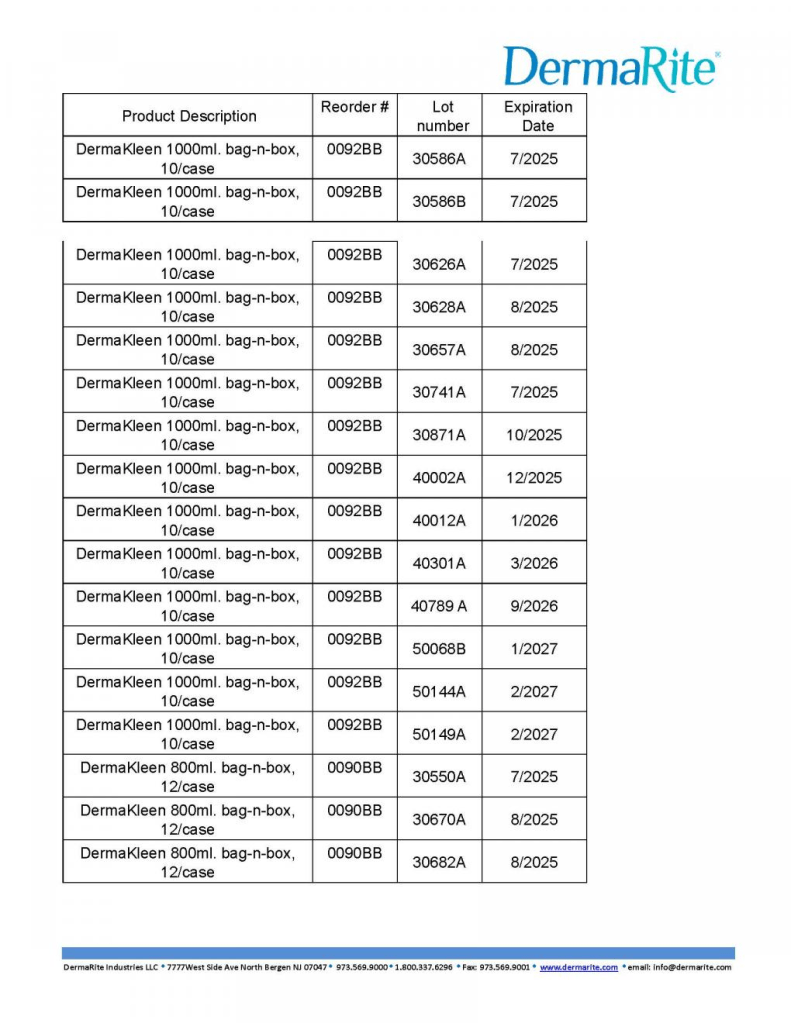
To date, DermaRite has not received any reports of adverse events related to this recall.
DermaKleen is an OTC Healthcare antiseptic lotion soap with Vitamin E indicated for handwashing to decrease bacteria on the skin.
DermaSarra is an OTC External analgesic indicated for temporary relief of itching associated with minor skin irritations due to: dry skin, insect bites, detergents, sunburn.
KleenFoam is an OTC Antimicrobial foam soap with Aloe Vera indicated for handwashing to decrease bacteria on the skin after changing diapers, after assisting ill people, or before contact with a person under medical care or treatment.
PeriGiene is an OTC Antiseptic cleanser indicated for use in the perineal area.
The recalled products were distributed nationwide in the United States and in Puerto Rico.
Recalled Product Information: (see Table image below)
DermaRite has notified its distributors and customers by e-mail to immediately examine available inventory and destroy all affected products in accordance with each facility’s process.
- AUG 1 – Member’s Mark dried fruit sold at Sam’s Clubs recalled because of Listeria contamination, Doehler Dry Ingredient Solutions, LLC Recalls Member’s Mark Freeze Dried Fruit Variety Pack for Listeria monocytogenes Contamination
- Four ill in Salmonella outbreak linked to egg product supplement
** July 31, 2025
Sold at: Select Sam’s Clubs in the following states: AL, AZ, CA, CO, CT, DE, FL, GA, HI, IA, ID, IL, IN, KS, LA, MD, ME, MI, MN, MO, MS, MT, NC, ND, NE, NH, NJ, NM, NV, NY, OH, OK, PA, PR, SC, SD, TN, TX, UT, VA, WI, WV, WY
** July 18, 2025
Sold at: All stores
June 11, 2025
Sold at: Walmart stores, Walmart.com
June 10, 2025
Amneal Pharmaceutical LLC Issues a Nationwide Recall of Sulfamethoxazole / Trimethoprim Tablets
Sold at: Select Walmart stores. See list of stores.
** Four ill in Salmonella outbreak linked to egg product supplement
** UKHSA reports continued rise in E. coli infections
** Aug. 1, 2025
Sold at: Walmart.com
By News Desk on August 1, 2025
Recently released data from the UK Health Security Agency (UKHSA) has shown another rise in E. coli infections in England in 2024.
Overall, 2,544 cultured-confirmed cases of Shiga toxin-producing E. coli (STEC) were reported with 564 STEC O157 and 1,980 non-O157. In 2023, 2,018 cultured-confirmed infections were noted compared to 2,063 in…Continue Reading
By Joe Whitworth on August 1, 2025
Four people have fallen sick after consuming a type of egg product supplement in the United Kingdom.
Public Health Scotland is leading the probe into a cluster of multidrug resistant Salmonella infections associated with an eggshell membrane food supplement sold online.
The UK Health Security Agency (UKHSA), Food Standards Agency…Continue Reading
**
** Albertsons Companies Stores in Arkansas, Louisiana, Oklahoma and Texas Voluntarily Expands Recall to Select Items Containing Tuna Salad from Reser’s Fine Foods Due to an Ingredient Recall Linked to Possible Listeria monocytogenes Contamination. The items containing tuna salad were available for purchase at the following banner stores: Albertsons, Randalls and Tom Thumb in Arkansas, Louisiana, Oklahoma and Texas.
Consumers with questions should contact Albertsons Companies’ Customer Service Center at 1-877-723-3929 Monday through Friday from 5 a.m. to 9 p.m. PST.
Product Recall Details:
| Product Name | UPC | Size | Sell Thru Dates (if applicable, Or Lot Code/Est. Number) | Store Banners | States |
|---|---|---|---|---|---|
| RM DUO TUNA SALAD W/CRACKER S | 27183000000 | EA | Jul 24 25 Thru Jul 29 25 | Albertsons, Randalls, Tom Thumb | AR, LA, OK, TX |
| RM SALAD TUNA PREMIUM SS | 21425000000 | EA | Jul 24 25 Thru Jul 29 25 | Albertsons, Randalls, Tom Thumb | AR, LA, OK, TX |
| RM SNACKER TRAY TUNA SALAD | 21151300000 | EA | Jul 24 25 Thru Jul 29 25 | Albertsons, Randalls, Tom Thumb | AR, LA, OK, TX |
| RM SNACKER TRAY TUNA SALAD | 21151300000 | EA | JUL 24 25 Thru Jul 29 25 | Albertsons, Randalls, Tom Thumb | AR, LA, OK, TX |
| RM SNDWCH TUNA SALAD CROISSANT SS COLD | 21788400000 | EA | Jul 23 25 Thru Jul 28 25 | Albertsons, Randalls, Tom Thumb | AR, LA, OK, TX |
| RM TUNA SALAD OVER BED OF LETTUCE SS | 21786400000 | EA | Jul 23 25 Thru Jul 28 25 | Albertsons, Randalls, Tom Thumb | AR, LA, OK, TX |
| SALAD TUNA PREMIUM | 21228800000 | Variable Weight | Jul 24 25 Thru Jul 29 25 | Albertsons, Randalls, Tom Thumb | AR, LA, OK, TX |
| TRAY CROISSANT MINI SALAD 16 IN | 27841300000 | EA | Jul 23 25 Thru Jul 28 25 | Albertsons, Randalls, Tom Thumb | AR, LA, OK, TX |
| TRAY CROISSANT MINI SALAD 18 IN | 27841200000 | EA | Jul 23 25 Thru Jul 28 25 | Albertsons, Randalls, Tom Thumb | AR, LA, OK, TX |
| TRAY SALAD SANDWICH 12 IN | 27841500000 | EA | Jul 23 25 Thru Jul 28 25 | Albertsons, Randalls, Tom Thumb | AR, LA, OK, TX |
| TRAY SALAD SANDWICH 16 IN | 27841400000 | EA | Jul 23 25 Thru Jul 28 25 | Albertsons, Randalls, Tom Thumb | AR, LA, OK, TX |
Share this:

Grok answers my question: Which immigration program from the past would work the best for our 21st Century

Key Points
- Research suggests the Bracero Program (1942-1964), a temporary labor agreement with Mexico, could be adapted for 21st-century needs, particularly for agricultural labor, if reformed with stronger worker protections.
- It seems likely that this program addresses modern labor shortages, but its historical issues, like exploitation, highlight the need for significant updates to align with current ethical standards.
- The evidence leans toward the Bracero Program as a model due to its scale and focus on temporary migration, though controversy exists around past labor abuses and their impact on workers.
Direct answer: The Bracero Program, active from 1942 to 1964, could work best for the 21st century if significantly reformed. This program allowed millions of Mexican workers to temporarily work in the U.S., mainly in agriculture, addressing labor shortages during and after World War II. Today, it could help meet seasonal labor needs, especially in farming, but it would need updates like guaranteed fair wages, safe housing, and protections against exploitation to meet modern ethical standards.Why It Fits Modern Needs
The U.S. still faces labor shortages in agriculture and other industries, and a reformed Bracero Program could provide legal pathways for temporary workers, reducing reliance on undocumented migration. Its historical scale—over 4.5 million participants—shows it can handle large-scale labor demands, which is relevant given current global migration patterns.Challenges and Reforms Needed
Historically, the program faced criticism for worker exploitation, low wages, and poor living conditions. For the 21st century, it would need strong labor laws, oversight to prevent abuse, and possibly options for workers to transition to permanent residency, ensuring it aligns with today’s values of fairness and human rights.Comparison to Other Programs
Other historical programs, like the Hart-Celler Act of 1965, shaped modern immigration but are more legislative frameworks than specific programs. The Bracero Program stands out for its focus on temporary labor, making it a practical model if reformed, though its past issues are a point of debate.For more details, see History.com on the Bracero Program and Wikipedia on the Bracero Program.
Survey Note: Evaluating Historical Immigration Programs for 21st-Century Relevance. This analysis explores which historical immigration program from the past could best serve the needs of the 21st century, focusing on the Bracero Program (1942-1964) as a potential model, while considering its historical context, challenges, and necessary reforms. The evaluation is grounded in a comprehensive review of historical immigration policies, their impacts, and their alignment with modern economic, humanitarian, and ethical priorities as of August 6, 2025.Historical Context and Program Overview. Immigration has been a defining feature of U.S. history, with policies evolving to meet economic, social, and political needs. The Bracero Program, initiated during World War II, was a bilateral agreement between the U.S. and Mexico to address labor shortages by allowing temporary Mexican workers, known as braceros, to work primarily in agriculture. Running from 1942 to 1964, it involved over 4.5 million workers and was the largest guest worker program in U.S. history. It was designed to fill labor gaps during the war and continued post-war, reflecting a need for seasonal agricultural labor.Other notable historical programs include:
- Hart-Celler Act (1965): Replaced national origins quotas with a system prioritizing family reunification and skilled immigration, forming the basis of current U.S. immigration law.
- Diversity Visa Program (1990): Aimed at diversifying immigration by allocating visas to underrepresented countries, though relatively recent.
- Refugee Resettlement Programs: Addressed humanitarian needs, such as resettling Vietnamese refugees in the 1970s, but lack the scale of labor-focused programs like the Bracero Program.
The Bracero Program’s structure, focusing on temporary labor migration, makes it a candidate for adaptation, given 21st-century labor demands, particularly in agriculture, where seasonal workers are crucial.Relevance to 21st-Century NeedsThe 21st century presents unique immigration challenges, including:
- Economic Needs: Labor shortages in agriculture, technology, and healthcare, driven by an aging U.S.-born workforce and global competition for skilled workers.
- Humanitarian Needs: Ongoing refugee crises and asylum seeker flows, requiring humane and legal pathways.
- Integration and Diversity: A need for policies that promote cultural diversity and successful integration, aligning with globalized societies.
- Border Security and Illegal Immigration: Managing borders while addressing undocumented migration, often linked to labor demand.
The Bracero Program addresses the economic need for temporary labor, particularly in agriculture, where mechanization has not fully replaced human workers. As of 2025, the U.S. agricultural sector continues to rely on migrant labor, with estimates suggesting significant portions of farmworkers are foreign-born. A reformed program could legalize these flows, reducing undocumented migration and improving labor conditions.Historical Analysis and Lessons LearnedThe Bracero Program’s historical impact was mixed:
- Positive Aspects: It met labor demands during and after WWII, with over 4.5 million participants contributing to U.S. agriculture. It also facilitated remittances to Mexico, supporting economic ties.
- Negative Aspects: Workers faced exploitation, including low wages, poor housing, and racial discrimination. Employers often ignored contract terms, and many braceros stayed illegally after contracts ended, contributing to undocumented immigration.
These issues highlight the need for reforms, such as:
- Worker Protections: Guaranteed minimum wages, safe housing, and access to healthcare, addressing past exploitation.
- Enforcement: Strong oversight to ensure compliance with labor laws, preventing abuse by employers.
- Legal Pathways: Options for workers to transition to permanent residency, reducing incentives for undocumented status.
Comparatively, the Hart-Celler Act shifted immigration toward family and skill-based systems, which are still relevant but lack the specific focus on temporary labor migration. The Diversity Visa Program promotes diversity but is less suited for addressing labor shortages. Refugee resettlement programs, while crucial, are humanitarian-focused and not primarily labor-oriented.Proposed Reforms for 21st-Century AdaptationTo make the Bracero Program viable today, the following reforms are essential:
- Labor Standards: Implement strict labor laws, including fair wages (e.g., aligning with H-2A visa standards) and safe working conditions, to prevent exploitation.
- Human Rights Protections: Ensure access to healthcare, education for workers’ families, and anti-discrimination measures, aligning with modern ethical standards.
- Legal Framework: Create clear legal pathways for workers, potentially allowing transitions to permanent residency after a set period, addressing long-term integration needs.
- Diversity and Inclusion: Expand eligibility to other countries facing labor surpluses, ensuring the program reflects global migration patterns and reduces dependency on a single nation.
These reforms would address the program’s historical flaws while leveraging its structure for temporary labor needs, making it a model for guest worker programs in 2025. Comparative Table: Historical Programs and 21st-Century Fit
| Program | Period | Focus | Strengths | Weaknesses | 21st-Century Fit |
|---|---|---|---|---|---|
| Bracero Program | 1942-1964 | Temporary agricultural labor | Large scale, met labor needs | Exploitation, poor conditions | High, with reforms for labor protections |
| Hart-Celler Act | 1965 | Family, skilled immigration | Foundation of current system | Not a specific program, ongoing use | Moderate, more legislative framework |
| Diversity Visa Program | 1990 | Diversity in immigration | Promotes underrepresented countries | Recent, not labor-focused | Low, less relevant for labor needs |
| Refugee Resettlement | Mid-20th C | Humanitarian protection | Addresses crises, humane | Not labor-focused, smaller scale | Low, humanitarian focus, not labor |
Controversy and DebateThe Bracero Program’s historical legacy is controversial, with labor unions and advocates criticizing its exploitation, while agricultural interests see it as a necessary labor solution. Modern debates, as seen in proposals like the “Bracero Program 2.0 Act” in 2025, highlight tensions between economic benefits and worker rights. Balancing these interests is crucial for its adaptation, with ongoing discussions about guest worker programs reflecting these tensions.ConclusionResearch suggests the Bracero Program, with significant reforms, could be the best historical immigration program for the 21st century, particularly for addressing temporary labor needs in agriculture. Its scale and focus on guest workers align with current economic demands, but its past issues necessitate updates like strong labor protections and legal pathways. While other programs like the Hart-Celler Act shaped modern policy, the Bracero Program’s specific structure makes it a practical model, provided it is adapted to meet ethical and legal standards as of August 6, 2025.For further reading, see:
- History.com on the Bracero Program
- Wikipedia on the Bracero Program
- Library of Congress on Latinx Civil Rights
:


You must be logged in to post a comment.