Slain Civil Rights Workers Murdered


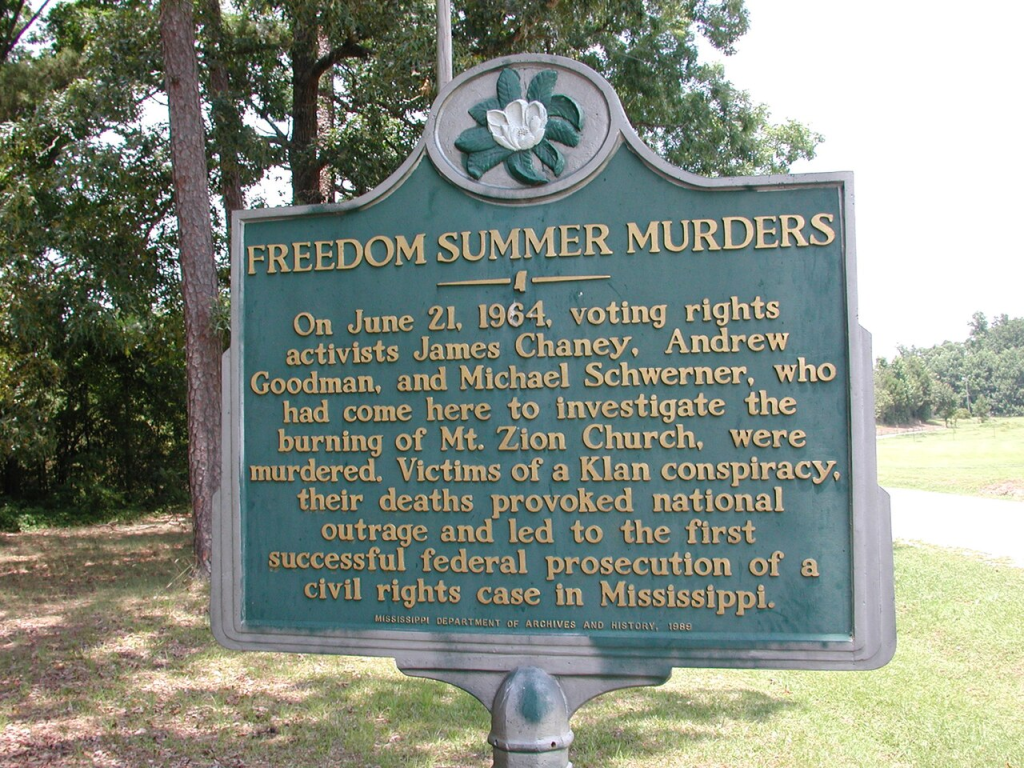
State of Mississippi roadside marker denoting the location where the 1964 murders of American civil rights workers Goodman, Chaney, and Schwerner took place

Three young civil rights workers, James Chaney, Andrew Goodman and Michael Schwerner, were found murdered and buried in an earthen dam outside Philadelphia, Mississippi.

They had disappeared on June 21 after being detained by Neshoba County police on charges of speeding.

They were participating in the Mississippi Summer Project organized by the Student Nonviolent Coordinating Committee (SNCC) to increase black voter registration.

When their car was found burned on June 23, President Lyndon Johnson ordered the FBI to search for the men.

Source: www.historyplace.com

on this day … 8/4 1735 – Freedom of the press was established with an acquittal of John Peter Zenger


1735 – Freedom of the press was established with an acquittal of John Peter Zenger. The writer of the New York Weekly Journal  had been charged with seditious libel by the royal governor of New York. The jury said that “the truth is not libelous.” 

1753 – George Washington became a Master Mason.

1790 – The Revenue Cutter Service was formed. This U.S. naval task force was the beginning of the U.S. Coast Guard.

1821 – “The Saturday Evening Post” was published for the first time as a weekly.

1914 – Britain declared war on Germany. The U.S. proclaimed its neutrality.

1921 – The first radio broadcast of a tennis match occurred. It was in Pittsburgh, PA.

1922 – The death of Alexander Graham Bell, two days earlier, was recognized by AT&T and the Bell Systems by shutting down all of its switchboards and switching stations. The shutdown affected 13 million phones.

1934 – Mel Ott became the first major league baseball player to score six runs in a single game.

1944 – Nazi police raided a house in Amsterdam and arrested eight people. Anne Frank, a teenager at the time, was one of the people arrested. Her diary would be published after her death.

1954 – The uranium rush began in Saskatchewan, Canada.

1956 – William Herz became the first person to race a motorcycle over 200 miles per hour. He was clocked at 210 mph.

1957 – Florence Chadwick set a world record by swimming the English Channel in 6 hours and 7 minutes.

1957 – Juan Fangio won his final auto race and captured the world auto driving championship. It was his the fifth consecutive year to win.

1958 – The first potato flake plant was completed in Grand Forks, ND.

1958 – Billboard Magazine introduced its “Hot 100” chart, which was part popularity and a barometer of the movement of potential hits. The first number one song was Ricky Nelson’s “Poor Little Fool.”

1972 – Arthur Bremer was found guilty of shooting George Wallace, the governor of Alabama. Bremer was sentenced to 63 years in prison.

1977 – U.S. President Carter signed the measure that established the Department of Energy.

1983 – New York Yankee outfielder Dave Winfield threw a baseball during warm-ups and accidentally killed a seagull. After the game, Toronto police arrested him for “causing unnecessary suffering to an animal.”

1984 – Carl Lewis won a gold medal in the Los Angeles Olympics.

1984 – Upper Volta, an African republic, changed its name to Burkina Faso.

1985 – Tom Seaver of the Chicago White Sox achieved his 300th victory.

1985 – Rod Carew of the California angels got his 3,000th major league hit.

1986 – The United States Football League called off its 1986 season. This was after winning only token damages in its antitrust lawsuit against the National Football League.

1987 – The Fairness Doctrine was rescinded by the Federal Communications Commission. The doctrine had required that radio and TV stations present controversial issues in a balanced fashion. 

1987 – A new 22-cent U.S. stamp honoring noted author William Faulkner, went on sale in Oxford, MS. Faulkner had been fired as postmaster of that same post office in 1924.

1989 – Iranian President Hashemi Rafsanjani offered to assist end the hostage crisis in Lebanon.

1990 – The European Community imposed an embargo on oil from Iraq and Kuwait. This was done to protest the Iraqi invasion of the oil-rich Kuwait.

1991 – The Oceanos, a Greek luxury liner, sank off of South Africa’s southeast coast. All of the 402 passengers and 179 crewmembers survived.

1994 – Yugoslavia withdrew its support for Bosnian Serbs. The border between Yugoslavia and Serb-held Bosnia was sealed.

1996 – Josia Thugwane won a gold medal after finishing first in the marathon. He became the first black South African to win a gold medal.

1997 – Teamsters began a 15-day strike against UPS (United Parcel Service). The strikers eventually won an increase in full-time positions and defeated a proposed reorganization of the company’s pension plan.

2007 – NASA’s Phoenix spacecraft was launched on a space exploration mission of Mars. The Phoenix lander descended on Mars on May 25, 2008.

2009 – North Korean leader Kim Jong-il pardoned two American journalists, who had been arrested and imprisoned for illegal entry earlier in the year.

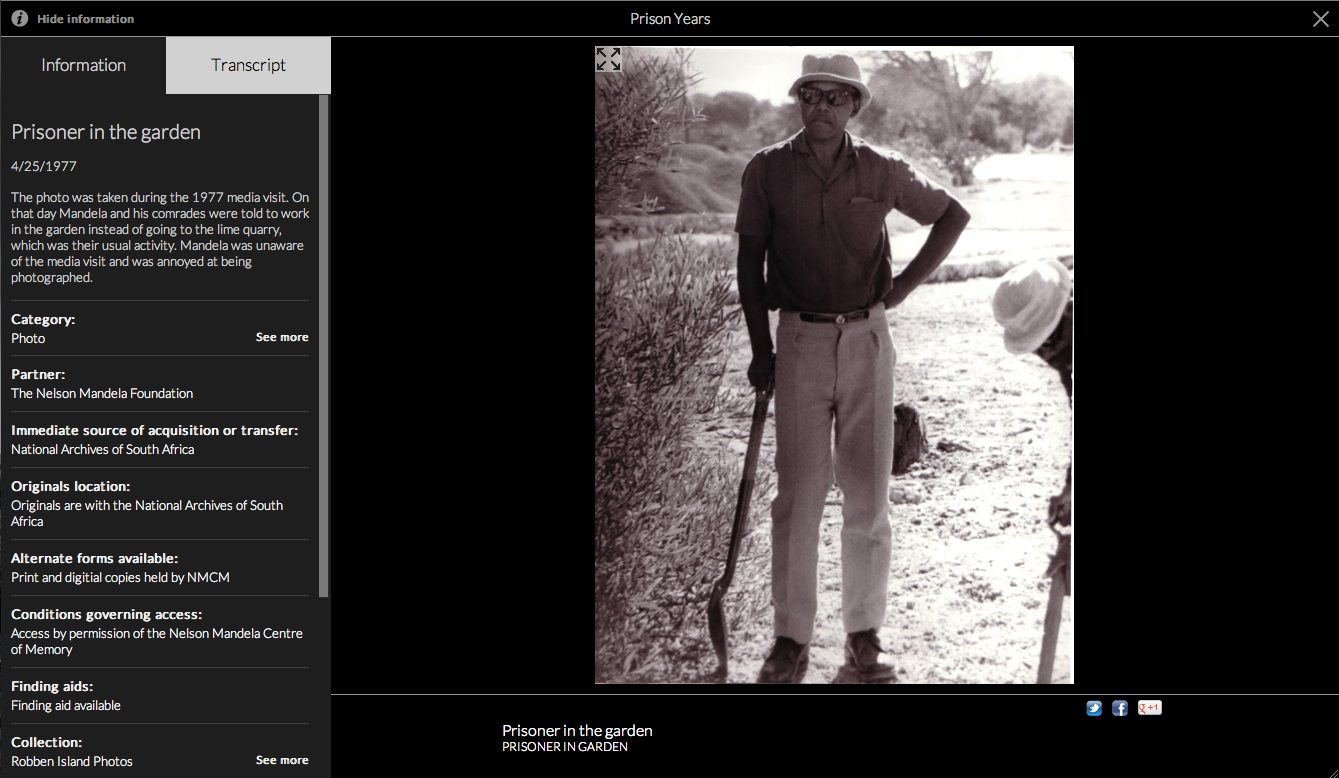
1962 Nelson Mandela is Arrested


Apartheid opponent Nelson Mandela was arrested by security police in South Africa. He was then tried and sentenced to five years in prison. In 1964, he was placed on trial for sabotage, high treason and conspiracy to overthrow the government and was sentenced to life in prison.

A worldwide campaign to free him began in the 1980s and resulted in his release on February 11, 1990, at age 71 after 27 years in prison. In 1993, Mandela shared the Nobel Peace Prize with South Africa’s President F.W. de Klerk for their peaceful efforts to bring a nonracial democracy to South Africa.

In April 1994, black South Africans voted for the first time in an election that brought Mandela the presidency of South Africa.

historyplace.com

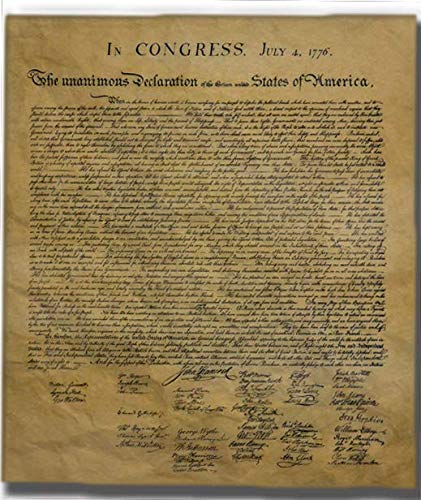
1776 Formal signing of the US Declaration of Independence by 56 people (date most accepted by modern historians)


The Declaration of Independence, Authentic Full Size Replica Printed on Antiqued Genuine Parchment. 23 x 29

Fate of the Signers of the Declaration of Independence

The following is often published and cited concerning the fate of the Signers, but its accuracy is doubtful, and should only be taken as “traditional” rather than historical. See the end for links to other sources on the subject.

Have you ever wondered what happened to the 56 men who signed the Declaration of Independence?

Five signers were captured by the British as traitors, and tortured before they died.

Twelve had their homes ransacked and burned. Two lost their sons serving in the Revolutionary Army; another had two sons captured.

Nine of the 56 fought and died from wounds or hardships of the Revolutionary War.

They signed and they pledged their lives, their fortunes, and their sacred honor. What kind of men were they?

Twenty-four were lawyers and jurists. Eleven were merchants, nine were farmers and large plantation owners; men of means, well educated. But they signed the Declaration of Independence knowing full well that the penalty would be death if they were captured.

Carter Braxton of Virginia, a wealthy planter and trader, saw his ships swept from the seas by the British Navy. He sold his home and properties to pay his debts, and died in rags.

Thomas McKeam was so hounded by the British that he was forced to move his family almost constantly. He served in the Congress without pay, and his family was kept in hiding. His possessions were taken from him, and poverty was his reward.

Vandals or soldiers looted the properties of Dillery, Hall, Clymer, Walton, Gwinnett, Heyward, Ruttledge, and Middleton.

At the battle of Yorktown, Thomas Nelson, Jr., noted that the British General Cornwallis had taken over the Nelson home for his headquarters. He quietly urged General George Washington to open fire. The home was destroyed, and Nelson died bankrupt.

Francis Lewis had his home and properties destroyed. The enemy jailed his wife, and she died within a few months.

John Hart was driven from his wife’s bedside as she was dying. Their 13 children fled for their lives. His fields and his gristmill were laid to waste. For more than a year he lived in forests and caves, returning home to find his wife dead and his children vanished. A few weeks later he died from exhaustion and a broken heart.

Norris and Livingston suffered similar fates. Such were the stories and sacrifices of the American Revolution. These were not wild-eyed, rabble-rousing ruffians. They were soft-spoken men of means and education. They had security, but they valued liberty more. Standing tall, straight, and unwavering, they pledged: “For the support of this declaration, with firm reliance on the protection of the divine providence, we mutually pledge to each other, our lives, our fortunes, and our sacred honor.”

They gave you and me a free and independent America. The history books never told you a lot about what happened in the Revolutionary War. We didn’t fight just the British.

We were British subjects at that time and we fought our own government!

Some of us take these liberties so much for granted, but we shouldn’t. So, take a few minutes while enjoying your 4th of July holiday and silently thank these patriots. It’s not much to ask for the price they paid. Remember: freedom is never free!

I hope you will show your support by please sending this to as many people as you can. It’s time we get the word out that patriotism is NOT a sin, and the Fourth of July has more to it than beer, picnics, and baseball games.

constitution.org

politics,pollution,petitions,pop culture & purses