on this day … 6/14 1943 – The U.S. Supreme Court ruled that schoolchildren could not be made to salute the U.S. flag if doing so conflicted with their religious beliefs.


1775 – The Continental Army was founded by the Second Continental Congress for purposes of common defense. This event is considered to be the birth of the United States Army. On June 15, George Washington was appointed commander-in-chief.

1777 – The Continental Congress in Philadelphia adopted the “Stars and Stripes” as the national flag of the United States. The Flag Resolution stated “Resolved: that the flag of the United States be made of thirteen stripes, alternate red and white; that the union be thirteen stars, white in a blue field, representing a new Constellation.” On May 20, 1916, President Woodrow Wilson officially proclaimed June 14 “Flag Day” as a commemoration of the “Stars and Stripes.”

1789 – Captain William Bligh of the HMS Bounty arrived in Timor in a small boat.

1834 – Cyrus Hall McCormick received a patent for his reaping machine.

1834 – Isaac Fischer Jr. patented sandpaper.

1841 – The first Canadian parliament opened in Kingston.

1846 – A group of U.S. settlers in Sonoma proclaimed the Republic of California.

1893 – Philadelphia observed the first Flag Day.

1900 – Hawaii became a U.S. territory.

1907 – Women in Norway won the right to vote.

1917 – General John Pershing arrived in Paris during World War I.

1919 – The first non-stop trans-Atlantic flight began. Captain John Alcot and Lt. Arthur Brown flew from Newfoundland to Ireland.

1922 – Warren G. Harding became the first U.S. president to be heard on radio. The event was the dedication of the Francis Scott Key memorial at Fort McHenry.

1927 – Nicaraguan President Adolfo Diaz signed a treaty with the U.S. allowing American intervention in his country.

1940 – The Nazis opened their concentration camp at Auschwitz in German-occupied Poland.

1940 – German troops entered Paris. As Paris became occupied loud speakers announced the implementation of a curfew being imposed for 8 p.m.

1943 – The U.S. Supreme Court ruled that schoolchildren could not be made to salute the U.S. flag if doing so conflicted with their religious beliefs.

1944 – Sixty U.S. B-29 Superfortress’ attacked an iron and steel works factory on Honshu Island.

1945 – Burma was liberated by Britain.

1949 – The state of Vietnam was formed.

1951 – “Univac I” was unveiled. It was a computer designed for the U.S. Census Bureau and billed as the world’s first commercial computer.

1952 – The Nautilus was dedicated. It was the first nuclear powered submarine.

1954 – U.S. President Dwight D. Eisenhower signed an order adding the words “under God” to the Pledge of Allegiance.

1954 – Americans took part in the first nation-wide civil defense test against atomic attack.

1965 – A military triumvirate took control in Saigon, South Vietnam.

1967 – Mariner 5 was launched from Cape Kennedy, FL. The space probe’s flight took it past Venus.

1982 – Argentine forces surrendered to British troops on the Falkland Islands.

1987 – The Los Angeles Lakers won the NBA title by defeating the defending Boston Celtics.

1989 – Former U.S. President Reagan received an honorary knighthood from Britain’s Queen Elizabeth II.

1990 – The U.S. Supreme Court upheld police checkpoints that are used to examine drivers for signs of intoxication.

1994 – The New York Rangers won the Stanley Cup by defeating the Vancouver Canucks. It was the first time the Rangers had won the cup in 54 years.

2002 – Actor Kirk Douglas received the UCLA Medal. The award is presented to people for cultural, political and humanitarian achievements.

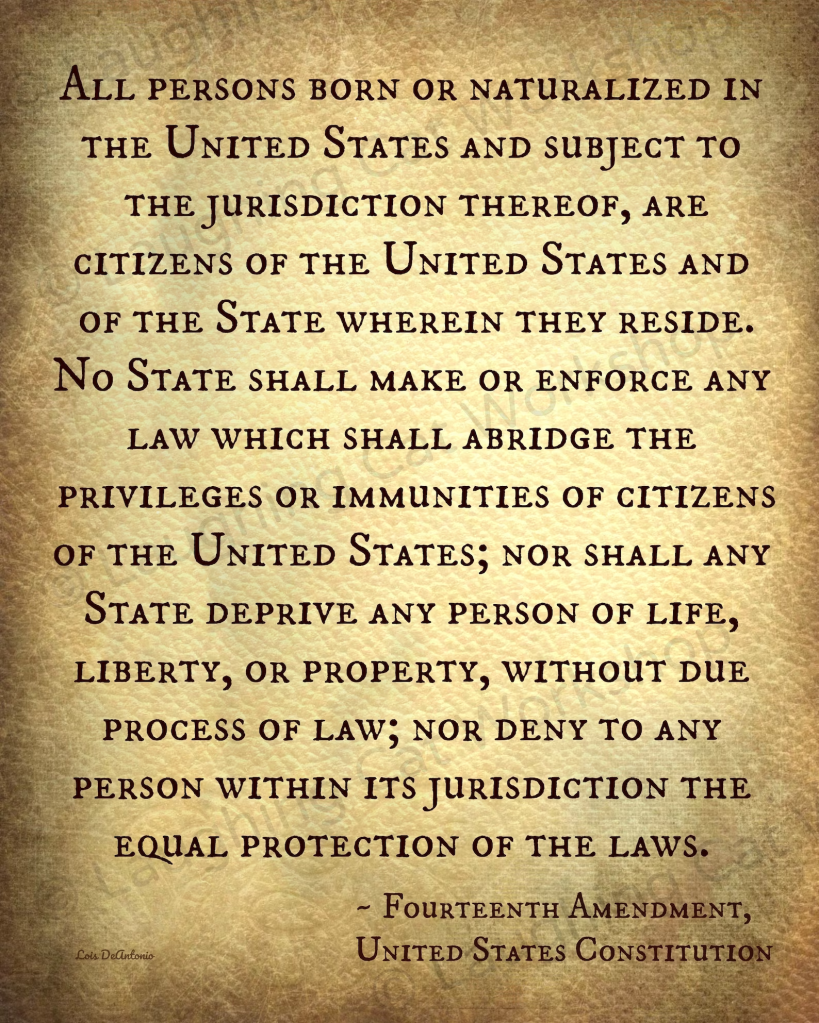
1866 – 14th Amendment


1866 – The 14th Amendment to the U.S. Constitution was passed by the U.S. Congress. It was ratified on July 9, 1868. The amendment was designed to grant citizenship to and protect the civil liberties of recently freed slaves. It did this by prohibiting states from denying or abridging the privileges or immunities of citizens of the United States, depriving any person of his life, liberty, or property without due process of law, or denying to any person within their jurisdiction the equal protection of the laws.

History… 6/13


1415 – Henry the Navigator, the prince of Portugal, embarked on an expedition to Africa.

1777 – The Marquis de Lafayette arrived in the American colonies to help with their rebellion against the British.

1789 – Ice cream was served to General George Washington by Mrs. Alexander Hamilton.

1825 – Walter Hunt patented the safety pin. Hunt then then sold the rights for $400.

1866 – The 14th Amendment to the U.S. Constitution was passed by the U.S. Congress. It was ratified on July 9, 1868. The amendment was designed to grant citizenship to and protect the civil liberties of recently freed slaves. It did this by prohibiting states from denying or abridging the privileges or immunities of citizens of the United States, depriving any person of his life, liberty, or property without due process of law, or denying to any person within their jurisdiction the equal protection of the laws.

1888 – The U.S. Congress created the Department of Labor.

1898 – The Canadian Yukon Territory was organized.

1900 – China’s Boxer Rebellion against foreigners and Chinese Christians erupted into violence.

1912 – Captain Albert Berry made the first successful parachute jump from an airplane in Jefferson, Mississippi.

1920 – The U.S. Post Office Department ruled that children may not be sent by parcel post.

1922 – Charlie Osborne started the longest attack on hiccups. He hiccuped over 435 million times before stopping. He died in 1991, 11 months after his hiccups ended.

1923 – The French set a trade barrier between the occupied Ruhr and the rest of Germany.

1927 – Charles Lindbergh was honored with a ticker-tape parade in New York City.

1927 – For the first time, an American Flag was displayed from the right hand of the Statue of Liberty.

1940 – Paris was evacuated before the German advance on the city.

1943 – German spies landed on Long Island, New York. They were soon captured.

1944 – Germany launched 10 of its new V1 rockets against Britain from a position near the Channel coast. Of the 10 rockets only 5 landed in Britain and only one managed to kill (6 people in London).

1944 – Marvin Camras patented the wire recorder.

1949 – Bao Dai entered Saigon to rule Vietnam. He had been installed by the French.

1951 – U.N. troops seized Pyongyang, North Korea.

1966 – The landmark “Miranda v. Arizona” decision was issued by the U.S. Supreme Court. The decision ruled that criminal suspects had to be informed of their constitutional rights before being questioned by police.

1967 – Solicitor General Thurgood Marshall was nominated by President Lyndon B. Johnson to become the first black justice on the U.S. Supreme Court.

1971 – The New York Times began publishing the “Pentagon Papers”. The articles were a secret study of America’s involvement in Vietnam.

1978 – Israelis withdrew the last of their invading forces from Lebanon.

1979 – Sioux Indians were awarded $105 million in compensation for the U.S. seizure in 1877 of their Black Hills in South Dakota.

1983 – The unmanned U.S. space probe Pioneer 10 became the first spacecraft to leave the solar system. It was launched in March 1972. The first up-close images of the planet Jupiter were provided by Pioneer 10.

1988 – The Liggett Group, a cigarette manufacturer, was found liable for a lung-cancer death. They were, however, found innocent by the federal jury of misrepresenting the risks of smoking.

1989 – The Detroit Pistons won their first National Basketball Association title. They beat the L.A. Lakers in four games.

1989 – U.S. President George H.W. Bush exercised his first Presidential veto on a bill dealing with minimum wage.

1992 – Future U.S. President Bill Clinton criticized rap singer Sister Souljah for making remarks “filled with hatred” towards whites.

1994 – A jury in Anchorage, Alaska, found Exxon Corp. and Captain Joseph Hazelwood to be reckless in the Exxon Valdez oil spill.

1995 – France announced that they would conduct eight more nuclear tests in the South Pacific.

2000 – In Pyongyang, North Korea’s leader Kim Jong Il welcomed South Korea’s President Kim Dae for a three-day summit. It was the first such meeting between the leaders of North and South Korea.

on-this-day.com

politics,pollution,petitions,pop culture & purses