Jimi Hendrix, (November 1942-1970)


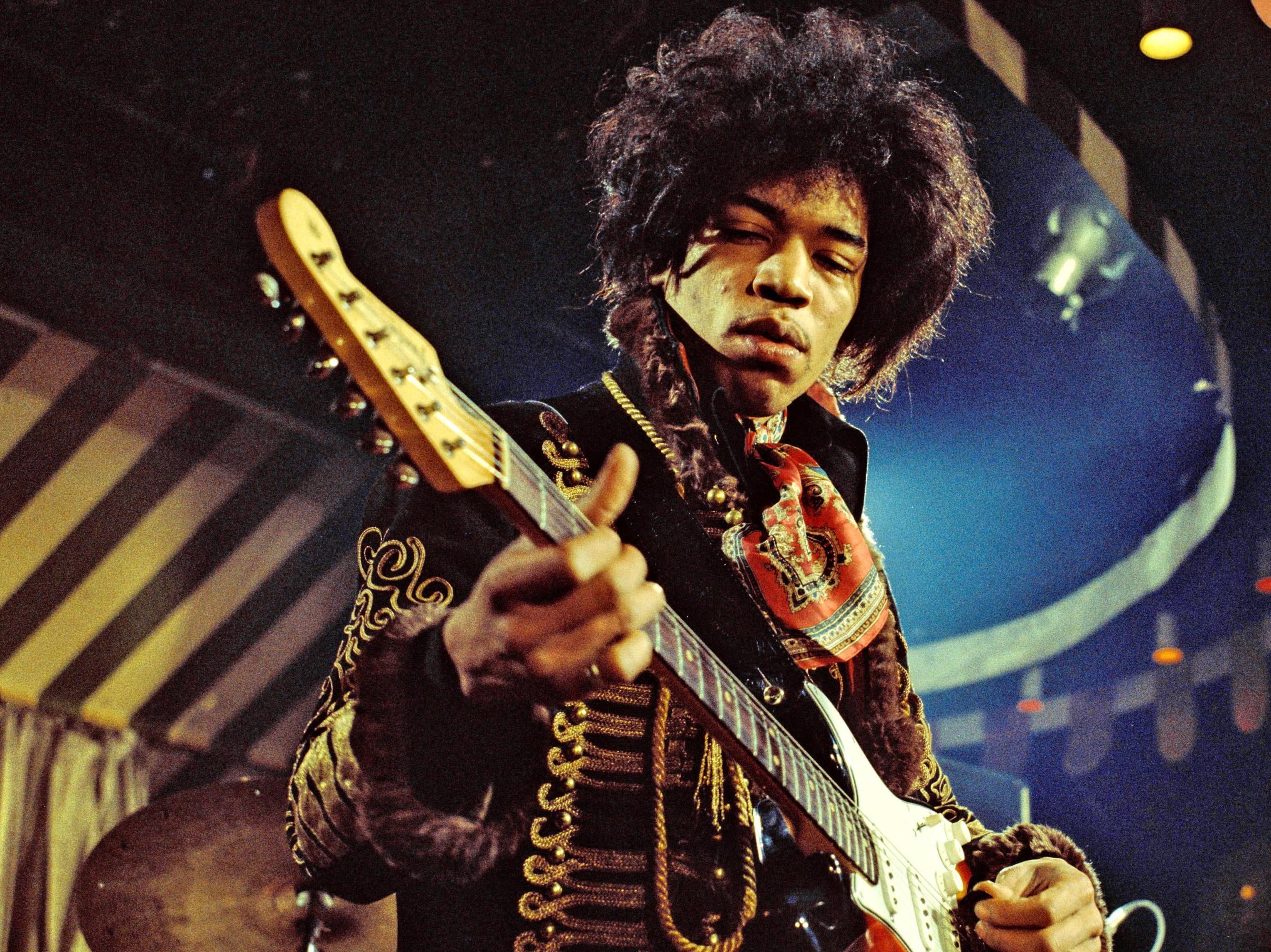
On September 18, 1970, 27-year-old rock superstar Jimi Hendrix is found unresponsive by a girlfriend inside London’s Samarkand Hotel in London, England. The guitarist is declared dead on arrival at a local hospital, and a post-mortem finds that he asphyxiated on his own vomit after overdosing on sleeping pills and alcohol.

Sources: youtube, history.com

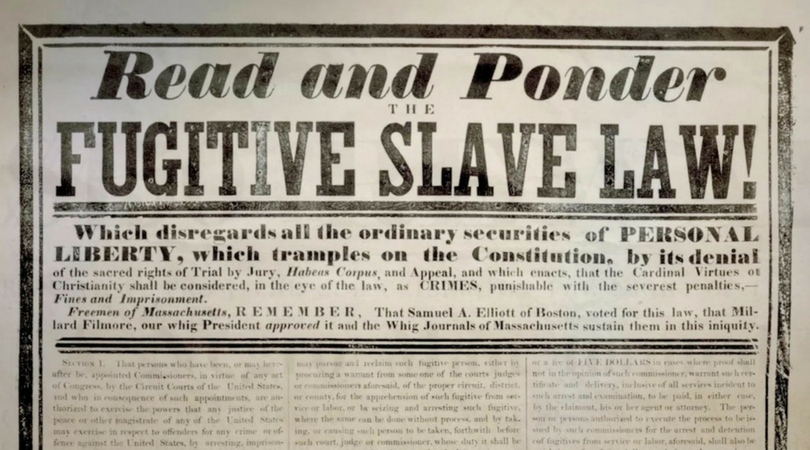
On 9/18/1850 – The Fugitive Slave Act was declared by the U.S. Congress. The act allowed slave owners to claim slaves that had escaped to other states.


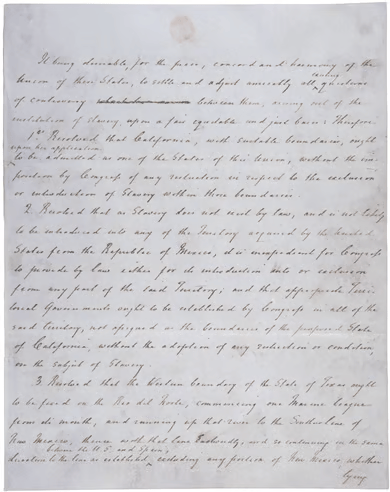
On 1/29/1850 – Henry Clay introduced in the Senate a * Compromise of 1850 Bill* on slavery that included the admission of California into the Union as a free state. 1850 Senator Henry Clay drafted the Compromise of 1850 to defuse tensions between slave states and free states over territories won during the Mexican–American War

Image result for When was the Fugitive Slave Act passed and what were the consequences of this law?

Passed on September 18, 1850 by Congress, The Fugitive Slave Act of 1850 was part of the Compromise of 1850. The act required that slaves be returned to their owners, even if they were in a free state. The act also made the federal government responsible for finding, returning, and trying escaped slaves.

Sources: battlefields.org , on-this-day.com

Henry Clay's handwritten draft of one of the bills that formed the Compromise of 1850
Henry Clay’s handwritten draft of one of the bills that formed the Compromise of 1850

The American Civil War devastated much of the country between 1861 and 1865, but the conflict could have actually happened much sooner. In 1850, a major dispute between slave states and free states arose regarding the status of lands acquired after the Mexican-American War (1846-48).

Many Southern states wanted to expand slavery into these new territories, which was opposed by the Northerners. These disputes, and others relating to the territorial expansion of the state of Texas. In early 1850, senator Henry Clay drafted a compromise that included the admission of California as a free state, the cession by Texas of some of its northern and western territorial claims in return for debt relief, the establishment of New Mexico and Utah territories, a ban on the importation of slaves into the District of Columbia for sale, and a more stringent fugitive slave law.

The compromise initially failed to gain wide support, but after President Zachary Taylor died, his successor Millard Fillmore and Democratic senator Stephen Douglas took the lead in passing Clay’s compromise through Congress as a series of five bills. The tensions were diffused, and the risk of conflict in the immediate term ended, but the debate over slavery did not end. Many years of controversy and debate eventually led to the secession of the Southern states and the Civil War in 1861.

Document Info

Author(s): Henry Clay
Location signed: USA

Source: National Archives

Related Events

  • 1850-01-29 Senator Henry Clay drafts the Compromise of 1850 to defuse tensions between slave states and free states over territories won during the Mexican–American War
  • 1850-03-07 Daniel Webster endorses the Compromise of 1850
  • 1850-09-18 US Congress passes Fugitive Slave Law as part of Compromise of 1850

onthisday.com

Second Battle of Gaza begins


As the major Allied offensive masterminded by Robert Nivelle was failing miserably on the Western Front, British forces in Palestine make their second attempt to capture the city of Gaza from the Ottoman army on April 17, 1917.

In the wake of the failed British assault on Gaza of March 26, 1917, Sir Archibald Murray, commander of British forces in the region, misrepresented the battle as a clear Allied victory, claiming Turkish losses to be triple what they actually were; in truth, at 2,400 they were significantly lower than the British total of 4,000. This led London’s War Office to believe their troops were on the verge of a significant breakthrough in Palestine and to order Murray to renew the attack immediately.

Though the previous assault had caught the Turks by surprise, the second one did not: the German general in charge of the troops at Gaza, Friedrich Kress von Kressenstein, was by now well aware of British intentions. By the time the British launched their second round of attacks on April 17, the Turks had accordingly strengthened their defenses and extended their forces along the road from Gaza to the nearby town of Beersheba.

Still, as in the First Battle of Gaza, British soldiers outnumbered Turkish troops by a ratio of two to one. Moreover, the British employed eight heavy Mark-1 tanks and 4,000 gas shells (used for the first time on the Palestine front) to ensure victory. The tanks proved unsuitable for the hot, dry desert conditions; however, three of them were captured by Turkish forces, which again put up a blisteringly effective defense despite their inferior numbers. After three days and heavy losses—the British casualty figure, of 6,444 men, was three times that of the Turks—Murray’s subordinate commander, Sir Charles Dobell, was forced to call off the British attacks, ending the Second Battle of Gaza with the city still firmly in Turkish control.

As a result of this second failure to capture Gaza, the Allies called in reinforcements, including Italian and French troops, which arrived from Europe in time to join the third and final Battle of Gaza that fall. Under the new regional command of Sir Edmund Allenby, the Allies finally broke through and gained control of Gaza in November 1917, leaving them free to move ahead toward Palestine’s capital city, Jerusalem, which fell into Allied hands on December 9.

Source: history.com

What is Ocean Acidification?


SalmonAcidification

The Chemistry

When carbon dioxide (CO2) is absorbed by seawater, chemical reactions occur that reduce seawater pH, carbonate ion concentration, and saturation states of biologically important calcium carbonate minerals. These chemical reactions are termed “ocean acidification” or “OA” for short. Calcium carbonate minerals are the building blocks for the skeletons and shells of many marine organisms. In areas where most life now congregates in the ocean, the seawater is supersaturated with respect to calcium carbonate minerals. This means there are abundant building blocks for calcifying organisms to build their skeletons and shells. However, continued ocean acidification is causing many parts of the ocean to become undersaturated with these minerals, which is likely to affect the ability of some organisms to produce and maintain their shells.

Since the beginning of the Industrial Revolution, the pH of surface ocean waters has fallen by 0.1 pH units. Since the pH scale, like the Richter scale, is logarithmic, this change represents approximately a 30 percent increase in acidity. Future predictions indicate that the oceans will continue to absorb carbon dioxide and become even more acidic. Estimates of future carbon dioxide levels, based on business as usual emission scenarios, indicate that by the end of this century the surface waters of the ocean could be nearly 150 percent more acidic, resulting in a pH that the oceans haven’t experienced for more than 20 million years.

The Biological Impacts

Ocean acidification is expected to impact ocean species to varying degrees. Photosynthetic algae and seagrasses may benefit from higher CO2 conditions in the ocean, as they require CO2 to live just like plants on land. On the other hand, studies have shown that a more acidic environment has a dramatic effect on some calcifying species, including oysters, clams, sea urchins, shallow water corals, deep sea corals, and calcareous plankton. When shelled organisms are at risk, the entire food web may also be at risk. Today, more than a billion people worldwide rely on food from the ocean as their primary source of protein. Many jobs and economies in the U.S. and around the world depend on the fish and shellfish in our oceans.


Pteropods

The pteropod, or “sea butterfly”, is a tiny sea creature about the size of a small pea. Pteropods are eaten by organisms ranging in size from tiny krill to whales and are a major food source for North Pacific juvenile salmon. The photos below show what happens to a pteropod’s shell when placed in sea water with pH and carbonate levels projected for the year 2100. The shell slowly dissolves after 45 days.  Photo credit: David Liittschwager/National Geographic Stock. Used with permission. All rights reserved. National Geographic Images.

Pteropod image showing acidification results


Shellfish

Freshly harvested oysters from Yaquina Bay, Oregon

In recent years, there have been near total failures of developing oysters in both aquaculture facilities and natural ecosystems on the West Coast. These larval oyster failures appear to be correlated with naturally occurring upwelling events that bring low pH waters undersaturated in aragonite as well as other water quality changes to nearshore environments. Lower pH values occur naturally on the West Coast during upwelling events, but a recent observations indicate that anthropogenic CO2 is contributing to seasonal undersaturation. Low pH may be a factor in the current oyster reproductive failure; however, more research is needed to disentangle potential acidification effects from other risk factors, such as episodic freshwater inflow, pathogen increases, or low dissolved oxygen. It is premature to conclude that acidification is responsible for the recent oyster failures, but acidification is a potential factor in the current crisis to this $100 million a year industry, prompting new collaborations and accelerated research on ocean acidification and potential biological impacts.

Photo: Freshly harvested oysters from Yaquina Bay, Oregon (Credit: NOAA)


Coral

Many marine organisms that produce calcium carbonate shells or skeletons are negatively impacted by increasing CO2 levels and decreasing pH in seawater. For example, increasing ocean acidification has been shown to significantly reduce the ability of reef-building corals to produce their skeletons. In a recent paper, coral biologists reported that ocean acidification could compromise the successful fertilization, larval settlement and survivorship of Elkhorn coral, an endangered species. These research results suggest that ocean acidification could severely impact the ability of coral reefs to recover from disturbance. Other research indicates that, by the end of this century, coral reefs may erode faster than they can be rebuilt. This could compromise the long-term viability of these ecosystems and perhaps impact the estimated one million species that depend on coral reef habitat.  For more information on the impact of ocean acidification on coral, see NOAA’s Coral Reef Watch website.

Ocean Acidification: An Emerging Global Problem

Ocean acidification is an emerging global problem. Over the last decade, there has been much focus in the ocean science community on studying the potential impacts of ocean acidification. Since sustained efforts to monitor ocean acidification worldwide are only beginning, it is currently impossible to predict exactly how ocean acidification impacts will cascade throughout the marine food chain and affect the overall structure of marine ecosystems. With the pace of ocean acidification accelerating, scientists, resource managers, and policymakers recognize the urgent need to strengthen the science as a basis for sound decision making and action.

~ NOAA