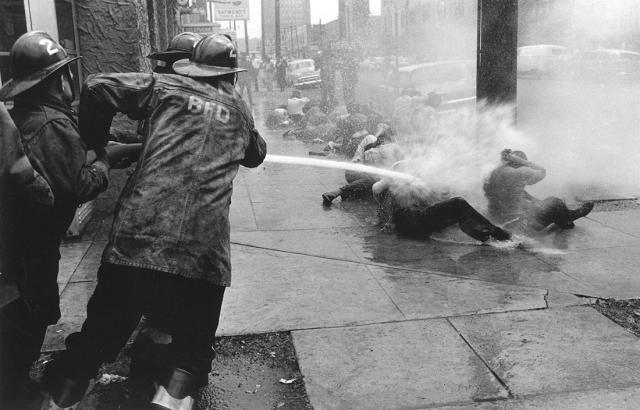
1963 – Police used dogs and cattle prods on peaceful civil rights demonstrators in Birmingham, AL.


Firemen turn fire hoses on demonstrators, Birmingham, Alabama, 1963Photo by Charles Moore. Fair Use Image CONTRIBUTED BY: SAMUEL MOMODU

The Birmingham Campaign was a movement led in early 1963 by the Southern Christian Leadership Conference (SCLC) which sought to bring national attention of the efforts of local black leaders to desegregate public facilities in Birmingham, Alabama. The campaign was led by Dr. Martin Luther King Jr. and Reverends James Bevel and Fred Shuttlesworth, among others.

In April 1963, King and the Southern Christian Leadership Conference (SCLC) joined Birmingham’s local campaign organized by Rev. Shuttlesworth and his group, the Alabama Christian Movement for Human Rights (ACMHR). The goal of the local campaign was to attack the city’s segregation system by putting pressure on Birmingham’s merchants during the Easter season, the second biggest shopping season of the year. When that campaign stalled, the ACMHR asked SCLC to help.

The campaign was originally scheduled to begin in early March 1963 but was postponed until April. On April 3, 1963, it was launched with mass meetings, lunch counter sit-ins, a march on city hall, and a boycott of downtown merchants. King spoke to Birmingham’s black citizens about nonviolence and its methods and appealed for volunteers. When Birmingham’s residents enthusiastically responded, the campaign’s actions expanded to kneel-ins at churches, sit-ins at the library, and a march on the county courthouse to register voters.

On April 10, 1963, the city government obtained a state court injunction against the protests. After debate, campaign leaders decided to disobey the court order. King contemplated whether he and Ralph Abernathy—SCLC’s second-in-command—should be arrested. King decided that he must risk jail. On Good Friday, April 12, 1963, King was arrested in Birmingham after violating the anti-protest injunction and was placed in solitary confinement. During this time, he wrote “Letter from Birmingham Jail” on the margins of the Birmingham News, in reaction to a statement published by eight Birmingham clergymen condemning the protests.

blackpast.org

Confederate History Month…or something else? things to remember


UNDER THE RADAR

From ThinkProgress

RADICAL RIGHT — MCDONNELL: SLAVERY WASN’T ‘SIGNIFICANT’ ENOUGH TO BE INCLUDED IN MY CONFEDERACY PROCLAMATION: TP

Last week, Virginia Gov. Bob McDonnell (R) “quietly declared April 2010 Confederate History Month,” calling on Virginians to, among other things, “understand the sacrifices of the Confederate leaders, soldiers and citizens during the period of the Civil War.” Notably absent from the proclamation, however, is any mention of slavery. McDonnell explained yesterday that he did not reference slavery because he focused on the issues that he “thought were most significant for Virginia.”

Neither of Virginia’s previous two governors, Democrats Mark Warner and Tim Kaine, declared a Confederate History Month. Republican governor Jim Gilmore, who served from 1998-2002, did issue such proclamations but acknowledged slavery as “one of the causes of the war” and a practice that “degraded the human spirit” and “is abhorred and condemned by Virginians.” For his final proclamation in 2001, Gilmore replaced Confederate History Month with “a tribute to both black and white Civil War combatants that expressly denounces slavery as the root cause of the four-year conflict.” Gilmore’s predecessor, Republican George Allen, started the practice of Confederate History Month. He didn’t include slavery in his proclamation and, under significant pressure from civil rights leaders, eventually apologized.

As the Richmond Times-Dispatch reported on April 12, 1997, Allen said, “Surely, I don’t want to upset anyone.

For those who are sincerely offended…I apologize.”

The American Prospect’s Adam Serwer writes that McDonnell’s proclamation is “telling” because “it reveals which Virginians he feels are ‘significant.'”

Why did trump want to allow Employers to deny Women Birth Control


just another ongoing rant …

A trump idea and or a  allowing employers to coverage as part of their health insurance for any religious or moral reason is beyond my understanding, especially since this attitude is bumping up against 98% of the women in this country who choose and use reproductive products sometime during their lives … including Catholics! btw

Does he know, do Republicans in Congress know or care about the statistics regarding “unsafe abortions?”

It would be nice for voters to know if these people even care about providing an affordable safe place for any health procedures because Planned Parenthood is not just about abortions …planned
parenthood allows women&men btw to get help, referrals, information, and or procedures provided by a doctor.  And FYI: No woman advocates for abortion, but there are legit reasons to exercise your rights and no person should get in between a woman and her doctor …we should all want women to have a choice, preferably use any and all safe birth control for family planning and what seems to be left out of all of this … Not that anyone needs a reminder, but sometimes republicans seem to need them quite often

… hey folks, it takes two to engage in sex so what part or role do men have in any of this nonsense, are folks just plain’ole stupid or is it a higher standard that Republicans seem to push upon women?   It makes you wonder if republican men don’t think about having to experience any of this ish because most feel ….well, as of late politicians show it with comments on the floor of Congress and then vote the reality of their privileged lives …   Not how the average American is living in this era of trump

1924 South African State pass the Industrial Conciliation Act No 11: provides for job reservation, excluded blacks from membership of registered trade unions, prohibited registration of black trade unions


In 1924, the Industrial Conciliation Act was enacted by the South African Parliament. This legislation aimed to address industrial disputes by establishing negotiation mechanisms. Here are the key provisions:

  1. Trade Unions: Employees were permitted to form trade unions. These unions would undergo approval, recognition, and registration processes.
  2. Industrial Councils: Trade unions could then be represented on industrial councils.
  3. Conciliation Process: Before a strike could occur, a process of conciliation was mandated.
  4. Exclusion of Black Workers: Unfortunately, workers “regulated by any Native Pass Laws and regulations” (which primarily referred to Black workers) were excluded from the definition of workers. Consequently, they were not allowed to join unions1.

This act significantly impacted the rights and representation of workers in South Africa during that era. It’s essential to recognize the historical context and the discriminatory practices that shaped labor relations at the time.

For more detailed information, you can refer to the work by Kiloh and Sibeko titled “A Fighting Union” 1. Although this legislation has been repealed, its legacy remains a part of South Africa’s complex history.

Source: BingAI

politics,pollution,petitions,pop culture & purses