

1960 – The U.S. Senate passed the Civil Rights Bill –
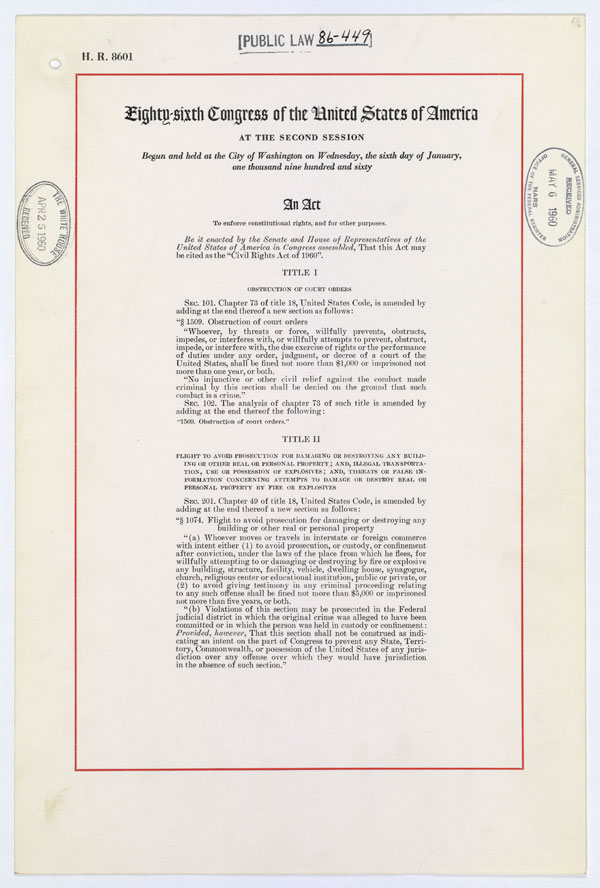
credit: Civil Rights Act of 1960; RG 11, General Records of the United States Government

It was designed to deal with discriminatory laws and practices in the segregated South, by which blacks and Mexican Texans had been effectively disenfranchised since the late 19th and start of the 20th century. It extended the life of the Civil Rights Commission, previously limited to two years, to oversee registration and voting practices. The act was signed into law by President Dwight D. Eisenhower and served to eliminate certain loopholes left by the Civil Rights Act of 1957.
The final vote in the House of Representatives was 311–109 (132–15 in the House Republican Conference and 179–93 in the House Democratic Caucus) with 11 members voting present or abstaining, while in the Senate the final vote was 71–18 (29–0 in the Senate Republican Conference and 42–18 in the Senate Democratic Caucus) with 11 members voting present or abstaining.
Wikipedia · Text under CC-BY-SA license
Share this:

1987 – Live models were used for the first time in Playtex bra ads

By BRUCE HOROVITZ
APRIL 21, 1987 12 AM PT
TIMES STAFF WRITER
Brassieres, which haven’t made much news since some were symbolically burned two decades ago, are historical footnotes again. Television advertisements for some bras will soon use models instead of manikins.
On May 4, NBC is scheduled to air an ad for the Playtex-made Cross Your Heart bra, which shows a woman wearing the product. This brings to an end the decades-old ban by the networks on commercials that show models in their underwear.
“I don’t see why it should be taboo to show a woman in a bra,” said Hercules P. Sotos, vice-chairman of International Playtex, the Stamford, Conn.-based manufacturer. “It’s much more effective in showing the product’s attributes than a manikin.”
Playtex is not alone. In a soon-to-be-aired television ad campaign for men’s underwear, Fruit of the Loom has hired a male model to wear briefs. Both the $4-million Playtex campaign and the Fruit of the Loom campaign were devised by Grey Advertising.
Share this:

Covid19 Recovery Phases – Healthy washington
by Lucas Combos

State leaders will examine each county’s status Monday and announce the results Tuesday. Last week, the Washington State Department of Health said more than a dozen counties looked at or near the thresholds to trigger a rollback to Phase 2. Counties that fail the metrics of their current phase will have to roll back by Friday.
Phase 2 allows for fewer people in most indoor spaces, cutting capacity for most businesses from 50 to 25 percent, and is likely to put more strict limits on the number of spectators allowed at professional sporting events.

For the complete article go to: patch.com
Share this:

1937 – Margaret Mitchell won a Pulitzer Prize for “Gone With The Wind.” ~ In the Library “Gone with the Wind”
 Margaret Mitchell’s Gone with the Wind, one of the best-selling novels of all time and the basis for a blockbuster 1939 movie, is published on this day in 1936.In 1926, Mitchell was forced to quit her job as a reporter at the Atlanta Journal to recover from a series of physical injuries. With too much time on her hands, Mitchell soon grew restless. Working on a Remington typewriter, a gift from her second husband, John R. Marsh, in their cramped one-bedroom apartment, Mitchell began telling the story of an Atlanta belle named Pansy O’Hara.In tracing Pansy’s tumultuous life from the antebellum South through the Civil War and into the Reconstruction era, Mitchell drew on the tales she had heard from her parents and other relatives, as well as from Confederate war veterans she had met as a young girl. While she was extremely secretive about her work, Mitchell eventually gave the manuscript to Harold Latham, an editor from New York’s MacMillan Publishing. Latham encouraged Mitchell to complete the novel, with one important change: the heroine’s name. Mitchell agreed to change it to Scarlett, now one of the most memorable names in the history of literature.
Published in 1936, Gone with the Wind caused a sensation in Atlanta and went on to sell millions of copies in the United States and throughout the world. While the book drew some criticism for its romanticized view of the Old South and its slaveholding elite, its epic tale of war, passion and loss captivated readers far and wide. By the time Mitchell won the Pulitzer Prize for Fiction in 1937, a movie project was already in the works. The film was produced by Hollywood giant David O. Selznick, who paid Mitchell a record-high $50,000 for the film rights to her book.
After testing hundreds of unknowns and big-name stars to play Scarlett, Selznick hired British actress Vivien Leigh days after filming began. Clark Gable was also on board as Rhett Butler, Scarlett’s dashing love interest. Plagued with problems on set, Gone with the Wind nonetheless became one of the highest-grossing and most acclaimed movies of all time, breaking box office records and winning nine Academy Awards out of 13 nominations.
Though she didn’t take part in the film adaptation of her book, Mitchell did attend its star-studded premiere in December 1939 in Atlanta. Tragically, she died just 10 years later, after she was struck by a speeding car while crossing Atlanta’s Peachtree Street. Scarlett, a relatively unmemorable sequel to Gone with the Wind written by Alexandra Ripley, was published in 1992.
history.com


You must be logged in to post a comment.