

** Tayto fined after large Salmonella outbreak
More than 500 people sickened in outbreak traced to snack food
** A recall of Pillsbury pizza pops in Canada has been expanded as the patient count in a related outbreak continues to grow. https://t.co/K1SPryLZVE
** Gerber expands recall of arrowroot biscuits to Canada
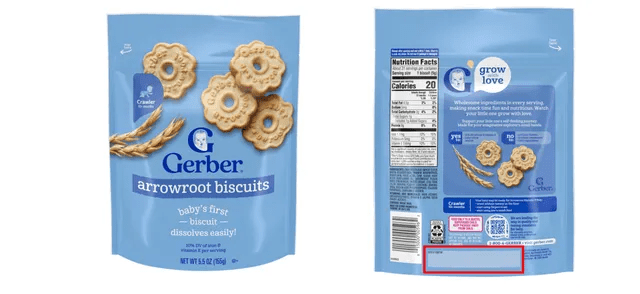
Gerber Products Company is recalling batches of Gerber Arrowroot Biscuits in Canada because of the potential presence of soft plastic and/or paper pieces that should not be consumed
** Left Coast Organics brand organic chia seeds have been recalled in Canada because of Salmonella contamination. https://t.co/Gpe8aNFPOU
** Recalled tuna sent to stores by FSN
Tri-Union Seafoods is cautioning consumers that a third-party distributor inadvertently released quarantined product that was associated with a February 2025 recall. The initial recall was conducted following notification from the
**
**IKM of San Jose, California is recalling the following cookware items because they may be contaminated with significant levels of lead (Pb) which may leach into food. No illnesses have been reported to date.
Consumers who have purchased the recalled products are urged to return them to the place of purchase for a full refund. Consumers with questions may contact the company at 1-650-695- 9009. Our operation hours are from 10:00 from 17:00 PST Mon-Fri, excluding national holidays.
– IKM Aluminum saucepan wooden handle 9” (56 pcs)
– A-cook Aluminum Kadai size 5 (43 pcs)
– Brass Tope (10 pcs)
– IKM 4-quart Pital brass pot (9 pcs)
** Navitas Organics is voluntarily recalling select lots of its 8oz Organic Chia Seeds due to possible Salmonella contamination. This recall is being conducted as a precautionary measure following a recall initiated by the company’s chia seed supplier.
Product was distributed nationally through retail stores such as Whole Foods Market and online retailers including Amazon. The recall applies to the following product packaged in sealed stand-up pouches:
W31025317 – Best If Used By: End MAY 2027
Navitas Organics – Organic Chia Seeds, 8oz, UPC 858847000284
Lot Codes (9-digit codes starting with “W”) are printed on the back of the chia seed bag above the nutritional information. The Lot Codes included in this recall are:
W31025283 – Best If Used By: End APR 2027
W31025286 – Best If Used By: End APR 2027
W31025287 – Best If Used By: End APR 2027
W31025311 – Best If Used By: End MAY 2027
W31025314 – Best If Used By: End MAY 2027
W31025315 – Best If Used By: End MAY 2027
W31025316 – Best If Used By: End MAY 2027
**
** Gregory’s Foods, Inc. of Eagan, MN is recalling its 2-pound 8.5-ounce packages of “Bag Full of Cookies” White Chocolate Macadamia Nut frozen cookie dough because some units may contain undeclared peanuts. Frozen Monster Cookie Dough, which contains Peanut, may be packaged in a bag that is labeled as White Chocolate Macadamia Nut. People who have allergies to peanuts run the risk of serious or life-threatening allergic reaction if they consume these products.
The recalled “Bag full of Cookies” White Chocolate Macadamia Nut frozen cookie dough was distributed in Minnesota, Wisconsin, and Nebraska in retail grocery stores and through distribution centers.
** IKM Recalls Product Because of Possible Health Risk
** Recent Recalls FSN
Panjiri, pinni and laddoo recalled because of undeclared milk
Chicken breasts recalled because of Listeria contamination
Cheese recalled because of Listeria contamination
Spring & Mulberry expands recall of chocolate bars over Salmonella concerns
Bread crumbs recalled because of undeclared milk, eggs
Sea moss gel recalled because of risk of botulism
Chocolate bars recalled after testing shows Salmonella contamination
** Superfoods Inc. dba Live it Up. Recalls Live it Up Super Greens Because of Possible Health Risk
The recall includes the following products:
Live it Up Super Greens, Wild Berry, 30 – 0.32oz (9g) Sticks, NET WT. 9.52oz (270g), with UPC 850077468070
Live it Up Super Greens, NET WT 8.5 oz (240g) with UPC 860013190804.
Live it Up Super Greens, 30 – 0.28oz (8g) sticks, NET WT. 8.47 oz (240g) with UPC 850077468063
Live it Up Super Greens, Wild Berry, NET WT 8.5OZ (240g), with UPC 860013190811
** This current recall was initiated after Tri-Union Seafoods discovered that quarantined cases, associated with the initial recall, were inadvertently shipped by a third-party distributor. The impacted products were distributed to limited retail stores as follows:
Safeway, Albertsons, Vons, and Pavilions – California Consumers can contact Tri-Union Seafoods at support@thaiunionhelp.zendesk.com or 833-374-0171, if they have any questions or to request replacement product. The toll-free number hours are Monday through Friday from 9:00 a.m. to 5:00 p.m. EST.
Meijer – Illinois, Indiana, Kentucky, Michigan, Ohio, and Wisconsin
Giant Foods – Maryland and Virginia
| Genova Yellowfin Tuna in Olive Oil 5.0 oz 4 Pack | 4800073265 | S84N D2L | 1/21/2028 |
| S84N D3L | 1/24/2028 | ||
| Genova Yellowfin Tuna in in Extra Virgin Olive Oil with Sea Salt 5.0 oz | 4800013275 | S88N D1M | 1/17/202 |
** Recent Recalls FSN – by News Desk
Sea moss gel recalled because of risk of botulism
Diva Fam Inc. is recalling all lots and flavors of its Sea Moss Gel Superfood because of the lack of required regulatory authorization and temperature monitoring records for pH-controlled food
Chicken breasts recalled because of Listeria contamination
Suzanna’s Kitchen of Norcross, GA, is recalling 13,720 pounds of ready- to-eat grilled chicken breast fillet products that may be contaminated with Listeria monocytogenes, the USDA’s Food
E. coli outbreak traced to Pillsbury pizza pops; recall underway
NEW: Egg sheets recalled because of concerns about Salmonella
Massive recall due to rodent and bird feces
Ground beef recalled because of E. coli O26
NZ: Warning issued after cheese taken from landfill
** Jan. 16, 2026 – Suzanna’s Kitchen, a Norcross, Ga., establishment, is recalling approximately 13,720 pounds of ready- to-eat grilled chicken breast fillet products that may be adulterated with Listeria monocytogenes ( Lm), the U.S. Department of Agriculture’s Food Safety and Inspection Service (FSIS) announced…
Impacted Products
• 10-lb. cases containing two 5 lb. bags of fully cooked grilled chicken breast fillets with rib meat, with lot code 60104 P1382 287 5 J14 on the side of the case and on the package.
** The U.S. Food & Drug Administration (FDA) has announced a cheese recall impacting more than 1.5 million bags of shredded cheese. The recalled cheese was produced by Great Lakes Cheese Co. Inc. and may be contaminated with metal fragments.
Great Lakes Cheese Co. Inc. initially announced the recall in October, but the FDA classified it as “Class II,” meaning that eating the cheese “may cause temporary or medically reversible adverse health consequences,” on Dec. 1.
** Superfoods Inc. dba Live it Up. Recalls Live it Up Super Greens Because of Possible Health Risk
** Medical device correction impacts a subset of FreeStyle Libre 3 and Libre 3 Plus sensors
Consumers can visit www.FreeStyleCheck.comExternal Link Disclaimer to see if their sensors are affected and to get a replacement at no charge
Abbott has identified and resolved the manufacturing issue related to this device action
No other Libre family sensors, readers or apps are impacted http://www.freestylecheck.com/
** Ambriola, Locatelli, Member’s Mark, Pinna, and Boar’s Head
** The Ambriola Company Issues Recall of Cheese Products Because of Listeria Health Risk https://www.fda.gov/safety/recalls-market-withdrawals-safety-alerts/ambriola-company-issues-recall-cheese-products-because-listeria-health-risk#:~:text=No%20illnesses%20have,03/12/26
** Spring & Mulberry Issues Voluntary Recall of Mint Leaf Date Sweetened Chocolate Bar Due to Possible Salmonella Contamination. https://www.fda.gov/safety/recalls-market-withdrawals-safety-alerts/spring-mulberry-issues-voluntary-recall-mint-leaf-date-sweetened-chocolate-bar-due-possible
** LOS ANGELES, Jan. 9, 2026 – Diva Fam Inc. (“Diva Fam” or the “Company”) today (January 9, 2026) announced a voluntary recall of all lots and flavors of Sea Moss Gel Superfood due to lack of required regulatory authorization and temperature monitoring records for pH-controlled food products. https://www.fda.gov/safety/recalls-market-withdrawals-safety-alerts/diva-fam-inc-announces-voluntary-recall-sea-moss-gel-superfood-products-due-possible-health-risk
By News Desk
** Egg sheets recalled because of concerns about Salmonella
Si Ji Mei brand Wuhan Egg Sheets with Glutinous Rice are under recall in Canada because of potential contamination with Salmonella. The recall was triggered by the company, according to
By News Desk
** More than 20 poisonings, 1 death reported in California linked to wild mushrooms
The California Department of Public Health (CDPH) is issuing an urgent advisory following a recent outbreak of amatoxin poisoning linked to the consumption of wild, foraged mushrooms. Confirmed cases have
** Grated Pecorino Romano Cheese Recall:
** A recall on Ore-ida and Sysco Imperial Tater-Tots for plastic contamination.
To date, there have been no reported injuries or illnesses associated with this recall, and it is currently unclear how the products became contaminated. Clear hard plastic fragments:McCain Foods USA Inc. Ore-Ida Tater Tots potatoes with the UPC code 1 00 72714 00215 8
Sysco Imperial Potato Tater Barrel with the UPC code 1 07 34730 62740 0
The tater tots were distributed: CA, WA, AR,AZ,CO,FL,HI, IA, ID,IL,KS,KY,LA,MI,MN,MO,MS,MT,NE,NM,ND,NV,OR,TX,UT,WI
** The recalled product was directly distributed to the two retailers listed below, located IA and NJ , between April 2023 to December 2023 There were no online sales.
1.Golden Land (Des Moines)
2740 Douglas Ave
Des Moines IA 50310
Tel: 515-468-8224
2.Terri Lee Oriental Groceries.
225 Maywood Ave.
Maywood NJ 07607
Tel: 201-843-7919
The recalled [Klong Kone] Shimp Paste (Klong Kone) “454 G. (1 LBS)” and “910 G. (2 LBS),” is packaged in a white plastic jar with a red cap. The product is a dark-colored paste with a salty flavor. The product was Packed and Distributed By: P. Prateepthong 2000, Product of Thailand.
The recalled product was sold in two sizes:
- [Klong Kone] Shrimp Paste (Klong Kone) ‘454 G. (1 LBS)’ , with UPC: 8853142000313, Product Code: DPA159
- [Klong Kone] Shrimp Paste (Klong Kone) ‘910 G. (2 LBS)’ , with UPC: 8853142000320, Product Code: DPA161
To date, there has been one report of four children becoming ill, which involved diarrhea and elevated blood levels.
** Sonoma, CA — Primavera Nueva Inc. is voluntarily recalling certain lots of its 4-count tamales because the products have the potential to be contaminated with Listeria monocytogenes, an organism which can cause serious and sometimes fatal infections in young children, frail or elderly people, and others with weakened immune systems. Although healthy individuals may suffer only short-term symptoms such as high fever, severe headache, stiffness, nausea, abdominal pain and diarrhea, listeria infection can cause miscarriages and stillbirths among pregnant women.
Product was distributed by Primavera Nueva Inc. in California and Nevada to retail stores.
The following 4-count tamales, produced between October 10, 2024 and October 10, 2025 are included:
- Roasted Green Chile & Jack Cheese
- Black Bean Bonanza & Jack Cheese
- Butternut Squash w/ Roasted Green Chiles & Cheese
- BBQ Chipotle Bean & White Cheddar
- Mushroom Spinach & Salsa with Two Cheeses
- Roasted Green Chile
- Black Bean Bonanza
- Butternut Squash w/ Roasted Green Chiles
- Mushroom Spinach & Salsa
- Roasted Pumpkin & White Cheddar.
No other Primavera Nueva products are affected.
No illnesses have been reported to date. Primavera Nueva has fully corrected the issue—enhanced cooking-temperature monitoring and verification have been in place since October 11, 2025.
Consumer Guidance
Consumers who have tamales with date codes 10/22 (year 2024) – 10/22 (year 2025) should not consume the product and should discard it.
For questions, contact:
Araceli Santoyo — primaveranueva@aol.com
707 939 9350, Monday through Friday 9am to 3pm pacific
** Distilled Water Meijer Steam Distilled Water one-gallon jugs have been recalled by the FDA for containing a “floating black foreign substance.”
The affected product was sold at Meijer stores in Illinois, Indiana, Kentucky, Michigan, Ohio, and Wisconsin.
** Mountain West Food Group, LLC, a Heyburn, Idaho establishment, is recalling approximately 2,855 pounds of raw ground beef products that may be contaminated with E. coli O26, the U.S. Department of Agriculture’s Food Safety and Inspection Service (FSIS) announced today…
Impacted Products
• 16-oz. (1-lb.) vacuum-sealed packages containing “FORWARD FARMS GRASS-FED GROUND BEEF” with “USE OF FREEZE BY 01/13/26 EST 2083” printed on the side of the packaging.
2
Consumers are advised to dispose of the recalled ground beef or return it to the place of purchase. For further information, consumers can contact the USDA Meat and Poultry Hotline at 888-MPHotline (888-674-6854) or send a question via email to MPHotline@usda.gov
** CHIPS AHOY!
- Baked Bites Brookie products with Best When Used By Dates listed in the grid provided by Mondelēz Global LLC.
- Recall
- Expansion: An additional code date (10MAY2026) and two additional UPCs of product pouches were added to the recall.
- Reason for Recall: Incorrect mixing process resulted in the formation of small corn starch clumps, which could constitute a choking hazard.
- Consumer Advice: Consumers should not consume the affected products and are advised to contact Mondelēz Global LLC for more information.
- Contact Information: Consumers can contact Mondelz Global LLC at 1-855-535-5948 for details.
**





 Be a Seed for Change
You must be logged in to post a comment.