Tag Archives: black people

The Charleston Shooting … In memory of


By

Wednesday’s tragic murder of nine black parishioners in Charleston’s Emanuel African Methodist Episcopal Church by a 21-year-old white man wanting “to start a civil war” is weighing heavily on the hearts of all of us. We cannot begin to understand the grief felt by the families of those lost or the Charleston community. But we can speak about what we do know. This was a racist committing a racially motivated murder. This was another tragic example of how guns too easily fall into the hands of dangerous people. This was a terrorist act.

Here is a round-up of the columns and news that we are reading and talking about. We hope they foster and inform your conversations, reflections, and actions too:

1. Jelani Cobb in The New Yorker: Murders in Charleston. “We have, quite likely, found at 110 Calhoun Street, in Charleston, South Carolina, the place where Columbine, Aurora, and Newtown cross with Baltimore, Ferguson, and Sanford.”

2. Ta-Nehisi Coates in The Atlantic: Take Down the Confederate Flag—Now. “Moral cowardice requires choice and action. It demands that its adherents repeatedly look away, that they favor the fanciful over the plain, myth over history, the dream over the real. Here is another choice. Take down the flag. Take it down now.”

3. Jeff Duo in the Washington Post: The legal loophole that allowed Dylann Roof to get a gun. “Dylann Roof, the man accused of a shooting spree that left nine people dead at a historic black church in Charleston on Wednesday night, should not have been able to get a gun.”

4. Jamelle Bouie in Slate: The Black American Holiday Everyone Should Celebrate but Doesn’t. “Juneteenth isn’t just a celebration of emancipation, it’s a celebration of our commitment to make it real.”

5. Jennifer Mascia in The Trace: Charleston Area Faced Gun Violence Spike Before Church Shooting. “Nearly eight out of every 10 killings in the area last year involved a firearm.”

6. Dan Wasserman’s editorial cartoon in The Boston Globe:

wasserman charleston

CREDIT: Dan Wasserman

And be sure to check out the latest news and opinions from our partners at ThinkProgress:

1. Judd Legum: NRA Board Member Blames Charleston Victim For His Own Death. Seriously.

2. Ian Millhiser: When John Roberts Said There Isn’t Enough Racism In America To Justify The Voting Rights Act. It’s a sordid business, this divvying up the amount of racism in the United States to decide whether Congress is allowed to enact laws intended to fix it.

3. Jack Jenkins: How The Charleston Shooting Is Linked To The Confederate Flag, According To A South Carolinian. While the Confederate flag is certainly about heritage, it is and always has been about hate.

4. Kiley Kroh: Charleston Victim’s Son Addresses Media On The Baseball Field. “Love is always stronger than hate. So if we just love the way my mom would, then the hate won’t be anywhere close to where the love is.”

Wishing you a safe and peaceful weekend.

Anniversary of Brown v. Board of Education of Topeka – remember Black History


Posted by Robin Caldwel

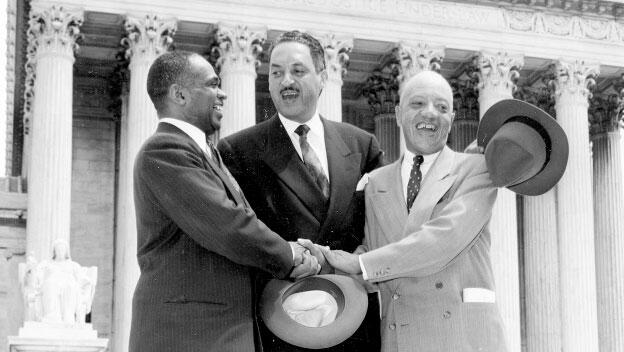
On May 17, 1954, Supreme Court under Chief Justice Earl Warren rendered a unanimous, landmark decision (9-0) declaring that state laws establishing separate public schools for black and white students and denying black children equal educational opportunities unconstitutional. The Brown v. the Board of Education of Topeka ruling overturned previous “separate but equal” rulings, including the 1896 decision, Plessy v. Ferguson. In effect, separation by race de jure (by law) violated the Equal Protection Clause of the Fourteenth Amendment of the United States Constitution.

In 1951, thirteen Topeka parents filed the class action lawsuit on behalf of their 20 children in the United States District Court for the district of Kansas. Leaders of the Topeka NAACP recruited the plaintiffs with Oliver Brown as the named plaintiff in the suit. The contention was that the state of Kansas, essentially, did not comply with separate but equal facilities for black and white children. Oliver Brown’s daughter, Linda, had to walk 6 blocks to catch a school bus that took her to the black elementary school 1 mile from their neighborhood, while a white elementary school was only seven blocks from the Browns’ home. Brown tried to register Linda at the school but was rejected. The Brown lawsuit was presented before the Supreme Court on appeal along with other suits representing plaintiffs in Washington, D. C., Virginia, South Carolina and Delaware.

The plaintiffs by name are as follows: Oliver Brown, Darlene Brown, Lena Carper, Sadie Emmanuel, Marguerite Emerson, Shirley Fleming, Zelma Henderson, Shirley Hodison, Maude Lawton, Alma Lewis, Iona Richardson, and Lucinda Todd.

Chief counsel for the NAACP, Thurgood Marshall, argued the case before the Supreme Court.

Patrik Henry Bass … Book recommendations


thefaces

Essence in-house  reviewer

discovers …


The Heiress – The Richest 11 yr old Black Girl in America

Searching for Sarah Rector … Abrams Books for young Readers

author Tonya Bolden recounts a gripping tale of Rector

*********************

Lost & Found – American Cocktail: A”Coloured Girl” in the World

Harvard Univ Press … Memoir of Anita Reynolds

an irrepressible chameleon who rubbed shoulders with Harlem Renaissance literati, modeled for Coco Chanel and more

****************************************

Shameful Past

David Beasley’s shocking book …

Without Mercy … St. Martin’s Press

sheds light on 6 Black men who were electrocuted on a single day in December 1938 at the same prison

*******************************

The Truth

Black Stats … The New Press

The go to source for the 411 on Black folks

Monique W. Morris

breaks down the numbers on those working on green jobs to our incarceration rates … Did you know that in the five years before the Great Depression, Black owned businesses in the United States increased by 61%

Gov’t offers $680 million for Indian farmers …as reported by AP – Reminder


By MARY CLARE JALONICK, AP

WASHINGTON — The government is offering American Indian farmers who say they were denied farm loans a $680 million settlement.

Unlike a second round of the black farmers suit that is now pending in Congress, the American Indian money would not need legislative action to be awarded.

The two sides agreed on the deal after more than 10 months of negotiations. The government and the Indian plaintiffs met in federal court Tuesday to present the settlement to U.S. District Judge Emmet Sullivan.

The agreement also includes $80 million in farm debt forgiveness for the Indian plaintiffs and a series of initiatives to try and alleviate racism against American Indians and other minorities in rural farm loan offices. Individuals who can prove discrimination could receive up to $250,000.

A hearing on preliminary approval of the deal is set for Oct. 29. Sullivan indicated he was pleased with the agreement, calling it historic and coming down off his bench to shake hands with lawyers from both sides.

Assistant Attorney General Tony West and Joseph Sellers, lead attorney for the plaintiffs, both said they were encouraged by the judge’s positive reaction.

“Based on the court’s comments, we’re optimistic,” West said after the hearing adjourned.

The lawsuit filed in 1999 contends Indian farmers and ranchers lost hundreds of millions of dollars over several decades because they were denied USDA loans that instead went to their white neighbors. The government settled a similar lawsuit filed by black farmers more than a decade ago.

“Today’s settlement can never undo wrongs that Native Americans may have experienced in past decades, but combined with the actions we at USDA are taking to address such wrongs, the settlement will provide some measure of relief to those who have been discriminated against,” Agriculture Secretary Tom Vilsack said in a statement.

Claryca Mandan of North Dakota’s Three Affiliated Tribes, a plaintiff in the case, stopped ranching after she and her husband were denied loans in the early 1980s. She said she was pleased with the settlement.

“This is a culmination of 30 years of struggle,” she said

And Republicans continue to interfere and hurt POC who own land

FREEDOM RIDERS : A Stanley Nelson Film : American Experience – In memory


  Get Inspired

 The World Premiere: In 2010 at Sundance Film Festival, US

 A Documentary Competition

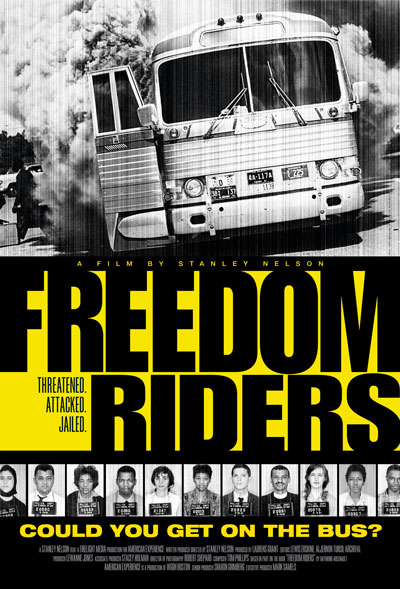
Award-winning filmmaker Stanley Nelson (Wounded Knee, Jonestown: The Life and Death of Peoples Temple, The Murder of Emmett Till) returns to the Sundance Film Festival with his latest documentary FREEDOM RIDERS, the powerful, harrowing and ultimately inspirational story of six months in 1961 that changed America forever. From May until November 1961, more than 400 black and white Americans risked their lives—and many endured savage beatings and imprisonment—for simply traveling together on buses and trains as they journeyed through the Deep South. Deliberately violating Jim Crow laws, the Freedom Riders’ belief in non-violent activism was sorely tested as mob violence and bitter racism greeted them along the way.

FREEDOM RIDERS features testimony from a fascinating cast of central characters: the Riders themselves, state and federal government officials, and journalists who witnessed the rides firsthand.

“I got up one morning in May and I said to my folks at home, I won’t be back today because I’m a Freedom Rider. It was like a wave or a wind that you didn’t know where it was coming from or where it was going, but you knew you were supposed to be there.” — Pauline Knight-Ofuso, Freedom Rider

Despite two earlier Supreme Court decisions that mandated the desegregation of interstate travel facilities, black Americans in 1961 continued to endure hostility and racism while traveling through the South. The newly inaugurated Kennedy administration, embroiled in the Cold War and worried about the nuclear threat, did little to address domestic Civil Rights.See the source image

“It became clear that the Civil Rights leaders had to do something desperate, something dramatic to get Kennedy’s attention. That was the idea behind the Freedom Rides—to dare the federal government to do what it was supposed to do, and see if their constitutional rights would be protected by the Kennedy administration,” explains Raymond Arsenault, author of Freedom Riders: 1961 and the Struggle for Racial Justice, on which the film is partially based.

Organized by the Congress of Racial Equality (CORE), the self-proclaimed “Freedom Riders” came from all strata of American society—black and white, young and old, male and female, Northern and Southern. They embarked on the Rides knowing the danger but firmly committed to the ideals of non-violent protest, aware that their actions could provoke a savage response but willing to put their lives on the line for the cause of justice.

Each time the Freedom Rides met violence and the campaign seemed doomed, new ways were found to sustain and even expand the movement. After Klansmen in Alabama set fire to the original Freedom Ride bus, student activists from Nashville organized a ride of their own. “We were past fear. If we were going to die, we were gonna die, but we can’t stop,” recalls Rider Joan Trumpauer-Mulholland. “If one person falls, others take their place.”

Later, Mississippi officials locked up more than 300 Riders in the notorious Parchman State Penitentiary. Rather than weaken the Riders’ resolve, the move only strengthened their determination. None of the obstacles placed in their path would weaken their commitment.

The Riders’ journey was front-page news and the world was watching. After nearly five months of fighting, the federal government capitulated. On September 22, the Interstate Commerce Commission issued its order to end the segregation in bus and rail stations that had been in place for generations. “This was the first unambiguous victory in the long history of the Civil Rights Movement. It finally said, ‘We can do this.’ And it raised expectations across the board for greater victories in the future,” says Arsenault.

“The people that took a seat on these buses, that went to jail in Jackson, that went to Parchman, they were never the same. We had moments there to learn, to teach each other the way of nonviolence, the way of love, the way of peace. The Freedom Ride created an unbelievable sense: Yes, we will make it. Yes, we will survive. And that nothing, but nothing, was going to stop this movement,” recalls Congressman John Lewis, one of the original Riders.

Says Stanley Nelson, “The lesson of the Freedom Rides is that great change can come from a few small steps taken by courageous people. And that sometimes to do any great thing, it’s important that we step out alone.”

CREDITS
A Stanley Nelson Film
A Firelight Media Production for AMERICAN EXPERIENCE

Produced, Written and Directed by
Stanley Nelson

Produced by
Laurens Grant

Edited by
Lewis Erskine, Aljernon Tunsil

Archival Producer
Lewanne Jones

Associate Producer
Stacey HolmanDirector of Photography
Robert Shepard

Composer
Tom Phillips

Music Supervisor
Rena Kosersky

Based in part on the book Freedom Riders by
Raymond Arsenault

AMERICAN EXPERIENCE is a production of WGBH Boston.
Senior producer
Sharon Grimberg

Executive producer
Mark Samels