Tag Archives: councilman

the 27th amendment


What is the 27th Amendment:

“No law, varying the compensation for the services of the Senators and Representatives, shall take effect, until an election of Representatives shall have intervened.” –

See more at: http://constitution.laws.com/27th-amendment#sthash.XQKBlcAs.dpuf

Date Proposed:

The 27th Amendment was first proposed on September 25th, 1789

Date Passed:

The 27th Amendment was passed May 7th, 1992

President of the United States Bill Clinton was the President of the United States during the ratification of the 27th Amendment

Stipulations of the 27th Amendment The 27th

Amendment is the most recent constitutional amendment passed; as of 2011, there have been 27 Constitutional Amendments passed with regard to the Constitution of the United States of America

The 27th Amendment addresses the salary rate of members of Congress, which is comprised of a bicameral legislature – the Senate and the House of Representatives The 27th Amendment stipulates that members of the Congress are not permitted to adjust their respective wage earnings in the middle of a term; in the event of a proposed wage adjustment, members of Congress must address any or all concerns with regard to wage adjustment prior to the starting of a new Congressional term

27th Amendment Facts

The 27th Amendment has never been cited within a Supreme Court Hearing The 27th Amendment addresses the adjustment of costs of living with regard to inflation The 27th Amendment is considered to be the Constitutional Amendment with the longest duration of time between the initial proposal and subsequent ratification; the 22nd Amendment is considered to maintain the second-longest duration of 4 years between proposal and passing

States Ratifying the 27th Amendment

1. Alabama 2. Alaska 3. Arizona 4. Arkansas 5. California 6. Colorado 7. Connecticut 8. Delaware 9. Florida 10. Georgia 11. Hawaii 12. Idaho 13. Illinois 14. Indiana 15. Iowa 16. Kansas 17. Kentucky 18. Louisiana 19. Maine 20. Maryland 21. Michigan 22. Minnesota 23. Missouri 24. Montana 25. Nevada 26. New Hampshire 27. New Jersey 28. New Mexico 29. North Carolina 30. North Dakota 31. Ohio 32. Oklahoma 33. Oregon 34. Rhode Island 35. South Carolina 36. South Dakota 37. Tennessee 38. Texas 39. Utah 40. Vermont 41. Virginia 42. Washington 43. West Virginia 44. Wisconsin 45. Wyoming

States Not Participatory in the Ratification of the 27th Amendment

1. Massachusetts 2. Mississippi 3. Nebraska 4. New York 5. Pennsylvania – See more at: http://constitution.laws.com/27th-amendment#sthash.XQKBlcAs.dpuf

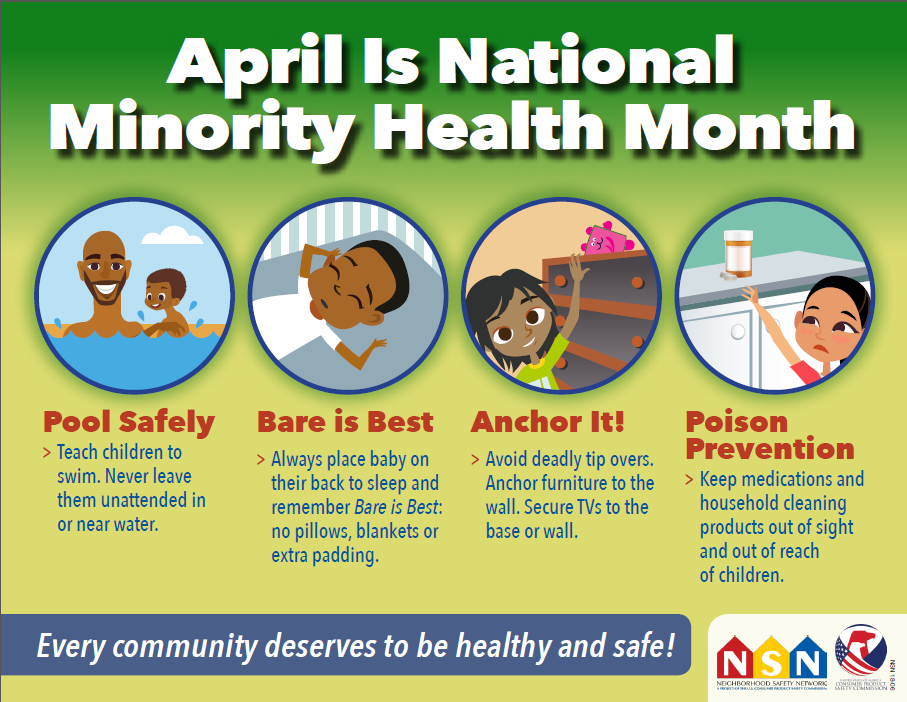
National Minority Health Month


Dept. of Health & Human Services

National Minority Health Month | CPSC.gov

Every April, the U.S. Department of Health and Human Services (HHS) Office of Minority Health (OMH) observes National Minority Health Month to highlight the importance of improving the health of racial and ethnic minority and American Indian/Alaska Native (AI/AN) communities and reducing health disparities.

OMH is proud to announce the theme for National Minority Health Month 2023: Better Health Through Better Understanding.

This year’s theme focuses on improving health outcomes for racial and ethnic minorities and AI/AN communities by providing them with culturally and linguistically competent healthcare services, information, and resources. When patients are provided with culturally and linguistically appropriate information, they are empowered to create healthier outcomes for themselves and their communities.

minorityhealth.hhs.gov

Freedom’s Sisters – Black History –


Additional Information (PDFs):

Fact Sheet

Overview and Bios

Freedom’s Sisters is an exhibition created by Cincinnati Museum Center, organized for travel by Smithsonian Institution Traveling Exhibition Services, and made possible by a grant from the Ford Motor Company Fund.

Presented locally by Macy’s.

Freedom’s Sisters is the first and most comprehensive traveling exhibit on women in the Civil Rights movement, focusing on the lives and contributions of 20 African American women – from key 19th century historical figures to contemporary leaders – who have fought for equality for people of color. Visitors of all ages and backgrounds will be moved and inspired by the stories of the women celebrated in this interactive exhibit. Created by Cincinnati Museum Center, in collaboration with The Ford Motor Company Fund, and Smithsonian Institution Traveling Exhibition Service (SITES), Freedom’s Sisters made its world premiere at Museum Center, and has now embarked on a three-year, nationwide tour. To see the full itinerary, click here.

Programming and Events

As Museum Center worked with Ford and SITES to develop the exhibit, a primary goal was to help encourage the next generation of leaders through dialogue on the civil rights struggle, past, present and future. Reaching young people was a crucial component of the exhibit’s mission. With Macy’s as the local presenting sponsor, 1,000 under served school children from the community joined the thousands of others who were able to see and benefit from this groundbreaking experience.

When Freedom’s Sisters opened on March 15, 2008, Museum Center was delighted to host all five of the “living legends” highlighted in the exhibit including: Myrlie-Evers Williams, Sonia Sanchez, Charlayne-Hunter Gault, Dr. Dorothy Height and Kathleen Cleaver. Several of these remarkable women returned to Cincinnati in July for the national N.A.A.C.P. convention. Myrlie-Evers Williams, in her address to conventioneers said that Freedom’s Sisters at Museum Center “was not to be missed!”

In association with Freedom’s Sisters, Museum Center hosted a poetry slam during National Poetry Month in April. An incredibly enthusiastic and diverse crowd turned out for the event—many of whom were brave even enough to get on the mic! In May, Museum Center presented a lecture by Darlene Clark Hine, Ph.D. Hine, who is considered a pioneer of African American women’s studies scholarship, was named Museum Center’s Distinguished Historian for 2008.

To provide a local tie, the Cincinnati History Museum developed a Cincinnati’s Freedom Sisters floor program, designed to educate children about the Civil Rights movement in Cincinnati. Through interactive smartboard activities students were able to access primary source material, and oral history interviews.

Ferguson … justice for only some? a repost


Corinne Ball, MoveOn.org Civic Action

Many of us have wrestled with intense emotions—sadness, anger, shock, and more—as we’ve followed the ongoing situation in Ferguson, Missouri.

The police killing of unarmed 18-year-old Michael Brown has ignited weeks of demonstrations. Even though most protesters have been peaceful, police appeared armed with military-grade equipment.1 Reporters have been threatened and arrested by police while trying to report the story.2 The whole country has been watching what’s happening in Ferguson.3 

Many of us have asked: What can we do to ensure justice for Michael Brown? What is this awful situation revealing—or reminding us—about racism in America, police militarization, and the way our criminal justice system too often fails communities of color? 

Many of us have been moved to take action. Nearly 150,000 MoveOn members joined ColorOfChange.org to call on the Department of Justice to intervene in the investigation into Michael Brown’s death. That petition will be delivered next week in Washington, DC.

Tens of thousands of us added our names to MoveOn member and Missouri State Senator Jamilah Nasheed’s petition calling for an independent prosecutor in the case. And many of us have made phone calls, joined community protests and vigils, and more.

MoveOn member and Missouri State Senator Jamilah Nasheed delivered tens of thousands of MoveOn member signatures in St. Louis this week, and her campaign has drawn coverage from CNN to the Wall Street Journal and beyond.4

The vigils and national outcry have already had an impact in Ferguson. Attorney General Eric Holder—who came to meet with Ferguson residents in person—is overseeing a Department of Justice investigation.5 The FBI is conducting an investigation into civil rights abuses by the Ferguson police department.6 And a grand jury has been convened to determine if charges will be filed against Officer Darren Wilson.7

We still have much left to do and many complex issues to address before Ferguson—and America—can heal and move forward. There is no quick fix. But there are things we can all do right now to get involved in the push for justice.

One step you can take—if you haven’t already—is to sign Senator Nasheed’s petition calling for a special prosecutor to investigate the shooting death of Michael Brown. Faith leaders and local residents have joined Senator Nasheed in expressing serious doubts about whether the prosecutor in St. Louis County, who previously failed to charge officers for murdering two unarmed black men, will objectively investigate the officer responsible.8

There’s also a huge amount of thoughtful online commentary that’s been sparked by this tragedy. Whatever you’re reading about Ferguson now, consider passing it along to a friend to keep the conversation going. Here’s one option: This piece from MSNBC’s “All In With Chris Hayes” puts the story in a broader perspective in a conversation with Marq Claxton, a retired New York Police Department detective, and Phillip Agnew, founder of the young activist group Dream Defenders:

Together, let’s continue to reflect, to speak out, and to take action.

Thanks for all you do.

–Corinne, Maria, Anna, Mark, and the rest of the team

Sources:

1. “A Former Marine Explains All the Weapons of War Being Used by Police in Ferguson,” The Nation, August 20, 2014
http://www.moveon.org/r/?r=300422&id=100249-17809870-7a_RFkx&t=7

2. “6 more journalists arrested in Ferguson protests,” CNN, August 19, 2014
http://www.moveon.org/r/?r=300423&id=100249-17809870-7a_RFkx&t=8
3. “A Movement Grows in Ferguson,” The New Yorker, August 17, 2014
http://www.moveon.org/r/?r=300415&id=100249-17809870-7a_RFkx&t=9  4. “Concerns arise about prosecutor in Michael Brown case,” CNN, August 20, 2014
http://www.moveon.org/r/?r=300425&id=100249-17809870-7a_RFkx&t=10“Missouri Governor Won’t Replace Prosecutor in Michael Brown Probe,” Wall Street Journal, August 21, 2014
http://www.moveon.org/r/?r=300426&id=100249-17809870-7a_RFkx&t=115. “Jay Nixon: Missouri Highway Patrol Will Take Over Supervision Of Security In Ferguson,” Associated Press, August 14, 2014
http://www.moveon.org/r/?r=300416&id=100249-17809870-7a_RFkx&t=126. “FBI Will Investigate Death of Black Teenager in Missouri,” The Washington Post, August 11, 2014
http://www.moveon.org/r/?r=300417&id=100249-17809870-7a_RFkx&t=14

7. “Holder visits Ferguson as grand jury hearings begin,” Los Angeles Times, August 20, 2014
http://www.moveon.org/r/?r=300424&id=100249-17809870-7a_RFkx&t=15


8. “Protesting the Prosecution,” Slate, August 21, 2014
http://www.moveon.org/r/?r=300418&id=100249-17809870-7a_RFkx&t=18

Want to support our work? MoveOn Civic Action is entirely funded by our 8 million members—no corporate contributions, no big checks from CEOs. And our tiny staff ensures that small contributions go a long way. Chip in here.


A Matter of Racial Justice – Posted in 2014, did the boost even happen? Black History


By

Like CAP Action on Facebook and follow us on Twitter!

A $10.10 Minimum Wage Means A $16.1 Billion Boost For People Of Color

Among the many important reasons to raise the minimum wage to $10.10, the issue is a matter of racial justice. Take a look at the graphic below from the Center for American Progress outlining how much racial groups would benefit if we raise the wage to $10.10 per hour:

minwage_color

People of color are far more likely to work minimum wage jobs: they represent 42 percent of those earners even though they make up just 32 percent of the workforce. And people of color who earn minimum wage are far more likely to live in poverty than average. A 2013 study found that three and a half million people of color would be lifted out of poverty if Congress passes a law raising the minimum wage to $10.10 — out of the six million total. That is 60 percent.

As we have mentioned before, raising the minimum wage has numerous positive economic effects for all Americans, like taking a step to reduce income inequality. It would also reduce government spending, providing an estimated savings from food stamps of $46 billion over ten years as fewer people with jobs need to rely on the program.

BOTTOM LINE: Low-wage jobs have dominated job growth since the end of the Great Recession, and these jobs are done disproportionately by people of color. New data shows yet another reason to raise the minimum wage to $10.10: it would provide a $16.1 billion boost to people of color and go a long way toward making sure that Americans working a full-time job don’t have to live in poverty.