Tag Archives: equality

FREEDOM RIDERS : A Stanley Nelson Film : American Experience – In memory


  Get Inspired

 The World Premiere: In 2010 at Sundance Film Festival, US

 A Documentary Competition

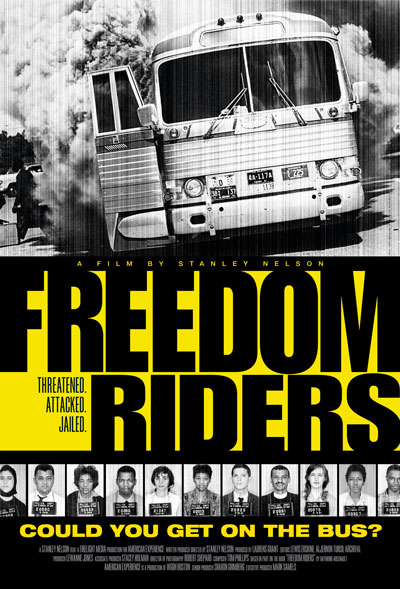
Award-winning filmmaker Stanley Nelson (Wounded Knee, Jonestown: The Life and Death of Peoples Temple, The Murder of Emmett Till) returns to the Sundance Film Festival with his latest documentary FREEDOM RIDERS, the powerful, harrowing and ultimately inspirational story of six months in 1961 that changed America forever. From May until November 1961, more than 400 black and white Americans risked their lives—and many endured savage beatings and imprisonment—for simply traveling together on buses and trains as they journeyed through the Deep South. Deliberately violating Jim Crow laws, the Freedom Riders’ belief in non-violent activism was sorely tested as mob violence and bitter racism greeted them along the way.

FREEDOM RIDERS features testimony from a fascinating cast of central characters: the Riders themselves, state and federal government officials, and journalists who witnessed the rides firsthand.

“I got up one morning in May and I said to my folks at home, I won’t be back today because I’m a Freedom Rider. It was like a wave or a wind that you didn’t know where it was coming from or where it was going, but you knew you were supposed to be there.” — Pauline Knight-Ofuso, Freedom Rider

Despite two earlier Supreme Court decisions that mandated the desegregation of interstate travel facilities, black Americans in 1961 continued to endure hostility and racism while traveling through the South. The newly inaugurated Kennedy administration, embroiled in the Cold War and worried about the nuclear threat, did little to address domestic Civil Rights.See the source image

“It became clear that the Civil Rights leaders had to do something desperate, something dramatic to get Kennedy’s attention. That was the idea behind the Freedom Rides—to dare the federal government to do what it was supposed to do, and see if their constitutional rights would be protected by the Kennedy administration,” explains Raymond Arsenault, author of Freedom Riders: 1961 and the Struggle for Racial Justice, on which the film is partially based.

Organized by the Congress of Racial Equality (CORE), the self-proclaimed “Freedom Riders” came from all strata of American society—black and white, young and old, male and female, Northern and Southern. They embarked on the Rides knowing the danger but firmly committed to the ideals of non-violent protest, aware that their actions could provoke a savage response but willing to put their lives on the line for the cause of justice.

Each time the Freedom Rides met violence and the campaign seemed doomed, new ways were found to sustain and even expand the movement. After Klansmen in Alabama set fire to the original Freedom Ride bus, student activists from Nashville organized a ride of their own. “We were past fear. If we were going to die, we were gonna die, but we can’t stop,” recalls Rider Joan Trumpauer-Mulholland. “If one person falls, others take their place.”

Later, Mississippi officials locked up more than 300 Riders in the notorious Parchman State Penitentiary. Rather than weaken the Riders’ resolve, the move only strengthened their determination. None of the obstacles placed in their path would weaken their commitment.

The Riders’ journey was front-page news and the world was watching. After nearly five months of fighting, the federal government capitulated. On September 22, the Interstate Commerce Commission issued its order to end the segregation in bus and rail stations that had been in place for generations. “This was the first unambiguous victory in the long history of the Civil Rights Movement. It finally said, ‘We can do this.’ And it raised expectations across the board for greater victories in the future,” says Arsenault.

“The people that took a seat on these buses, that went to jail in Jackson, that went to Parchman, they were never the same. We had moments there to learn, to teach each other the way of nonviolence, the way of love, the way of peace. The Freedom Ride created an unbelievable sense: Yes, we will make it. Yes, we will survive. And that nothing, but nothing, was going to stop this movement,” recalls Congressman John Lewis, one of the original Riders.

Says Stanley Nelson, “The lesson of the Freedom Rides is that great change can come from a few small steps taken by courageous people. And that sometimes to do any great thing, it’s important that we step out alone.”

CREDITS
A Stanley Nelson Film
A Firelight Media Production for AMERICAN EXPERIENCE

Produced, Written and Directed by
Stanley Nelson

Produced by
Laurens Grant

Edited by
Lewis Erskine, Aljernon Tunsil

Archival Producer
Lewanne Jones

Associate Producer
Stacey HolmanDirector of Photography
Robert Shepard

Composer
Tom Phillips

Music Supervisor
Rena Kosersky

Based in part on the book Freedom Riders by
Raymond Arsenault

AMERICAN EXPERIENCE is a production of WGBH Boston.
Senior producer
Sharon Grimberg

Executive producer
Mark Samels

Langston Hughes’ 114th Birthday Google Doodle


a google doodle worth reposting … google

Happy Birthday Stevie Wonder ~ Black History Month


Republican hypocrisy …A message from Jim Dean and damn if things have yet to change


A repost from 2011

Republicans only care about one thing — tax cuts. It’s the only thing they talk about.

When Americans demand jobs — Republicans say “tax cuts.”

When Democrats take action on education, healthcare and job creation — Republicans say “tax cuts.”

When people demand Wall Street be held accountable for wrecking the economy — Republicans say “tax cuts.”

Republicans are obsessed with cutting taxes, but now that Democrats have put forward a payroll tax cut that will put real money in the pockets of working Americans, Republicans say “No!”

Republicans are hypocrites that only care about lining the pockets of their big-money friends and it’s time we called them out for it.

We’re demanding answers. Click here to ask Republicans in Congress — Why do you hate tax cuts for working families?

Republicans have been getting a free pass on this too for too long. It’s time that we stand up and called them out for propping up the super rich while pushing working families down.

Sign the petition today and we’ll back it up with an aggressive campaign to demand answers from Republicans. We’ll deliver your signatures not just to every Republican in Congress, but to every Republican running for president and demand answers in front of the media. We’ll make calls to their offices. We’ll do whatever it takes to expose Republican tax hypocrisy.

Join us now and demand answers.

Republicans need to stop flip-flopping on tax cuts when it comes to working families and figure out where they stand.

Thank you for everything you do.

-Jim

Jim Dean, Chair
Democracy for America

The Only African American Automobile Company! ~~ Lonnie G. Bunch at The NMAAHC- in memory of Black History


NMAAHC -- National Museum of African American History and Culture

Lonnie Bunch, museum director, historian, lecturer, and author, is proud to present A Page from Our American Story, a regular on-line series for Museum supporters. It will showcase individuals and events in the African American experience, placing these stories in the context of a larger story — our American story.
A Page From Our American Story
At the dawn of the Automobile Age in the early 20th century, hundreds of small auto companies sprouted up across America as entrepreneurs recognized that society was transitioning from horse-drawn carriages to transportation powered by the internal combustion engine. Some of these early companies grew to become giants that are still with us today, such as Ford and Chevrolet. Many others remained small, struggling to compete against the assembly lines of the larger manufacturers.One such company was C.R. Patterson & Sons of Greenfield, Ohio, makers of the Patterson-Greenfield automobile from 1915 to 1918. Though its name is little recognized today, there is in fact a very important reason to ensure that it is not lost to history: it was, and remains to this day,the only African American owned and operated automobile company.

Frederick Patterson with a prototype of the Patterson-Greenfield automobile.

Charles Richard Patterson was born into slavery on a Virginia plantation in 1833. Not much is known about his life on the plantation, and historians have to sift through conflicting reports about how he came to settle in Greenfield, Ohio, a town with strong abolitionist sympathies. Some say his family arrived in the 1840s, possibly after purchasing their freedom; others suggest Patterson alone escaped in 1861. In any case, he learned the skills of the blacksmith and found work in the carriage-making trade, where he developed a reputation for building a high quality product. In 1873, he formed a business partnership with another carriage maker in town, J.P. Lowe, who was white, and eventually became sole proprietor of the renamed C.R. Patterson & Sons in 1893. It was a successful business employing an integrated workforce of 35-50 by the turn of the century, and Charles Patterson became a prominent and respected citizen in Greenfield. His catalog listed some 28 models, from simple open buggies to larger and more expensive closed carriages for doctors and other professionals.

When Patterson died in 1910, the business passed to his son Frederick, who was already something of a pioneer. He was college-educated and was the first black athlete to play football for Ohio State University. He was also an early member and vice president of the National Negro Business League founded by Booker T. Washington. Now, as owner and operator of the enterprise his father started, Frederick Patterson began to see the handwriting on the wall: the days of carriages and horse-drawn buggies were nearing an end.

Early advertisement for the Patterson-Greenfield automobile. At first, the company offered repair and restoration services for the “horseless carriages” that were beginning to proliferate on the streets of Greenfield. No doubt this gave workers the opportunity to gain some hands-on knowledge about these noisy, smoky and often unreliable contraptions. Like his father, Frederick was a strong believer in advertising and placed his first ad for auto repair services in the local paper in 1913. Initially, the work mostly involved repainting bodies and reupholstering interiors, but as the shop gained more experience with engines and drivetrains, they began to offer sophisticated upgrades and improvements to electrical and mechanical systems as well.

This valuable experience allowed C.R. Patterson & Sons to take the next great step in its own story as well as in African American history: in 1915, it announced the availability of the Patterson-Greenfield automobile at a price of $685. From the company’s publicity efforts, it is evident they were bursting with pride:

“Our car is made with three distinct purposes in mind. First — It is not intended for a large car. It is designed to take the place originally held by the family surrey. It is a 5-passenger vehicle, ample and luxurious. Second — It is intended to meet the requirements of that class of users, who, though perfectly able to spend twice the amount, yet feel that a machine should not engross a disproportionate share of expenditure, and especially it should not do so to the exclusion of proper provisions for home and home comfort, and the travel of varied other pleasurable and beneficial entertainment. It is a sensibly priced car. Third — It is intended to carry with it (and it does so to perfection) every conceivable convenience and every luxury known to car manufacture. There is absolutely nothing shoddy about it. Nothing skimp and stingy.”

A child leans out of a 1917 Patterson-Greenfield roadster. Orders began to come in, and C.R. Patterson & Sons officially entered the ranks of American auto manufacturers. Over the years, several models of coupes and sedans were offered, including a stylish “Red Devil” speedster. Ads featured the car’s 30hp Continental 4-cylinder engine, full floating rear axle, cantilever springs, electric starting and lighting, and a split windshield for ventilation. The build quality of the Patterson-Greenfield automobile was as highly regarded as it had been with their carriages.

The initial hope and optimism, however, proved to be fairly short-lived. In an age of increased mechanization and production lines, small independent shops featuring hand-built, high quality products weren’t able to scale up production or compete on price against the rapidly growing car companies out of Detroit. In small quantities, parts and supplies were expensive and hard to come by when major manufacturers were buying them by the trainload at greatly reduced costs. Plus, the labor hours per car were much higher than that of assembly line manufacturers. As a result, the profit margin on each Patterson-Greenfield was low.

A Patterson-Greenfield bus printed with the words 'Greenfield School District'. In 1918, having built by some estimates between 30 and 150 vehicles, C.R. Patterson & Sons halted auto production and concentrated once again on the repair side of the business. But they weren’t done yet. In the 1920s, the company began building truck and bus bodies to be fitted on chassis made by other manufacturers. It was in a sense a return to their original skills in building carriage bodies without engines and drivetrains and, for a period of time, the company was quite profitable. Then in 1929, the stock market crashed and the Great Depression set in. As with many small businesses, sales dried up and loans were hard to obtain. The company, now run by the sons of Frederick Patterson, soldiered on until 1939 when, after 74 years, C.R. Patterson & Sons closed its doors forever.

Sadly, no Patterson-Greenfield automobiles are known to survive today. But we should not let that dim the fact that two great entrepreneurs, Charles Richard Patterson and his son Frederick Patterson built and sustained a business that lasted several generations and earned a place not just in African American history, but in automotive history as well.

 Portrait of Lonnie Bunch All the best,
Signed by Lonnie Bunch
Lonnie Bunch
Director

The National Museum of African American History and Culture is the newest member of the Smithsonian Institution’s family of extraordinary museums. The museum will be far more than a collection of objects. The Museum will be a powerful, positive force in the national discussion about race and the important role African Americans have played in the American story — a museum that will make all Americans proud.

P.S. We can only reach our $250 million goal with your help. I hope you will consider making a donation or becoming a Charter Member today.