Tag Archives: Los Angeles

Don’t Put a Coal Mine in Bryce Canyon – Let’s Move to Solar!


care2 petitionsite actionAlert

Bryce Canyon National Park in Utah is home to over 100 species of birds, thousands of plant species, and numerous mammals. However, the national park is in danger of being replaced by a coal mine.The city of Los Angeles is set to sap the natural wonder of its biodiversity, but you can help save this natural wonder.»Bryce Canyon has provided a great research area for scientists and a beautiful place for families to visit. Utah tourism is at stake in addition to Bryce Canyon itself.Los Angeles does not need this power. An alternate solution has been proposed — one that wouldn’t require the destruction of a natural haven OR the use and production of dirty energy from coal. People are speaking out about the city of Los Angeles instead creating its own solar energy. Thousands of LA residents have demanded that the city eliminate coal power by 2020, and put LA’s sunny weather to good use.Sign this petition to protect Bryce Canyon National Park, and a brighter, cleaner future for Los Angeles! »

Thanks for taking action!Rachel M.
Care2 and ThePetitionSite Team
Save Bryce Canyon National Park from Big Coal!
Take Action Now!
Take Action!


Al Jazeera English Adds Bureaus, Programming in US


Dear Al Jazeera English supporter,

Thanks for watching our channel, demanding our channel, and staying in touch.

We’re excited to tell you about some new developments here at Al Jazeera English-we’re redoubling our efforts to really tell the stories of Americans across the country as we head into the election year.

New bureaus, new correspondents in the U.S.

We are proud to announce the addition of three new U.S. based correspondents to our team in the Americas: Alan Fisher in Washington, DC, Andy Gallacher in Miami, and John Hendren in Chicago.   The newly opened Miami and Chicago bureaus add to the already established Al Jazeera English bureaus in Washington, DC, New York, and Los Angeles.  Alan, Andy, and John join the over 150 Al Jazeera English staff based in the U.S., and will be part of Al Jazeera’s expanded coverage from the U.S. heading into the election year.

“Inside Story” in Washington DC

Our daily discussion show “Inside Story” will begin airing five days a week out of Washington, DC, on December 12th. The show will air every weekday at 6:30am and 7:30pm ET and will be focusing on tackling  the major issues facing Americans today-everything from the presidential elections to joblessness to immigration.

Your input

As always, please send us your thoughts, ideas, and suggestions on how we can tell stories that most accurately reflect your experiences and the issues you care most about.

We always strive to bring you the best coverage of both the United States and the world that we can, and your continued support means a lot to us.

Sincerely,

Al Jazeera Communications Team

Demand Al Jazeera English from your cable provider today: www.iwantaje.com

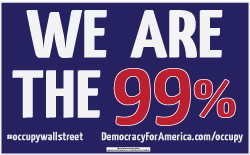
Get your Occupy Wall Street yard sign …


Occupy Wall Street hasn’t made specific demands yet but they’ve already won their first big fight — big banks and their right-wing allies in Congress have taken notice… and they’re scared of what they see.

Occupy Wall Street has inspired occupations in hundreds of cities across the country — from Atlanta to Boston to Los Angeles. Now, it’s time to expand the fight beyond major cities and into the suburbs, the countryside — everywhere.

The problem is local occupations outside of major cities may never be able to reach the kind of critical mass that will turn heads and force elected leaders to respond. Yet small towns and rural areas standing up and getting involved is the most likely way to help build this movement to the next level.

So we’ve spent the week asking members of Occupy Wall Street and DFA what’s the best thing we could do right now to help build the movement for the long term. The answer was clear. Help us show support for Occupy Wall Street everywhere — including our own front yard. That’s why we put together “We are the 99 percent” lawn signs so Americans everywhere can join the movement.

Start your own occupation to support and grow the movement — Get an Occupy Wall Street yard sign right now.


Normally we give merchandise away for free, but yard signs are expensive.

It costs $1.29 to print each sign. It costs $2.50 to package them. It can cost up to $9.75 to ship them, depending on where you live. And when buying signs in large quantities, it costs up to $1,000 just to add a second color to the sign.

When it’s all said and done — each sign costs $13.76 to print, package and ship directly to your home. So, we’re asking for a contribution of at least $16 to help cover all the costs. If you contribute more, we’ll use the additional money raised to support our continued involvement, spreading the message, and supporting the people on the ground in New York and beyond who started this bold movement.

It’s October. In New York, Boston, and even Atlanta, Occupy Wall Street needs sleeping bags, blankets, medical supplies and so much more. Making a contribution today not only gets you a yard sign so you can show your support, it will help us deliver more of the resources that people on the ground need right now.

Get your “We are the 99 percent” yard sign right now.

Thank you for everything you do.

-Charles

Charles Chamberlain, Political Director
Democracy for America

P.S. Our lawyers say we need to make it clear that the total amount of your purchase is a contribution to Democracy for America under the Federal Election Campaign Act. Please contribute now and get your lawn sign today.

OCCUPY Your City …Robert Greenwald


by on Oct  4, 2011

People young and old are taking the streets to let our government and corporations know that we are a democracy that’s not for sale. Take action:http://bravenewfoundation.org/occupy

Wilson: Can we keep up our progress on AIDS? It’s 2023, what do you


Phill Wilson is the president and CEO of the Black AIDS Institute, a national HIV/AIDS think tank focused exclusively on black people.

Phill Wilson
Special to CNN

Editor’s note: Watch “Hope Survives: 30 Years of AIDS,” an AC360° special, at 9 p.m. ET Friday. Phill Wilson is the president and CEO of the Black AIDS Institute, a national HIV/AIDS think tank focused exclusively on black people. Follow him on Twitter.

(CNN) – I was infected with HIV in 1981, the year the disease was discovered.

Back then, most people died in six to 12 months from horrible diseases like Kaposi’s sarcoma, a skin cancer normally found in older men of Semitic descent; pneunocystis carinii pneumonia, a fungal infection in the lungs; cryptococcal meningitis, which causes the lining of your brain to swell; or toxoplasmosis: You got that from cat feces, and it turned your brain to Swiss cheese.

There were no treatments, really. A “long-time survivor” was someone who lived 18 months.

I was 24 then. In April, I will celebrate my 54th birthday.

I almost didn’t make it. In 1996, my doctor at Kaiser Permanente in Los Angeles called my mother in Chicago to tell her that if she wanted to see me alive again, she should fly to Los Angeles immediately. They had given me less than 24 hours to live. I was in a coma in the ICU.

I eventually came out of that crisis, and my doctor prescribed something brand new: a three-drug regimen, commonly referred to as “the cocktail.” I recovered from that crisis and went on to found the Black AIDS Institute, an organization I still lead.

What a difference three decades can make. We have gone from no drugs to a few very toxic drugs that didn’t really work to more than 25 antiretroviral drugs used to treat HIV. The new drugs are highly effective, and the side effects are much reduced.

Read more from Wilson on CNN.com’s Opinion Page

Editor’s note:
Greater Than AIDS– a new national movement to respond to AIDS in America– is asking Americans to share their “Deciding Moments,” personal experiences that changed how they think about the disease and inspired them to get involved. For many it is someone close to them who was infected. For some it was their own diagnosis. For others it was a realization that we all have a role to play. Tell us about your “Deciding Moment” by visiting: www.greaterthan.org/moment.

Related: Visit Greater Than AIDS for answers to frequently asked questions about HIV/AIDS, as well as information about local testing centers.

More about: 360° Radar • AIDS • Opinion • Phill Wilson
This article was first posted on Jan 14, 2011