Tag Archives: republicans

National Minority Health Month


Dept. of Health & Human Services

National Minority Health Month | CPSC.gov

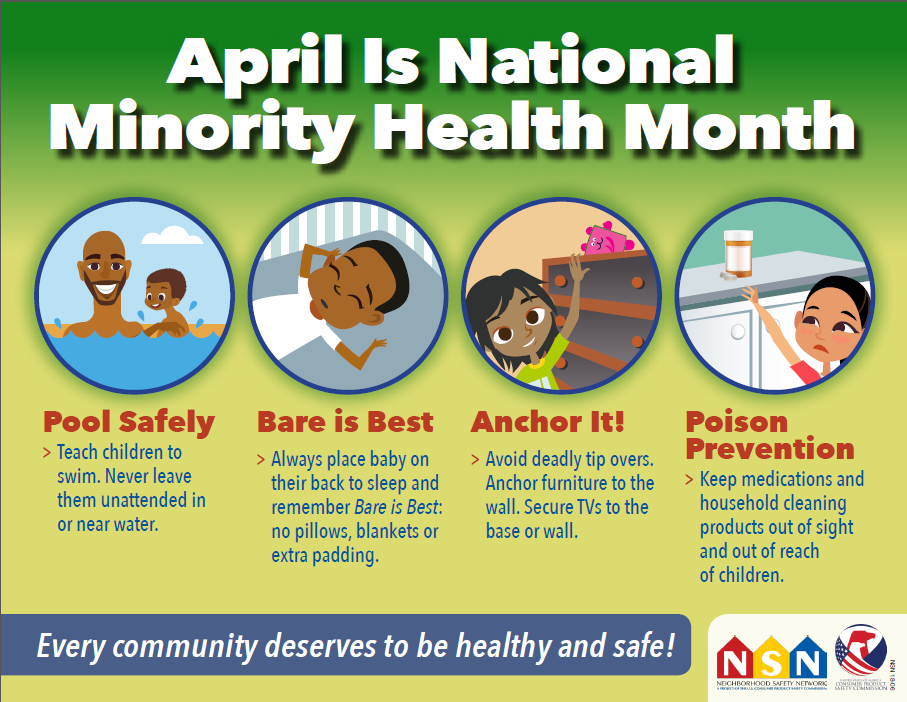
Every April, the U.S. Department of Health and Human Services (HHS) Office of Minority Health (OMH) observes National Minority Health Month to highlight the importance of improving the health of racial and ethnic minority and American Indian/Alaska Native (AI/AN) communities and reducing health disparities.

OMH is proud to announce the theme for National Minority Health Month 2023: Better Health Through Better Understanding.

This year’s theme focuses on improving health outcomes for racial and ethnic minorities and AI/AN communities by providing them with culturally and linguistically competent healthcare services, information, and resources. When patients are provided with culturally and linguistically appropriate information, they are empowered to create healthier outcomes for themselves and their communities.

minorityhealth.hhs.gov

Freedom’s Sisters – Black History –


Additional Information (PDFs):

Fact Sheet

Overview and Bios

Freedom’s Sisters is an exhibition created by Cincinnati Museum Center, organized for travel by Smithsonian Institution Traveling Exhibition Services, and made possible by a grant from the Ford Motor Company Fund.

Presented locally by Macy’s.

Freedom’s Sisters is the first and most comprehensive traveling exhibit on women in the Civil Rights movement, focusing on the lives and contributions of 20 African American women – from key 19th century historical figures to contemporary leaders – who have fought for equality for people of color. Visitors of all ages and backgrounds will be moved and inspired by the stories of the women celebrated in this interactive exhibit. Created by Cincinnati Museum Center, in collaboration with The Ford Motor Company Fund, and Smithsonian Institution Traveling Exhibition Service (SITES), Freedom’s Sisters made its world premiere at Museum Center, and has now embarked on a three-year, nationwide tour. To see the full itinerary, click here.

Programming and Events

As Museum Center worked with Ford and SITES to develop the exhibit, a primary goal was to help encourage the next generation of leaders through dialogue on the civil rights struggle, past, present and future. Reaching young people was a crucial component of the exhibit’s mission. With Macy’s as the local presenting sponsor, 1,000 under served school children from the community joined the thousands of others who were able to see and benefit from this groundbreaking experience.

When Freedom’s Sisters opened on March 15, 2008, Museum Center was delighted to host all five of the “living legends” highlighted in the exhibit including: Myrlie-Evers Williams, Sonia Sanchez, Charlayne-Hunter Gault, Dr. Dorothy Height and Kathleen Cleaver. Several of these remarkable women returned to Cincinnati in July for the national N.A.A.C.P. convention. Myrlie-Evers Williams, in her address to conventioneers said that Freedom’s Sisters at Museum Center “was not to be missed!”

In association with Freedom’s Sisters, Museum Center hosted a poetry slam during National Poetry Month in April. An incredibly enthusiastic and diverse crowd turned out for the event—many of whom were brave even enough to get on the mic! In May, Museum Center presented a lecture by Darlene Clark Hine, Ph.D. Hine, who is considered a pioneer of African American women’s studies scholarship, was named Museum Center’s Distinguished Historian for 2008.

To provide a local tie, the Cincinnati History Museum developed a Cincinnati’s Freedom Sisters floor program, designed to educate children about the Civil Rights movement in Cincinnati. Through interactive smartboard activities students were able to access primary source material, and oral history interviews.

Beaver Gland Castoreum Not Used in Vanilla Flavorings According to Manufacturers ~ a follow up ?


by Jeanne Yacoubou, MS
VRG Research Director

A reader wrote to The VRG in April 2011 about a comment made by British chef, Jamie Oliver, on The Late Show with David Letterman. Mr. Oliver said that vanilla flavoring in ice cream is made with castoreum, a substance derived from beaver anal glands. The reader asked us if there was any truth to this statement.

The VRG asked five companies that manufacture both natural and artificial vanilla, vanilla extracts, concentrates, distillates, powders, and flavors. All five unanimously stated that castoreum is not used today in any form of vanilla sold for human food use.

One company, in business for ninety years, informed The VRG that they have never used castoreum in their products. “At one time,” we were told by a senior level employee at this company, “to the best of my knowledge, it was used to make fragrance and still may be.”

Companies directed us to the Code of Federal Regulations (CFR) which they all said they follow strictly and exclusively: http://www.accessdata.fda.gov/scripts/cdrh/cfdocs/cfcfr/cfrsearch.cfm?fr=169.175

To quote the CFR, Title 21, Part 169, Subpart B, Section175 (cited as 21CFR169.175) on this point:

“…[v]anilla extract is the solution in aqueous ethyl alcohol of the sapid and odorous principles extractable from vanilla beans. In vanilla extract the content of ethyl alcohol is not less than 35 percent by volume…The vanilla constituent may be extracted directly from vanilla beans or it may be added in the form of concentrated vanilla extract or concentrated vanilla flavoring or vanilla flavoring concentrated to the semisolid form called vanilla oleo-resin. Vanilla extract may contain one or more of the following optional ingredients:
(1) Glycerin. (2) Propylene glycol. (3) Sugar (including invert sugar). (4) Dextrose. (5) Corn sirup (including dried corn sirup). (VRG Note: spelling appears exactly as is from the original.)
(b)(1) The specified name of the food is ‘Vanilla extract’ or ‘Extract of vanilla’.
(2) When the vanilla extract is made in whole or in part by dilution of vanilla oleoresin, concentrated vanilla extract, or concentrated vanilla flavoring, the label shall bear the statement ‘Made from ___’ or ‘Made in part from ___’, the blank being filled in with the name or names ‘vanilla oleoresin’, ‘concentrated vanilla extract’, or ‘concentrated vanilla flavoring’, as appropriate…”

Section 177 of this subpart in the CFR Title 21 specifies requirements for vanilla flavoring:

“…[v]anilla flavoring conforms to the definition and standard of identity and is subject to any requirement for label statement of ingredients prescribed for vanilla extract by 169.175, except that its content of ethyl alcohol is less than 35 percent by volume.

(b) The specified name of the food is Vanilla flavoring.”

A major ingredients supplier that sells both natural and artificial vanilla extracts, concentrates, distillates, and flavors to many food companies told us this about some of their vanilla flavorings: “The flavor itself contains proprietary information that cannot be shared but it’s made from a combination of raw materials, such as vanillin, vanitrope, heliotropin, and maltol.” (VRG Note: All ingredients in this list are either all-vegetable or synthetic.) We were also informed by this company when The VRG asked specifically about castoreum in food ingredients: “…It’s not a common raw material that is used and we don’t use it, so I can safely say that our natural vanilla flavors do not contain any animal juices. All vanilla extracts are free of it, too, wherever you go.”

What is true is that castoreum is generally recognized as safe (GRAS) and so approved for use in foods by the Food and Drug Administration (FDA). (A few other animal-derived ingredients including ambergris (whale-derived) and musk (civet-derived) also have GRAS status and so may be ingredients in products intended for humans): http://www.accessdata.fda.gov/scripts/cdrh/cfdocs/cfcfr/CFRSearch.cfm?fr=582.50

According to G.A. Burdock in a 2007 article published in the International Journal of Toxicology, “Castoreum extract… is a natural product prepared by direct hot-alcohol extraction of castoreum, the dried and macerated castor sac scent glands (and their secretions) from the male or female beaver. It has been used extensively in perfumery and has been added to food as a flavor ingredient for at least 80 years. Both the Flavor and Extract Manufacturers Association (FEMA) and the Food and Drug Administration (FDA) regard castoreum extract as generally recognized as safe (GRAS).”

When castoreum occurs in a food, it does not have to be listed by its name. It is considered a “natural flavor” and may be so designated on a food package according to the CFR: http://www.accessdata.fda.gov/scripts/cdrh/cfdocs/cfcfr/CFRSearch.cfm?fr=501.22

Readers who are doubtful of a particular brand listing “natural flavors” as ingredients are encouraged to call the food’s manufacturer and specifically request detail on which “natural flavor(s)” is/are present in the food.

For updates on vanilla flavor and other food ingredients, subscribe to our free e-newsletter at http://www.vrg.org/vrgnews/
Readers may wish to purchase our Guide to Food Ingredients available at http://www.vrg.org/catalog/index.php?main_page=product_info&cPath=1&products_id=8

To support VRG research, go to https://www.givedirect.org/give/givefrm.asp?CID=1565

The contents of this blog, website and our other publications, including Vegetarian Journal, are not intended to provide personal medical advice. Medical advice should be obtained from a qualified health professional. We often depend on product and ingredient information from company statements. It is impossible to be 100% sure about a statement, info can change, people have different views, and mistakes can be made. Please use your best judgment about whether a product is suitable for you. To be sure, do further research or confirmation on your own.

– See more at: http://www.vrg.org/blog/2011/06/17/beaver-gland-castoreum-not-used-in-vanilla-flavorings-according-to-manufacturers/#sthash.W09gMLrl.dpuf

by Jeanne Yacoubou, MS
VRG Research Director

A reader wrote to The VRG in April 2011 about a comment made by British chef, Jamie Oliver, on The Late Show with David Letterman. Mr. Oliver said that vanilla flavoring in ice cream is made with castoreum, a substance derived from beaver anal glands. The reader asked us if there was any truth to this statement.

The VRG asked five companies that manufacture both natural and artificial vanilla, vanilla extracts, concentrates, distillates, powders, and flavors. All five unanimously stated that castoreum is not used today in any form of vanilla sold for human food use.

One company, in business for ninety years, informed The VRG that they have never used castoreum in their products. “At one time,” we were told by a senior level employee at this company, “to the best of my knowledge, it was used to make fragrance and still may be.”

Companies directed us to the Code of Federal Regulations (CFR) which they all said they follow strictly and exclusively: http://www.accessdata.fda.gov/scripts/cdrh/cfdocs/cfcfr/cfrsearch.cfm?fr=169.175

To quote the CFR, Title 21, Part 169, Subpart B, Section175 (cited as 21CFR169.175) on this point:

“…[v]anilla extract is the solution in aqueous ethyl alcohol of the sapid and odorous principles extractable from vanilla beans. In vanilla extract the content of ethyl alcohol is not less than 35 percent by volume…The vanilla constituent may be extracted directly from vanilla beans or it may be added in the form of concentrated vanilla extract or concentrated vanilla flavoring or vanilla flavoring concentrated to the semisolid form called vanilla oleo-resin. Vanilla extract may contain one or more of the following optional ingredients:
(1) Glycerin. (2) Propylene glycol. (3) Sugar (including invert sugar). (4) Dextrose. (5) Corn sirup (including dried corn sirup). (VRG Note: spelling appears exactly as is from the original.)
(b)(1) The specified name of the food is ‘Vanilla extract’ or ‘Extract of vanilla’.
(2) When the vanilla extract is made in whole or in part by dilution of vanilla oleoresin, concentrated vanilla extract, or concentrated vanilla flavoring, the label shall bear the statement ‘Made from ___’ or ‘Made in part from ___’, the blank being filled in with the name or names ‘vanilla oleoresin’, ‘concentrated vanilla extract’, or ‘concentrated vanilla flavoring’, as appropriate…”

Section 177 of this subpart in the CFR Title 21 specifies requirements for vanilla flavoring:

“…[v]anilla flavoring conforms to the definition and standard of identity and is subject to any requirement for label statement of ingredients prescribed for vanilla extract by 169.175, except that its content of ethyl alcohol is less than 35 percent by volume.

(b) The specified name of the food is Vanilla flavoring.”

A major ingredients supplier that sells both natural and artificial vanilla extracts, concentrates, distillates, and flavors to many food companies told us this about some of their vanilla flavorings: “The flavor itself contains proprietary information that cannot be shared but it’s made from a combination of raw materials, such as vanillin, vanitrope, heliotropin, and maltol.” (VRG Note: All ingredients in this list are either all-vegetable or synthetic.) We were also informed by this company when The VRG asked specifically about castoreum in food ingredients: “…It’s not a common raw material that is used and we don’t use it, so I can safely say that our natural vanilla flavors do not contain any animal juices. All vanilla extracts are free of it, too, wherever you go.”

What is true is that castoreum is generally recognized as safe (GRAS) and so approved for use in foods by the Food and Drug Administration (FDA). (A few other animal-derived ingredients including ambergris (whale-derived) and musk (civet-derived) also have GRAS status and so may be ingredients in products intended for humans): http://www.accessdata.fda.gov/scripts/cdrh/cfdocs/cfcfr/CFRSearch.cfm?fr=582.50

According to G.A. Burdock in a 2007 article published in the International Journal of Toxicology, “Castoreum extract… is a natural product prepared by direct hot-alcohol extraction of castoreum, the dried and macerated castor sac scent glands (and their secretions) from the male or female beaver. It has been used extensively in perfumery and has been added to food as a flavor ingredient for at least 80 years. Both the Flavor and Extract Manufacturers Association (FEMA) and the Food and Drug Administration (FDA) regard castoreum extract as generally recognized as safe (GRAS).”

When castoreum occurs in a food, it does not have to be listed by its name. It is considered a “natural flavor” and may be so designated on a food package according to the CFR: http://www.accessdata.fda.gov/scripts/cdrh/cfdocs/cfcfr/CFRSearch.cfm?fr=501.22

Readers who are doubtful of a particular brand listing “natural flavors” as ingredients are encouraged to call the food’s manufacturer and specifically request detail on which “natural flavor(s)” is/are present in the food.

For updates on vanilla flavor and other food ingredients, subscribe to our free e-newsletter at http://www.vrg.org/vrgnews/
Readers may wish to purchase our Guide to Food Ingredients available at http://www.vrg.org/catalog/index.php?main_page=product_info&cPath=1&products_id=8

To support VRG research, go to https://www.givedirect.org/give/givefrm.asp?CID=1565

The contents of this blog, website and our other publications, including Vegetarian Journal, are not intended to provide personal medical advice. Medical advice should be obtained from a qualified health professional. We often depend on product and ingredient information from company statements. It is impossible to be 100% sure about a statement, info can change, people have different views, and mistakes can be made. Please use your best judgment about whether a product is suitable for you. To be sure, do further research or confirmation on your own.

– See more at: http://www.vrg.org/blog/2011/06/17/beaver-gland-castoreum-not-used-in-vanilla-flavorings-according-to-manufacturers/#sthash.W09gMLrl.dpuf

beever-sac-400x400Posted on June 17, 2011 by The VRG Blog Editor

VRG Research Director

A reader wrote to The VRG in April 2011 about a comment made by British chef, Jamie Oliver, on The Late Show with David Letterman. Mr. Oliver said that vanilla flavoring in ice cream is made with castoreum, a substance derived from beaver anal glands. The reader asked us if there was any truth to this statement.

The VRG asked five companies that manufacture both natural and artificial vanilla, vanilla extracts, concentrates, distillates, powders, and flavors. All five unanimously stated that castoreum is not used today in any form of vanilla sold for human food use.

One company, in business for ninety years, informed The VRG that they have never used castoreum in their products. “At one time,” we were told by a senior level employee at this company, “to the best of my knowledge, it was used to make fragrance and still may be.”

Companies directed us to the Code of Federal Regulations (CFR) which they all said they follow strictly and exclusively: http://www.accessdata.fda.gov/scripts/cdrh/cfdocs/cfcfr/cfrsearch.cfm?fr=169.175

To quote the CFR, Title 21, Part 169, Subpart B, Section175 (cited as 21CFR169.175) on this point:

   “…[v]anilla extract is the solution in aqueous ethyl alcohol of the sapid and odorous principles extractable from vanilla beans. In vanilla extract the content of ethyl alcohol is not less than 35 percent by volume…The vanilla constituent may be extracted directly from vanilla beans or it may be added in the form of concentrated vanilla extract or concentrated vanilla flavoring or vanilla flavoring concentrated to the semisolid form called vanilla oleo-resin. Vanilla extract may contain one or more of the following optional ingredients:

   (1) Glycerin. (2) Propylene glycol. (3) Sugar (including invert sugar). (4) Dextrose. (5) Corn sirup (including dried corn sirup). (VRG Note: spelling appears exactly as is from the original.)

   (b)(1) The specified name of the food is ‘Vanilla extract’ or ‘Extract of vanilla’.

   (2) When the vanilla extract is made in whole or in part by dilution of vanilla oleoresin, concentrated vanilla extract, or concentrated vanilla flavoring, the label shall bear the statement ‘Made from ___’ or ‘Made in part from ___’, the blank being filled in with the name or names ‘vanilla oleoresin’, ‘concentrated vanilla extract’, or ‘concentrated vanilla flavoring’, as appropriate…”

Section 177 of this subpart in the CFR Title 21 specifies requirements for vanilla flavoring:

“…[v]anilla flavoring conforms to the definition and standard of identity and is subject to any requirement for label statement of ingredients prescribed for vanilla extract by 169.175, except that its content of ethyl alcohol is less than 35 percent by volume.

(b) The specified name of the food is Vanilla flavoring.”

A major ingredients supplier that sells both natural and artificial vanilla extracts, concentrates, distillates, and flavors to many food companies told us this about some of their vanilla flavorings: “The flavor itself contains proprietary information that cannot be shared but it’s made from a combination of raw materials, such as vanillin, vanitrope, heliotropin, and maltol.” (VRG Note: All ingredients in this list are either all-vegetable or synthetic.) We were also informed by this company when The VRG asked specifically about castoreum in food ingredients: “…It’s not a common raw material that is used and we don’t use it, so I can safely say that our natural vanilla flavors do not contain any animal juices. All vanilla extracts are free of it, too, wherever you go.”

What is true is that castoreum is generally recognized as safe (GRAS) and so approved for use in foods by the Food and Drug Administration (FDA). (A few other animal-derived ingredients including ambergris (whale-derived) and musk (civet-derived) also have GRAS status and so may be ingredients in products intended for humans): http://www.accessdata.fda.gov/scripts/cdrh/cfdocs/cfcfr/CFRSearch.cfm?fr=582.50

According to G.A. Burdock in a 2007 article published in the International Journal of Toxicology, “Castoreum extract… is a natural product prepared by direct hot-alcohol extraction of castoreum, the dried and macerated castor sac scent glands (and their secretions) from the male or female beaver. It has been used extensively in perfumery and has been added to food as a flavor ingredient for at least 80 years. Both the Flavor and Extract Manufacturers Association (FEMA) and the Food and Drug Administration (FDA) regard castoreum extract as generally recognized as safe (GRAS).”

When castoreum occurs in a food, it does not have to be listed by its name. It is considered a “natural flavor” and may be so designated on a food package according to the CFR: http://www.accessdata.fda.gov/scripts/cdrh/cfdocs/cfcfr/CFRSearch.cfm?fr=501.22

Readers who are doubtful of a particular brand listing “natural flavors” as ingredients are encouraged to call the food’s manufacturer and specifically request detail on which “natural flavor(s)” is/are present in the food.

 For updates on vanilla flavor and other food ingredients, subscribe to our free e-newsletter at http://www.vrg.org/vrgnews/

Readers may wish to purchase our Guide to Food Ingredients available at http://www.vrg.org/catalog/index.php?main_page=product_info&cPath=1&products_id=8

 To support VRG research, go to https://www.givedirect.org/give/givefrm.asp?CID=1565

 The contents of this blog, website and our other publications, including Vegetarian Journal, are not intended to provide personal medical advice. Medical advice should be obtained from a qualified health professional. We often depend on product and ingredient information from company statements. It is impossible to be 100% sure about a statement, info can change, people have different views, and mistakes can be made. Please use your best judgment about whether a product is suitable for you. To be sure, do further research or confirmation on your own.


– See more at: http://www.vrg.org/blog/2011/06/17/beaver-gland-castoreum-not-used-in-vanilla-flavorings-according-to-manufacturers/#sthash.W09gMLrl.dpuf by Jeanne Yacoubou, MS

The Rick Scott Squeeze … repost! Remember when he was a gov. remember what he did and compare contrast this to gov desantis


By CAP Action War Room

Rick Scott’s Policies Are Failing Floridians, And They’re Not Happy

Ahead of Florida’s first gubernatorial debate on Friday, Governor Rick Scott is on the hot seat.

From failing to expand Medicaid and opposing an increase to the minimum wage, to ignoring climate change as a central threat to his state, Scott has hurt the lives and livelihoods of millions of Floridians—many of whom are from communities of color. A new Center for American Progress Action Fund report details Scott’s failure to act on behalf of his state’s residents. Accompanying the report, a new survey shows how Floridians disagree with his harmful positions.

The CAP Action report highlights several ways that Gov. Scott is failing Floridians:

  • Gov. Scott has opposed raising the minimum wage, even though 55 percent of Floridians support raising it to $10.10 per hour and a whopping 79 percent don’t think they could support their family on the current minimum wage. His opposition to raising the wage to $10.10 means that 1.7 million Floridians—including 357,000 African Americans and 536,000 Hispanics—are being denied fair wages. While Scott says efforts to raise the minimum wage make him “cringe,” workers are losing out on $2.1 billion in wages and Florida forgoes $1.3 billion in economic growth. Additionally, raising the minimum wage would save the state money. By putting more money into the pockets of working Floridians, 195,000 people would no longer need food stamps, saving the state $295.1 million each year.
  • Gov. Scott also now refuses to expand access to health coverage for Floridians through Medicaid, despite the facts that Florida has the third-highest uninsured rate in the nation. Gov. Scott’s failure to act means 764,000 working Floridians fall into the Medicaid coverage gap, including 214,000 African Americans and 200,000 Hispanics. This failure is costing the state 63,000 jobs, $66 billion in additional federal funds, and $20 billion in Florida taxpayer money that is going to other states to fund their expanded Medicaid programs.
  • Gov. Scott refuses to address climate change. Initially a climate denier, Gov. Scott now says he is “not a scientist,” a new talking point for conservatives who are trying to skirt the issue. This is despite the fact that Florida is one of the most at-risk states from the damaging effects of climate change and Florida voters are less likely to support a candidate who denies that man-made climate change is real. His failure to act means most of South Florida will be completely washed away by the end of the century, according to current forecasts, and risks $9 billion in lost tourism by 2025 and $40 billion by 2050. Hispanics in particular will feel the effects of climate change, since about half of the state’s Hispanic population lives in South Florida counties.

Floridians are recognizing these failures. By a 12-point margin in the latest survey, voters are less likely to vote to for Scott because of his position opposing a minimum wage increase. Voters are less likely to support Scott by an 11-point margin based on his refusal to expand Medicaid to cover the state’s 1 million low- and moderate-income Floridians. And by a 16-point margin, Florida voters are less likely to vote for a candidate — like Scott — who denies that man-made climate change is real.

BOTTOM LINE: Florida Governor Rick Scott’s policies on the minimum wage, Medicaid expansion, and climate change are failing to create an economy that works for every Floridian, not just the wealthiest. Voters in the state disagree with these positions, and they are taking notice.

Like CAP Action on Facebook and follow us on Twitter!