Tag Archives: senate spot

The scientists are crying


Climate change is wreaking havoc on our planet — and scientists are literally crying in despair. The biggest climate summit of the decade is just four months away. If we can pack the streets at the largest climate march in history we can get our leaders to agree to end fossil fuels for good — join now!

I’m in

Better Than Billionaires


By

Automatic Voter Registration Allows More Americans’ Voices To Be Heard

“Who’s your billionaire?” Now more than ever, any serious presidential candidate needs to have an answer for this question. Over the weekend, we found out who the answer for Senator Marco Rubio is: Norman Braman, a billionaire auto dealer from Miami.

Braman isn’t just supporting Rubio’s White House bid to the expected tune of $10 million; he has been a key figure in Rubio’s professional and personal life for many years. Here is the New York Times report:

As Mr. Rubio has ascended in the ranks of Republican politics, Mr. Braman has emerged as a remarkable and unique patron. He has bankrolled Mr. Rubio’s campaigns. He has financed Mr. Rubio’s legislative agenda. And, at the same time, he has subsidized Mr. Rubio’s personal finances, as the rising politician and his wife grappled with heavy debt and big swings in their income.

To state the obvious: The increasing influence of big money in politics from donors like Norman Braman, the Koch Brothers, and others, drowns out the voices of everyday Americans in the political process. There are a number of ways to combat this threat to democracy; one big target for reformers is to overturn the judicial decisions like Citizens United that have opened the floodgates to unlimited spending on elections. That is a critical fight.

Here is another important way to make it easier for all citizens to have their voices heard: make voting more accessible. One of the most progressive methods for doing that is called Automatic Voter Registration (AVR), a system by which states would integrate information from existing government databases — such as departments of motor vehicles, the Postal Service, revenue agencies, and others — to compile and update the voting rolls with information that they already collect. Oregon just became the first state in the country to implement this type of system, and it expects to add 300,000 people to voter rolls as a result.

Now, a new report from the Center for Popular Democracy outlines some of the transformative impacts AVR would have across the country. If Automatic Voter Registration were adopted in all states, it would potentially result in 55 million new voters added to the rolls.

AVR would result in the registration of currently underrepresented communities as well, including approximately:

  • 17 million new Black and Latino registrants
  • 31 million registrants under age 45
  • 29 million registrants with an annual income of $50,000 or less

While most voting rights news focuses on the concerted efforts by conservatives to suppress the vote, especially among disadvantaged communities, automatic voter registration is gaining momentum. California, which just advanced its own AVR bill late last month, could be the next state to take this important step.

BOTTOM LINE: With our campaign finance laws continuing to loosen, millionaires and billionaires will only increase the amount of influence they exert in our political process. But there are important steps being taken to counter them: policies like automatic voter registration would register millions of voters, raise voter turnout, and make our democracy healthier and more representative of its citizens.

A License To Kill


By

As Florida Governor, Jeb Bush Pioneered The Nation’s First “Stand Your Ground” Law

This Friday, Jeb Bush is scheduled to address the National Urban League, one of the nation’s oldest and largest civil rights organizations. He is going to be on the hot seat – and deservedly so. As Governor of Florida, Jeb worked hand in hand with the NRA to pioneer the nation’s first Stand Your Ground law, brought to national attention when George Zimmerman killed Trayvon Martin. The results, detailed in a new CAP Action report, have been devastating. Here are a few of the findings outlined in the report:

1. Since the passage of the law, Florida’s gun homicide rate jumped above the national average – and has stayed there. In the 6 years prior to the law‘s passage, the rate of gun homicides in Florida was 3.7 per 100,000 residents, below the national average rate of 4 murders per 100,000 residents. After Stand Your Ground was passed in the state, the average gun homicide rate jumped to more than 4.5 murders per 100,000 residents in Florida while going down nationwide. In the two years following the enactment of the Stand Your Ground law, the number of gun-related homicides in Florida increased by more than 200 cases.

2. Florida’s Stand Your Ground law appears to have a disparate impact on black communities. A study by the Tampa Bay Times of nearly 200 Stand Your Ground cases in Florida found that defendants seeking to avoid criminal liability for a homicide by mounting a Stand Your Ground defense were significantly more likely to be successful if they killed a black victim than a white victim. In fact, from 2005 to 2012, defendants who raised a Stand Your Ground defense in Florida were 24 percent more likely to avoid criminal liability for a homicide if they killed a black victim.

3. The impacts of Stand Your Ground have translated to an additional 600 homicides per year across the country. Within one year of Gov. Bush’s signing, 21 other states had introduced the legislation and 13 had enacted expanded self-defense laws. A 2012 study by researchers at Texas A&M University found that Stand Your Ground laws led to more homicides: States that enacted such laws saw an 8 percent increase in homicides, which translated to an additional 600 homicides per year across all states with these laws. National Urban League’s own 2013 study found that in states that enacted Stand Your Ground laws between 2005 and 2007, the rate of justifiable homicides increased by 53 percent.

A new op-ed drawn from CAP Action’s report and written by Ben Jealous, former president and CEO of the NAACP, highlights how Florida’s Stand Your Ground law poses an even larger threat in Florida because the states gun laws are so weak. In fact Florida’s gun laws remain so lax that George Zimmerman, who in addition to shooting and killing Trayvon Martin, was arrested for assaulting a police officer, the subject of a domestic violence restraining order, arrested 3 times for domestic violence, and threatened to kill a man during a road rage incident, is still permitted carry a gun in Florida.

BOTTOM LINE: America has Jeb Bush to thank for Stand Your Ground. And as research continues to suggest, America has this NRA-backed law to thank for hundreds more gun homicides every year and a disproportionate impact on communities of color.


what a successful Presidency looks like


The following sponsored message was sent to you by AlterNet on behalf of DCCC:

To be sure the numbers have shot upward

This is what a successful Presidency looks like:

President Obama Took Office
(January 2009)
Today
7,949 The Dow Jones Index 17,573
7.8% Unemployment 5.8%
-5.4% GDP Growth 3.5%
9.8% Deficit GDP % 2.8%
37.7 Consumer Confidence 94.5

In 6 years under President Barack Obama, we’ve made incredible progress as a country.

Often in the face of incredible obstruction, the President has continued to fight for us and lead us forward.

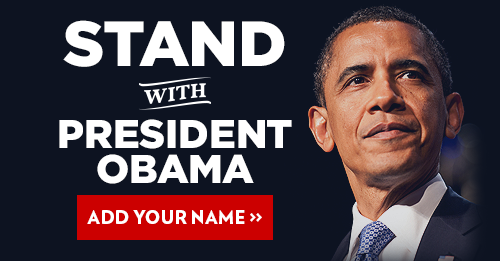
Will you add your name now and say that you’re still standing with President Obama in his final two years in office?

Sign your name to say you’re standing with President Obama:
http:// action.dccc.org/i-stand-with-obama

Pursuing transformative technology with the Google Impact Challenge: Disabilities ~ a repost


GOOGLeWhen Laura Palmaro was 10 years old, she woke one morning to find that the central vision in her left eye had all but disappeared. She was not ill and had no genetic issues—it was completely out of the blue. When she was 14, the same rare condition struck her right eye, and she began her freshman year of high school legally blind. Suddenly she was forced to depend on other people to read everything aloud, from school assignments to menus. The toughest part, according to Laura, was losing her sense of independence—and not knowing when or how she would get it back.

Laura has since adopted technological solutions to her vision challenges, using a combination of screen-readers and magnification software to read, work and more. Now a program manager at Google, she is following her passion, helping Chrome and Chrome OS teams make their products more accessible. “Technology has truly transformed my life,” she says. “Assistive technology can tear down boundaries, and empower people to find their independence and fulfill their dreams.”

We agree with Laura about the power of technology to change lives. And in order to support more people like her—people who see obstacles as opportunities—we’re launching the Google Impact Challenge: Disabilities. We’re putting $20 million in Google.org grants behind nonprofits using emerging technologies to increase independence for people living with disabilities, and today we’re issuing an open call to identify new areas of opportunity at g.co/ImpactChallengeDisability.

We’re kicking things off with support for two remarkable organizations. Each of these organizations is using technology to dramatically reduce the cost of and access to prosthetic limbs and auditory therapy, respectively—which could be transformative for hundreds of millions of people.

  • The Enable community connects people who want prosthetics with volunteers who use 3D printers to design, print, assemble, and fit them, for free. This dramatically cuts costs, increases speed of distribution, and meets unmet needs. We’ll support the Enable Community Foundation’s efforts with a $600,000 grant to advance the design, distribution and delivery of open-source 3D-printed upper-limb prosthetics.
  • Diagnosing auditory challenges can be a struggle in low income communities—the equipment is expensive, bulky and unrealistic, particularly in the developing world. With our support, and a $500,000 grant, World Wide Hearing will develop, prototype and test an extremely low cost tool kit for hearing loss using smartphone technology that’s widely available—and affordable—in the developing world.

The Google Impact Challenge: Disabilities will seek out nonprofits and help them find new solutions to some serious “what ifs” for the disabled community. We will choose the best of these ideas and help them to scale by investing in their vision, by rallying our people and by mobilizing our resources in support of their missions.

But of course, we realize there’s always room to improve our products as well. We have a team committed to monitoring the accessibility of Google tools; and we provide engineering teams with training to incorporate accessibility principles into products and services. That doesn’t just mean improving existing Google tools, it means developing new ones as well. For example, Liftware is a stabilizing utensil designed to help people with hand tremors eat more easily, and self-driving cars could one day transform mobility for everyone.

Historically, people living with disabilities have relied on technologies that were often bulky, expensive, and limited to assisting with one or two specific tasks. But that’s beginning to change. Thanks to groups like Enable and World Wide Hearing, and with tools like Liftware, we’re starting to see the potential for technologies that can profoundly and affordably impact millions. But we’ll all get there sooner if we make it a team effort—which is why we’re launching Google Impact Challenge: Disabilities today. Together, we can create a better world, faster.

Posted by Jacquelline Fuller, Director, Google.org