Tag Archives: United States Congress

the 27th amendment


What is the 27th Amendment:

“No law, varying the compensation for the services of the Senators and Representatives, shall take effect, until an election of Representatives shall have intervened.” –

See more at: http://constitution.laws.com/27th-amendment#sthash.XQKBlcAs.dpuf

Date Proposed:

The 27th Amendment was first proposed on September 25th, 1789

Date Passed:

The 27th Amendment was passed May 7th, 1992

President of the United States Bill Clinton was the President of the United States during the ratification of the 27th Amendment

Stipulations of the 27th Amendment The 27th

Amendment is the most recent constitutional amendment passed; as of 2011, there have been 27 Constitutional Amendments passed with regard to the Constitution of the United States of America

The 27th Amendment addresses the salary rate of members of Congress, which is comprised of a bicameral legislature – the Senate and the House of Representatives The 27th Amendment stipulates that members of the Congress are not permitted to adjust their respective wage earnings in the middle of a term; in the event of a proposed wage adjustment, members of Congress must address any or all concerns with regard to wage adjustment prior to the starting of a new Congressional term

27th Amendment Facts

The 27th Amendment has never been cited within a Supreme Court Hearing The 27th Amendment addresses the adjustment of costs of living with regard to inflation The 27th Amendment is considered to be the Constitutional Amendment with the longest duration of time between the initial proposal and subsequent ratification; the 22nd Amendment is considered to maintain the second-longest duration of 4 years between proposal and passing

States Ratifying the 27th Amendment

1. Alabama 2. Alaska 3. Arizona 4. Arkansas 5. California 6. Colorado 7. Connecticut 8. Delaware 9. Florida 10. Georgia 11. Hawaii 12. Idaho 13. Illinois 14. Indiana 15. Iowa 16. Kansas 17. Kentucky 18. Louisiana 19. Maine 20. Maryland 21. Michigan 22. Minnesota 23. Missouri 24. Montana 25. Nevada 26. New Hampshire 27. New Jersey 28. New Mexico 29. North Carolina 30. North Dakota 31. Ohio 32. Oklahoma 33. Oregon 34. Rhode Island 35. South Carolina 36. South Dakota 37. Tennessee 38. Texas 39. Utah 40. Vermont 41. Virginia 42. Washington 43. West Virginia 44. Wisconsin 45. Wyoming

States Not Participatory in the Ratification of the 27th Amendment

1. Massachusetts 2. Mississippi 3. Nebraska 4. New York 5. Pennsylvania – See more at: http://constitution.laws.com/27th-amendment#sthash.XQKBlcAs.dpuf

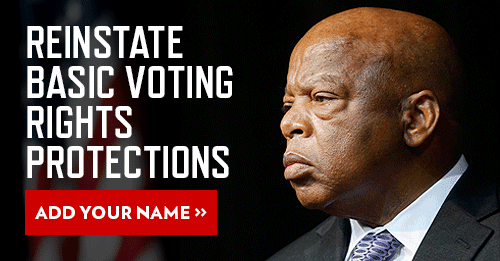
a message from Rep. John Lewis ~Reinstate Voting Rights Protections ~ In Memory


I’m deeply saddened.

If Congress doesn’t act, this will be the first election in 50 years without critical protections from the Voting Rights Act.

the right to vote is precious… even sacred.

That’s why in 1963, I marched on Washington with Martin Luther King for the right to vote.

That’s why in 1965, I gave a little blood on that bridge in Selma, Alabama for the right to vote.

Folks marched for this. Folks fought for this. And some even died for the right to vote.

But today, the vital protections in the Voting Rights Act have been gutted by the conservative Justices on the Supreme Court.

Voting is the most powerful non-violent tool we have in a democratic society. And we’ve got to use it!

Will you demand that Republicans fix the Voting Rights Act?

Thanks,

Congressman John Lewis

  • Hopefully, the VRA becomes Permanent Law,  with a few caveats that direct actions towards States that still feel the need to engage in Racism and or Discrimination on any level during elections Suppressing the Vote! – Nativegrl77

Fashion tips … Handbags


7 Tricks to Ensure Your Handbags Will Last for Years

By Allyson Payer

We’re more willing to splurge on a beautiful designer handbag than on any other wardrobe component, justifying our purchase by saying, “Well, this’ll last me for years,” which brings us to today’s subject: learning how to preserve and properly care for these investment items. Luckily, there are a few simple steps you can take to ensure that your precious satchels are kept in mint condition for years to come.

Scroll down to see our tips, and to shop gorgeous investment bags that you’ll want to protect!

1. Protect The Material:7 Tricks to Ensure Your Handbags Will Last for YearsThe Blonde Salad

Want to shield your new bag from spills and dirt before they happen? Scotchgard Fabric will do the trick for fabric panels, while Scotchgard Suede and Nubuck is a great water and oil repellant for suede. Both Collonil and Chamberlain’s make great leather-protecting products. Apply product with a clean white cotton cloth, followed by a dry cotton cloth to buff. Use products regularly on heavily used bags. With any products, test a small patch on the bag to make sure it doesn’t cause discoloration.

image

Collonil Leather Gel

image

Chamberlain’s Leather Milk

2. Store Them Properly:

image

Le 21eme

Do your bags get tossed onto a haphazard heap at the bottom of your closet? They’ll last longer if stored the right way, ideally in an upright position in their dust bags or a cotton pillowcase. Never store them in plastic or vinyl, which traps moisture inside. Stuff your bags with scarves, sweaters, or acid-free tissue paper, or use a handbag insert made for this purpose. Cross the handles over each other to avoid wear on the bag and unclip any removable straps for long-term storage.

Related: The ONE Mistake Every Handbag Owner Makes

image

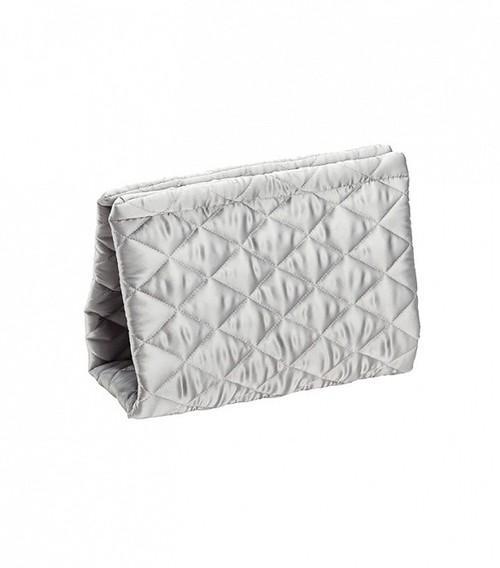
The Container Store Quilted Handbag Shapers

image

The Container Store Linen Handbag Storage Bin

3. Remove Stains the Right Way:

image

Athens Streetstyle

The first step is to know what type of stain you’re dealing with, as that will dictate the removal method. See specific techniques below!

Food stains: Crush white chalk and let it sit on the stain overnight. Brush off with a clean cloth in the morning.

Oil stains: Put cornstarch on the stain immediately, rubbing it in to create heat from friction, which will help the oil absorb. Brush the powder off with a clean cloth after you’ve rubbed it in—don’t let it sit on the stain.

Ink stains: If the stain is fresh, use a white eraser to immediately erase the spot, without applying too much pressure so that the color doesn’t come off. If the ink is already set, you’ll need a professional (see tip #7). An eraser also works for dirt stains.

Water stains: Blot water stains, let them dry naturally, and bring your bag to a professional for removal.

Odor removal: Keep a plastic bag filled with baking soda inside your handbag. Zip the handbag or place it in a larger bag that seals if it doesn’t zip. Keep the baking soda in the bag for one or two days to absorb the odor. Another option? Place a couple of dryer sheets in the bag for a few days.

Related: Heavy Purse? 5 Smart Ways to Lighten Your Load

4. Protect the Lining: 

image

A Love is Blind

Use pouches to store cosmetics and liquids, which will protect the handbag lining from spills and keep you organized to boot. Avoid click pens at all cost, opting for pens with caps instead. Better yet, put those in your pouch too, in case of dreaded ink leaks.

image

Comme des Garçons Star Embossed Small Pouch

5. Keep Metal Hardware Shiny:

image

A Love is Blind

Do your best to keep away jewelry and zippers that could scratch your bag’s metal hardware. A go-to household item, Mr. Clean’s Magic Erasers, do a great job of cleaning up tarnished and grimy hardware.

Related: 14 Items Every Woman Should Have In Her Purse

6. Practice Routine Maintenance: 

image

Athens Streetstyle

Here are a few best practices when it comes to daily handbag maintenance:

1. Avoid handling your bag if your hands are dirty or have lotion or cream on them.
2. Keep your bag out of direct sunlight.
3. Rotate which handbag you carry regularly so that they don’t wear out too quickly.
4. Use a suede brush to clean and revive suede.
5. Regular use of a leather moisturizer will keep the leather supple and free of cracks.
6. Wipe your bag down on a weekly basis (when in use) with a soft cloth.

7. Take It to a Professional:

image


A Love is Blind

For stains and wear and tear beyond your handbag maintenance skill set, take it to a handbag repair professional. Most shoe repair professionals also work on handbags. They’ll treat it for you, clean it, and restore color as needed. If your bag doesn’t have metal feet on the bottom, it’s wise to have those installed, as they’ll protect it from scratches and dirt.

Related: Your Ultimate Guide to Fall’s Must-Have It-Bags

Shop Investment Handbags:

image

A.P.C. Edith Leather Shoulder Bag

A structured black bag will take you from day to night. Bonus points for sleek gold hardware.

image

Chloe Large Drew Grained Leather Shoulder Bag

All the cool girls are wearing this It-bag with a cool yet classic vibe.

Related: Is THIS The New It-Bag for Fall?

image

M2Malletier Memento Mori Bag

This slightly larger version of M2Malletier’s popular clutch style is perfect for everyday wear.

image

Building Block Bucket Bag

Buttery forest green leather and oversized tassels join forces to create a perfectly quirky bucket bag for fall.

image

Mark Cross Laura Leather Shoulder Bag

Boxy shapes are in for fall, so tap into the trend with this structured Mark Cross version.

image

Rag & Bone Haircalf Bradbury Small Flap Hobo

This leopard calf-hair bag makes a subtle statement and gives a luxe feel to any outfit.

21st Century … Colonialism


Residual Colonialism In The 21St Century …

  The 21st century deserves better. More importantly, the nearly 2 million people still living under colonial rule deserve better.

Article
definitely a repost
  • 2012•05•29

    John Quintero

    Residual colonialism in the 21st centuryPhoto: DB King

    Though colonialism is generally considered to be a relic of the past, nearly 2 million people in 16 “non-self-governing territories” across the globe still live under virtual colonial rule.  In recognition of the United Nations International Week of Solidarity with the Peoples of Non-Self-Governing Territories (25–31 May), we present this analysis of “residual colonialism in the 21st century”.

    ♦ ♦ ♦

    In 2009, the Government of the United Kingdom (UK) suspended parts of the Constitution of the Turks and Caicos Islands (TCI), a British Overseas Territory, in response to allegations of systemic corruption in the territory. Direct rule from London was imposed over the democratically elected local government. This unilateral, top-down action removed the constitutional right to trial by jury, suspended the ministerial government and the House of Assembly, and charged a UK-appointed Governor with the administration of the islands.

    A tentative period for elections has been given (fall 2012 at the earliest), but this is subject to the deliberation of the British government and tied to a series of specific milestones that must be met. These announcements provoked protests and demonstrations by the islanders. The suspension of the TCI government over corruption allegations seems to run contrary to the way in which financial and governance crises are handled around the world, including in the UK itself. Scandals are part of political life, but constitutions are not suspended nor are democratically elected governments and institutions disbanded.

    How is it that these events have occurred in a world based on a system of supposedly equal sovereign states? The answer lies in the little known fact that colonial structures continue to exist even today in some parts of the world.

    Continuing colonialism

    The wave of decolonization that swept around the world in the latter half of the 20th century was once heralded as one of the great liberating movements in history. Yet, few seem to realize that colonialism is still with us. As of 2012, 16 territories are deemed still to be under colonial rule and are labeled by the United Nations as “non-self-governing territories (NSGTs)” — areas in which the population has not yet attained a full measure of self-government.

    The 16 NSGTs, home to nearly 2 million people, are spread across the globe. They remain under the tutelage of former colonial powers (currently referred to as “administering powers”), such as the UK, the USA and France.

    Most of the NSGTs feature as only small dots on the world map but are in fact prominent players on the world stage. Some act as the world’s leading financial centres, with GDP per capita amongst the world’s top 10 (e.g., the Cayman Islands and Bermuda), some constitute vital bastions for regional security (e.g., Guam), and there are those whose geographical location has made them prone to diplomatic disputes (e.g., Gibraltar and the Falklands/Malvinas).

    A UN committee on decolonization does exist (Special Committee of 24 on Decolonization), under the purview of the Fourth Committee of the United Nations General Assembly (Special Political and Decolonization Committee). Its mission is to oversee the implementation of the Declaration on the Granting of Independence to Colonial Countries and Peoples (14 December 1960).

    The world underwent a political renovation following the formation of the United Nations in 1945, and the number of sovereign UN Member States has skyrocketed from the original 51 to 193. However, the 50-plus years since the founding of the United Nations have proved to be insufficient to eradicate a centuries-old structure of dominance. This is in spite of the advancement of legal systems based on the notions of the sovereign equality of states and human rights prevalent in the contemporary world.

    Decolonization, as bluntly put by UN Secretary General Ban Ki-moon, remains an unfinished business; an unfinished process that has been with the international community for too long. In solidarity with the peoples of the NSGTs, the present decade (2010-2020) has been declared the Third International Decade for the Eradication of Colonialism (as the past two decades have proved inadequate to ensure the disappearance of such an archaic concept).

    Independence is not the only option

    The doctrine of self-determination and political equality has prevailed as the guiding principle for decolonization ever since the inception of the United Nations. Much progress has been achieved and political autonomy for many former dependent states (micro-states, even) has been realized, but the decolonization process remains stalled. No territory has achieved self-government since East Timor (now Timor-Leste) won full independence from Indonesia in 2002.

    The many achievements of decolonization by the United Nations cannot be considered truly global while some peoples continue to live under colonial rule. Administering states such as the UK and France continue to exercise top-down authority through modernized dependency governance models that, while perhaps ensuring sustained economic progress, create a democratic deficit and political vulnerability based on unequal status.

    The decolonization agenda championed by the United Nations is not based exclusively on independence. There are three other ways in which an NSGT can exercise self-determination and reach a full measure of self-government (all of them equally legitimate): integration within the administering power, free association with the administering power, or some other mutually agreed upon option for self-rule.

    The current impasse is due, in part, to the denial by the administering states of these options, but also to a lack of public awareness on the part of the peoples of the NSGTs that they are entitled to freely determine their territory’s political status in accordance with the options presented to them by the United Nations. It is the exercise of the human right of self-determination, rather than independence per se, that the United Nations has continued to push for.

    ColonizedNon-Self-GoverningThe framework against colonialism

    International law provides a particularly effective conceptual framework from which to criticize these complex dependency arrangements. In the UN Charter, not only Articles 1 and 55 maintain that one of its fundamental purposes and principles is “to develop friendly relations among nations based on respect for the principle of equal rights and self-determination of peoples”. A further three chapters of the Charter are devoted to the dependent territories, namely Chapter XI (Declaration regarding Non-Self-Governing Territories), Chapter XII (International Trusteeship System) and Chapter XIII (The Trusteeship Council).

    Core human rights conventions, such as the International Covenant on Civil and Political Rights (ICCPR) and the International Covenant on Economic, Social and Cultural Rights (ICESCR) both affirm the right of self-determination and that the states parties to the covenants have the responsibility to promote the realization of self-determination, in conformity with the provisions of the Charter of the United Nations. Colonialism has been formally delegitimized as an acceptable international practice, as per the Declaration on the Granting of Independence to Colonial Countries and Peoples (General Assembly Resolution 1514 [XV]) in 1960 and a companion resolution defining the three legitimate models of political equality (General Assembly Resolution 1541 [XV]). Further resolutions, for example, established permanent sovereignty over natural resources (General Assembly Resolution 1803 [XVII]).

    In October 1970, UN General Assembly Resolution 2621 (XXV) declared that the further continuation of colonialism in all its forms and manifestations is a crime, and in 1977 General Assembly Resolution 32/14 reaffirmed the legitimacy of the struggle of peoples for independence, territorial integrity, national unity and liberation from colonial and foreign domination and alien subjugation by all available means, including armed struggle.

    The road ahead

    Colonialism made the political world map look much as it does today, drawing up borders with no regard for local sensibilities and realities. It negated or purposefully misconceived the cultural, economic, political and social conditions under which the colonized led their lives. In the process, colonial powers imposed inappropriate identities on the people they ruled, crippling peoples’ self-esteem, thus diminishing their self-efficacy and potentially stunting their long-term social development.

    Given the modern emphasis on the equality of states and inalienable nature of their sovereignty, many people do not realize that these non-self-governing structures still exist. Thus, the world has closed its eyes to continuing colonial dependence.

    World media has the potential to play a pivotal role in advancing decolonization by exposing developments that infringe on the exercise of the right of self-determination and that worsen the political vulnerability of the NSGTs. The issue at hand is not that colonialism does not exist in today’s world because the populations of these territories overwhelmingly do not define these territories as colonies. Rather, it is that these populations have not been provided with an opportunity to decide on a legitimate political status through popular consultation in the form of an acceptable act of self-determination. Once this is made sufficiently clear, media coverage and overview can be expected.

    In light of the disbandment of an overseas democratically elected government in TCI, the international community, the public in general and the peoples of the NGSTs alike have been reminded that the UN agenda on colonialism is very much relevant and crucial — -not only for the protection of fundamental human rights, but to democratic governance and an international order principled upon the notions of sovereignty and the equality of states.

    One of the greatest and most visible achievements of the United Nations has been to pursue the decolonization of the colonized world. However, a successful end to this process cannot be based on simply removing territories from the UN list of NSGTs (de-listing), but rather on the actual achievement of full self-government.

    De-listing cannot be perceived as the goal, but rather as a secondary product resulting from clear indicators of self-government, political equality vis-à-vis the administering state, and the promotion and support of genuine political education programmes that allow the populace of those territories to freely choose their status and their future. Not doing so would result in stymieing the legitimate aspirations of peoples whose human rights the United Nations was created to protect.

    Colonialism is a concept of an exploitative past that runs counter to the principles of sovereign equality on which the United Nations is grounded. As commonly expressed in General Assembly debates, colonialism is anachronistic, archaic, and outmoded; it contravenes the fundamental tenets of democracy, freedom, human dignity and human rights.

    The 21st century deserves better. Most importantly, the nearly 2 million people still living under colonial rule deserve better.

    Black History Month

6 tips …


WordPressDancing-3.

6 tips for putting words to music

 I am not a songwriter musician or lyrist, but I love to read definitely listen and more often than not dance to the spoken word when put to music.

 My personal interest is in the art of movement, specifically dance;  when music is combined with words in innovative patterns can soothe invigorate irritate as well as make you move and feel good.

 They say Music is said to soothe the savage beast least we talk about when done right …  Words can touch our souls and that also awakens our senses. Most of us can agree that the art of dance and or music transcends language barriers.

So, my six tips are below …

 (1) Make it personal because reading experiences about a one night stand love at first sight, first love, lust, a long term love brings a sense of connection folks sometimes look for and set to music can only enhance a good lyric . .Right

2) Be yourself  folks do go out their way to learn the lyrics to a song and will like love and feel  the performer is genuine in their delivery and not trying to be something else,  can actually be heard seen felt 

3) The kind of music that makes an impression also provides imagery and a vision of something the song is about; even if it is abstract, the image is sort of like a coffee table object.  Always up for interpretation depending on who is listening to reading or learning the lyrics … of course, when it comes to love … when someone is singing to you … take time to listen; I heard that once and then again you may have heard the song but weren’t feeling the music

 (4) Rhymes Reason and Rhythm because who doesn’t like the art of movement …and more often than not that is what kind of music makes great artist move up into the stratosphere … in my opinion. I dance because I have to and anything that has a great hook a great bass or syncopation definitely will be played more than once in my house. The rhythm of life

 (5) Always assume a video of your creation is a possibility so … be that visionary

 (6)     🙂  Always believe you were born to make music  (:


So, what makes you get onto the dance floor … 

first posted in 2013, def tweaked