
1989 Tiananmen Square massacre takes place
1934 FDR asks for drought-relief funds
1919 Congress passes the 19th Amendment
1876 Express train crosses the nation in 83 hours
1862 Confederates evacuate Fort Pillow

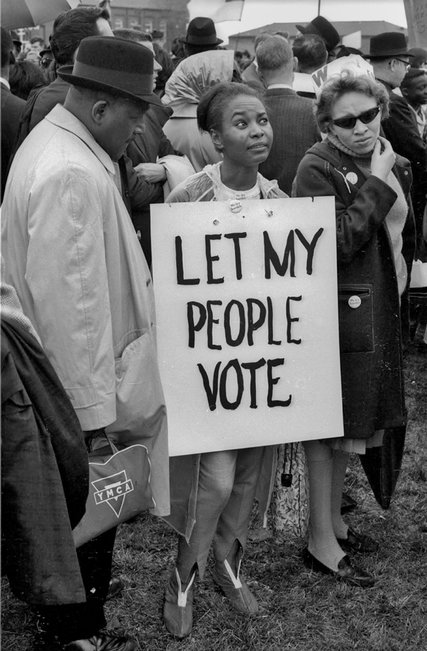
by Martin Luther King, Jr.
Speech given before the Lincoln Memorial at the March on Washington, May 17, 1957
Three years ago the Supreme Court of this nation rendered in simple, eloquent and unequivocal language a decision which will long be stenciled on the mental sheets of succeeding generations. For all men of good will, this May 17 decision came as a joyous daybreak to end the long night of segregation. It came as a great beacon light of hope to millions of distinguished people throughout the world who had dared only to dream of freedom. It came as a legal and sociological deathblow to the old Plessy doctrine of “separate-but-equal.” It came as a reaffirmation of the good old American doctrine of freedom and equality for all people.
Unfortunately, this noble and sublime decision has not gone without opposition. This opposition has often risen to ominous proportions. Many states have risen up in open defiance. The legislative halls of the South ring loud with such words as “interposition” and “nullification.” Methods of defiance range from crippling economic reprisals to the tragic reign of violence and terror. All of these forces have conjoined to make for massive resistance.
But, even more, all types of conniving methods are still being used to prevent Negroes from becoming registered voters. The denial of this sacred right is a tragic betrayal of the highest mandates of our democratic traditions and its is democracy turned upside down.
So long as I do not firmly and irrevocably possess the right to vote I do not possess myself. I cannot make up my mind — it is made up for me. I cannot live as a democratic citizen, observing the laws I have helped to enact — I can only submit to the edict of others.
So our most urgent request to the president of the United States and every member of Congress is to give us the right to vote. Give us the ballot and we will no longer have to worry the federal government about our basic rights. Give us the ballot and we will no longer plead to the federal government for passage of an anti-lynching law; we will by the power of our vote write the law on the statute books of the southern states and bring an end to the dastardly acts of the hooded perpetrators of violence. Give us the ballot and we will transform the salient misdeeds of blood-thirsty mobs into calculated good deeds of orderly citizens. Give us the ballot and we will fill our legislative halls with men of good will, and send to the sacred halls of Congressmen who will not sign a Southern Manifesto, because of their devotion to the manifesto of justice. Give us the ballot and we will place judges on the benches of the South who will “do justly and love mercy,” and we will place at the head of the southern states governors who have felt not only the tang of the human, but the glow of the divine. Give us the ballot and we will quietly and nonviolently, without rancor or bitterness, implement the Supreme Court’s decision of May 17, 1954.
<!–Read about recent allegations of voter disenfranchisement in Florida
and other states across the country in these articles.
17
–>
Learn more about Martin Luther King, Jr. and read more of his speeches and writings at The Martin Luther King, Jr. Papers Project at Stanford University.
Resources: pbs.org
Memorial Day weekend has hosted several important developments in the world of criminal justice. Today, the Cleveland Police department—which has come under fire in recent months in the nationwide debate over police tactics—agreed to follow some of the strictest standards in the nation over its officers’ use of force. Cleveland agreed to the terms as part of a settlement reached with the Department of Justice over what justice officials called a “pattern of unconstitutional policing and excessive use of force.”
According to the Justice Department’s report, the Cleveland police department used stun guns inappropriately, punched and kicked unarmed people, shot at people who did not pose a threat, and failed to report or investigate most of these incidents. As a part of the settlement, Cleveland agreed to some of the most rigorous policing standards in the nation. These include:
The settlement comes just two days after a white Cleveland officer who fired at least 49 shots at two unarmed African Americans was acquitted of manslaughter by an Ohio judge. Officer Brelo’s acquittal—as the latest in a series of troubling racially charged incidents across the US in places like Baltimore, Staten Island, and Ferguson, MO—prompted protests that remained largely peaceful but still resulted in the arrest of 71 people.
Some bad news also came out of the criminal justice sphere this weekend. On Friday, Maryland Governor Larry Hogan vetoed three important criminal justice reform bills. In addition to vetoing a bill to limit civil asset forfeiture, and a bill to remove the penalty for marijuana paraphernalia, Hogan also vetoed a felon re-enfranchisement bill that would have restored voting rights to 60,000 ex-felons. Restoring access to the ballot for ex-felons is a priority in the criminal justice reform community and Hogan’s veto will serve as an important test to see whether reform advocates will show that choices like Hogan’s can have political repercussions.
BOTTOM LINE: Agreements like the one made between Cleveland and the Department of Justice have the potential to create meaningful change to a flawed system. But as Gov. Hogan’s vetoes remind us, there is much more work to be done to convince some elected officials to do their part.
 by uslegal.com
Stop and frisk is when police “temporarily” detain somebody and pat down their outer clothing when there are specific articulate facts leading a reasonable police officer to believe a person is armed and dangerous. It is not necessary for the officer to articulate or identify a specific crime they think is being committed, only that a set of factual circumstances exist that would lead a reasonable officer to have a reasonable suspicion that criminal activity is occurring. “Reasonable suspicion” is one step below “probable cause” and one step above a hunch.
A “frisk” by definition is a type of search that requires a “lawful stop”. It is best thought of as a separate act, but in practice, a suspect who refuses to answer questions in a stop may be providing the officer with sufficient justification to frisk. A frisk should not be for anything other than a dangerous weapon or contraband. However, if other evidence, like a suspected drug container, is felt, it can be seized by the officer under the “plain feel” doctrine. The test for “plain feel” is that the item’s contraband nature be “immediately apparent”.
Resource: uslegal.com
One of several problems with stop & frisk, is that most if not all Police demand name, address, question people of colour when in upper income communities and or assume gang affiliation least we talk about the percentage of Black Latino Asian or Caucasian men&women being stopped on a daily basis … is it a quota, a civil rights issue, a misuse or abuse of power ~ Nativergrl77
The North Carolina Racial Justice Act of 2009
Prohibited seeking or imposing the death penalty on the basis of race. The act identified types of evidence that might be considered by the court when considering whether race was a basis for seeking or imposing the death penalty and established a process by which relevant evidence might be used to establish that race was a significant factor in seeking or imposing the death penalty. The defendant had the burden of proving that race was a significant factor in seeking or imposing the death penalty, and the state was allowed to offer evidence to rebut the claims or evidence of the defendant. If race was found to be a significant factor in the imposition of the death penalty, the death sentence would automatically be commuted to life imprisonment without the possibility of parole.[1]
North Carolina General Assembly Repeal Attempts [edit]
Under pressure from a group of 43 district attorneys, who expressed opposition to the act citing the clog of the court system in the state, the North Carolina Senate passed a bill by a 27-14 vote on November 28, 2011, that would have effectively repealed the Racial Justice Act.[2]
However, on December 14, Governor Bev Perdue, a Democrat, vetoed the bill, saying that while she supports the death penalty, she felt it was “simply unacceptable for racial prejudice to play a role in the imposition of the death penalty in North Carolina.”[3] The state legislature did not have enough votes to override Perdue’s veto.
The North Carolina General Assembly passed a major revision of the law in 2012 authored by Rep. Paul Stam (R-Wake). The rewrite “severely restricts the use of statistics to only the county or judicial district where the crime occurred, instead of the entire state or region. It also says statistics alone are insufficient to prove bias, and that the race of the victim cannot be taken into account.” The bill was vetoed by Gov. Perdue, but this time, the legislature overrode the governor’s veto.[4]
The North Carolina General Assembly voted to effectively repeal the entire law in 2013 and Gov. Pat McCrory, a Republican, signed the repeal into law.[5]
On April 20, 2012, in the first case appealed under the Racial Justice Act, the then-Senior Resident Superior Court Judge in Cumberland County (Fayetteville), Judge Greg Weeks, threw out the death sentence of Marcus Raymond Robinson, automatically commuting his sentence to life without parole. Robinson contended that when he was sentenced to death in 1994, prosecutors deliberately kept blacks off the jury. Robinson’s lawyers cited a study from Michigan State University College of Law indicating that prosecutors across North Carolina improperly used their peremptory challenges to systemically exclude qualified black jurors from jury service.[6][7][8]
Resource …wiki
so, I do not know how accurate this is


You must be logged in to post a comment.