Tag Archives: United States

10 Reasons Dish Soap May Be the Only Product You Need?


===================================================================================

If you think dish soap is just a boring kitchen essential, well, we hate to burst your bubble.

That little inexpensive plastic bottle of Joy or Palmolive (or store brand, if you’re thrifty) is actually far more useful than we give it credit for! Not only can you clean a sink-full of dirty dishes with it, you can do everything from lightening your hair color to ridding your pets of fleas!

Instead of heading to the supermarket and spending a small fortune on products that fix squeaky hinges, kill the weeds in your lawn and clean your air conditioning units, use that inexpensive bottle of dish soap you already have to handle all of that.

1)

Remove Carpet Stains

 Mix dish soap with warm water (approximately 1 tablespoon to 2 cups) and blot the stain with the solution. Continue to do so until the stain has lifted. To remove residual soap, simply sponge the area with a damp sponge or cloth.

2)

Get Your Hair Squeaky Clean

If your shampoo is not cutting it and the natural build-up of oil is causing your hair to look a little lackluster, wash it with dish soap. This grease fighter will eliminate what your shampoo has left behind. Lather, rinse and follow up with shampoo.

3)

Fight Grease Stains on Shirts

You don’t have to invest in stain fighters – just use dish soap. Simply squirt a drop or two on the grease stain and let it work its magic overnight. Once it’s had time to work the stain, wash your shirt as usual.

Photo: Fuse, Thinkstock

4)

A Longer Lasting Manicure

Did you know the natural oils around your nails can shorten the life of your manicure, if you don’t eliminate them pre-polish? Soak your fingers in a bowl of warm water and a few drops of dish soap before you add your polish. Just make sure you dry your hands thoroughly before you paint them.

Photo: Gubcio, Thinkstock

5)

Fix Hair Color Overload

If you’ve colored your hair at home and took it a few shades to dark, dish soap can save a bad situation. Wash your hair with this miracle product to lighten color.

Photo: Ra3nr, Thinkstock

6)

Lubricate Those Squeaky Hinges

Add a drop or two of dish soap to any hinge that’s making a sound when it shouldn’t. No need to rinse it off – just let it work its magic.

Photo: Luknaja

7)

Clean Your Air Con Unit to Stay Cool

The filters on your air conditioning unit attract dust and all manner of dirt and if you don’t keep them clean, you’re breathing all that in. Remove the filters from your unit, soak them in warm water and dish soap and give them a gentle scrub. Once they’re clean, dry them completely and return them to the unit. You’ll be nice and cool and breathing clean air at the same time.

Photo: Adrian825, Thinkstock

Read More
8)

 If your furry friend is suffering a flea infestation, bathe him using a healthy amount of dish soap, which will dry out and kill the fleas.

Photo: Laures, Thinkstock


 9)

Kill Weeds Without Harsh Chemicals

The last thing you want is to douse your lawn and plants in heavy duty chemicals. Mix a little bit of dish soap with ¼ – ½ cup of coarse salt in a spray bottle and fill to the top with distilled white vinegar. Spray the troublesome areas and watch weeds wither away.

Photo: Wylius, Thinkstock

10)

Create an Ice Pack

Fill a freezer sandwich bag with dish soap and freeze it completely. It’s ideal for bumps and bruises as well as keeping a lunchbox chilled. Dish soap takes longer to melt than water.

Photo:  Stockbyte, Thinkstock

Google Maps ~~ Change.org


Petitioning Google, Inc, Larry Page

Remove maps to secret domestic violence shelters.

Petition by Jeremy Janice
Lafayette, Louisiana
55,520
Supporters

A Visit to the White House Kitchen Garden:


The President awards the Medal of Honor.

Parents, staff, and students tour the White House Kitchen Garden on the South Grounds of the White House after participating in a “Let’s Move!” event preparing and eating a garden harvest with the First Lady in the East Room of the White House, June 3, 2015. (Official White House Photo by Lawrence Jackson)

See more from our “Photo of the Day” gallery here.


5 Photos: The President Awards the Medal of Honor to Sergeant William Shemin and Private Henry Johnson

On Tuesday, in a ceremony at the White House, President Obama awarded the Medal of Honor posthumously to Army Sergeant William Shemin and Army Private Henry Johnson for conspicuous gallantry during World War I.

READ MORE

Our Continued Commitment to America’s Foster Youth

Last month was National Foster Care Month. It provided us an important opportunity to highlight the many ways that the Administration has worked to stem the often disproportionate, unfair, and heartbreaking challenges facing our foster youth, and to provide them the equal opportunity for success that they deserve. We want them to know they are not alone.

READ MORE

5 Facts You Should Know About the Role Trade Plays on America’s Farms and Ranches

Without the expanded trade that came with past trade agreements, the agricultural economy and the American economy as a whole would not be as strong as it is today. But new trade agreements are only possible if our negotiators can speak with one voice to negotiate free and fair trade deals. Trade Promotion Authority (TPA) — now being considered in Congress — allows them to do just that.

READ MORE


Southern Rites: The Heartbreaking Story of Justin Patterson’s Death


Wh<i>Best viewed in full screen mode</i><br>Julie and Bubba, 2002en Gillian Laub started photographing the racially divided town of Mount Vernon, Ga. — with its segregated homecomings and proms — she stumbled onto the story of Justin Patterson, a 22-year-old black man who was killed, on Jan. 29, 2011, by Norman Neesmith, a 62-year-old white man.

posted in Time

Patterson’s story, which further divided Mount Vernon, is the subject of Southern Rites, a HBO documentary premiering on May 18.

Dedee Clarke, Justin’s mother, spoke to TIME.

In HBO’s Southern Rites, photographer Gillian Laub goes to Mount Vernon, Ga., a racially divided town

Gillian Laub:Sha’von, Justin and Santa, 2012

“When I got the call, it was around 3.45 in the morning and my youngest son, Sha’von, said that Justin had been shot and he was dead… For a long time, Sha’von wouldn’t talk about it, he would only tell me things in bits and pieces. It wasn’t until 2013 that he told me the whole story. I think that the thing that bothered him the most was that the gun was actually aimed at him. Justin looked back, saw that and pushed Sha’von out of the way and took the shot himself. It’s something I don’t think he’ll really recover from. He just has to learn to live with it. It’s a day-by-day process, but I don’t think anybody can ever be the same.

The first time I met Gillian was in 2010. My youngest son, Sha’von, was attending the prom that year, and she was photographing it. I thought the work she was doing was great. But I didn’t know that much about her, I just knew that the pictures that she was taking were important. I didn’t get to know her on a deeper level until my son, Justin, died.

[When Gillian shifted her focus to what had happened to Justin], I was, at first, a little reluctant. But I could just see her passion and drive as she talked to me and I knew at that point that she really cared. I was more relaxed around her and I began to open up. But I just remember saying that it wasn’t going to be pretty sight because I was just not in the right state of mind, and she understood that.

You have to feel some kind of compassion when you do this. And Gillian had that; she felt it. And because she felt it, I believed that shows in her work.

Of course, it was very difficult to see Norman Neesmith in Gillian’s film. I had always made it a point not to really look directly at him. And to see him up close and personal in the film, it was very hard. It was hard to watch some of the things that he said. It’s just hard to hear that he never really acknowledged that his daughter invited them into his home. I felt that he thought he was a victim. I don’t think he understands that Justin had a life. He had a daughter. And she will never have her father.

Gillian’s work makes me feel that my son’s death was not in vain. That’s the one thing that I can hope for. I’m hoping that it will help someone. It’s too late for my son, but maybe it can help somebody else.

I’m hoping it will help other mothers to see that you can still survive that kind of pain and. I’m a survivor because God says I am. Everything that I believe in is because of God. He’s the reason that I’m here because there’s no way I could have done any of this by myself. I felt like nobody really cared because the story wasn’t out. It was a while before it was even in a paper. To see it now and to know that people really care, it does make me feel supported. It definitely does. I’m thinking that everyone will have an idea of what happened. This is real life. These people are real people; they feel that pain continuously every day.

My goal here is for people to know and understand that there’s still, very much so, a lot of injustice in this world and something has to be done about it.”

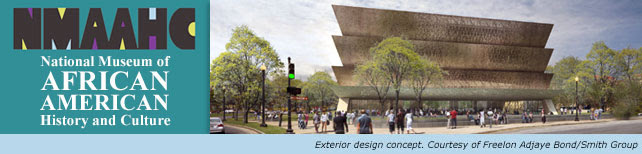
NMAAHC: Edison R. Wato, Jr., Membership Program Manager


NMAAHC -- National Museum of African American History and Culture

NMAAHC involved in the historic Slave Wrecks Project 
Iron ballast used to weigh down the ship

Objects from a slave ship that sank off the coast of Cape Town in 1794 will be on long-term loan to the Smithsonian’s National Museum of African American History and Culture (NMAAHC). The announcement, took place at a historic ceremony at Iziko Museums of South Africa. The discovery of the ship marks a milestone in the study of the trans-Atlantic slave trade and showcases the results of the Slave Wrecks Project, a unique global partnership among museums and research institutions, including the NMAAHC and six partners in the U.S. and Africa.

Objects from the shipwreck—iron ballast to weigh down the ship and its human cargo and a wooden pulley block—were retrieved this year from the wreck site of the São José-Paquete de Africa, a Portuguese slave ship that sank off the coast of Cape Town on its way to Brazil while carrying more than 400 enslaved Africans from Mozambique.

Lonnie G. Bunch III, founding director of NMAAHC, and Rooksana Omar, CEO of Iziko Museums, joined in the announcement of the shipwreck’s discovery and the artifact loan agreement.


Underwater  Archeology

Founded in 2008, Slave Wrecks Project (SWP) brings together partners who have been investigating the impact of the slave trade on world history. It spearheaded the recent discovery of the São José wreck and the ongoing documentation and retrieval of select artifacts. In addition, extensive archival research was conducted on four continents in six countries that ultimately uncovered the ship captain’s account of the wrecking in the Cape archives as well as the ship’s manifest in Portuguese archives.

SWP, established with funding from the Ford Foundation, set a new model for international collaboration among museums and research institutions. It has been combining groundbreaking slave shipwreck investigation, maritime and historical archeological training, capacity building, heritage tourism and protection, and education to build new scholarship and knowledge about the study of the global slave trade.

The São José’s voyage was one of the earliest in the trans-Atlantic slave trade from East Africa to the Americas, which continued well into the 19th century. More than 400,000 East Africans are estimated to have made the Mozambique-to-Brazil journey between 1800 and 1865. The ship’s crew and some of the more than 400 enslaved on board were rescued after the ship ran into submerged rocks about 100 meters (328 feet) from shore. Tragically, more than half of the enslaved people perished in the violent waves and those who were saved were resold into slavery in the Western Cape.

The São José wreck site is located between two reefs, a location that creates a difficult environment to work in because it is prone to strong swells creating challenging conditions for the archaeologists. To date, only a small percentage of the site has been excavated; fully exploring the site will take time.

Sincerely,
edison signature
Edison R. Wato, Jr.
Membership Program Manager

P.S. Follow any of the links below for more information on the NMAAHCs involvement in this historic project. Follow this link to watch a video about the project.

Washington Post: Humble Objects that Tell a Powerful Story
New York Times: Grim History Traced in Sunken Slave Ship Found Off South Africa
New York Times: Finding a Slave Ship, Uncovering History
CNN: Wreck of 18th Century Slave Ship Discovered
SI Press Release: NMAAHC To Display Objects from Slave Shipwreck Found Near Cape Town, South Africa