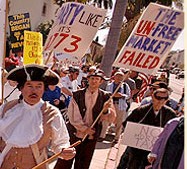
In the last couple weeks Ken Buck has spent a lot of time trying to walk back the extreme positions he took to win support from the Tea Party. But we think it’s important for Coloradans to hear what Ken Buck really believes.

In the last couple weeks Ken Buck has spent a lot of time trying to walk back the extreme positions he took to win support from the Tea Party. But we think it’s important for Coloradans to hear what Ken Buck really believes.

Forget the “enthusiasm gap.” Here’s the real story about who is more fired up and ready to go — just as our campaigns shift into GOTV (get-out-the-vote) mode.
Reports are coming in from across the country of record early voting turnout in key states like Ohio and Iowa — with Democratic turnout far outpacing our opponents.
On Saturday, OFA volunteers reached out to more than 1 million voters in a single day — levels we haven’t seen since the closing days of the presidential campaign two years ago.
And on Sunday night, Barack and Michelle Obama spoke to more than 35,000 Ohioans about these final two weeks. It was the largest rally since the inauguration.
But none of that will be enough unless we continue building through the final days of this election.
Will you sign up to fill a crucial GOTV shift in the final four days of our Vote 2010 campaign?

As the President said in Columbus,”there’s no more important time to be out there knocking on doors, making phone calls, and helping voters get to the polls” than on the Saturday, Sunday, and Monday before Election Day — and on Election Day itself, November 2nd.
Supporters across the country will come together in the final days to help eke out every last vote we can — from the grandmother who would like nothing more than to vote and just needs a ride, to that last call to convince a first-time voter from 2008 that he needs to get back to the polls this year.
And from New York to California, Alaska to Florida — and everywhere in between — there are key races that will need every ounce of energy you can spare.
Please sign up to help in the closing days of this campaign:
http://my.barackobama.com/ShiftGOTV
Thanks,
Mitch
Mitch Stewart
Director
Organizing for America
|
||||||||
THIS WEEK on CHANGE.ORG Voting Rights ViolatedPlus: Free Eddy Zheng • Chicago’s Wonder Women • Pink Ribbon Hypocrisy • Abercrombie’s Child Labor • Sidewalk Sitting Ban
Election Day is near, and candidates across the country are busy traversing their districts in yet another election that will likely be decided by voter turnout. But voting in the United States has never been as easy as simply showing up at the polls – and in some states it’s getting more difficult in ways that disproportionately affect immigrant and minority voters. The poster child for this trend is Georgia under Republican Governor Sonny Perdue. Just before the 2008 election, the Department of Justice was forced to intervene to block a flawed voter-verification process in the state that inaccurately flagged thousands of Georgia residents as non-citizens, denying them the right to vote. This election, Georgia is once again planning an extensive new voter-verification process that voting rights advocates say could effectively disenfranchise thousands of citizens. But this time the state hasn’t stopped at its attempt to implement more barriers to voting. Instead, it has also challenged the bedrock provision of the Voting Rights Act of 1965 that requires jurisdictions with a history of racial discrimination in voting to submit proposed voting changes for federal pre-approval to ensure that they are free from discrimination. This is part of a disturbing movement of states with a dark history of voting discrimination – including Alabama, North Carolina and Texas – that are proposing newly restrictive voting measures that disproportionally impact minority voters while simultaneously challenging the Voting Right Act’s provision requiring they receive approval from the courts. We’ve made dramatic progress in reducing discrimination in our electoral system in the four decades since the Voting Rights Act was passed. But there are still reports of irregularities and racially-charged voter suppression in almost every election, and in that context challenges to the most important voting rights legislation ever passed in the United States should concern everyone. That’s why with Election Day only two weeks away, we’re joining with our friends at the NAACP Legal Defense Fund in urging our national leaders to affirm the breadth and depth of the Voting Rights Act and prevent the disenfranchisement of minority voters. Please add your voice in support of the voting rights of all Americans today. For more news and commentary on this week in change, see the summaries of your favorite causes below. |
||||||||
Free Eddy Zheng in IMMIGRANT RIGHTS Eddy Zheng was sentenced to over two decades in jail at the age of 16, in a process language barriers prevented him and his family from fully understanding. Since his release, he has distinguished himself as a leader in prisoner rehabilitation and youth violence prevention, winning the appreciation of the San Francisco mayor and other elected officials. Yet, as a non-citizen, he faces deportation for his ancient crime. Zheng has applied for a governor’s pardon, and you can help him win it. Read more » |
||||||||
Chicago’s Wonder Women in EDUCATION If you’ve seen the documentary Waiting For Superman, you know that America’s education system is in crisis. What happens when a group of moms take things into their own hands? Since September 15, moms from the South Side of Chicago have staged a sit-in to demand a school library for their children. Chicago Public Schools plans to knock down an old building and replace it with a field, but the moms want to turn it into a community center. Read more » |
||||||||
Pink Ribbon Hypocrisy in HEALTH It’s National Breast Cancer Awareness Month, and alcohol companies are asking women to booze it up for the disease. But the irony is sobering: alcohol directly contribute to breast cancer. Will the pink-ribbon labels come clean and tell consumers of the health risks or remain defined by their duplicity? Read more » |
||||||||
Abercrombie’s Child Labor in END HUMAN TRAFFICKING Despite international condemnation, the government of Uzbekistan continues to remove millions of children from schools across the country and force them to pick cotton in arduous conditions. Sixty-five of the world’s largest apparel brands have refused to buy Uzbek cotton picked by forced child labor. But ironically, children and teens’ clothing companies Abercrombie and Fitch and Gymboree have refused to stand against forced child labor. Read more » |
||||||||
Sidewalk Sitting Ban in END HOMELESSNESS On Election Day, residents of San Francisco will go to the polls to vote on something called the Sit-Lie Ordinance, or Proposition L. End Homelessness bloggers Rich and Elizabeth Lombino write that homeless advocates describe it another way: discriminatory. If passed, the ordinance will make it illegal to sit or lie on a city sidewalk between the hours of 7 a.m. and 11 p.m. Opponents worry that arbitrary enforcement will mean that people who “look homeless” are forced to move along while others are allowed to stay and rest. Read more » |
||||||||
| Have a great week,
– The Change.org Team
|
|
|
| More transparency and control over location
Posted: 18 Oct 2010 11:10 AM PDT We’ve always focused on offering people the most relevant results. Location is one important factor we’ve used for many years to customize the information that you find. For example, if you’re searching for great restaurants, you probably want to find ones near you, so we use location information to show you places nearby.
Today we’re moving your location setting to the left-hand panel of the results page to make it easier for you to see and control your preferences. With this new display you’re still getting the same locally relevant results as before, but now it’s much easier for you to see your location setting and make changes to it.
Your location setting is now always visible on the left side of the search results page.
We do our best to automatically detect the most useful location, but we don’t always get it right—so in some cases you’ll want to change the setting. At other times, you may want to change your location to explore information relevant to another area. For example, let’s say you’re at work in Mountain View and you’re making plans to see a movie in San Francisco (a common occurrence here at Google). You can change your location to “San Francisco” and search for [showtimes] to find movie listings in San Francisco or search for [restaurants] to find places to eat before the show. Similarly, if you’re planning a trip to Hawaii, you can change the location to “Honolulu” and start exploring the [weather], [hotels] and of course the [beaches]. The location you set can be as specific as a particular zip code or as general as an entire country, but more specific settings generally lead to better search results.
Click “Change location” to specify your location preference.
You used to be able to see and control your location settings, but it was a little clunky. To see your settings, you could click “View customizations” on the results page and to modify them you could click “Change location” next to a variety of search results, such as maps and movie listings. As time has gone by, more and more locally relevant information has come online, whether it’s local business listings or a blog from your hometown. Meanwhile, Google has become much better at presenting this locally relevant content—so it felt like the right time to make this setting easier to find. The new interface is rolling out now and will be available in more than 40 languages soon. We’re not changing anything about how we use location information to improve search, so it doesn’t change our existing privacy policies. To learn more about our new interface and how we use location in search, check out our help center. Posted by Mack Lu, Associate Product Manager    |


Dear Debt Adviser,
Jumping off the debt merry-go-round By Steve Bucci
I have around $15,000 in credit card debt from college. I’m approximately five to six years from my last use of these two cards, which have since been charged off. Assuming the seven-year point rolls around, what are my steps to ensuring these charges don’t follow me?
I understand the immorality of not paying a debt, but I haven’t been able to save enough to really make a substantial effort in paying it off. I fear I will get caught in a never-ending, $100-a-month payoff plan.
— Kyle
 Dear Kyle,
It sounds like you need some help with your savings plan. My guess is that if you haven’t been able to save enough in five or six years to pay off your credit cards, then I’ll bet you haven’t been able to save very much at all. So, let me tackle your savings issue first, and then I’ll get to your very correct fear of a long-term, dysfunctional relationship with the collections process.
Saving money is not optional. If you want to be successful today, you can’t just save what’s left over at the end of each pay cycle. You need to have a plan to spend, a plan to save, and you need to do the saving before you spend. Low savings will force you to use credit, and in your case getting new credit may be problematic every time you hit a bump in life. A car accident, mechanical repair, illness, leaky pipe … you name it. Without savings, how do you handle it? Not well. Especially as you get older and accumulate more bumps in the road of life.
My suggestion is to immediately begin to put away a set amount each pay period based on a spending plan that includes savings. Every time you get a raise, promotion, tax refund or birthday gift of money, I want you to put half in the emergency savings fund and keep half for current expenses. Saving money that you don’t have yet is my favorite way of accumulating six months of expenses in an emergency account.
Now, on to your debt situation: The seven-year period you are referring to is the time frame for reporting your credit card accounts on your credit report. Negative information generally must be removed after seven years. But you still owe the money.
Collections businesses are big in the United States. There is a large and active market in uncollected debt that is sold and resold as the debt ages to increasingly aggressive buyers. So you can expect to hear from debt collectors for a very long time after the seven-year reporting period is over.
Another time frame you will want to be familiar with is the statute of limitations, or SOL, for collecting debt in your state. However, if your debt is beyond the SOL in your state, collectors can still call you and mail you in an attempt to collect what is owed. You can tell them you know about the statute in your state and you have no intention of paying. However, they can just resell your debt to the next collector.
As I see it, you have several choices. You can wait for the statute of limitations to run out and ignore the phone calls and collection attempts from the collectors, you can deal with the collectors on your own or through an attorney, you can file bankruptcy or you can work out a way to pay what you owe.
For complete closure on this part of your financial life, I suggest saving as much money as possible for the next six to 12 months and then contacting the creditors to explore a settlement for the amount you have saved. Be sure to get any settlement agreement in writing before you make a payment. Should you be contacted by collection companies regarding the accounts that were settled, you will need to simply forward them a copy of the settlement agreement. Whatever you do, start saving seriously and you won’t have to fear collectors ever again.
Get weekly advice on slashing debt and debt consolidation tips. Subscribe to Credit Card News.
To ask a question of the Debt Adviser, go to the “Ask the Experts” page, and select “Debt” as the topic. Read more Debt Adviser columns and more stories about debt management.
Bankrate’s content, including the guidance of its advice-and-expert columns and this website, is intended only to assist you with financial decisions. The content is broad in scope and does not consider your personal financial situation. Bankrate recommends that you seek the advice of advisers who are fully aware of your individual circumstances before making any final decisions or implementing any financial strategy. Please remember that your use of this website is governed by Bankrate’s Terms of Use.
Plummeting home values and tougher lending standards make getting a home equity loan tougher than in the past. But it isn’t a lost cause if you improve your credit score and shop around cautiously.
Qualifying for a home equity loan and getting the best rate depend on several factors, including your home’s current value and your credit score. The better your credit score, the better your chance of getting a home equity loan.
To improve your credit score, avoid making late payments, pay off your credit cards and be patient. The longer you can prove you are a responsible borrower, the more faith the lender will have in you.
Don’t forget to check periodically to make sure everything on your credit report is accurate. Under the Fair Credit Reporting Act, you have the right to dispute any inaccuracies on your credit report.
Don’t just assume that because one bank turned you down, you’re out of luck. Try several banks. Many community banks, credit unions, and savings and loan associations also have cash and want to lend.
When looking for a home equity loan, be mindful of high-cost lenders or what the Federal Deposit Insurance Corp. calls “predatory lenders.” If the offer is unsolicited or seems too good to be true, chances are it’s not true.
Before signing a home equity loan, contact multiple lenders and rely on recommendations from family and friends. Comparison shopping is one of the best methods of protecting yourself when shopping for a home equity loan.
 Create a news alert for “home equity”


You must be logged in to post a comment.