Urgent needs in SOUTH SUDAN ~!~~ Dan O’Neill, Mercy Corps


URGENT NEEDS IN
SOUTH SUDAN:
1.7 million people have fled their homes and nearly 4 million may starve as a result of the fighting that started last December.

Photo: Osee Mbailwako / Mercy Corps

Photo: Osee Mbailwako / Mercy Corps
It’s easy to help right now:
Your first monthly gift will be MATCHED to help 2x as many people when you sign up by Sept. 30

Indigenous leaders join largest climate event ever


“If the Amazon rainforest disappears, it won’t just be a problem for indigenous peoples, but for all humanity.”
– Kichwa leader Patricia GualingaDear carmen,

Patricia has traveled from her home in the heart of the Amazon to represent her people and bring the message of indigenous communities throughout the rainforest to policy-makers in New York City. The Cause to get Patricia and other allies to the People’s Climate March is halfway to its goal. Please help us reach that goal today!

At this moment hundreds of thousands of people are at the People’s Climate March in New York. We have joined them because it is time to change course and build a future we can all live and thrive in. We are there because our future is in peril and the changing climate is a key indicator.

With your support, Amazon Watch has led a delegation of grassroots and indigenous leaders from the heart of the Amazon. Their message affects us all: KEEP THE OIL IN THE GROUND starting with the Amazon! Humanity’s survival depends on not burning two-thirds our global oil reserves. Our climate cannot afford to burn more fossil fuels. We should end our fossil fuel addiction starting with keeping the oil in the ground in the Amazon basin.

Today is just the beginning. Delegates will attend meetings with policy-makers all week long to ensure that indigenous and grassroots voices from the Amazon are heard in New York and beyond. This is only possible because of the support of thousands of people like you from around the world who have donated to the Cause. Please join them and give today.

For the Amazon and all life,

For those who dream big: Announcing the winners of the 2014 Google Science Fair


Posted: 22 Sep 2014 08:52 PM PDT

Ciara Judge, Émer Hickey and Sophie Healy-Thow became interested in addressing the global food crisis after learning about the Horn of Africa famine in 2011. When a gardening project went awry, they discovered a naturally occurring bacteria in soil called Diazotroph. The girls determined that the bacteria could be used to speed up the the germination process of certain crops, like barley and oats, by 50 percent, potentially helping fulfill the rising demand for food worldwide. Oh—and they’re 16 years old.

Today, Ciara, Émer and Sophie were named the Grand Prize Winner and the 15-16 age category winners of our fourth annual Google Science Fair. They are some of thousands of students ages 13-18 who dared to ask tough questions like: How can we stop cyberbullying? How can I help my grandfather who has Alzheimer’s from wandering out of bed at night? How can we protect the environment? And then they actually went out and answered them.

From thousands of submissions from 90+ countries, our panel of esteemed judges selected 18 finalists representing nine countries—Australia, Canada, France, India, Russia, U.K., Ukraine and the U.S.—who spent today impressing Googlers and local school students at our Mountain View, Calif. headquarters. In addition to our Grand Prize Winners, the winners of the 2014 Google Science Fair are:

  • 13-14 age category: Mihir Garimella (Pennsylvania, USA) for his project FlyBot: Mimicking Fruit Fly Response Patterns for Threat Evasion. Like many boys his age, Mihir is fascinated with robots. But he took it to the next level and actually built a flying robot, much like the ones used in search and rescue missions, that was inspired by the way fruit flies detect and respond to threats. Mihir is also the winner of the very first Computer Science award, sponsored by Google.
  • 17-18 age category: Hayley Todesco (Alberta, Canada) for her project Waste to Water: Biodegrading Naphthenic Acids using Novel Sand Bioreactors. Hayley became deeply interested in the environment after watching Al Gore’s documentary “An Inconvenient Truth.” Her project uses a sustainable and efficient method to break down pollutant substances and toxins found in tailing ponds water in her hometown, a hub of the oil sands industry.
  • The Scientific American Science in Action award: Kenneth Shinozuka (Brooklyn, New York) for his wearable sensors project. Kenneth was inspired by his grandfather and hopes to help others around the world dealing with Alzheimer’s. The Scientific American award is given to a project that addresses a health, resource or environmental challenge.
  • Voter’s Choice award: Arsh Dilbagi (India) for his project Talk, which enables people with speech difficulties to communicate by simply exhaling.

As the Grand Prize winners, Ciara, Émer and Sophie receive a 10-day trip to the Galapagos Islands provided by National Geographic, a $50,000 scholarship from Google, a personalized LEGO prize provided by LEGO Education and the chance to participate in astronaut training at the Virgin Galactic Spaceport in the Mojave desert.

Thanks to all of our young finalists and to everyone who participated in this year’s Google Science Fair. We started the Science Fair to inspire scientific exploration among young people and celebrate the next generation of scientist and engineers. And every year we end up amazed by how much you inspire us. So, keep dreaming, creating and asking questions. We look forward to hearing the answers.

Posted by Clare Conway, on behalf of the Google Science Fair team

Over 675,000 of us marched around the world


Months ago, our community decided on a crazy goal – the largest mobilisation on climate change in history. Yesterday, we blew past our wildest expectations, with a climate march *6 times* the size of anything before it!!! This was 80 city blocks of New York:
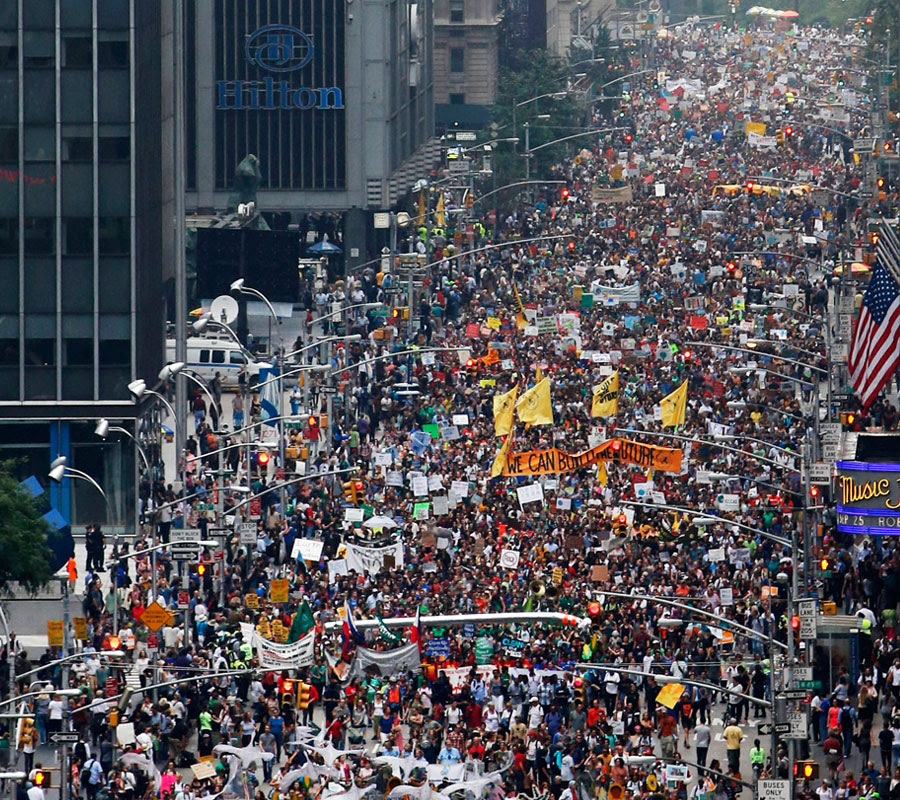
People's Climate March

And this was London, Berlin, Bogota, Paris, Delhi, and Melbourne…
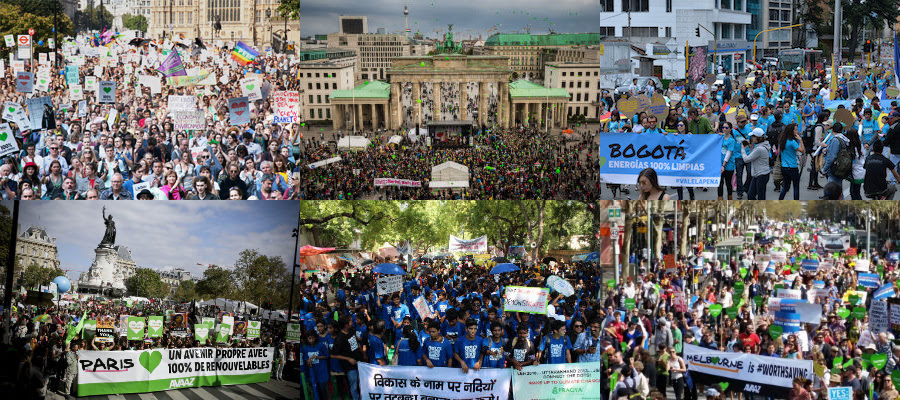
Over 675,000 of us marched around the world. It was a beautiful expression of our love for all that climate change threatens, and our hope that we can save this world and build a society powered by 100% safe, clean energy. Click to see more pictures from the day:

https://secure.avaaz.org/en/climate_march_reportback/?biEWLbb&v=46379

Together, we made history, but it’s just the beginning. The crucial Paris climate summit is 15 months from now — that’s where we need a global deal. By March next year, countries have pledged to make their national commitments — so our movement will divide to focus on these national targets. But every few months until Paris we’ll come together globally again and again, bigger and bigger, to beat a drum for change, for 100% clean energy, that our leaders can only follow. The movement we’ve been waiting for has begun.

With gratitude,

Ricken, Emma, Alice, Iain, Nataliya, Patri, Oliver, Diego, Rewan and the whole Avaaz team

PS – We worked with thousands of organisations to make this day happen and particularly love our friends at 350. But our community deserves to celebrate the step we’ve taken. The Avaaz team and community played a central role in almost all the marches and events held. The Guardian called it “an organising triumph” for Avaaz and the BBC said “the marches brought more people on to the streets than ever before, thanks to the organisational power of the social media site Avaaz.” We fielded hundreds of organisers and thousands of volunteers, and donations from our community provided millions in funding to the effort. The challenges of our time call us to be better, and together we’ve done that, growing and changing into a new and more effective kind of movement, a movement that is now both online, and offline. Huge gratitude to everyone who made it happen. 

Webinar: Do you know the impact of the Supreme Court’s decisions on women?


National Women’s Law Center
Hobby Lobby. McCullen. Young?

If you’re a Supreme Court watcher, you probably know the first two are recent Supreme Court decisions of particular importance to women. But do you know about the third case, coming up next?

The Supreme Court and WomenRegister for ourwebinar today and find out what the Supreme Court’s recent decisions and upcoming cases could mean for women’s health and economic security.Register Now

In its past term, the Supreme Court issued two rulings (Hobby Lobby v. Burwell and McCullen v. Coakley) that could potentially have a significant impact on both women’s health and women’s economic security. Although the legal issues in these cases differed, in both of its decisions the Court indicated that women’s reproductive health needs could be singled out for lesser legal protections.

Will the trend continue this Supreme Court term? The Court has already decided to hear the pregnancy discrimination case (Young v. UPS), and may see another contraceptive coverage case before the term is out.

Join our webinar on Thursday, October 2 at 1:00 p.m. ET to learn more about the new term and what Court’s decisions last term tell us about it.

Thanks for everything you do for women.

Sincerely,
Emily J. Martin
Vice President and General Counsel
National Women’s Law Center

Judy Waxman
Vice President for Health and Reproductive Rights
National Women’s Law Center