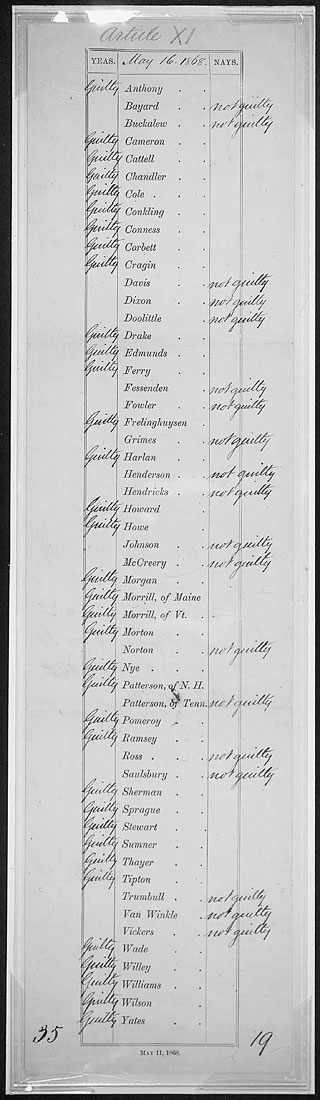
1868 – U.S. President Andrew Johnson was acquitted during the Senate impeachment, by one vote


The first Senate vote in the impeachment of President Andrew Johnson was taken on May 16, 1868. Article XI was called the “omnibus article” because it combined all of the charges against the President. As a result of 19 voting “Not Guilty” and 35 voting “Guilty,” the Senate fell 1 vote short of the two-thirds majority required for removal. After a 10-day recess, the Senate reconvened and voted on Articles II and III. In each case, the result was identical: Johnson was not guilty by a single vote. The Senate then voted to end the trial.

In the 1868 Johnson impeachment trial, the embattled president was just one vote away from being removed from office on each of the three charges put to a vote. There were 11 total articles of impeachment, but the Senate voted to adjourn the trial when it was clear that the voting would be the same for each remaining charge.

To: Police Chief Mirtha V. Ramos and DeKalb County Chief Executive Officer Michael L. Thurmond


#JusticeforZadok: Demand Justice For Matthew “Zadok” Williams

campaigns.organizefor.org

HW Campaign created by Hahnah Williams

#JusticeforZadok: Demand Justice For Matthew "Zadok" Williams

Here are our demands:

1. Immediately release ALL media related to the murder of Matthew “Zadok” Williams. This includes but is not limited to 911 call recordings, transcripts, and medical examiner reports.

2. Immediately release the full names and employment records of all officers involved in the murder of Matthew Zadok Williams.

3. Terminate the employment of officers involved in the murder.

Why is this important?

Just eight days before the verdict that convicted Derek Chauvin, unidentified police officer(s) killed my brother, Matthew “Zadok” Williams in his own home moments after he asked the officers to identify themselves as he kneeled behind a piece of furniture. Like so many others, my brother was killed in broad daylight in his home. On April 12th, 2021, DeKalb County, Georgia police officers approached my brother and asked him to leave his own property. According to the police department, officers assumed that Zadok was a trespasser based on two 911 calls from a woman living in the condo behind Zadok’s condo. These calls have yet to be released.

The police department has released some body camera footage and the media is only showing excerpts of the incident. We are calling on Chief Ramos to set an example by ending the secrecy that is rampant behind the blue line and promoting transparency. In the footage available, Zadok has a mental health crisis outside in an incident involving a knife after walking down his steps and being asked to leave his property. Zadok subsequently retreats into his home through an upstairs window. The police began to kick his door open. Once the door is breached, Zadok immediately kneels behind a cushioned piece of furniture to protect himself from gunshots as he tells the officers that he is defending his property and asks the officers to back up and speak to him through the doorway. Zadok is not a threat, and police begin talking to him telling him that he doesn’t have to die. The absurdity of the comment by officers at the scene reveals the culture of dehumanization that is deeply embedded in departments across the nation. A 911 call should not be synonymous with death for Black people. Instead of backing up and talking to Zadok from the doorway as he requested and helping him, police officers shot into his home and killed him while he was kneeling behind furniture.

The officers and supervisor at the scene left him there for nearly an hour and a half to die. No medical aid was rendered and when SWAT teams and EMS arrived more than an hour after the shooting, my brother was subsequently pronounced dead. My family was notified nearly 24 hours after his death.

Such an egregious disregard for my brother’s life speaks to the culture of policing in DeKalb County and across the country. Police officers are rarely held accountable for killing, harassing and assaulting Black people and my family is committed to doing everything in our power to ensure that these officers are held accountable and that other families in DeKalb County don’t have to endure what we have had to go through.

It’s been a month since police officer(s) murdered my brother Matthew Zadok Williams, and the police officer(s) responsible still have not been held accountable. We don’t even know their full names. Zadok was a remarkable brother, uncle, and son, and he meant the world to our entire family. I strongly urge Police Chief Mirtha V. Ramos and Chief Executive Officer, Michael L Thurmond to hold the officers responsible for this ruthless action accountable and to provide my family with answers.

Both Police Chief Ramos and CEO Thurmond have the authority to release all media related to Zadok’s murder, identify the officers to the public, and terminate the officers employment. We want these police officers to be held accountable. This is the first step towards true criminal justice reform here in DeKalb County.

Sign the petition: Tell Police Chief Ramos and CEO Thurmond to release all media related to Zadok’s murder, identify the officers, and terminate the employment of the officer(s) who killed my brother Zadok now!

campaigns.organizefor.org

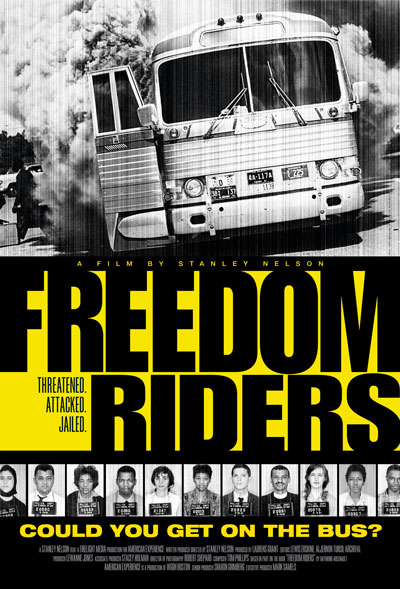
FREEDOM RIDERS : A Stanley Nelson Film : American Experience – In memory


  Get Inspired

 The World Premiere: In 2010 at Sundance Film Festival, US

 A Documentary Competition

Award-winning filmmaker Stanley Nelson (Wounded Knee, Jonestown: The Life and Death of Peoples Temple, The Murder of Emmett Till) returns to the Sundance Film Festival with his latest documentary FREEDOM RIDERS, the powerful, harrowing and ultimately inspirational story of six months in 1961 that changed America forever. From May until November 1961, more than 400 black and white Americans risked their lives—and many endured savage beatings and imprisonment—for simply traveling together on buses and trains as they journeyed through the Deep South. Deliberately violating Jim Crow laws, the Freedom Riders’ belief in non-violent activism was sorely tested as mob violence and bitter racism greeted them along the way.

FREEDOM RIDERS features testimony from a fascinating cast of central characters: the Riders themselves, state and federal government officials, and journalists who witnessed the rides firsthand.

“I got up one morning in May and I said to my folks at home, I won’t be back today because I’m a Freedom Rider. It was like a wave or a wind that you didn’t know where it was coming from or where it was going, but you knew you were supposed to be there.” — Pauline Knight-Ofuso, Freedom Rider

Despite two earlier Supreme Court decisions that mandated the desegregation of interstate travel facilities, black Americans in 1961 continued to endure hostility and racism while traveling through the South. The newly inaugurated Kennedy administration, embroiled in the Cold War and worried about the nuclear threat, did little to address domestic Civil Rights.See the source image

“It became clear that the Civil Rights leaders had to do something desperate, something dramatic to get Kennedy’s attention. That was the idea behind the Freedom Rides—to dare the federal government to do what it was supposed to do, and see if their constitutional rights would be protected by the Kennedy administration,” explains Raymond Arsenault, author of Freedom Riders: 1961 and the Struggle for Racial Justice, on which the film is partially based.

Organized by the Congress of Racial Equality (CORE), the self-proclaimed “Freedom Riders” came from all strata of American society—black and white, young and old, male and female, Northern and Southern. They embarked on the Rides knowing the danger but firmly committed to the ideals of non-violent protest, aware that their actions could provoke a savage response but willing to put their lives on the line for the cause of justice.

Each time the Freedom Rides met violence and the campaign seemed doomed, new ways were found to sustain and even expand the movement. After Klansmen in Alabama set fire to the original Freedom Ride bus, student activists from Nashville organized a ride of their own. “We were past fear. If we were going to die, we were gonna die, but we can’t stop,” recalls Rider Joan Trumpauer-Mulholland. “If one person falls, others take their place.”

Later, Mississippi officials locked up more than 300 Riders in the notorious Parchman State Penitentiary. Rather than weaken the Riders’ resolve, the move only strengthened their determination. None of the obstacles placed in their path would weaken their commitment.

The Riders’ journey was front-page news and the world was watching. After nearly five months of fighting, the federal government capitulated. On September 22, the Interstate Commerce Commission issued its order to end the segregation in bus and rail stations that had been in place for generations. “This was the first unambiguous victory in the long history of the Civil Rights Movement. It finally said, ‘We can do this.’ And it raised expectations across the board for greater victories in the future,” says Arsenault.

“The people that took a seat on these buses, that went to jail in Jackson, that went to Parchman, they were never the same. We had moments there to learn, to teach each other the way of nonviolence, the way of love, the way of peace. The Freedom Ride created an unbelievable sense: Yes, we will make it. Yes, we will survive. And that nothing, but nothing, was going to stop this movement,” recalls Congressman John Lewis, one of the original Riders.

Says Stanley Nelson, “The lesson of the Freedom Rides is that great change can come from a few small steps taken by courageous people. And that sometimes to do any great thing, it’s important that we step out alone.”

CREDITS
A Stanley Nelson Film
A Firelight Media Production for AMERICAN EXPERIENCE

Produced, Written and Directed by
Stanley Nelson

Produced by
Laurens Grant

Edited by
Lewis Erskine, Aljernon Tunsil

Archival Producer
Lewanne Jones

Associate Producer
Stacey HolmanDirector of Photography
Robert Shepard

Composer
Tom Phillips

Music Supervisor
Rena Kosersky

Based in part on the book Freedom Riders by
Raymond Arsenault

AMERICAN EXPERIENCE is a production of WGBH Boston.
Senior producer
Sharon Grimberg

Executive producer
Mark Samels

1897 – “The Stars and Stripes Forever” by John Phillip Sousa was performed for the first time. It was at a ceremony where a statue of George Washington was unveiled.


“The Stars and Stripes Forever” by John Phillip Sousa was performed for the first time on May 14, 1897 at a ceremony unveiling a statue of George Washington. Listen here (as performed by the United States Marines Band):