Heat – Advisory


Tue, Jul 21, 10:00 AM PDT to Wed, Jul 22, 11:00 PM PDT

What

Hot conditions with high temperatures up to 88 to 95 degrees expected and low temperatures from 62 to 65 degrees. This will pose a moderate to major risk of heat-related illness.

Where

Eastern Kitsap County, City of Seattle, Downtown Everett / Marysville Area, Eastside, Foothills and Valleys of Central King County, Foothills and Valleys of Pierce and Southern King Counties, Foothills and Valleys of Snohomish and Northern King Counties, Lowlands of Pierce and Southern King Counties, and Shoreline / Lynnwood / South Everett Area.

When

From 10 AM Tuesday to 11 PM PDT Wednesday.

Impacts

Heat will significantly increase the risk of heat-related illnesses for those who are sensitive to heat, especially those without effective cooling or adequate hydration.

Additional Details

Areas closest to the water will experience cooler daytime high temperatures.

Summary

Drink plenty of fluids, stay in an air-conditioned room, stay out of the sun, and check up on relatives and neighbors. Young children and pets should never be left unattended in vehicles under any circumstances. Take extra precautions if you work or spend time outside. When possible reschedule strenuous activities to early morning or evening. Know the signs and symptoms of heat exhaustion and heat stroke. Wear lightweight and loose fitting clothing when possible. To reduce risk during outdoor work, the Occupational Safety and Health Administration recommends scheduling frequent rest breaks in shaded or air conditioned environments. Anyone overcome by heat should be moved to a cool and shaded location. Heat stroke is an emergency! Call 9 1 1. For sheltering information and other human services in your area, dial 2 1 1 during business hours or visit wa211.org anytime.

Issued By

NWS Seattle WA

1848 – Seneca Falls … July 19 to 20, 1848 – Women’s History Month


image from Google

Originally known as the Woman’s Rights Convention, the Seneca Falls Convention fought for the social, civil, and religious rights of women. The meeting was held from July 19 to 20, 1848 at the Wesleyan Chapel in Seneca Falls, New York.

Despite scarce publicity, 300 people—mostly area residents—showed up. On the first day, only women were allowed to attend (the second day was open to men).

Elizabeth Cady Stanton, one of the meeting’s organizers, began with a speech on the convention’s goals and purpose:

“We are assembled to protest against a form of government, existing without the consent of the governed—to declare our right to be free as man is free, to be represented in the government which we are taxed to support, to have such disgraceful laws as give man the power to chastise and imprison his wife, to take the wages which she earns, the property which she inherits, and, in case of separation, the children of her love.”

The convention proceeded to discuss the 11 resolutions on women’s rights. All passed unanimously except for the ninth resolution, which demanded the right to vote for women. Stanton and African American abolitionist Frederick Douglass gave impassioned speeches in its defense before it eventually (and barely) passed.

The five women who organized the Seneca Falls Convention were also active in the abolitionist movement, which called for the emancipation of slaves and the end of racial discrimination. They included:
 

  • Elizabeth Cady Stanton, a leading women’s rights advocate who was a driving organizer of the Seneca Falls Convention. Stanton first became invested in women’s rights after talking to her father, a law professor, and his students. She studied at Troy Female Seminary and worked on women’s property rights reform in the early 1840s.
  • Lucretia Mott, a Quaker preacher from Philadelphia, who was known for her anti-slavery, women’s rights and religious reform activism.
  • Mary McClintock, the daughter of Quaker anti-slavery, temperance and women’s rights activists. In 1833, McClintock and Mott organized the Philadelphia Female Anti-Slavery Society. At the Seneca Falls Convention, McClintock was appointed secretary.
  • Martha Coffin Wright, Lucretia Mott’s sister. In addition being a lifelong proponent of women’s rights, she was an abolitionist who ran a station on the Underground Railroad from her Auburn, New York, home.
  • Jane Hunt, another Quaker activist, was a member of McClintock’s extended family through marriage.

Stanton and Mott first met in London in 1840, where they were attending the World Anti-Slavery Convention with their husbands. When the convention excluded women delegates solely based on their sex, the pair resolved to hold a women’s rights convention.

Back in the United States, women’s rights reformers had already begun contending for women’s rights to speak out on moral and political issues beginning in the 1830s. Around the same time in New York, where Stanton lived, legal reformers had been discussing equality and challenging state laws prohibiting married women from owning property. By 1848, equal rights for women was a divisive issue.

In July of 1848, Stanton, frustrated with her role staying at home raising kids, convinced Mott, Wright and McClintock to help organize the Seneca Falls Convention and write its main manifesto, the Declaration of Sentiments.

Together, the five women drafted a notice to announce “a Convention to discuss the social, civic and religious condition and rights of Woman” around Hunt’s tea table.

The Declaration of Sentiments was the Seneca Falls Convention’s manifesto that described women’s grievances and demands. Written primarily by Elizabeth Cady Stanton, it called on women to fight for their Constitutionally guaranteed right to equality as U.S.

“We hold these truths to be self-evident; that all men and women are created equal,” the document stated. Inspired by the Declaration of Independence, the Declaration of Sentiments asserted women’s equality in politics, family, education, jobs, religion and morals.

The declaration began with 19 “abuses and usurpations” that were destined to destroy a woman’s “confidence in her own powers, to lessen her self-respect, and to make her willing to lead a dependent and abject life.”

Because women didn’t have the right to vote—a right given to “the most ignorant and degraded men”—they were forced to submit to laws to which they did not consent. Women were denied an education and issued an inferior role in the church.

Moreover, women were required to be obedient to their husbands and prevented from owning property, including the wages they earned (which technically belonged to their husbands). And they received unequal rights upon divorce.

In light of these abuses, the declaration called on women to “throw off such government.”

Next came a list of 11 resolutions, which  demanded women be regarded as men’s equal. The resolutions called on Americans to regard any laws that placed women in an inferior position to men as having “no force or authority.” They resolved for women to have equal rights within the church and equal access to jobs.

The ninth resolution was the most controversial, as it called women “to secure to themselves their sacred right to the elective franchise,” or the right to vote.

Although its passage led many women’s rights proponents to withdraw their support, the ninth resolution went on to become the cornerstone of the women’s suffrage movement.

In New York and across the U.S., newspapers covered the convention, both in support and against its objectives.

Horace Greely, the influential editor of The New York Tribune, echoed the opinion of many people at the time. While skeptical of giving women the right to vote, he argued that if Americans really believed in the Constitution, women must attain equal rights:

“When a sincere republican is asked to say in sober earnest what adequate reason he can give, for refusing the demand of women to an equal participation with men in political rights, he must answer, None at all. However unwise and mistaken the demand, it is but the assertion of a natural right, and such must be conceded.”

Two weeks later, on August 2, 1848, the Seneca Falls Convention reconvened at the First Unitarian Church of Rochester, New York, to reaffirm the movement’s goals with a larger audience.

In the following years, the convention’s leaders continued to campaign for women’s rights at state and nationwide events. Reformers frequently referred to the Declaration of Sentiments as they campaigned for women’s rights.

Between 1848 and 1862, the participants of the Seneca Falls Convention used the Declaration of Sentiments to “employ agents, circulate tracts, petition the State and national Legislatures, and endeavor to enlist the pulpit and the press in our behalf.”

After 72 years of organized struggle, all American women finally achieved the same rights as men at the polling box when, in 1920, women won the right to vote with the passage of the Nineteenth Amendment to the U.S. Constitution.

Declaration of Sentiments and Resolutions. Rutgers University.
Elizabeth Cady Stanton. National Park Service.
Jane Hunt. National Park Service.
Lucretia Mott. National Park Service.
Mary McClintock. National Park Service.
Martha C. Wright. National Park Service.
Report of the Women’s Rights Convention. National Park Service.
Second Day of Seneca Falls Convention, July 20, 1848. Library of Congress.
Seneca Falls Convention. The Encyclopedia of New York State.
The Declaration of Sentiments, Seneca Falls Conference, 1848. Fordham University.
The Seneca Falls Convention. Library of Congress.
The Seneca Falls Convention: Setting the National Stage for Women’s Suffrage. The Gilder Lehrman Institute of American History.

Opinions … what’s your definition


Opinions are personal beliefs or judgments, while hate speech involves expressions that demean or incite violence against individuals or groups based on characteristics like race, religion, or sexual orientation

Definitions

  • Opinion: An opinion is a personal belief or judgment that is not founded on certainty or proof. It can encompass a wide range of thoughts and feelings about various topics, and while opinions can be controversial or unpopular, they are generally protected under free speech laws.
  • Hate Speech: Hate speech refers to any form of communication that attacks or discriminates against a person or group based on attributes such as race, religion, ethnicity, sexual orientation, or gender identity. This can include derogatory language, slurs, and incitements to violence or prejudice. While hate speech is often offensive, it is not formally defined in U.S. law, and its protection under the First Amendment is complex

Legal Context

  • First Amendment Protections: The First Amendment of the U.S. Constitution protects a wide array of speech, including opinions that may be offensive or hateful. However, this protection is not absolute. Hate speech that incites violence or constitutes a true threat may lose its protection under the law 
  • Distinction in Legal Terms: While opinions are generally protected, hate speech can cross legal thresholds that may lead to consequences, especially if it incites violence or constitutes harassment. Courts have established that for speech to lose constitutional protection, it must meet specific criteria, such as inciting imminent lawless action

Societal Implications

  • Impact of Hate Speech: Hate speech can have significant social consequences, contributing to a hostile environment for marginalized groups. It can perpetuate discrimination and violence, leading to calls for more stringent regulations against such expressions
  • Debate on Free Speech: The distinction between opinion and hate speech often sparks debate, particularly in academic and public settings. While some argue for the protection of all speech, others advocate for limiting hate speech to foster a more inclusive and safe environment
  • Center for American Progress
    In summary, while opinions are a fundamental aspect of free expression, hate speech poses unique challenges that intersect with legal protections and societal values. Understanding this distinction is crucial for navigating discussions about free speech and its limits in a diverse society.

Sources: unconstitutional.net, legalclarity.org, Center for American Progress

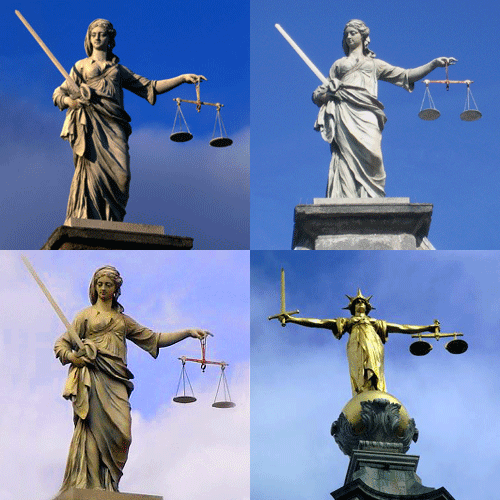
Crimes Sent to the Hague (ICC Jurisdiction)


The International Criminal Court (ICC) in The Hague prosecutes individuals for the most serious crimes under international law, as defined in the Rome Statute. These are not ordinary crimes — they are large-scale, organized violations of humanitarian law that often involve mass atrocities during armed conflict or peacetime

The Four Main Crimes the ICC Prosecutes

  1. Genocide
    Acts committed with the specific intent to destroy, in whole or in part, a national, ethnic, racial, or religious group. This includes killing group members, causing serious harm, imposing measures to prevent births, or forcibly transferring children to another group l
  2. Crimes Against Humanity
    Serious violations committed as part of a widespread or systematic attack against any civilian population, regardless of whether an armed conflict exists. Examples include murder, enslavement, torture, rape, apartheid, and enforced disappearances
  3. War Crimes
    Grave breaches of the Geneva Conventions and other rules of armed conflict. These include:
    • Deliberately targeting civilians or protected persons
    • Using prohibited weapons
    • Killing or torturing prisoners of war
    • Forcing children under 15 into the armed forces
    • Destroying property without military justification
    • Taking hostages or unlawful detention of protected persons 
  4. Crime of Aggression
    The use of armed force by a state leader against another sovereign state in violation of the UN Charter. Only those in a position to control a state’s political or military decisions can be charged 

When the ICC Gets Involved

The ICC can act when:

  • The accused is a national of a state party to the Rome Statute.
  • The crime occurred on the territory of a state party.
  • The UN Security Council refers a situation to the Court 

It complements, not replaces, national courts — it only steps in when national systems are unwilling or unable to prosecute 

In short: The Hague’s ICC handles the gravest crimes — genocide, crimes against humanity, war crimes, and the crime of aggression — when they meet the legal thresholds and jurisdictional requirements under the Rome Statute 

Sources: wiki, legalclarity.org

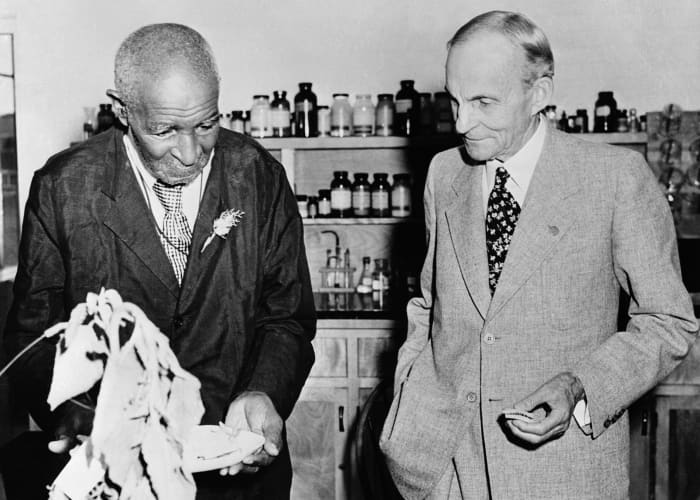
1942 – George Washington Carver begins an experimental project with Henry Ford


The agricultural chemist George Washington Carver, head of Alabama’s famed Tuskegee Institute, arrives in Dearborn, Michigan at the invitation of Henry Ford, founder of Ford Motor Company. Born to slave parents in Missouri during the Civil War, Carver managed to get a high …read more