|
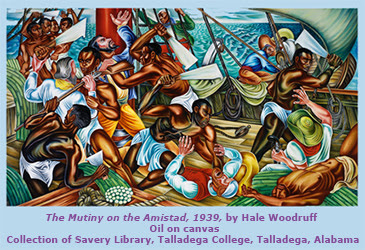
Hale Woodruff
In Memory

Pioneers, Activists, Black People, Black History
|
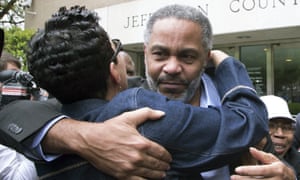
The brutal new memorial to the south’s dark side has left some in Alabama frustrated and angry at its insistence on confronting the past
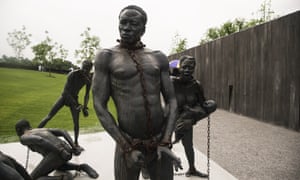
Black men were lynched for “standing around”, for “annoying white girls”, for failing to call a policeman “mister”. Those are just a few of the horrific stories on display at a new national memorial to lynching victims in Montgomery, Alabama.
One mile away, another historical monument tells a very different tale about the American south: the First White House of the Confederacy celebrates the life of “renowned American patriot” Jefferson Davis, who served as the president of the Confederate states, while making virtually no mention of the hundreds of black people he and his family enslaved.
The contradictions of Montgomery’s historical narratives were on full display this week as thousands of tourists and progressive activists flocked to the city to mark the opening of the country’s first memorial to lynching victims – while some locals quietly seethed, saying they resented the new museum for dredging up the past and feared it would incite anger and backlash within black communities.
“It’s going to cause an uproar and open old wounds,” said Mikki Keenan, a 58-year-old longtime Montgomery resident, who was eating lunch at a southern country-style restaurant a mile from the memorial. Local residents, she said, feel “it’s a waste of money, a waste of space and it’s bringing up bullshit”.
“It keeps putting the emphasis on discrimination and cruelty,” chimed in her friend, who asked not to be named for fear that her child would disapprove of her remarks. The memorial, she added, could spark violence.
The angry and in some cases blatantly racist reactions to the National Memorial for Peace and Justice and accompanying Legacy Museum provided a window into some white Americans’ deep resistance to confronting the nation’s brutal history of racial violence, from slavery to mass incarceration.
While celebrities and civil rights icons lauded the memorial as a powerful symbol of America’s shame and a turning point toward healing, some conservatives in Alabama rolled their eyes at the project, saying they were more concerned with saving Confederate monuments, now under threat from leftwing activists.
Alabama’s Republican governor, Kay Ivey, wasn’t present at the memorial launch, but did release a video promoting her efforts to preserve Confederate monuments a week prior.
Seated at the front porch of the First White House on a sunny morning, curator Bob Wieland said he supported the Legacy Museum, but felt strongly that Confederate landmarks be preserved, especially as the city is changing and the “sleepy old cotton south falls away”. That means, he said, “keeping this museum [the First White House] just to have a positive taste, an old south taste, as the new comes up”.
Asked about criticisms that the state-funded First White House “whitewashes” the evils of slavery, Wieland said, “We could certainly tone down the celebration [of Davis], but … it is part of civil war history.” Discussing the lack of references to slavery, he said the museum was “more of a political military history” than a “social history”.
While some of the most vocal Alabama defenders of Confederate monuments said they broadly backed the concept of a lynching memorial, they also expressed anxiety about its impact, some reverting to racist stereotypes of African American rioters.
“Bring that stuff to light, and let it be there, but don’t dwell on it,” said Tommy Rhodes, a member of the Alabama Sons of Confederate Veterans. “We have moved past it … You don’t want to entice them and feed any fuel to the fire.”
Randall Hughey, another member who also owns a local radio station, emphasized his support of the museum – but also repeatedly questioned the veracity of its facts.
“They have every right to have the memorial, if it’s accurate,” he said, adding that he was perplexed by reports of more than 4,000 lynchings. “That seems pretty incredible to me that there would be that many documented lynchings … That was not the norm.”
Equal Justice Initiative, the group behind the memorial and lynching data, did six years of research and made extensive visits to southern sites.
Mary Massey, a 58-year-old nurse on her way to lunch in Montgomery, expressed disdain at the project: “We didn’t have nothing to do with that. I think they just need to leave it alone. It’s just stirring up something.”
Her husband, Jim, said he supported the memorial as a way to recognize a “horrible” piece of black history, but added: “It’s gone and won’t happen again.” He also said he suspected that for many in Montgomery, the reaction was: “Let sleeping dogs lay.”
Keenan, who is Native American, said she would never visit the memorial and was worried it would exacerbate “racism” in Montgomery: “It ain’t gonna change that. It’s going to get it started more.”
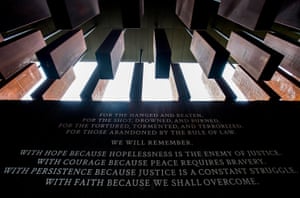
At the opening day of the memorial – which features hanging steel monuments dangling like bodies above the visitors – some black Alabamians said they felt optimistic.
“For so long, society has put a shadow over these things,” said Brittany Willie, a 19-year-old from Huntsville, Alabama, who found an engraving of the name of one of her ancestors. “People are going to see this and realize these people were innocent. They were killed for who they are.”
“This is something our children need to know, so they can understand the struggle,” added Victoria Dunn, a 40-year-old Montgomery resident, who came with her husband.
“This is going to be something embraced by everybody.”
… we have a small favour to ask. More people are reading the Guardian than ever but advertising revenues across the media are falling fast. And unlike many news organisations, we haven’t put up a paywall – we want to keep our journalism as open as we can. So you can see why we need to ask for your help. The Guardian’s independent, investigative journalism takes a lot of time, money and hard work to produce. But we do it because we believe our perspective matters – because it might well be your perspective, too.
I appreciate there not being a paywall: it is more democratic for the media to be available for all and not a commodity to be purchased by a few. I’m happy to make a contribution so others with less means still have access to information.Thomasine, Sweden
If everyone who reads our reporting, who likes it, helps fund it, our future would be much more secure. For as little as $1, you can support the Guardian – and it only takes a minute. Thank you.
The Guardian
Jimi Hendrix
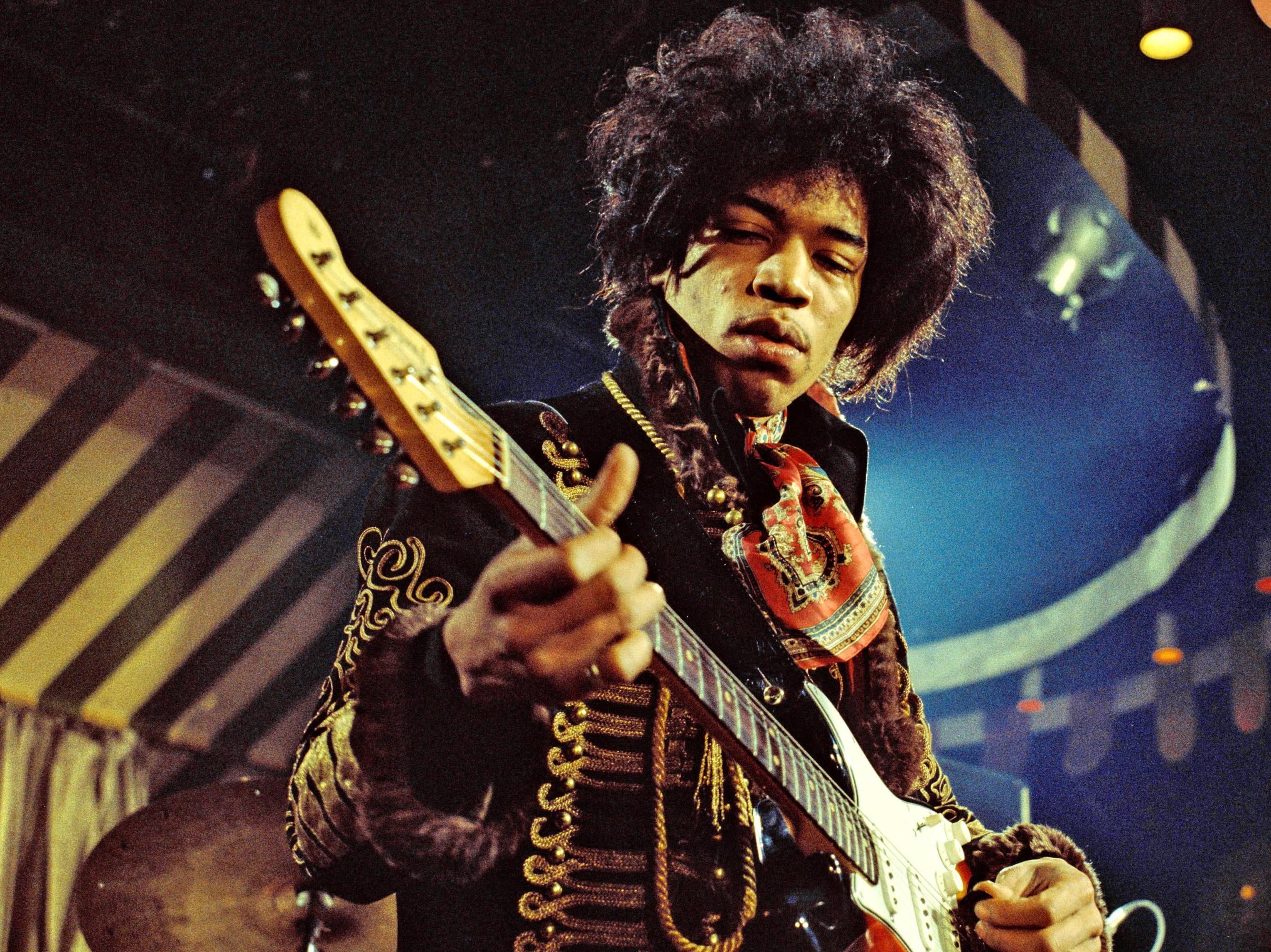
Born: 1942 | Died: 1970
More than 40 years after his mysterious death,
music legend Jimi Hendrix is still widely considered the greatest guitarist in the history of rock ‘n’ roll.
Born on November 27, 1942, in Seattle, Washington, Jimi Hendrix learned to play guitar as a teenager, and grew up to become a rock guitar legend who excited audiences in the 1960s with his innovative electric guitar playing.
One of his most memorable performances was at Woodstock in 1969, where he performed “The Star Spangled Banner.”
Hendrix died in 1970 from drug-related complications, leaving his mark on the world of rock music and remaining popular to this day.
For more information on Jimi, go to www.bio.com
Bio.com
if you see any errors please comment…
Nativegrl77
 by uslegal.com
Stop and frisk is when police “temporarily” detain somebody and pat down their outer clothing when there are specific articulate facts leading a reasonable police officer to believe a person is armed and dangerous. It is not necessary for the officer to articulate or identify a specific crime they think is being committed, only that a set of factual circumstances exist that would lead a reasonable officer to have a reasonable suspicion that criminal activity is occurring. “Reasonable suspicion” is one step below “probable cause” and one step above a hunch.
A “frisk” by definition is a type of search that requires a “lawful stop”. It is best thought of as a separate act, but in practice, a suspect who refuses to answer questions in a stop may be providing the officer with sufficient justification to frisk. A frisk should not be for anything other than a dangerous weapon or contraband. However, if other evidence, like a suspected drug container, is felt, it can be seized by the officer under the “plain feel” doctrine. The test for “plain feel” is that the item’s contraband nature be “immediately apparent”.
Resource: uslegal.com
One of several problems with stop & frisk, is that most if not all Police demand name, address, question people of colour when in upper income communities and or assume gang affiliation least we talk about the percentage of Black Latino Asian or Caucasian men&women being stopped on a daily basis … is it a quota, a civil rights issue, a misuse or abuse of power ~ Nativergrl77
The North Carolina Racial Justice Act of 2009
Prohibited seeking or imposing the death penalty on the basis of race. The act identified types of evidence that might be considered by the court when considering whether race was a basis for seeking or imposing the death penalty and established a process by which relevant evidence might be used to establish that race was a significant factor in seeking or imposing the death penalty. The defendant had the burden of proving that race was a significant factor in seeking or imposing the death penalty, and the state was allowed to offer evidence to rebut the claims or evidence of the defendant. If race was found to be a significant factor in the imposition of the death penalty, the death sentence would automatically be commuted to life imprisonment without the possibility of parole.[1]
North Carolina General Assembly Repeal Attempts [edit]
Under pressure from a group of 43 district attorneys, who expressed opposition to the act citing the clog of the court system in the state, the North Carolina Senate passed a bill by a 27-14 vote on November 28, 2011, that would have effectively repealed the Racial Justice Act.[2]
However, on December 14, Governor Bev Perdue, a Democrat, vetoed the bill, saying that while she supports the death penalty, she felt it was “simply unacceptable for racial prejudice to play a role in the imposition of the death penalty in North Carolina.”[3] The state legislature did not have enough votes to override Perdue’s veto.
The North Carolina General Assembly passed a major revision of the law in 2012 authored by Rep. Paul Stam (R-Wake). The rewrite “severely restricts the use of statistics to only the county or judicial district where the crime occurred, instead of the entire state or region. It also says statistics alone are insufficient to prove bias, and that the race of the victim cannot be taken into account.” The bill was vetoed by Gov. Perdue, but this time, the legislature overrode the governor’s veto.[4]
The North Carolina General Assembly voted to effectively repeal the entire law in 2013 and Gov. Pat McCrory, a Republican, signed the repeal into law.[5]
On April 20, 2012, in the first case appealed under the Racial Justice Act, the then-Senior Resident Superior Court Judge in Cumberland County (Fayetteville), Judge Greg Weeks, threw out the death sentence of Marcus Raymond Robinson, automatically commuting his sentence to life without parole. Robinson contended that when he was sentenced to death in 1994, prosecutors deliberately kept blacks off the jury. Robinson’s lawyers cited a study from Michigan State University College of Law indicating that prosecutors across North Carolina improperly used their peremptory challenges to systemically exclude qualified black jurors from jury service.[6][7][8]
Resource …wiki
so, I do not know how accurate this is




 Be a Seed for Change
You must be logged in to post a comment.