

United Auto Workers – April 10, 1941

1941 – Ford Motor Co. became the last major automaker to recognize the United Auto Workers as the representative for its workers.
Henry Ford, the company’s founder, was vehemently antiunion, and his position appeared firmly entrenched. Newly enacted federal labor legislation, the National Labor Relations Act (also known as the Wagner Act) of 1935, ran counter to Ford’s modus operandi. Between 1937 and 1941 almost every plant Ford operated had been brought up on charges before the National Labor Relations Board (NLRB), the body charged with enforcing the 1935 law. The situation came to a head in 1941 after years of litigation and clear signs the company could be in financial peril if it did not submit to collective bargaining. The NLRB called an election for 21 May 1941 at all the Ford plants in Dearborn, Michigan, in which the UAW-CIO (Congress of Industrial Organizations) had won the right to represent workers. This election paved the way for successful labor negotiations between the parties and an excellent contract for Ford union members.
Share this:

Titanic 4/10/1912
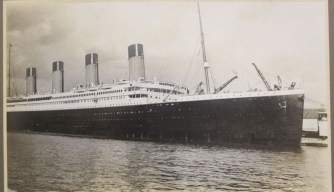
Titanic’s departure from Southampton on April 10 was not without some oddities. A small coal fire was discovered in one of her bunkers–an alarming but not uncommon occurrence on steamships of the day. Stokers hosed down the smoldering coal and shoveled it aside to reach the base of the blaze. After assessing the situation, the captain and chief engineer concluded that it was unlikely it had caused any damage that could affect the hull structure, and the stokers were ordered to continue controlling the fire at sea.
According to a theory put forth by a small number of Titanic experts, the fire became uncontrollable after the ship left Southampton, forcing the crew to attempt a full-speed crossing; moving at such a fast pace, they were unable to avoid the fatal collision with the iceberg.
Another unsettling event took place when Titanic left the Southampton dock. As she got underway, she narrowly escaped a collision with the America Line’s S.S. New York. Superstitious Titanic buffs sometimes point to this as the worst kind of omen for a ship departing on her maiden voyage.
DISASTER STRIKES ABOARD TITANIC
On April 14, after four days of uneventful sailing, Titanic received sporadic reports of ice from other ships, but she was sailing on calm seas under a moonless, clear sky.
At about 11:30 p.m., a lookout saw an iceberg coming out of a slight haze dead ahead, then rang the warning bell and telephoned the bridge. The engines were quickly reversed and the ship was turned sharply—instead of making direct impact, Titanic seemed to graze along the side of the berg, sprinkling ice fragments on the forward deck.
Sensing no collision, the lookouts were relieved. They had no idea that the iceberg had a jagged underwater spur, which slashed a 300-foot gash in the hull below the ship’s waterline.
By the time the captain toured the damaged area with Harland and Wolff’s Thomas Andrews, five compartments were already filling with seawater, and the bow of the doomed ship was alarmingly pitched downward, allowing seawater to pour from one bulkhead into the neighboring compartment.
Andrews did a quick calculation and estimated that Titanic might remain afloat for an hour and a half, perhaps slightly more. At that point the captain, who had already instructed his wireless operator to call for help, ordered the lifeboats to be loaded.
TITANIC’S LIFEBOATS
A little more than an hour after contact with the iceberg, a largely disorganized and haphazard evacuation began with the lowering of the first lifeboat. The craft was designed to hold 65 people; it left with only 28 aboard.
Tragically, this was to be the norm: During the confusion and chaos during the precious hours before Titanic plunged into the sea, nearly every lifeboat would be launched woefully under-filled, some with only a handful of passengers.
In compliance with the law of the sea, women and children boarded the boats first; only when there were no women or children nearby were men permitted to board. Yet many of the victims were in fact women and children, the result of disorderly procedures that failed to get them to the boats in the first place.
Exceeding Andrews’ prediction, Titanic stubbornly stayed afloat for close to three hours. Those hours witnessed acts of craven cowardice and extraordinary bravery. Hundreds of human dramas unfolded between the order to load the lifeboats and the ship’s final plunge: Men saw off wives and children, families were separated in the confusion and selfless individuals gave up their spots to remain with loved ones or allow a more vulnerable passenger to escape.
THE RMS TITANIC SINKS
The ship’s most illustrious passengers each responded to the circumstances with conduct that has become an integral part of the Titanic legend. Ismay, the White Star managing director, helped load some of the boats and later stepped onto a collapsible as it was being lowered. Although no women or children were in the vicinity when he abandoned ship, he would never live down the ignominy of surviving the disaster while so many others perished.
Thomas Andrews, Titanic’s chief designer, was last seen in the First Class smoking room, staring blankly at a painting of a ship on the wall. Astor deposited his wife Madeleine into a lifeboat and, remarking that she was pregnant, asked if he could accompany her; refused entry, he managed to kiss her goodbye just before the boat was lowered away. Although offered a seat on account of his age, Isidor Straus refused any special consideration, and his wife Ida would not leave her husband behind. The couple retired to their cabin and perished together.
Benjamin Guggenheim and his valet returned to their rooms and changed into formal evening dress; emerging onto the deck, he famously declared, “We are dressed in our best and are prepared to go down like gentlemen.”
Molly Brown helped load the boats and finally was forced into one of the last to leave. She implored its crewmen to turn back for survivors, but they refused, fearing they would be swamped by desperate people trying to escape the icy seas.
Titanic, nearly perpendicular and with many of her lights still aglow, finally dove beneath the ocean’s surface at about 2:20 a.m. on April 15. Throughout the morning, Cunard’s Carpathia, after receiving Titanic’s distress call at midnight and steaming at full speed while dodging ice floes all night, rounded up all of the lifeboats. They contained only 705 survivors.
AFTERMATH OF THE TITANIC CATASTROPHE
At least five separate boards of inquiry on both sides of the Atlantic conducted comprehensive hearings on Titanic’s sinking, interviewing dozens of witnesses and consulting with many maritime experts. Every conceivable subject was investigated, from the conduct of the officers and crew to the construction of the ship.
While it has always been assumed that the ship sank as a result of the gash that caused the bulkhead compartments to flood, various other theories have emerged over the decades, including that the ship’s steel plates were too brittle for the near-freezing Atlantic waters, that the impact caused rivets to pop and that the expansion joints failed, among others.
Technological aspects of the catastrophe aside, Titanic’s demise has taken on a deeper, almost mythic, meaning in popular culture. Many view the tragedy as a morality play about the dangers of human hubris: Titanic’s creators believed they had built an unsinkable ship that could not be defeated by the laws of nature.
This same overconfidence explains the electrifying impact Titanic’s sinking had on the public when she was lost. There was widespread disbelief that the ship could possibly have sunk, and, due to the era’s slow and unreliable means of communication, misinformation abounded. Newspapers initially reported that the ship had collided with an iceberg but remained afloat and was being towed to port with everyone on board.
It took many hours for accurate accounts to become widely available, and even then people had trouble accepting that this paragon of modern technology could sink on her maiden voyage, taking more than 1,500 souls with her.
The ship historian John Maxtone-Graham has compared Titanic’s story to the Challenger space shuttle disaster of 1986. In that case, the world reeled at the notion that one of the most sophisticated inventions ever created could explode into oblivion along with its crew. Both tragedies triggered a sudden collapse in confidence, revealing that we remain subject to human frailties and error, despite our presumptions of technological infallibility.
Access hundreds of hours of historical video, commercial free, with HISTORY Vault. Start your free trial today.
Share this:

Miner Demographics and Statistics in the US

Miner demographic s research summary. Zippia estimates miner demographics and statistics in the United States by using a database of 30 million profiles. Our miner estimates are verified against BLS, Census, and current job openings data for accuracy.
Zippia’s data science team found the following key facts about miners after extensive research and analysis:
- There are over 14,311 miners currently employed in the United States.
- 9.4% of all miners are women, while 90.6% are men.
- The average miner age is 40 years old.
- The most common ethnicity of miners is White (76.2%), followed by Hispanic or Latino (12.6%), Unknown (4.1%) and Black or African American (4.1%).
- In 2022, women earned 95% of what men earned.
- 4% of all miners are LGBT.
- Miners are 71% more likely to work at private companies in comparison to public companies.
Source: zippia.com
Share this:

1975 – Lee Elder becomes first Black golfer to play in Masters
On April 10, 1975, 41-year-old Lee Elder becomes the first Black golfer to play in the Masters, considered the most prestigious event in the sport. Elder shoots 37 on the front and back nine for a 74 at the Augusta (Georgia) National Golf Club and trails leader Bobby Nichols by seven strokes. “I didn’t have any nervousness whatsoever,” Elder says after the round.
In Round 2, Elder shot a 78 and missed the cut in the tournament, won by Jack Nicklaus. Elder had qualified for the Masters by winning the 1974 Monsanto Open.
Many considered Elder’s historic achievement long overdue for the Masters and Augusta National and for a sport that had never been known for racial tolerance. The Professional Golfers Association, the organizer of the main professional tours played by men in North America, didn’t approve participation of African Americans in events it co-sponsored until 1952.
Augusta National didn’t have a Black member until 1990 (businessman Ron Townsend) or female member until 2012 (former Secretary of State Condoleezza Rice).
For the complete article, got to history.com
Citation Information
Article TitleLee Elder becomes first Black golfer to play in MastersAuthorHistory.com EditorsWebsite NameHISTORY
URL
https://www.history.com/this-day-in-history/lee-elder-masters-black-sports-trailblazers
DateApril 9, 2023PublisherA&E Television NetworksLast UpdatedDecember 14, 2021Original Published DateDecember 14, 2021


You must be logged in to post a comment.