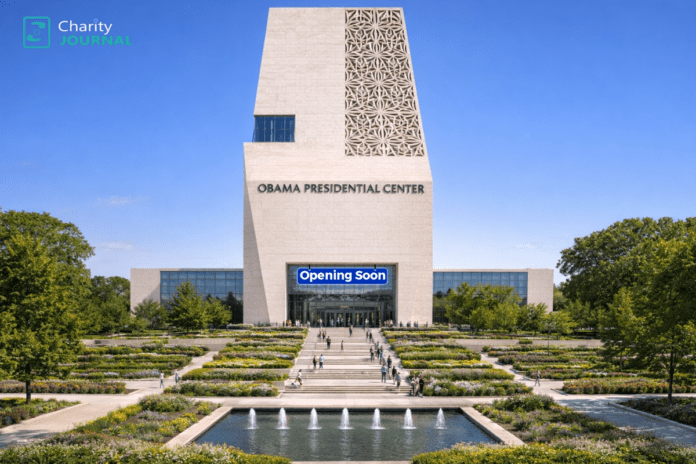
The Obama Presidential Center ~ is about to open its doors … wow


The Obama Presidential Center is set to open its doors soon, and it’s an exciting development!

The main museum tower of the Obama Presidential Center is intentionally designed to resemble four hands coming together in an upward motion. This design reflects President Obama’s themes of collaboration, civic participation, unity, collective action, and community strength.

It looks so solid and windowless

  • The lack of windows is intentional: sunlight damages historical documents, textiles, and artifacts.
  • The building’s granite exterior protects the presidential archives and museum materials.
  • The tower rises 225 feet and includes the “Sky Room” at the top.

Multiple sources confirm the construction of the Center itself is funded entirely by private fundraising through the Obama Foundation. This includes donations from:

  • philanthropists
  • foundations
  • private individuals
  • major donors (e.g., Jeff Bezos, per reporting)

No municipal, state, or federal tax dollars are used for the building.

Sources: newsmeaww.com , fakta.com

7 Summer Solstice Facts


Let’s get on with some fun facts about the June solstice:

The kind of energy the Sun emits most strongly is not ultraviolet, gamma rays, or even visible light—it’s actually infrared. That’s the Sun’s strongest emission, which is the kind we feel as heat.

As for the Sun’s visible emissions, its strongest is the green light. That’s why our eyes are maximally sensitive to that color.

With all that, most people only care about one single solstice fact:

  1. “Solstice” comes from the Latin words sol (sun) and sistere (to stand still). On the summer solstice, the Sun’s path stops advancing northward each day and appears to stop in the sky before going back the other way.
  2. On the solstice, the Sun reaches its northernmost position, reaching the Tropic of Cancer and standing still before reversing direction and starting to move south again. (See illustration above.) In fact, that’s how the Tropic of Cancer got its name. A few thousand years ago, the solstice happened when the Sun was in the constellation of Cancer the Crab.
  3. On the summer solstice, you may observe that the Sun’s path across the sky is curved—NOT a straight line. It appears to rise and keeps veering to the right as it passes high overhead. This is quite different from the laser-straight path the Sun moves along in late March and late September, near the equinoxes.
  4. You may also observe that the midday Sun is highest up in the sky (or, lowest if you live in the Southern Hemisphere). But did you know that the Sun’s highest point is getting lower and lower over time? That’s because Earth’s tilt is slowly decreasing.
  5. It may be the “longest day,” but it’s not the latest sunset or the earliest sunrise! The earliest sunrises happen before the summer solstice, and the latest sunsets happen after the summer solstice. See it for yourself wherever you live.
  6. In India, the summer solstice ends the 6-month period when spiritual growth is supposedly easiest. Better hurry—you only have a few days left!
  7. On this day, the Sun rises farthest left on the horizon and sets at its rightmost possible spot. Sunlight strikes places in your home that are illuminated at no other time.

Sun and clouds

Source: almanac.com

Crimes Sent to the Hague (ICC Jurisdiction)


The International Criminal Court (ICC) in The Hague prosecutes individuals for the most serious crimes under international law, as defined in the Rome Statute. These are not ordinary crimes — they are large-scale, organized violations of humanitarian law that often involve mass atrocities during armed conflict or peacetime

The Four Main Crimes the ICC Prosecutes

  1. Genocide
    Acts committed with the specific intent to destroy, in whole or in part, a national, ethnic, racial, or religious group. This includes killing group members, causing serious harm, imposing measures to prevent births, or forcibly transferring children to another group l
  2. Crimes Against Humanity
    Serious violations committed as part of a widespread or systematic attack against any civilian population, regardless of whether an armed conflict exists. Examples include murder, enslavement, torture, rape, apartheid, and enforced disappearances
  3. War Crimes
    Grave breaches of the Geneva Conventions and other rules of armed conflict. These include:
    • Deliberately targeting civilians or protected persons
    • Using prohibited weapons
    • Killing or torturing prisoners of war
    • Forcing children under 15 into the armed forces
    • Destroying property without military justification
    • Taking hostages or unlawful detention of protected persons 
  4. Crime of Aggression
    The use of armed force by a state leader against another sovereign state in violation of the UN Charter. Only those in a position to control a state’s political or military decisions can be charged 

When the ICC Gets Involved

The ICC can act when:

  • The accused is a national of a state party to the Rome Statute.
  • The crime occurred on the territory of a state party.
  • The UN Security Council refers a situation to the Court 

It complements, not replaces, national courts — it only steps in when national systems are unwilling or unable to prosecute 

In short: The Hague’s ICC handles the gravest crimes — genocide, crimes against humanity, war crimes, and the crime of aggression — when they meet the legal thresholds and jurisdictional requirements under the Rome Statute 

Sources: wiki, legalclarity.org

Sedition


A revolt or an incitement to revolt against established 

authority, usually in the form of Treason or Defamation against the government.

Sedition is the crime of revolting or inciting revolt 

against government. However, because of the broad protection of free speech under the First Amendment, prosecutions for sedition are rare. Nevertheless, sedition remains a crime in the United States under 18 U.S.C.A. § 2384 (2000), a federal statute that punishes seditious conspiracy, and 18 U.S.C.A. § 2385 (2000), which outlaws advocating the overthrow of the federal government by force. Generally, a person may be punished for sedition only when he or she makes statements that create a Clear and Present Danger to rights that the government may lawfully protect (schenck v. united states, 249 U.S. 47, 39 S. Ct. 247, 63 L. Ed. 470 [1919]).

The crime of seditious conspiracy is committed when two or more persons in any state or U.S. territory conspire to levy war against the U.S. government. A person commits the crime of advocating the violent overthrow of the federal government when she willfully advocates or teaches the overthrow of the government by force, publishes material that advocates the overthrow of the government by force, or organizes persons to overthrow the government by force. A person found guilty of seditious conspiracy or advocating the overthrow of the government may be fined and sentenced to up to 20 years in prison. States also maintain laws that punish similar advocacy and conspiracy against the state government.

Governments have made sedition illegal since time immemorial. The precise acts that constitute sedition have varied. In the United States, Congress in the late eighteenth century believed that government should be protected from “false, scandalous and malicious” criticisms. Toward this end, Congress passed the Sedition Act of 1798, which authorized the criminal prosecution of persons who wrote or spoke falsehoods about the government, Congress, the president, or the vice president. The act was to expire with the term of President John Adams.

The Sedition Act failed miserably. Thomas Jefferson opposed the act, and after he was narrowly elected president in 1800, public opposition to the act grew. The act expired in 1801, but not before it was used by President Adams to prosecute numerous public supporters of Jefferson, his challenger in the presidential election of 1800. One writer, Matthew Lyon, a congressman from Vermont, was found guilty of seditious libel for stating, in part, that he would not be the “humble advocate” of the Adams administration when he saw “every consideration of the public welfare swallowed up in a continual grasp for power, in an unbounded thirst for ridiculous pomp, foolish adulation, and selfish avarice” (Lyon’s Case, 15 F. Cas. 1183 [D. Vermont 1798] [No. 8646]). Vermont voters reelected Lyon while he was in jail. Jefferson, after winning the election and assuming office, pardoned all persons convicted under the act.

In the 1820s and 1830s, as the movement to abolish Slavery grew in size and force in the South, Southern states began to enact seditious libel laws. Most of these laws were used to prosecute persons critical of slavery, and they were abolished after the Civil War. The federal government was no less defensive; Congress enacted seditious conspiracy laws before the Civil War aimed at persons advocating secession from the United States. These laws were the precursors to the present-day federal seditious conspiracy statutes.

In the late nineteenth century, Congress and the states began to enact new limits on speech, most notably statutes prohibiting Obscenity. At the outset of World War I, Congress passed legislation designed to suppress antiwar speech. The Espionage Act of 1917 (ch. 30, tit. 1, § 3, 40 Stat. 219), as amended by ch. 75, § 1, 40 Stat 553, put a number of pacifists into prison. Socialist leader eugene v. debs was convicted for making an antiwar speech in Canton, Ohio (Debs v. United States, 249 U.S. 211, 39 S. Ct. 252, 63 L. Ed. 566 [1919]). Charles T. Schenck and Elizabeth Baer were convicted for circulating to military recruits a leaflet that advocated opposition to the draft and suggested that the draft violated the Thirteenth Amendment’s ban on Involuntary Servitude (Schenck v. United States, 249 U.S. 47, 39 S. Ct. 247, 63 L. Ed. 470 [1919]).

The U.S. Supreme Court did little to protect the right to criticize the government until after 1927. That year, Justice louis d. brandeis wrote an influential concurring opinion in Whitney v. California, 274 U.S. 357, 47 S. Ct. 641, 71 L. Ed. 1095 (1927), that was to guide First Amendment Jurisprudence for years to come. In Whitney the High Court upheld the convictions of political activists for violation of federal anti-syndicalism laws, or laws that prohibit the teaching of crime. In his concurring opinion, Brandeis maintained that even if a person advocates violation of the law, “it is not a justification for denying free speech where the advocacy falls short of incitement and there is nothing to indicate that the advocacy would be immediately acted on.” Beginning in the 1930s, the Court became more protective of political free speech rights.

The High Court has protected the speech of racial supremacists and separatists, labor organizers, advocates of racial Integration, and opponents of the draft for the Vietnam War. However, it has refused to declare unconstitutional all sedition statutes and prosecutions. In 1940, to silence radicals and quell Nazi or communist subversion during the burgeoning Second World War, Congress enacted the Smith Act (18 U.S.C.A. §§ 2385, 2387), which outlawed sedition and seditious conspiracy. The Supreme Court upheld the constitutionality of the act in Dennis v. United States, 341 U.S. 494, 71 S. Ct. 857, 95 L. Ed. 1137 (1951).

Sedition prosecutions are extremely rare, but they do occur. Shortly after the 1993 bombing of the World Trade Center in New York City, the federal government prosecuted Sheik Omar Abdel Rahman, a blind Egyptian cleric living in New Jersey, and nine codefendants on charges of seditious conspiracy. Rahman and the other defendants were convicted of violating the seditious conspiracy statute by engaging in an extensive plot to wage a war of Terrorism against the United States. With the exception of Rahman, they all were arrested while mixing explosives in a garage in Queens, New York, on June 24, 1993.

The defendants committed no overt acts of war, but all were found to have taken substantial steps toward carrying out a plot to levy war against the United States. The government did not have sufficient evidence that Rahman par ticipated in the actual plotting against the government or any other activities to prepare for terrorism. He was instead prosecuted for pro viding religious encouragement to his cocon spirators. Rahman argued that he only performed the function of a cleric and advised followers about the rules of Islam. He and the others were convicted, and on January 17, 1996, Rahman was sentenced to life imprisonment by Judge Michael Mukasey.

Following the September 11th Attacks of 2001, the federal government feared that terrorist networks were very real threats, and that if left unchecked, would lead to further insurrection. As a result, Congress enacted the Providing Appropriate Tools Required to Intercept and Obstruct Terrorism Act (USA PATRIOT) Act of 2001, Pub. L. No. 107-56, 115 Stat. 272. Among other things, the act increases the president’s authority to seize the property of individuals and organizations that the president determines have planned, authorized, aided, or engaged in hostilities or attacks against the United States.

The events of September 11 also led to the conviction of at least one American. In 2001, U.S. officials captured John Philip Walker Lindh, a U.S. citizen who had trained with terrorist organizations in Pakistan and Afghanistan. Lindh, who became known as the “American Taliban,” was indicted on ten counts, including conspiracy to murder U.S. nationals. In October 2002, he was sentenced to 20 years in prison.

Further readings

Cohan, John Alan. 2003. “Seditious Conspiracy, the Smith Act, and Prosecution for Religious Speech Advocating the Violent Overthrow of Government.” St. John’s Journal of Legal Commentary 17 (winter-spring).

Curtis, Michael Kent. 1995. “Critics of ‘Free Speech’ and the Uses of the Past.” Constitutional Commentary 12 (spring).——. 1995. “The Curious History of Attempts to Suppress Antislavery Speech, Press, and Petition in 1835–37.” Northwestern University Law Review 89 (spring).

Downey, Michael P. 1998. “The Jeffersonian Myth in Supreme Court Sedition Jurisprudence.” Washington University Law Quarterly 76 (summer).

Gibson, Michael T. 1986. “The Supreme Court and Freedom of Expression from 1791 to 1917.” Fordham Law Review 55 (December).

Grinstein, Joseph. 1996. “Jihad and the Constitution: The First Amendment Implications of Combating Religiously Motivated Terrorism.” Yale Law Journal 105 (March).

Levinson, Nan. 2003. Outspoken: Free Speech Stories. Berkeley: Univ. of California Press.

Weintraub, Leonard. 1987. “Crime of the Century: Use of the Mail Fraud Statute Against Authors.” Boston University Law Review 67 (May).

Cross-references

Cold WarCommunismFreedom of SpeechSocialism.West’s Encyclopedia of American Law, edition 2. Copyright 2008 The Gale Group, Inc. All rights reserved.