How can I reduce my exposure to Roundup in food?


Practically, this means supporting local farmers who adopt sustainable practices and choosing food products certified by organizations like the USDA’s Organic label or the Leaping Bunny Program. By making informed choices, we can contribute to a more resilient food system that prioritizes pollinator health and maintains ecosystem balance.

Another way to reduce exposure to Roundup is to be more mindful of the foods that are most likely to contain high levels of the herbicide. Consumers can focus on buying whole, unprocessed foods, which tend to be lower in pesticide residues and contaminants. They can also cook and prepare foods in ways that minimize exposure, such as washing and peeling fruits and vegetables, and choosing cooking methods that break down or eliminate pesticide residues. By being more informed and taking proactive steps, consumers can reduce their exposure to Roundup and promote healthier eating habits. Environmental Factors Contributing to Bee Declines: Interactions with Glyphosate

Glyphosate has been a major concern for bee health, and research suggests that its interactions with environmental factors are crucial in understanding declining bee populations. Let’s explore these interactions further.

Additionally, it seems that our own NIH may have information that the Supreme Court of the United States (SCOTUS) overlooked. I’m not entirely sure, but I found this while searching for information. The only solution is to stop consuming certain foods that scientific studies have documented as toxic due to pesticide use, such as Roundup, or foods that were directly treated with these chemicals.

Farina, W. M., Balbuena, M. S., Herbert, L. T., Goñalons, C. M., & Vázquez, D. E. (2019). Effects of the Herbicide Glyphosate on Honey Bee Sensory and Cognitive Abilities: Individual Impairments with Implications for the Hive. Insects, 10(10), 354. https://doi.org/10.3390/insects10100354

Sources: panflavor.com, beekeepercorner.com

2015 Same-sex marriage is made legal nationwide with Obergefell v. Hodges decision


2015 Same-sex marriage is made legal nationwide with Obergefell v. Hodges decision

June 26, 2015 marks a major milestone for civil rights in the United States, as the Supreme Court announces its decision in Obergefell v. Hodges. By one vote, the court rules that same-sex marriage cannot be banned in the United States and that all same-sex marriages …read more

on this day … 6/26 1998 – The U.S. Supreme Court ruled that employers are always potentially liable for supervisor’s sexual misconduct toward an employee.


1096 – Peter the Hermit’s crusaders forced their way across Sava, Hungary.

1243 – The Seljuk Turkish army in Asia Minor was wiped out by the Mongols.

1483 – Richard III usurped himself to the English throne.

1794 – The French defeated an Austrian army at the Battle of Fleurus.

1804 – The Lewis and Clark Expedition reached the mouth of the Kansas River after completing a westward trek of nearly 400 river miles.

1819 – The bicycle was patented by W.K. Clarkson, Jr.

1844 – John Tyler took Julia Gardiner as his bride, thus becoming the first U.S. President to marry while in office.

1870 – The first section of the boardwalk in Atlantic City, NJ, was opened to the public.

1894 – The American Railway Union called a general strike in sympathy with Pullman workers.

1900 – The United States announced that it would send troops to fight against the Boxer rebellion in China.

1900 – A commission that included Dr. Walter Reed began the fight against the deadly disease yellow fever.

1907 – Russia’s nobility demanded drastic measures to be taken against revolutionaries.

1908 – Shah Muhammad Ali’s forces squelched the reform elements of Parliament in Persia.

1917 – General John “Black Jack” Pershing arrived in France with the American Expeditionary Force.

1925 – Charlie Chaplin’s comedy “The Gold Rush” premiered in Hollywood.

1926 – A memorial to the first U.S. troops in France was unveiled at St. Nazaire.

1924 – After eight years of occupation, American troops left the Dominican Republic.

1927 – The Coney Island Cyclone roller coaster opened in New York.

1936 – The Focke-Wulf Fw 61 made its first flight. It is often considered the first practical helicopter.

1942 – The Grumman F6F Hellcat fighter was flown for the first time.

1945 – The U.N. Charter was signed by 50 nations in San Francisco, CA.

1948 – The Berlin Airlift began as the U.S., Britain and France started ferrying supplies to the isolated western sector of Berlin.

1951 – The Soviet Union proposed a cease-fire in the Korean War.

1959 – CBS journalist Edward R. Murrow interviewed Lee Remick. It was his 500th and final guest on “Person to Person.”

1959 – U.S. President Eisenhower joined Britain’s Queen Elizabeth II in ceremonies officially opening the St. Lawrence Seaway.

1961 – A Kuwaiti vote opposed Iraq’s annexation plans.

1963 – U.S. President John Kennedy announced “Ich bin ein Berliner” (I am a Berliner) at the Berlin Wall.

1971 – The U.S. Justice Department issued a warrant for Daniel Ellsberg, accusing him of giving away the Pentagon Papers.

1974 – In Troy, Ohio, a Marsh supermarket installed the first bar code scanning equipment, made by IBM, and a product with a bar code was scanned for the first time. The product was Juicy Fruit gum.

1975 – Indian Prime Minister Indira Gandhi declared a state of emergency due to “deep and widespread conspiracy.”

1976 – In Toronto, Canada, the CN Tower opened to the public. The official opening date is listed as October 1, 1976. It was the world’s tallest free-standing stucture and the world’s tallest tower until 2010.

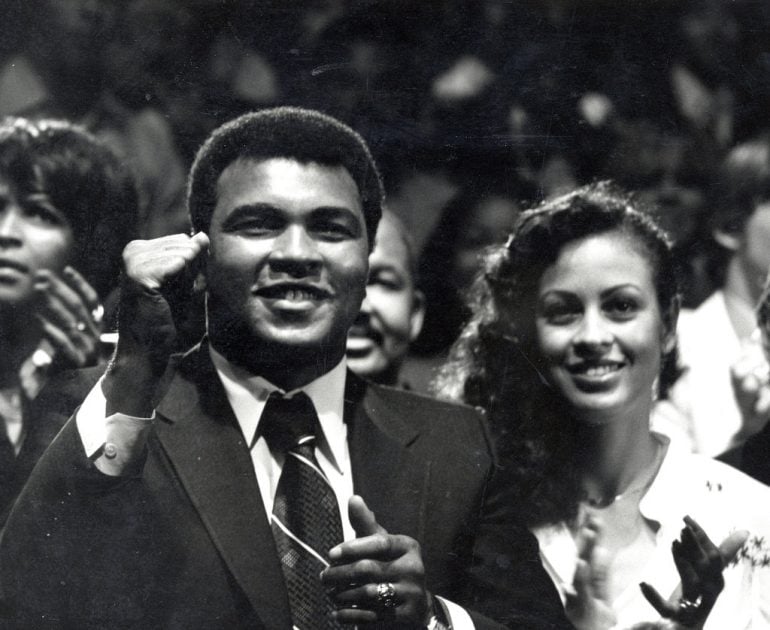
1979 – Muhammad Ali, at 37 years old, announced that he was retiring as world heavyweight boxing champion.

1985 – Wilbur Snapp was ejected after playing “Three Blind Mice” during a baseball game. The incident followed a call made by umpire Keith O’Connor.

1987 – The movie “Dragnet” opened in the U.S.

1996 – The U.S. Supreme Court ordered the Virginia Military Institute to admit women or forgo state support.

1997 – The U.S. Supreme Court struck down the Communications Decency Act of 1996 that made it illegal to distribute indecent material on the Internet.

1997 – J.K. Rowlings book “Harry Potter and the Philosopher’s Stone” was published in the U.K. The book was later released in the U.S. under the name “Harry Potter and the Sorcerer’s Stone.” This was the first book in the Harry Potter series.

1997 – The U.S. Supreme Court upheld state laws that allow for a ban on doctor-assisted suicides.

1998 – The U.S. and Peru open school to train commandos to patrol Peru’s rivers for drug traffickers.

1998 – The U.S. Supreme Court ruled that employers are always potentially liable for supervisor’s sexual misconduct toward an employee.

2000 – The Human Genome Project and Celera Genomics Corp. jointly announced that they had created a working draft of the human genome.

2000 – Indonesia’s President Abdurrahman Wahid declared a state of emergency in the Moluccas due to the escalation of fighting between Christians and Muslims.

2001 – Ray Bourque (Colorado Avalanche) announced his retirement just 17 days after winning his first Stanley Cup. Bouque retired after 22 years and held the NHL record for highest-scoring defenseman and playing in 19 consecutive All-Star games.

2002 – WorldCom Inc. filed for Chapter 11 bankruptcy protection.

1996 – The U.S. Supreme Court ordered the Virginia Military Institute to admit women or forgo state support ~ United States v. Virginia, 518 U.S. 515 (1996)


june 26

OCTOBER TERM, 1995
Syllabus
UNITED STATES v. VIRGINIA ET AL.
CERTIORARI TO THE UNITED STATES COURT OF APPEALS FOR THE FOURTH CIRCUIT
No.94-1941. Argued January 17, 1996-Decided June 26,1996*
Virginia Military Institute (VMI) is the sole single-sex school among Virginia’s public institutions of higher learning. VMI’s distinctive mission is to produce “citizen-soldiers,” men prepared for leadership in civilian life and in military service. Using an “adversative method” of training not available elsewhere in Virginia, VMI endeavors to instill physical and mental discipline in its cadets and impart to them a strong moral code. Reflecting the high value alumni place on their VMI training, VMI has the largest per-student endowment of all public undergraduate institutions in the Nation. The United States sued Virginia and VMI, alleging that VMI’s exclusively male admission policy violated the Fourteenth Amendment’s Equal Protection Clause. The District Court ruled in VMI’s favor. The Fourth Circuit reversed and ordered Virginia to remedy the constitutional violation. In response, Virginia proposed a parallel program for women: Virginia Women’s Institute for Leadership (VWIL), located at Mary Baldwin College, a private liberal arts school for women. The District Court found that Virginia’s proposal satisfied the Constitution’s equal protection requirement, and the Fourth Circuit affirmed. The appeals court deferentially reviewed Virginia’s plan and determined that provision of single-gender educational options was a legitimate objective. Maintenance of single-sex programs, the court concluded, was essential to that objective. The court recognized, however, that its analysis risked bypassing equal protection scrutiny, so it fashioned an additional test, asking whether VMI and VWIL students would receive “substantively comparable” benefits. Although the Court of Appeals acknowledged that the VWIL degree lacked the historical benefit and prestige of a VMI degree, the court nevertheless found the educational opportunities at the two schools sufficiently comparable.
Held:
1. Parties who seek to defend gender-based government action must demonstrate an “exceedingly persuasive justification” for that action. E. g., Mississippi Univ. for Women v. Hogan, 458 U. S. 718,724. Nei-
*Together with No. 94-2107, Virginia et al. v. United States, also on certiorari to the same court.