The Buckeye Squeeze


By

Ohio’s Middle Class Is Hurting, And GOP Policies Will Just Make It Worse

In a little more than 24 hours, 10 Republican men will take the stage in Cleveland for the first GOP primary debate. More than likely, most candidates will claim they are champions of Ohio’s middle class.

It is true that Ohio’s working families need a champion, as a new CAP Action report indicates. The Cleveland Plain Dealer discusses the report’s key points ahead of debate night, highlighting that that the median household income in Ohio has dropped by more than 6% in the last 30 years. As the Plain Dealer states, “only three states fared worse” than Ohio in terms of median household income.

However, another new CAP Action report shows that Republican rhetoric on how they value working Ohioans is far different than reality. Actually, many GOP candidates supporting policies that benefit the wealthy at the expense of the Ohio middle class.

In short, GOP candidates’ policies would hurt Ohio’s working families. Here are a few key examples:

  • Conservative tax policies overwhelming benefit the wealthiest Americans at the expense of working families. For example, Jeb Bush, Ted Cruz, Marco Rubio, and Rick Perry have all called for eliminating or drastically reducing the capital gains tax, a policy that would benefit 92% of Ohio taxpayers who made $1 million or more in 2012, but would have almost no impact on Ohio’s middle class.
  • Conservative policies make it harder to create good-paying jobs. Right-to-work laws, like the one signed by Gov. Scott Walker, are associated with average wages that are 3.1% lower than wages in states without right-to-work laws. Ohio governor and GOP candidate John Kasich pushed anti-worker legislation, which was rejected by Ohio voters, that would have likely lowered incomes and hurt job growth.
  • GOP candidates oppose policies that help families balance work and home. Women are the sole, primary, or co-breadwinners in more than 68 percent of Ohio families, yet Republican candidates oppose key policies such as paid sick days, paid family and medical leave, equal pay, and access to childcare. Gov. Walker and Gov. Jindal signed pre-emption laws, preventing cities in their states from requiring paid sick leave.
  • GOP governors ignore runaway tuition costs. Under Gov. Jindal and Gov. Perry, students faced exploding costs. College tuition and fees grew 44 percentage points in Louisiana and 69.3 percentage points more in Texas, respectively, more than in Ohio.

BOTTOM LINE: GOP candidates may claim they will help the middle class, but their policies benefit the wealthy while hurting job growth and making it harder for families to balance work and home and afford college for their children. With a falling median income, Ohio’s middle class cannot afford the choices offered by this class of Republican candidates.

Mayor Rauner … seems to be against his constituents


  Rauner suspends $26 million in social services, public health grants

Rauner suspends $26 million in social services, public health grants

Gov. Bruce Rauner’s office worked with the Departments of Human Services and Public Health “to see which grants could be suspended and prioritized essential services.”


Associated Press

Illinois Gov. Bruce Rauner suspended $26 million in social services and public health grants as part of his push to whittle away at a $1.6 billion shortfall in the current state budget.

The Republican’s office released a list of targeted programs late Friday that included funding to pay for the funerals and burials of public-assistance recipients, smoking cessation, teen programs, autism, and HIV and AIDS programs, among other things.

Rauner also froze $3.4 million in funding for immigrant integration assistance as part of ongoing efforts to keep the state rolling through the June 30 end of the fiscal year.

Rauner’s office said the check-writing halt – he also interrupted $180 million in parkland grants in March – is necessary because the expenditures were based on the assumption a temporary income tax would be extended past January, but it wasn’t after Rauner won the election.

“Part of the solution to solving the inherited $1.6 billion budget hole without raising taxes or increasing borrowing is to continue to evaluate the current fiscal year’s budget,” Rauner spokeswoman Catherine Kelly said. “The governor’s office worked with agencies to see which grants could be suspended and prioritized essential services.”

The cuts will save the state $21.8 million in Department of Human Services Grants and $4.5 million in unexpended funding through the Department of Public Health. The suspensions only affect this year’s funding, Kelly said.

But there’s always another price – this one paid for by constituents who, as soon as Monday morning, will be told through closed doors there’s no more money to help them.

Breandan Magee, senior director of programs for the Illinois Coalition for Immigrant and Refugee Rights, said dozens of organizations assisted 102,000 legal immigrants in 2014 with applications for citizenship, English as a Second Language classes and health and nutrition programs for low-income immigrants.

“There are 299 jobs across 60 different immigrant-services agencies at risk” with funding ceasing, Magee said Saturday. “There are workshops scheduled for citizenship, applications for citizenship pending, ESL classes hallway through.”

Immigrant integration programs – which Rauner proposed eliminating entirely in the 2016 budget – will forfeit nearly half of their $6.7 million budget, according to figures provided by the governor’s office. Magee said he hopes the state will cover expenses he’s already incurred.

A copy of Friday’s letter from Human Services, obtained by The Associated Press, notifies the recipient to “immediately cease incurring additional obligations, costs or spending any further grant funds.” Agencies must submit records of all spending for the year. Jimi Orange of Children’s Home and Aid faces the unenviable task of telling up to 25 of the 100 children in Chicago’s impoverished West Englewood neighborhood they can’t come to Earle Elementary School for after-class tutoring and cultural activities because the state has recalled the remaining $3.1 million of Teen REACH money for kids ages 7 to 17.

“The staff’s concern is how to tell the families? What to tell the kids? How to tell the kids?” Orange said. “These are kids who already have abandonment issues, trust issues.”

Parkland-related grants Rauner has suspended this year include $90 million for park facility construction, $56 million for local governments to purchase open space for future parkland, and $30 million for museum capital-construction grants.

Grants suspended by Rauner include:

DEPARTMENT OF HUMAN SERVICES

Funeral & Burial, $6.9 million

Rauner’s ‘turnaround budget’ has cuts called ‘reckless,’ ‘wrong priorities’

You be the judge. Look at the list below and decide if grants for the Homeless or for HIV assistance, Addiction  prevenetion, and so on are reckless.

Immigrant Integration Services, $3.4 million

Welcoming Centers, $191,300

ARC Lifespan, $118,100

Best Buddies, $250,000

Autism, $1 million

Group Home Loans, $20,000

Compulsive Gambling $406,000

Westside Health, $94,200

Addiction Prevention, $1.6 million

Assistance for Homeless, $300,000

Community Services, $2 million

Teen REACH, $3.1 million

Coalition F/Tech Assist-Child, $250,000

For Children’s Health Program, $231,600

Outreach to Individuals to Engage in Services, $380,700

Regions Special Consumer Support, $277,700

SMRF Training, $420,100

Transportation, $43,900

DD Latino Outreach, $87,500

Microboard Development and Outreach, $47,500

Epilepsy, $514,700

DHS TOTAL: $21.8 million

DEPARTMENT OF NATURAL RESOURCES

Brothers and Sisters United Against HIV/AIDS, $789,800

Increasing Access to Health Care-Wellness on Wheels, $180,000

Wellness on Wheels – Mobile Administration 2015, $135,000

Illinois Tobacco Quitline, $3.1 million

Project Safe Sleep Education and Outreach, $250,000

MidAmerica Regional Public Health Leadership Institute, $75,000

IDPH TOTAL: $4.5 million

DEPARTMENT OF NATURAL RESOURCES*

Park and Recreational Facility Construction, $89.5 million

Open Space Lands Acqusition and Development, $56.3 million

Museum Capital Grants, $30.4 million

Bike Paths, Mud-to-Parks, others, $2.6 million

IDNR TOTAL: $178.8 million

*Grants suspended in March

FETUS TISSUE AND RESEARCH


maboulette's avatarAs My World Turns

Since the 1930s, tissue from fetuses have been used for the development of vaccines and in the recent past used to help advance stem cell research and treatments for diseases that are degenerative such as Parkinson’s disease. These researchers usually take tissue samples from a fetus that has already been aborted under conditions permitted by law and grow these cells from the tissue in Petri dishes.

Most of the uses of fetal tissue (and much of the debate) are not new. It has become a problem as the public is finding out about it and not researching how this is done.

Additionally, the ways fetal tissues are allowed to be gotten and used are not new either. The guidelines on this topic written by the U.S. Department of Health and Human Services released these guidelines on this topic in the 1990s.

The federal regulations state women must decide to have…

View original post 467 more words

After Cecil the lion


Petitioning South African Airways US

Tell South African Airways to stop shipping slaughtered wildlife trophies

Petition by Regina Fugate
Cape Town, South Africa
54,482
Supporters

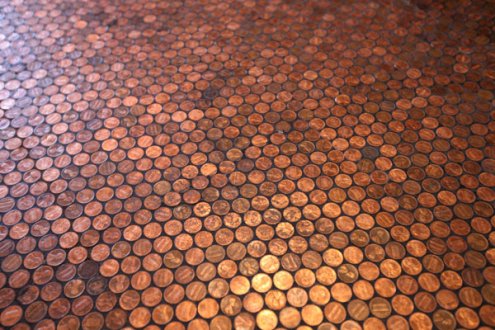
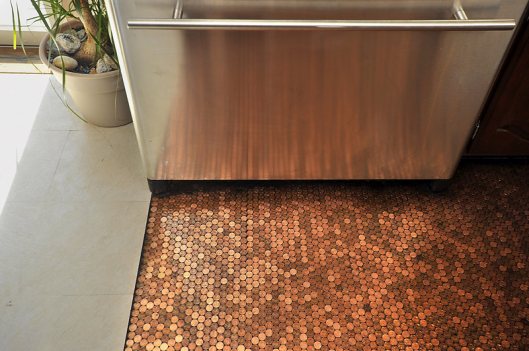
Coin Flooring – Cents and Sensibility: How to Make a Penny&Nickel Floors


a repost Jul 2012 ~~ 9/2013

Posted by ADetailedHouse

in Architecture, Baths, Design, DIY, Flooring, Home Improvement, Interior Design, Kitchens, Lifestylepenny-floorpennyflooronconcrete


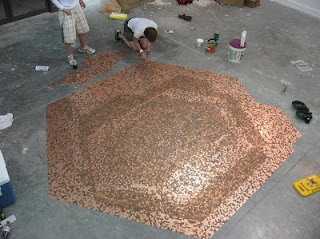
The picture above are of a massive concrete floor. I could see some car enthusiast doing this to a garage floor.  This floor has no thinset, merely polyurethane and epoxy (via Happy Roost Blog)

A Detailed House, Floors made out of coins, Floors made out of pennies, How to make a nickel floor, How to make a penny floor, Nickel floor, Penny floor, Portland Press Herald, Standard Grill

With two little ones running around the house, I am always picking things up off the floor. I am amazed, though, by the sheer number of coins! Granted, we play “store” a lot, which involves a cash register, spare change, and my youngest setting up “shop” where ever I am… no matter what I’m doing, working or not! They have piggy banks that they love to fill, so why are the coins spread cavalierly on the floor?

I tell myself it’s good for me – like exercise – and picking them up is the equivalent of toe touches, but not even an Army Drill Sargent would put someone through this Now my thought process is that I’m just going to start cementing them down, so I will eventually end up with these floors:


pennyfloormeshsheets pennyfloor$1.96 penneyfloorthinset


penneyfloorportland

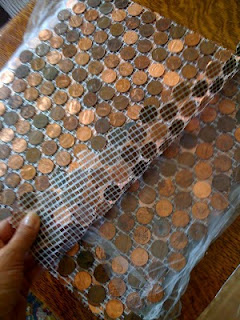
Instead of hunching over a floor, you could also glue them to mesh, like tile sheets


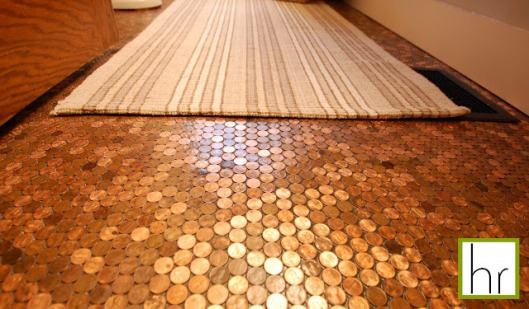
Pennies are about $1.96/square foot. Not too shabby for a unique copper floor!

(via apartmenttherapy.com)


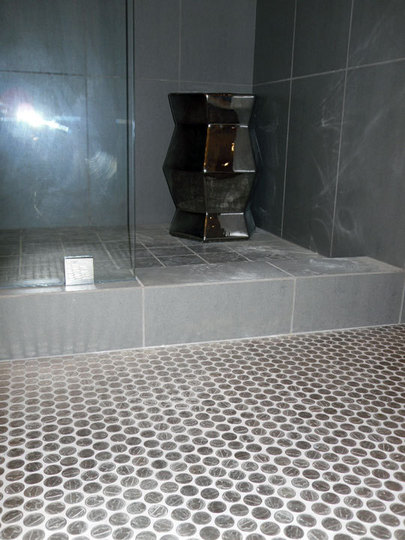
nickeltilefloorgrouted

Nickels are about $10/square foot. Here’s what you do to You need to make sure your floor is clean. Use a wax remover if applying over linoleum, which can be done.If you want shiny pennies, you can soak them in vinegar. Make sure the coins have the patina you want even if it means going to the bank and getting rolls and rolls of pennies to search for clean coins.If you want a design, lay it out first on the floor so you know how it will fit together.Glue the coins directly to the floor, preferably in the same direction and pay attention to heads or tails (if it matters to you). Weldbond, a tile or glass glue, was used for many of the penny floors, but some used Elmer’s Glue, which seems a little on the flimsy side, and Gorilla Glue.You now have two options:You can apply thinset (a chocolate brown was used on the pennies) OR You can apply a thick coat of a high gloss polyurethaneFor the final top coat, apply another coat of polyurethane and/or an epoxy sealer (pictured below) to seal and make cleaning the floor easier.

For the world traveler, you could make a floor that incorporates coins from all the countries that you’ve visited as a sweet reminder.


politics,pollution,petitions,pop culture & purses