Update from the White House Council on Women and Girls


womens_day_2013GOOGLE

Happy belated Mother’s Day to all of our moms out there!

This week, to celebrate moms across the country, President Obama surprised three moms who had written letters to him over the course of this year with phone calls to wish them a happy Mother’s Day! The President also issued a Presidential Proclamation in celebration of Mother’s Day and in honor of the mothers who lift us up every day.

Additionally, Mother’s Day was the beginning of National Women’s Health Week! Thank you to all who participated. We hope you had an opportunity to learn about the steps you can take for better health and the great preventive health benefits the ACA provides.

On Monday, President Obama and the U.S. Department of Health and Human Services issued important guidance on the Affordable Care Act: Most insurers must cover, without cost-sharing, at least one form of contraception in each of the 18 methods for women that the FDA has identified. Learn more below about this new guidance and the steps the Obama administration took to eliminate any ambiguity around ACA reforms.

And last week, to celebrate Military Spouse Appreciation Day and an early Mother’s Day, the First Lady and Dr. Biden invited military-connected moms to the White House for their annual Mother’s Day Tea.

Read on for opportunities to engage, and don’t forget to follow the Chair of the White House Council on Women and Girls, Valerie Jarrett, on Twitter at @vj44. You can also email us at cwg@who.eop.gov. We look forward to continuing the conversation!

Latest News and Administration Highlights

A Recap of National Women’s Health Week: May 10-16

Thank you to all who participated and engaged with National Women’s Health Week on May 10-16! National Women’s Health Week is an observance led by the U.S. Department of Health and Human Services Office on Women’s Health. The goal is to empower women to make their health a priority. The week served as a time to help women understand what steps they can take to improve their health and the preventive care benefits afforded to women under the ACA.

While National Women’s Health Week may be over, every day is an opportunity to engage and learn what steps you can take for better health!

The White House Council on Women and Girls and Office on Women’s Health continues to encourage women across the country to:

  • Check out easy-to-use resources from the Office on Women’s Health.
  • Learn what steps you should take for good health based on your age.
  • Share National Women’s Health Week infocards with your friends, family, and coworkers.
  • Check out the Presidential Proclamation recognizing National Women’s Health Week, 2015.

What You Need to Know About the New Contraception Guidance:

It is crucial that insurance companies provide all the benefits that women deserve under the Affordable Care Act, at no cost or inconvenience. So this week, the Obama administration took steps to eliminate any ambiguity around the reforms the ACA calls for. Here is what the Administration’s guidance makes clear:

Learn more about the guidance here.

And here’s a quick recap on how the ACA has been giving women greater control of their own health care since 2010:

  • Providing tax credits for women who cannot afford quality health insurance
  • Prohibiting insurance companies from charging a woman more because of her health status or gender
  • Covering preventive services with no deductible or co-pay, such as cervical cancer screenings, contraception, and more

Read more about what this Administration is doing to protect important preventive services.

A Mother’s Day Surprise from President Obama

President Obama called three unsuspecting mothers who had written to him recently to wish them a happy Mother’s Day. The mothers, from Minnesota, Arizona and Florida, had all written the President letters over the course of the year.

Watch the great video of his conversation with these moms here!

Watch the President's conversation with moms.

The Faces of Health Care

Read about the incredible impact the Affordable Care Act is having on Americans across the country. This week, we are highlighting the stories of women who have benefited from the ACA:

The First Lady, Dr. Biden, and Ben Folds Celebrate Military-Connected Moms

On May 9, to celebrate Military Spouse Appreciation Day and an early Mother’s Day, the First Lady and Dr. Biden invited military-connected moms to the White House for their annual Mother’s Day Tea.

These mothers, grandmothers, and their guests enjoyed sandwiches, cupcakes, and shortbreads with a selection of teas and juices. Kids came too to make Mother’s Day gifts of petal potpourri, lace-topped cupcakes, and even potted-flower cakes. The First Lady and Dr. Biden greeted the spouses, thanked all military-connected moms, and recognized their service.

Watch the video of their remarks here:

Watch the video of their remarks.

Stay Connected

Did a friend forward this to you? Sign up for Council on Women and Girls updates here.

A Prom Divided ~ May 2009


Gillian Laub for The New York Times

Students from Montgomery County High School in Mount Vernon, Ga., before the prom.

Published: May 21, 2009


About now, high-school seniors everywhere slip into a glorious sort of limbo. Waiting out the final weeks of the school year, they begin rightfully to revel in the shared thrill of moving on. It is no different in south-central Georgia’s Montgomery County, made up of a few small towns set between fields of wire grass and sweet onion. The music is turned up. Homework languishes. The future looms large. But for the 54 students in the class of 2009 at Montgomery County High School, so, too, does the past. On May 1 — a balmy Friday evening — the white students held their senior prom. And the following night — a balmy Saturday — the black students had theirs.

Skip to next paragraph

Gillian Laub for The New York Times

The white students’ prom was held on May 1 at a community center in nearby Vidalia; the black students had theirs at the same place the following night.

Gillian Laub for The New York Times

Niesha Bell, a senior, was voted queen of the black prom. Niesha’s mother, Angela Bell, graduated from Montgomery County High School in 1978 and also attended a racially segregated prom. “I don’t see how things will ever change around here,” says Angela, a cashier. “It’s hard to see my girl in the same situation I was in 30 years ago.”

Gillian Laub for The New York Times

Friends and family come together to watch the white students parade into their prom.

Racially segregated proms have been held in Montgomery County — where about two-thirds of the population is white — almost every year since its schools were integrated in 1971. Such proms are, by many accounts, longstanding traditions in towns across the rural South, though in recent years a number of communities have successfully pushed for change. When the actor Morgan Freeman offered to pay for last year’s first-of-its-kind integrated prom at Charleston High School in Mississippi, his home state, the idea was quickly embraced by students — and rejected by a group of white parents, who held a competing “private” prom. (The effort is the subject of a documentary, “Prom Night in Mississippi,” which will be shown on HBO in July.) The senior proms held by Montgomery County High School students — referred to by many students as “the black-folks prom” and “the white-folks prom” — are organized outside school through student committees with the help of parents. All students are welcome at the black prom, though generally few if any white students show up. The white prom, students say, remains governed by a largely unspoken set of rules about who may come. Black members of the student council say they have asked school administrators about holding a single school-sponsored prom, but that, along with efforts to collaborate with white prom planners, has failed. According to Timothy Wiggs, the outgoing student council president and one of 21 black students graduating this year, “We just never get anywhere with it.” Principal Luke Smith says the school has no plans to sponsor a prom, noting that when it did so in 1995, attendance was poor.

Students of both races say that interracial friendships are common at Montgomery County High School. Black and white students also date one another, though often out of sight of judgmental parents. “Most of the students do want to have a prom together,” says Terra Fountain, a white 18-year-old who graduated from Montgomery County High School last year and is now living with her black boyfriend. “But it’s the white parents who say no. … They’re like, if you’re going with the black people, I’m not going to pay for it.”

“It’s awkward,” acknowledges JonPaul Edge, a senior who is white. “I have as many black friends as I do white friends. We do everything else together. We hang out. We play sports together. We go to class together. I don’t think anybody at our school is racist.” Trying to explain the continued existence of segregated proms, Edge falls back on the same reasoning offered by a number of white students and their parents. “It’s how it’s always been,” he says. “It’s just a tradition.”

Earlier this month, on the Friday night of the white prom, Kera Nobles, a senior who is black, and six of her black classmates drove over to the local community center where it was being held. Standing amid a crowd of about 80 parents, siblings and grandparents, they snapped pictures and whooped appreciatively as their white friends — blow-dried, boutonniered and glittering in a way that only high-school seniors can — did their “senior walk,” parading in elegant pairs into the prom. “We got stared at a little, being there,” said one black student, “but it wasn’t too bad.”

After the last couple were announced, after they watched the white people’s father-daughter dance and then, along with the other bystanders, were ushered by chaperones out the door, Kera and her friends piled into a nearby KFC to eat. Whatever elation they felt for their dressed-up classmates was quickly wearing off.

“My best friend is white,” said one senior girl, a little glumly. “She’s in there. She’s real cool, but I don’t understand. If they can be in there, why can’t everybody else?”

The seven teenagers — a mix of girls and boys — slowly worked their way through two buckets of fried chicken. They cracked jokes about the white people’s prom (“I feel bad for them! Their prom is lame!”). They puzzled merrily over white girls’ devotion both to tanning beds (“You don’t like black people, but you’re working your hardest to get as brown as I am!”) and also to the very boys who were excluded from the dance (“Half of those girls, when they get home, they’re gonna text a black boy”). They mused about whether white parents really believed that by keeping black people out of the prom, it would keep them out of their children’s lives (“You think there aren’t going to be black boys at college?”). And finally, more somberly, they questioned their white friends’ professed helplessness in the face of their parents’ prejudice (“You’re 18 years old! You’re old enough to smoke, drive, do whatever else you want to. Why aren’t you able to step up and say, ‘I want to have my senior prom with the people I’m graduating with?’ ”).

It was getting late now. KFC was closing. Another black teenager was mopping the floor nearby. A couple of the boys mentioned they had to wash their cars in the morning. Kera had an early hair appointment. The next night, they would dress up and dance raucously for four hours before tumbling back outside, one step closer to graduating. In the meantime, a girl named Angel checked her cellphone to see if any of the white kids had texted from inside their prom. They hadn’t. Angel shrugged. “I really don’t understand,” she said. “Because I’m thinking that these people love me and I love them, but I don’t know. Tonight’s a different story.”

About that RAW Milk…


USFDA_footer“Back to nature” – that’s what many Americans are trying to do with the foods that we buy and eat. We are shopping at farmer’s markets, purchasing organic food, participating in food cooperatives (or co-ops), and even growing our own food.  In addition, many people are eating food with minimal processing.

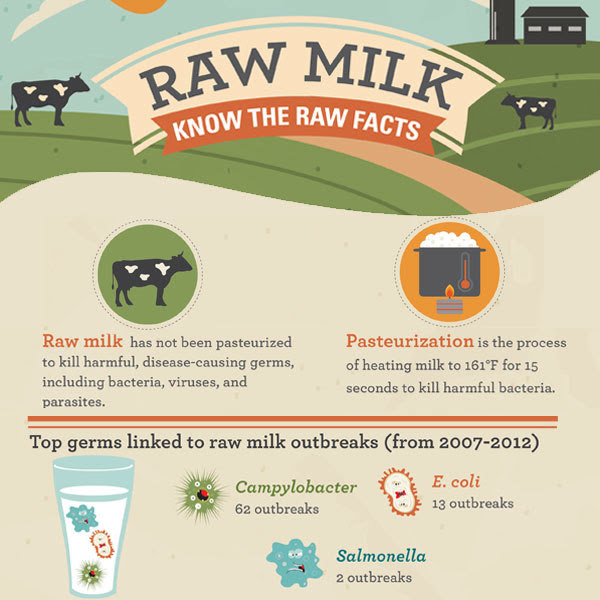
However, raw milk and products made from it (including soft cheese, ice cream, and yogurt) can pose severe health risks, including death. That’s because raw milk has not undergone a process called pasteurization that kills disease-causing germs, such as Campylobacter, E. coli, and Salmonella.

Read our latest blog to learn the facts about raw milk.

Infographic showing the difference between raw milk (uncooked) and pasteurized milk (heated at high temps for 15 sec) and safety risks of raw milk.

Blue Bell will lay off 1,450 employees


Move follows recall after listeria outbreak

By

David Kesmodel

Ice-cream maker Blue Bell Creameries LP said it would lay off 37% of its 3,900 employees as it works to recover from a sweeping recall of all its products last month because of a listeria outbreak.

The Texas company said on Friday it will lay off 750 full-time and 700 part-time employees, and put another 1,400 on partially paid furlough. Blue Bell also is taking other cost-cutting measures, including salary reductions for remaining staff.

The company said the moves were necessary because cleaning and improving its four production plants will take longer than it initially anticipated, especially at its main plant in Brenham, Texas.

“The agonizing decision to lay off hundreds of our great workers and reduce hours and pay for others was the most difficult one I have had to make in my time as Blue Bell’s CEO and President,” Blue Bell Chief Executive Paul Kruse said in a news release.

Blue Bell, a 108-year-old company that is among the biggest U.S. ice-cream makers, voluntarily recalled all of its frozen desserts in April after the U.S. Centers for Disease Control and Prevention linked its ice cream to a listeria outbreak that has resulted in three deaths and additional illnesses.

Blue Bell said Friday there is no firm timeline for when it will begin producing ice cream again. When it does begin, it will be limited “and phased in over time.”

An expanded version of this report appears on WSJ.com

Amtrak And Our Infrastructure Crisis


By

In The Wake Of The Amtrak Tragedy, Let’s Refocus On Investing In Our Nation

Eight people have died and 200 were injured when an Amtrak train traveling more than 100 miles per hour in a 50 MPH zone careened off the tracks near Philadelphia on Monday night. Former Congressman and Senior Fellow at the Center for American Progress Patrick Murphy (D-PA), who was a passenger on the train, described the accident as “so fast, it was surreal. But there was a few moments where I thought I was going to die and that was one of them.” While federal officials have confirmed the train was going far too fast around a turn, the cause of the accident is still under investigation.

Regardless of the possible causes, tragedies like this often serve as a wake-up call for the public. And when it comes to our country’s funding for Amtrak and for transportation infrastructure more broadly, we need one. Badly.

Amtrak is vastly overburdened. More travelers than ever are taking trains, and yet federal funding continues to decrease. In the Northeast Corridor, already the densest rail route in the United States and responsible for 30 percent of the entire country’s GDP, 11.6 million people ride the Amtrak each year and yet the route has $4.3 billion in backlogged repairs (millions more riders use Amtrak-owned infrastructure in the region on commuter rails). Congressional leaders are not addressing the need; in fact, hours after the crash, a House panel voted to cut Amtrak’s budget by a fifth. Here’s a chart from ThinkProgress to give you a better idea:

amtrak2

CREDIT: Andrew Breiner

In addition, technology exists today that may have prevented the fatal crash. Positive train control (PTC) is a technology that allows railroads to use GPS to slow or stop trains in cases from hijacking to human error. The president of Amtrak called PTC “the most important rail safety advancement of our time,” but parts of the funding-starved Northeast Corridor including where the crash took place still lack the system.

These are serious problems in their own right, but our transportation infrastructure funding shortage goes beyond the issues with Amtrak alone. In the 1950s, we spent nearly 5 percent of GDP on transport and water infrastructure projects. Now, while Europe remains at that level and China and other Asian countries are spending close to twice that, U.S. infrastructure spending has plummeted. We are, simply put, falling behind: Amtrak’s ‘high-speed’ Acela train travels an average of 84 mph; a Japanese bullet train topped out last month at 375 mph.

But it’s not just about speed. As we are reminded after each accident, it’s about saving lives. The United States needs to make the necessary investments to remain the world’s greatest superpower. Instead, we have a Republican Congress hell-bent on slashing infrastructure investment and doubling down on cutting Amtrak’s budget.

Meanwhile, a freight train derailed today outside Pittsburgh (there were no injuries). There were 1,241 derailments across the U.S. in 2014.

BOTTOM LINE: Regardless of who or what is at fault in this case, the tragic Amtrak accident that has killed eight people and hurt hundreds more must be a wake-up call to address our nation’s infrastructure crisis. Smart, pro-growth investment in infrastructure is a critical step America must take to prepare for the 21st century, and conservatives should stop standing in the way.

politics,pollution,petitions,pop culture & purses