Will the EPA Choose Political Influence over Science?


Rainforest Action Network
 
Tell Obama’s EPA not to cave to industry pressure on palm oil and climate change.
EPA Science
Take Action

The EPA recently confirmed that the destruction of rainforests for palm oil is having a devastating impact on our climate. In fact, this deforestation, in large part for palm oil plantations, has led Indonesia to become the third largest greenhouse gas emitter in the world, just behind China and the United States.

These severe climate and forest impacts should ensure that palm-oil based biofuels stay out of the EPA’s Renewable Fuel Standard, which mandates that American motorists use 36 billion gallons of biofuel in their cars and trucks by 2022. But not if the powerful palm oil lobby has anything to do with it. A massive lobby effort led by palm oil companies Cargill and Wilmar is being waged to persuade the EPA to overturn its own climate science on palm oil.

Tell Obama’s EPA not to cave to industry pressure on palm oil and climate change.

Palm oil companies know this is jeopardizing news to their multi-billion dollar industry. In the United States, the EPA’s decision could also determine to what extent the U.S. becomes a major palm oil buyer. Consumption of palm oil in the United States is growing at a much faster rate than anywhere else in the world–making sense that industry reps from Indonesia and Malaysia are concerned about protecting palm oil’s reputation here.

The palm oil industry will do whatever it takes to maximize profits at the expense of destruction of the forest, species, and communities of Indonesia and Malaysia–where 85% of the world’s palm oil is cultivated.

Please urge the EPA to adhere to its own scientific findings over listening to palm oil industry giants such as Cargill and Wilmar.

Ashley Schaeffer

For the forests,

Ashley Schaeffer
Rainforest Agribusiness Campaigner

Pelosi – House Dems and Congress in the Newsroom JUNE 2012


The Environment

Touring Seattle's biodiesel plant
Leader Pelosi touring Seattle Biodiesel’s manufacturing plant

Protecting the environment is vital to protect the health of all Americans, particularly our children. Democrats are fighting for cleaner air, cleaner water, and preservation of our natural resources, understanding that what we do today has an impact on future generations of Americans. We stand up for fair policies that protect America’s environment while allowing for economic opportunity—priorities that can work together.

Under Democratic leadership, the House took serious steps in the 110th and 111th Congresses to launch a clean energy economy that will create jobs, lower energy costs for American families and businesses, reduce our dangerous dependence on foreign oil, and reduce the carbon pollution causing climate change. Instead of building on this progress, House Republicans have been slashing investments in clean energy solutions and giving away tens of billions in tax breaks to Big Oil. They should join us in strengthening, not weakening our ability to ensure clean air and a healthier environment for our children.

Recent News & Actions

Pelosi Statement on Earth Day»

A Record that Speaks for Itself: GOP Votes to Support Big Oil»

Republican Energy Plan: Standing with Big Oil»

115 Members of Congress to Speaker Boehner: Reconsider Use of Styrofoam in House Facilities»

Legislation in the 112th Congress

Democratic Legislation – Make It in America: Clean Energy Jobs Now agenda»

H.R. 2021 – More Giveaways to Big Oil, Not Lower Gas Prices»

H.R. 1229 & H.R. 1231 – More Gifts To Big Oil, But No Relief for Taxpayers or Consumers»

H.R. 1230 – A Gift to Big Oil, But No Relief for Taxpayers or Consumers»

Upton-Inhofe Weaken Clean Air Act»

Legislation in the 111th Congress

American Clean Energy and Security Act of 2009 — Historic legislation to launch a new clean energy economy—to create 1.7 million American jobs (with the Recovery Act); help reduce our dangerous dependence on foreign oil by 5 million barrels per day; keep energy costs low for Americans, protects consumers from price increases with lower income families seeing no cost; with no increase to the deficit. Requires a reduction in the carbon pollution causing climate change from major U.S. sources of 17 percent by 2020 (the basis for America’s proposal going into the Copenhagen Climate Summit) and 80 percent by 2050, compared to 2005 levels. Invests in new clean energy and efficiency technologies. Passed House June 26, 2009.

American Recovery and Reinvestment Act of 2009 — Makes historic investments of more than $69 billion in clean energy: modernizing the electricity grid to make it more efficient and reliable; tax incentives to spur energy savings and create clean energy jobs; and a significant commitment to clean energy research, and to develop advanced battery technology. Estimated to create more than 700,000 jobs by 2012, nearly double renewable electricity over four years (instead of increasing only 6 percent), and save consumers up to $98 a year in energy costs. Signed into law on February 17, 2009.

Congressional Budget for FY 2010 — Provides for a 10% increase for investments in clean renewable energy, energy efficiency, research and technological development, and paves the way for fiscally responsible legislation to spur clean energy and energy independence. Passed by the House and Senate, April 29, 2009.

Legislation in the 110th Congress

Energy Independence and Security Act in 2007 — Landmark energy law to increase vehicle fuel efficiency for the first time in more than 3 decades, to 35 miles per gallon in 2020, projected to save $1,000 per vehicle each year; to expand the use of American-grown biofuels, and to combat oil market manipulation. Signed into law on December 19, 2007.

Food, Conservation, and Energy Act of 2008
 — The Farm Bill made an historic commitment to American biofuels—which are keeping gas prices 15 percent lower than they otherwise would be due to fuel blending—and increased Commodity Futures Trading Commission oversight authority to detect and prevent manipulation of energy prices. President Bush vetoed this bill, but Congress overrode that veto. It became law on June 18, 2008.

Energy Improvement and Extension Act of 2008 — Legislation that extended and expanded tax incentives for renewable electricity, energy and fuel from America’s heartland, as well as for plug-in hybrid cars, and energy efficient homes, buildings, and appliances, is critical to creating and preserving more than 500,000 good-paying clean energy American jobs in the wind and solar industries alone. After President Bush threatened to veto these provisions several times, it was signed into law on October 3, 2008 as part of the Emergency Economic Stabilization Act.

Change Starts At Home

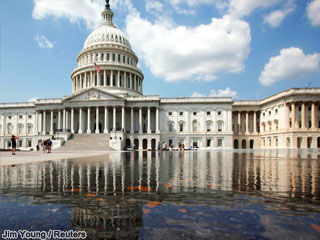
Democrats in the House took bold action to combat global warming and achieve energy independence, beginning right here in the Capitol. In 2007, House Democrats launched our “Green the Capitol” initiative—our commitment to reducing the Capitol’s carbon footprint by making our operations more energyefficient and to ensure our nation’s leaders remain responsible stewards of our environment.

Speaker Pelosi  planting a tree
Pelosi planting a tree outside of the Capitol to commemorate Earth Day 2008

Today, the House has reduced its carbon footprint by 74 percent and converted our Capitol Power Plant from coal to clean natural gas. The Capitol—which serves as a beacon of freedom—is also now a shining example of sustainability.

Learn about the Greening the Capitol Initiative»

CONGRESS: the Republican led House adjourned to witch hunt – the Senate considers S.3240 Farm bill, Judicial appts 3.5yrs later …


the Senate Convened 10:00amET June 12, 2012

  • Following the prayer and pledge, the Senate will resume consideration of Executive Calendar #607, Andrew Hurwitz, of AZ, to be United States Circuit Judge for the 9th Circuit, post-cloture.
  • Following any Leader remarks, the first hour will be equally divided and controlled between the two Leaders or their designees with the Majority controlling the first half and the Republicans controlling the final half.
  • The Senate will recess from 12:30pm until 2:15pm to allow for the weekly caucus meetings.
  • By unanimous consent, all time during adjournment, recess and morning business will count post-cloture on the Hurwitz nomination.
  • We expect to yield back time and confirm the Hurwitz nomination during Tuesday’s session. We are also working on an agreement for amendments to S.3240, the Farm bill.

Prior to the caucus recess, Senator McCain asked unanimous consent to take up and adopt a resolution regarding the recent intelligence leaks. Senator Wyden objected to the request.

All post-cloture debate time was yielded back and by voice vote the Senate confirmed Executive Calendar #607, the nomination of Andrew Hurwitz, of AZ, to be United States Circuit Judge for the 9th Circuit.

The Senate then adopted the motion to proceed to S.3240, the Farm Bill. We will be in a period of debate only until 4pm.

The period for debate only on the Farm bill has been extended until 5:30pm today. In the meantime, the managers of the bill are working on an agreement to consider several amendments to the bill.

Senator Reid asked the following unanimous consent to consider several amendments and a motion to the Farm bill and Senator Paul objected. (See Paul’s remarks on ending aid to Pakistan and Senator Reid’s remarks on the Farm bill below)

Senator Reid asked unanimous consent to call up and agree to a Stabenow-Roberts perfecting amendment #2389 (Managers’ amendment) and that the bill, as amended, be considered original text for the purpose of further amendment. That the amendments and motion listed below be the first in order to the bill, with 60 minutes for debate equally divided on each amendment. That upon the use or yielding back of all time, the Senate proceed to vote in relation to the amendments and motion.

– Paul amendment #2182 (SNAP);

– Shaheen amendment #2160 (Sugar);

– Coburn amendment #2353 (elimination of certain working land conservation programs ;

– Cantwell amendment #2370 (pulse crop products) and

– Lee Motion to Recommit the bill, S.3240, to the Committee on Agriculture, Nutrition and Forestry with instructions to report the same back to the Senate with a reduction in spending to 2008 levels so that overall spending shall not exceed $604,840,000,000.

Further, no amendments or motions are in order to the amendments or the Lee motion prior to the votes other than motions to waive points of order and motions to table. Upon disposition of the Lee motion, the Majority Leader will be recognized.

As noted earlier, Senator Paul objected to this request.

Senator Reid then called up Stabenow-Roberts amendment #2389 (Managers’ amendment) and a second degree amendment #2390 (date change).

He then moved to recommit the bill with instructions to report back forthwith amendment #2391 and offered amendments to the instructions in the first and second degree amendment slots. Those amendments are as follows:

– Reid amendment #2392, which is text of Paul amendment #2182 (SNAP) and

– Reid amendment #2393 which is text of Shaheen amendment #2160 (Sugar).

Finally, for procedural reasons he moved to proceed to S.1940, Flood Insurance extension. The Farm bill remains the pending business.

The following amendments and motion are pending to S.3240, the Farm bill:

WRAP UP

No ROLL CALL VOTES

LEGISLATIVE ITEMS

Adopted S.Res.491, commending the participants in the 44th International Chemistry Olympiad and recognizing the importance of education in the fields of science, technology, engineering, and mathematics to the future of the United States.

Adopted S.Res.492, designating June 15, 2012, as “World Elder Abuse Awareness Day”.

Completed the Rule 14 process of H.R.436, an act to amend the Internal Revenue Code of 1986 to repeal the excise tax on medical devices. (Republican request)

No EXECUTIVE ITEMS

  ************************************************************************

 JUNE 12, 201210:00:16 A.M.   The House convened, starting a new legislative day…  Adjournm, After only 5minutes of Work
10:02:34 A.M.   The Speaker designated the Honorable Mac Thornberry to act as Speaker pro tempore for today.
10:03:44 A.M.   Today’s prayer was offered by Reverend Dr. Alan Keiran, Office of the United States Senate Chaplain.
10:04:45 A.M.   The Speaker announced approval of the Journal. Pursuant to clause 1, rule I, the Journal stands approved.
10:04:58 A.M.   PLEDGE OF ALLEGIANCE – The Chair led the House in reciting the Pledge of Allegiance to the Flag.
10:05:33 A.M.   The Speaker announced that the House do now adjourn pursuant to a previous special order. The next meeting is scheduled for 10:00 a.m. on June 15, 2012.

… Nicole Haber, Climate Reality


Thank you for supporting the historic limit on carbon pollution in the United States. This landmark rule is essential to ending carbon pollution in the U.S.

 We know solutions to the climate crisis can seem out of reach. But with this new rule, we can do something right away to move a step closer to solving the climate crisis.

 I wanted to share something with you as a small token of our appreciation. We made this short video that shows the reality of climate change, how the new Carbon Pollution Standard works, and how you can get involved.

 Share this video with your friends and family. Put it on your Facebook page. Tweet it. With your help, we can ensure that everyone knows about this essential step towards reducing the pollution that’s warming our planet.

http://forms.climaterealityproject.org/push-button-save-planet

 Thanks again,

 Nicole Haber
 Digital Director
 The Climate Reality Project

How You Can Tell When the Deficit is a Problem


A Lot More Important Than the Federal Deficit.

A few days ago, I was stuck in the car for a long drive. Because of the complete absence of progressive talk from Orlando’s airwaves, I had no real choice but to listen to the nasal maundering of Mark Levin on the radio. Levin was very upset about the federal deficit.

Interestingly, Levin was a high-level appointee in the Reagan Administration. Dick Cheney, who was Reagan’s Defense Secretary and later the Vice President, said 10 years ago that “Reagan proved deficits don’t matter.”

I must concede that it is rather difficult to reconcile the conflicting statements of these two gentlemen, Messrs. Levin and Cheney. Evidently, they believe deficits are a terrible tragedy when a Democrat is President, and a wonderful gift when a Republican is President.

There has got to be a more objective standard than that.

Here’s one: the federal deficit is a problem when long-term interest rates are high, and not much of a problem when long-term interest rates are low. The Federal Reserve dictates short-term interest rates, but long-term rates still are, pretty much, set by the market, in its usual ruthless fashion. (Which is why James Carville said that after he dies, he “want[s] to come back as the bond market. You can intimidate everybody.”)

When long-term interest rates are high, a federal deficit competes against and “crowds out” private borrowing and investment. When long-term interest rates are low, the federal deficit is not taking away from borrowing by the private sector. On the contrary, the federal deficit is acting as a needed boost to aggregate demand in the economy, an action also known as “fiscal policy.” When the economy is slack, every dollar of reduction in federal spending takes three or four dollars off of our gross national product.

So, by that test, where are we? Well, as I explained last week, long-term U.S. interest rates are at their lowest in history. So what does that tell you about the deficit?

Sorry – I didn’t mention that there was going to be a quiz.

When Ronald Reagan was President, long-term interest rates sometimes exceeded 15% – ten times as high as long-term interest rates today. The market was screaming at the top of its lungs that the Reagan deficit was too high. And today? Silence.

Look around the world. The ten-year note in Greece yields a little less than 30%. Pakistan, 13%. Portugal and Venezuela, 12%. In those countries, the bond market is shouting, “Cut that out!”

Not here.

Thanks to all the deficit-mongering by Mark Levin, Rush Limbaugh, Fox “News,” etc., a lot of Americans are scared by the federal deficit. The advice from Democratic pollsters is to go along with this hand-wringing. But there is an alternative: Explain to the American people when a federal deficit is bad, and when it is not.

Like I just did.

Courage,

Alan Grayson

politics,pollution,petitions,pop culture & purses