
Massive earthquake strikes Haiti, 2010
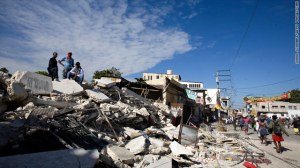
On this day in 2010, a magnitude 7.0 earthquake devastates the Caribbean island nation of Haiti. The quake, which was the strongest to strike the region in more than 200 years, left over 200,000 people dead and some 895,000 Haitians homeless.
The earthquake hit southern Haiti at 4:53 p.m. local time. The nation’s capital, Port-au-Prince, a densely populated city located about 15 miles from the quake’s epicenter, suffered widespread devastation. Countless dwellings were reduced to rubble, while hospitals, churches and schools collapsed and roads were blocked with debris. Numerous government structures were heavily damaged or destroyed, including the presidential palace, parliament building and main prison. (At the time of the quake, Haiti lacked a national building code, and many structures were shoddily constructed.) In the aftermath of the quake, amidst fears that victims’ decomposing corpses could spread disease, trucks picked up thousands of bodies and dumped them into mass graves.
Even before the earthquake, Haiti, which occupies the western third of the island of Hispaniola (the Dominican Republic occupies the other two-thirds), was the poorest country in the Western Hemisphere, with 80 percent of its 9 million residents existing in poverty. Political corruption and violence, disease, malnutrition and limited access to education were a way of life for many in Haiti, which gained its independence from France in an 1804 slave revolt.
A large-scale, international relief operation was launched soon after the quake hit, with the United States taking charge and sending thousands of military troops to Haiti to deliver supplies, assist with search-and-rescue efforts and help maintain order. Relief efforts initially were hampered by earthquake damage to roads, communication systems and the Port-au-Prince airport and main port.
Governments and individuals around the world made donations and pledges of aid to Haiti totaling billions of dollars. However, on the first-year anniversary of the disaster, reconstruction efforts were still in their infancy. Thousands of people left homeless by the quake were living in tents, and only a small portion of the heavy debris resulting from the disaster had been cleared.
resource: history.com
i would like to add that the problem is getting access to education due to dollars and the fact that they are mostly privately run least we talk about the limited jobs in public schools and wages tend to be lower in non-public schools.


 The Blonde Salad













 Be a Seed for Change
You must be logged in to post a comment.