Tag Archives: Food

In Memory …. Langston Hughes – Black History


Langston Hughes

Image result for langston hughes. Size: 202 x 200. Source: blogs.cofc.edu

19021967, Joplin, MO

James Mercer Langston Hughes was born February 1, 1902, in Joplin, Missouri. His parents divorced when he was a young child, and his father moved to Mexico. He was raised by his grandmother until he was thirteen, when he moved to Lincoln, Illinois, to live with his mother and her husband, before the family eventually settled in Cleveland, Ohio. It was in Lincoln that Hughes began writing poetry. After graduating from high school, he spent a year in Mexico followed by a year at Columbia University in New York City. During this time, he held odd jobs such as assistant cook, launderer, and busboy. He also travelled to Africa and Europe working as a seaman. In November 1924, he moved to Washington, D. C. Hughes’s first book of poetry, The Weary Blues, (Knopf, 1926) was published by Alfred A. Knopf in 1926. He finished his college education at Lincoln University in Pennsylvania three years later. In 1930 his first novel, Not Without Laughter, (Knopf, 1930) won the Harmon gold medal for literature.

Hughes, who claimed Paul Lawrence Dunbar, Carl Sandburg, and Walt Whitman as his primary influences, is particularly known for his insightful, colorful portrayals of black life in America from the twenties through the sixties. He wrote novels, short stories and plays, as well as poetry, and is also known for his engagement with the world of jazz and the influence it had on his writing, as in his book-length poem Montage of a Dream Deferred (Holt, 1951). His life and work were enormously important in shaping the artistic contributions of the Harlem Renaissance of the 1920s. Unlike other notable black poets of the period—Claude McKay, Jean Toomer, and Countee Cullen—Hughes refused to differentiate between his personal experience and the common experience of black America. He wanted to tell the stories of his people in ways that reflected their actual culture, including both their suffering and their love of music, laughter, and language itself.

The critic Donald B. Gibson noted in the introduction to Modern Black Poets: A Collection of Critical Essays (Prentice Hall, 1973) that Hughes “differed from most of his predecessors among black poets . . . in that he addressed his poetry to the people, specifically to black people. During the twenties when most American poets were turning inward, writing obscure and esoteric poetry to an ever decreasing audience of readers, Hughes was turning outward, using language and themes, attitudes and ideas familiar to anyone who had the ability simply to read . . . Until the time of his death, he spread his message humorously—though always seriously—to audiences throughout the country, having read his poetry to more people (possibly) than any other American poet.”

Langston Hughes died of complications from prostate cancer in May 22, 1967, in New York City. In his memory, his residence at 20 East 127th Street in Harlem has been given landmark status by the New York City Preservation Commission, and East 127th Street has been renamed “Langston Hughes Place.”

In addition to leaving us a large body of poetic work, Hughes wrote eleven plays and countless works of prose, including the well-known “Simple” books: Simple Speaks His Mind, (Simon & Schuster, 1950); Simple Stakes a Claim, (Rinehart, 1957); Simple Takes a Wife, (Simon & Schuster, 1953); and Simple’s Uncle Sam (Hill and Wang, 1965). He edited the anthologies The Poetry of the Negro and The Book of Negro Folklore, wrote an acclaimed autobiography, The Big Sea (Knopf, 1940), and cowrote the play Mule Bone (HarperCollins, 1991) with Zora Neale Hurston.


Selected Bibliography

Poetry

Collected Poems of Langston Hughes (Knopf, 1994)
The Panther and the Lash: Poems of Our Times (Knopf, 1967)
Ask Your Mama: 12 Moods for Jazz (Knopf, 1961)
Montage of a Dream Deferred (Holt, 1951)
One-Way Ticket (Knopf, 1949)
Fields of Wonder (Knopf, 1947)
Freedom’s Plow (Musette Publishers, 1943)
Shakespeare in Harlem (Knopf, 1942)
The Dream Keeper and Other Poems (Knopf, 1932)
Scottsboro Limited (The Golden Stair Press, 1932)
Dear Lovely Death (Troutbeck Press, 1931)
Fine Clothes to the Jew (Knopf, 1927)
The Weary Blues (Knopf, 1926)

Prose

Remember Me to Harlem: The Letters of Langston Hughes and Carl Van Vechten, 1925-1964 (Knopf, 2001)
The Arna Bontemps-Langston Hughes Letters (Dodd, Mead, 1980)
Good Morning, Revolution: Uncollected Social Protest Writings by Langston Hughes (Hill, 1973)
Simple’s Uncle Sam (Hill and Wang, 1965)
Something in Common and Other Stories (Hill and Wang, 1963)
Tambourines to Glory (John Day, 1958)
Simple Stakes a Claim (Rinehart, 1957)
I Wonder as I Wander (Rinehart, 1956)
Laughing to Keep From Crying (Holt, 1952)
Simple Takes a Wife (Simon & Schuster, 1953)
Simple Speaks His Mind (Simon & Schuster, 1950)
The Ways of White Folks (Knopf, 1934)
Not Without Laughter (Knopf, 1930)

Drama

Collected Works of Langston Hughes, vol. 5: The Plays to 1942: Mulatto to The Sun Do Move (University of Missouri Press, 2000)
The Political Plays of Langston Hughes (Southern Illinois University Press, 2000)
Mule Bone (HarperCollins, 1991)
Five Plays by Langston Hughes (Indiana University Press, 1963)

Poetry in Translation

Cuba Libre (Anderson & Ritchie, 1948)
Selected Poems of Gabriela Mistral (Indiana University Press, 1957)

Translation

Masters of the Dew (Reynal & Hitchcock, 1947)

National Minority Health Month


Dept. of Health & Human Services

National Minority Health Month | CPSC.gov

Every April, the U.S. Department of Health and Human Services (HHS) Office of Minority Health (OMH) observes National Minority Health Month to highlight the importance of improving the health of racial and ethnic minority and American Indian/Alaska Native (AI/AN) communities and reducing health disparities.

OMH is proud to announce the theme for National Minority Health Month 2023: Better Health Through Better Understanding.

This year’s theme focuses on improving health outcomes for racial and ethnic minorities and AI/AN communities by providing them with culturally and linguistically competent healthcare services, information, and resources. When patients are provided with culturally and linguistically appropriate information, they are empowered to create healthier outcomes for themselves and their communities.

minorityhealth.hhs.gov

A Matter of Racial Justice – Posted in 2014, did the boost even happen? Black History


By

Like CAP Action on Facebook and follow us on Twitter!

A $10.10 Minimum Wage Means A $16.1 Billion Boost For People Of Color

Among the many important reasons to raise the minimum wage to $10.10, the issue is a matter of racial justice. Take a look at the graphic below from the Center for American Progress outlining how much racial groups would benefit if we raise the wage to $10.10 per hour:

minwage_color

People of color are far more likely to work minimum wage jobs: they represent 42 percent of those earners even though they make up just 32 percent of the workforce. And people of color who earn minimum wage are far more likely to live in poverty than average. A 2013 study found that three and a half million people of color would be lifted out of poverty if Congress passes a law raising the minimum wage to $10.10 — out of the six million total. That is 60 percent.

As we have mentioned before, raising the minimum wage has numerous positive economic effects for all Americans, like taking a step to reduce income inequality. It would also reduce government spending, providing an estimated savings from food stamps of $46 billion over ten years as fewer people with jobs need to rely on the program.

BOTTOM LINE: Low-wage jobs have dominated job growth since the end of the Great Recession, and these jobs are done disproportionately by people of color. New data shows yet another reason to raise the minimum wage to $10.10: it would provide a $16.1 billion boost to people of color and go a long way toward making sure that Americans working a full-time job don’t have to live in poverty.

On This Day ~~ Haiti … In memory


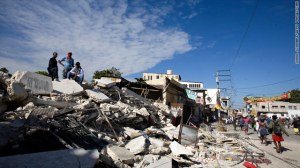
Massive earthquake strikes Haiti, 2010

On this day in 2010, a magnitude 7.0 earthquake devastates the Caribbean island nation of Haiti. The quake, which was the strongest to strike the region in more than 200 years, left over 200,000 people dead and some 895,000 Haitians homeless.

The earthquake hit southern Haiti at 4:53 p.m. local time. The nation’s capital, Port-au-Prince, a densely populated city located about 15 miles from the quake’s epicenter, suffered widespread devastation. Countless dwellings were reduced to rubble, while hospitals, churches and schools collapsed and roads were blocked with debris. Numerous government structures were heavily damaged or destroyed, including the presidential palace, parliament building and main prison. (At the time of the quake, Haiti lacked a national building code, and many structures were shoddily constructed.) In the aftermath of the quake, amidst fears that victims’ decomposing corpses could spread disease, trucks picked up thousands of bodies and dumped them into mass graves.

Even before the earthquake, Haiti, which occupies the western third of the island of Hispaniola (the Dominican Republic occupies the other two-thirds), was the poorest country in the Western Hemisphere, with 80 percent of its 9 million residents existing in poverty. Political corruption and violence, disease, malnutrition and limited access to education were a way of life for many in Haiti, which gained its independence from France in an 1804 slave revolt.

A large-scale, international relief operation was launched soon after the quake hit, with the United States taking charge and sending thousands of military troops to Haiti to deliver supplies, assist with search-and-rescue efforts and help maintain order. Relief efforts initially were hampered by earthquake damage to roads, communication systems and the Port-au-Prince airport and main port.

Governments and individuals around the world made donations and pledges of aid to Haiti totaling billions of dollars. However, on the first-year anniversary of the disaster, reconstruction efforts were still in their infancy. Thousands of people left homeless by the quake were living in tents, and only a small portion of the heavy debris resulting from the disaster had been cleared.

resource: history.com

i would like to add that the problem is getting access to education due to dollars and the fact that they are mostly privately run least we talk about the limited jobs in public schools and wages tend to be lower in non-public schools.

The Story of the Horse


The Story of the HorseIn any discussion of the history of humankind, it becomes quickly apparent that this narrative would be utterly different without the inclusion of horses.

In our July/August 2015 issue, executive editor Jarrett A. Lobell and online editor Eric A. Powell bring us a special section, “The Story of the Horse,” in which they explore the unique roles that this animal has played in diverse areas of the human experience, and the evolving relationship we have had with horses across the millennia.

to get the complete article click on the link above!