Pipsqueek says: I’m so happy your my friend!


It’s tempting to simply look away from Patel’s case on the grounds that it is an outlier, however tragic. But it demonstrates how unsparing the criminal-justice system can be to women whose pregnancies end in (or otherwise involve) suspicious circumstances. If one lesson of the case is about the legal risk of inducing your own late-term abortion, another is about the peril of trying to get medical help when you are bleeding and in pain.
Last July, Patel went to an emergency room in South Bend, Ind., where she told the doctors she had a miscarriage. Asked what she had done with the fetal remains, she said the baby was stillborn and, not knowing what else to do, she put the body in a bag and left it in a Dumpster. The police were able to recover the body. Later, they also found text messages in which Patel told a friend about ordering pills to induce an abortion from a pharmacy in Hong Kong and about taking the medication. Three days later, she texted the same friend, “Just lost the baby.”
Patel was charged with felony child neglect and feticide, based on the supposed self-abortion. Asked by Slate’s Leon Neyfakh about the apparent contradiction between the charges, the St. Joseph County prosecutor, Ken Cotter, said that a person can be guilty of feticide under Indiana law for deliberately trying to end a pregnancy, even if the fetus survives. As Neyfakh points out, the Indiana feticide statute exempts legal abortions — but while the pills Patel took are available in the United States with a prescription, it’s against the law to order them online, as she apparently did. And so she was prosecuted for taking the medication as well as for letting her baby die after the self-abortion failed.
If this case were only about a woman who clearly gave birth to a live baby and then killed her child, it would be clear cut. There is a line between pregnancy and birth, and once it is crossed, the state has just as much at stake in protecting the life of a newborn as it does in protecting the life of anyone else. But the evidence that Patel’s baby was born alive is sharply contested. The pathologist who testified for the defense, Shaku Teas, said the baby was stillborn. Teas told the court the fetus was at 23 or 24 weeks gestation and that its lungs weren’t developed enough to breathe. (Here’s more support for this position.)
But the pathologist for the prosecution, Joseph Prahlow, testified that the fetus was further along than that — at 25 to 30 weeks gestation, which is past the point of viability — and was born alive. News reports from the trial emphasized Prahlow’s use of a “lung float test” in making his determination. The idea behind the test — which dates from the 17th century — is that if the lungs float in water, the baby took at least one breath. If they sink, then the fetus died before leaving the womb.
If that sounds like the old test for witchcraft — if an accused witch floated, she was judged guilty; if she sank, she was innocent — it’s also about as old and nearly as discredited. “The lung float test was disproven over 100 years ago as an indicator for live birth,” Gregory J. Davis, assistant state medical examiner for Kentucky and a professor of pathology and lab medicine at the University of Kentucky, told me. “It’s just not valid.”
When I called Prahlow, who is a professor of pathology and lab medicine at the Indiana University School of Medicine, South Bend, and a former president of the National Association of Medical Examiners, he conceded that “the lung float test, in and of itself, is unreliable.” Still, Prahlow argued, the lung test could “provide corroborating evidence, in light of additional findings.”
Prahlow enumerated those findings to me as he had to the Patel jury: The weight of the lungs and the other organs, the inflation of the lungs and the air sacs, the presence of blood in the lung vessels and the “relative maturity” of the lungs. Put these findings together, along with a lack of blood in the baby’s body, and “I can’t come up with any other explanation other than that this baby was born alive,” Prahlow said.
But Davis was unconvinced. He said that while he knows and respects Prahlow, his conclusion was “dead wrong.” Prahlow’s list of findings are still “totally nonspecific” as to whether Patel’s baby died in utero or after being born, Davis said. “Or even if we agree hypothetically that the baby took a breath, that doesn’t mean Ms. Patel did anything wrong. What if she was scared and bleeding herself, and she didn’t clamp the cord in time, because she didn’t know how, and the baby died?”
To Davis, the forensics in this case can’t determine whether Patel was culpable any more than looking at a body that fell from a high building can determine whether the fall was a suicide, an accident or a homicide. “Sometimes the only answer you can give as a scientist is ‘I don’t know,’” he said.
Whatever happened to Patel and her baby at the point of delivery, it’s hard to imagine that either the prosecution or the judge at sentencing would have come down as hard on her if they weren’t sure she’d tried to induce her own illegal abortion. And this is where Patel’s case moves from a fight over birth to a fight over pregnancy.
This is the first case I can find in which a state-level feticide law has been successfully used to punish a woman for trying to have an abortion. Women have been charged with other crimes after taking abortion pills without a prescription, but the feticide charge appears to be Indiana’s idea. It could spread, though: About 38 states have fetal homicide laws in place.
The common justification for these measures is that they protect pregnant women against unscrupulous abortion providers or abusive partners. Indiana’s feticide law was intended to apply to the knowing or intentional termination of another’s pregnancy, its history shows. Abortion opponents, who support feticide laws, have given repeated assurances that their aim is not to put pregnant women in prison. “We do not think women should be criminalized,” Marjorie Dannenfelser, president of the anti-abortion group Susan B. Anthony List told NPR in 2012 after a woman in Idaho was prosecuted for a self-induced abortion, also with pills she ordered online. “Criminal sanctions or any kind of sanctions are appropriate for abortionists and not for women.”
Nevertheless, prosecutions like these are growing more frequent. In Indiana, before Purvi Patel, there was Bei Bei Shuai, a Chinese immigrant who tried to commit suicide while pregnant and was also charged with feticide. The charges against Shuai were dropped in 2013 after she pleaded guilty to a lesser charge and spent a year in custody. In Iowa, Christine Taylor faced charges for attempted fetal homicide after falling down the stairs, going to the hospital and being reported for trying to end her pregnancy.
Continue reading the main story
The charges in Taylor’s case were dropped, too. But in an Op-Ed in The Times last year, Lynn M. Paltrow, executive director of National Advocates for Pregnant Women, and Jeanne Flavin, a sociology professor at Fordham University, detailed similar cases. A study they conducted, surveying cases since 1973, turned up hundreds of arrests of women for actions taken during their own pregnancies that the authorities deemed harmful to their fetuses.
Many of the cases involved women who took drugs like cocaine and methamphetamines during pregnancy. But they also included women who refused cesarean sections their doctors recommended — and, lately, women who took abortion pills they ordered online. Last September, I wrote about a mother in Pennsylvania, Jennifer Whalen, who went to prison for helping her 16-year-old daughter do that, even though it was a first-trimester abortion and the girl came to no harm. (Whalen has since been released.)
Patel’s case stands out, for the draconian length of the sentence she received, and for the disturbing image of a baby left in a Dumpster. But it is also part of a pattern. “This case shows how easy it is to sweep up women who’ve had miscarriages and stillbirths into a criminal justice framework,” Paltrow told me. For her, the key question is how to ensure that fewer women become as desperate as Patel must have been about her pregnancy. “Do you think these cases will be less rare if you terrify people and make them criminals?” she said.
First March from Selma
When You Pray, Move Your Feet.
— African Proverb.
Charles White(?), photographer, Selma, Alabama, March 1965.
photo courtesy of Representative John Lewis

John Lewis (on right in trench coat) and Hosea Williams (on the left) lead marchers across the Edmund Pettus Bridge.
On Sunday March 1965, about six hundred people began a fifty-four mile march from Selma, Alabama to the state capitol in Montgomery. They were demonstrating for African American voting rights and to commemorate the death of Jimmie Lee Jackson, shot three weeks earlier by an state trooper while trying to protect his mother at a civil rights demonstration. On the outskirts of Selma, after they crossed the Edmund Pettus Bridge, the marchers, in plain sight of photographers and journalists, were brutally assaulted by heavily armed state troopers and deputies.
One hundred years after the Civil War, in many parts of the nation, the 15th Amendment had been nullified by discriminatory laws, ordinances, intimidation, violence, and fear which kept a majority of African Americans from the polls. The situation was particularly egregious in the city of Selma, in Dallas County, Alabama, where African Americans made up more than half the population yet comprised only about 2 percent of the registered voters. As far back as 1896, when the U.S. House of Representatives adjudicated the contested results of a congressional election held in Dallas County, it was stated on the floor of Congress:
…I need only appeal to the memory of members who have served in this House for years and who have witnessed the contests that time and time again have come up from the black belt of Alabama—since 1880 there has not been an honest election in the county of Dallas…
Hon. W. H. Moody, of Massachusetts
Contested Election Case, Aldrich vs. Robbins, Fourth District, Alabama: Speeches of Hon. W.H. Moody, of Massachusetts [et al.] in the House of Representatives, 3 (2239),
March 12 and 13, 1896.
From Slavery to Freedom, 1824-1909
However, by March 1965, the Dallas County Voters League, the Southern Christian Leadership Council (SCLC), and the Student Nonviolent Coordinating Committee (SNCC) were all working for voting rights in Alabama. John Lewis headed SNCC’s voter registration effort and, in March , he and fellow activist Hosea Williams led the group of silent marchers from the Brown Chapel AME Church to the foot of the Pettus bridge and into the event soon known as “Bloody Sunday.”
Alabama Police Attack Selma-to-Montgomery Marchers,
 Federal Bureau of Investigation photograph
Selma, Alabama, March 7, 1965. — http://www.nps.gov/history/nr/travel/civilrights/al4.htm
“We Shall Overcome”: Historic Places of the Civil Rights Movement — http://www.cr.nps.gov/nr/travel/civilrights/index.htm
When ABC television interrupted a Nazi war crimes documentary, Judgement in Nuremberg, to show footage of violence in Selma a powerful metaphor was presented to the nation. Within forty-eight hours, demonstrations in support of the marchers were held in eighty cities and thousands of religious and lay leaders, including Dr. Martin Luther King, flew to Selma. On March 9, Dr. King led a group again to the Pettus Bridge where they knelt, prayed, and, to the consternation of some, returned to Brown Chapel. That night a Northern minister, who was in Selma to march, was killed by white vigilantes.
Outraged citizens continued to inundate the White House and the Congress with letters and phone calls. On March 9, for example, Jackie Robinson, the baseball hero, sent a telegram to the President:
“IMPORTANT YOU TAKE IMMEDIATE ACTION IN ALABAMA ONE MORE DAY OF SAVAGE TREATMENT BY LEGALIZED HATCHET MEN COULD LEAD TO OPEN WARFARE BY AROUSED NEGROES AMERICA CANNOT AFFORD THIS IN 1965”
In Montgomery, Federal Judge Frank Johnson, Jr. temporarily restrained all parties in order to review the case. And, President Lyndon Johnson addressed the American people before a televised Joint Session of Congress, saying, “There is no issue of States rights or national rights. There is only the struggle for human rights…We have already waited a hundred years and more, and the time for waiting is gone…”
Rev. Ralph Abernathy walking with Dr. Martin Luther King, Jr., as They Lead Civil Rights Marchers out of Camp to Resume Their March
United Press International — http://www.loc.gov/pictures/item/94505571/
Selma to Montgomery, Alabama, March 21-25, 1965.
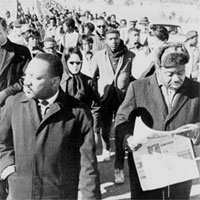 New York World-Telegram & Sun Collection,
Prints & Photographs Division — http://www.loc.gov/rr/print/
Allowing CBS footage of “Bloody Sunday” as evidence in court, Judge Johnson ruled on March 17, that the demonstrators be permitted to march. Under protection of a federalized National Guard, voting rights advocates left Selma on March 21 and stood 25,000 strong on March 25 before the state capitol in Montgomery. As a direct consequence of these events, the U.S. Congress passed the Voting Rights Act of 1965, guaranteeing every American twenty-one and over the right to register to vote. During the next four years the number of U.S. blacks eligible to vote rose from 23 to 61 percent.
John Lewis went on to serve as Director of the Voter Education Project, a program that eventually added nearly four million minorities to the voter rolls. To mark the thirty-fifth anniversary of “Bloody Sunday,” on March 7, 2000, Lewis, a U.S. Congressman from Atlanta’s 5th District, and Hosea Williams crossed the Pettus Bridge accompanied by President William Clinton, Coretta Scott King, and others. Asked to contrast this experience with that of 1965 the Congressman responded, “This time when I looked there were women’s faces and there were black faces among the troopers. And this time when we faced them, they saluted.”
•American Treasures is an exhibition of special items in the Library of Congress collections. The exhibition is divided into four sections: Top Treasures, Memory, Imagination, and Reason. The latter includes images taken about 1963 by Danny Lyon, staff photographer for SNCC, a key organizing body during the Civil Rights Movement.
•Search on the term Selma, Alabama in the black and white photos of the Farm Services Administration collection, FSA/OWI Photographs, 1935-1945 to see images of the city taken during the 1930s by the photographer Walker Evans. Search on Alabama to see images taken by the FSA photographers Dorothea Lange, Arthur Rothstein, Marion Post Wolcott, and Carl Mydans.
•The Great Migration made northerners more aware of disenfranchisement in the Deep South and newspapers like The Gazette and The Advocate fostered awareness within the black community. Search on the term vote in African-American Experience in Ohio, 1850-1920 to view about 100 items that address the issue. See, for example, the 1887 article “Negro Voting Power” and the 1888 article “First Colored Voter.” The poet Paul Lawrence Dunbar mentions Alabama disenfranchisement in his article “Paul Dunbar’s Protest.”
•Music drawn from a tradition of Southern spirituals helped sustain the Civil Rights Movement. Search on the term spiritual in the John Lomax and Ruby Terrel Lomax collection Southern Mosaic to hear some of the tunes which comprise that tradition. Listen, for example, to versions of “This Little Light of Mine,” “Long Way to Travel,” and “Great Day” as they were rendered in the South back in 1939.
•Images of 20th Century African American Activists: A Select List presents frequently requested images from the Prints & Photographs Division of the Library. Except where otherwise noted in the “Reproduction Number” line, images are considered to be in the public domain. The selection includes images of Martin Luther King, John Lewis, and Ralph Abernathy.
•Search the Today in History Archive on the term states rights to learn more about an issue which lay at the heart of the American system. Ironically, on March 7, 1850, (exactly 115 years before “Bloody Sunday”) Daniel Webster gave his famous “Seventh of March speech” in favor of the Compromise of 1850, which, while it postponed the Civil War, strengthened states’ rights at the cost of African-American freedom. Search on the term Alabama to learn more about events in the state, such as the arrest of Rosa Parks.
•With the exception of Concord Bridge, where the American Revolution began, no bridge in America marks an event as historically momentous as that marked by the Edmund Pettus Bridge. Nevertheless, search across the Photos and Prints section of American Memory on the term bridge to see a wide array of other bridges. See, for example, Burnside’s Bridge (fought over during the Battle of Antietam), a Covered Bridge in Vermont, and the Locust St. Bridge in Des Moines, Iowa. Also search the Today in History Archive on the term bridge to read features on the Brooklyn Bridge, Williamsburg Bridge, and Golden Gate Bridge.
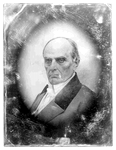 Daniel Webster
I wish to speak today; not as a Mass[achusetts] man – nor a Northern man – but as an American, & a member of the Senate of the U[nited] S[tate]s.
Daniel Webster’s notes for his speech to the United States Senate favoring the Compromise of 1850, March 7, 1850.
Words and Deeds in American History: Selected Documents Celebrating the Manuscript Division’s First 100 Years
Daniel Webster
produced by Mathew Brady’s studio, circa 1851-1860.
America’s First Look into the Camera: Daguerrotype Portraits and Views, 1839-1864
The acquisition of territory following the U.S. victory in the Mexican War revived concerns about the balance of free and slave states in the Union. On March 7, 1850, Senator Daniel Webster delivered his famous “Seventh of March” speech urging sectional compromise on the issue of slavery. Advising abolition-minded Northerners to forgo antislavery measures, he simultaneously cautioned Southerners that disunion inevitably would lead to war.
Following the lead of senators Henry Clay and Stephen Douglas, Webster endorsed Clay’s plan to assure sectional equilibrium in Congress. Passed after eight months of congressional wrangling, the legislation admitted California to the Union as a free state, permitted the question of slavery in Utah and New Mexico territories to be decided by popular sovereignty, settled Texas border disputes, and abolished slave trading in the District of Columbia while strengthening the Fugitive Slave Act.
The legislative package known as the Compromise of 1850 postponed the Civil War by a decade. However, like the 1820 Missouri Compromise, the Compromise of 1850 failed to resolve the question of slavery in a meaningful way. Over the course of the 1850s, the inadequacies of both measures were made painfully clear. “Popular sovereignty” undermined the Missouri compromise by suggesting the earlier division of the country along the thirty-sixth parallel into free states and slave states no longer applied. Indeed, the Kansas-Nebraska Act of 1854 permitted slavery. The resulting bloodshed in Kansas, like later incidents at Harper’s Ferry, presaged the violent conflict of the Civil War.
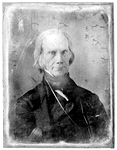 Henry Clay
produced by Mathew Brady’s studio, circa 1850-1852.
America’s First Look into the Camera: Daguerrotype Portraits and Views, 1839-1864
Incidents of the War. A Harvest of Death, Gettysburg, July 1863.
Timothy H. O’Sullivan, photographer.
Selected Civil War Photographs
•Words and Deeds in American History: Selected Documents Celebrating the Manuscript Division’s First 100 Years , an online display of approximately ninety representative documents preserved by the Manuscripts Division, Library of Congress, includes features on John C. Calhoun’s speech to the United States Senate against the Compromise of 1850 and Henry Clay’s appointment as secretary of state on March 7, 1825.
•Read the Documentary History of Slavery in the United States by John Larkin Dorsey. A contemporary of Webster and Clay, Dorsey reviews slavery in the U.S. from 1774 and the Continental Congress to 1850 with special attention to the Fugitive Slave Law of 1850 and the probable dissolution of the Union. Search African American Perspectives: Pamphlets from the Daniel A. P. Murray Collection, 1818-1907 on slavery to access this document and many more.
•For more information about the movement to abolish slavery, visit the Abolition section of African American Odyssey, and the Abolition section of The African-American Mosaic as well. Also, read the Today in History features on Abolition in the District of Columbia , and on the abolitionists Lucretia Coffin Mott, and Elijah Parish Lovejoy.
•Browse The Frederick Douglass Papers. Many remarkable items are included in the papers of this nineteenth-century African-American abolitionist who escaped from slavery and then risked his own freedom by becoming an outspoken antislavery lecturer, writer, and publisher. The papers are divided into a series of nine sets. Set nine, for example, contains a booklet entitled Two Speeches by Frederick Douglass (on West Indian Emancipation and the Dred Scott Decision).
•A search on Daniel Webster in American Memory collections yields more than 2,000 items—including correspondence, speeches, images of statues, and even sheet music.
* Developed by the U.S. Department of Interior, National Park Service, U.S. Department of Transportation, The Federal Highway Administration, and the National Conference of State Historic Preservation Officers.
Black History Month
Memorial Day weekend has hosted several important developments in the world of criminal justice. Today, the Cleveland Police department—which has come under fire in recent months in the nationwide debate over police tactics—agreed to follow some of the strictest standards in the nation over its officers’ use of force. Cleveland agreed to the terms as part of a settlement reached with the Department of Justice over what justice officials called a “pattern of unconstitutional policing and excessive use of force.”
According to the Justice Department’s report, the Cleveland police department used stun guns inappropriately, punched and kicked unarmed people, shot at people who did not pose a threat, and failed to report or investigate most of these incidents. As a part of the settlement, Cleveland agreed to some of the most rigorous policing standards in the nation. These include:
The settlement comes just two days after a white Cleveland officer who fired at least 49 shots at two unarmed African Americans was acquitted of manslaughter by an Ohio judge. Officer Brelo’s acquittal—as the latest in a series of troubling racially charged incidents across the US in places like Baltimore, Staten Island, and Ferguson, MO—prompted protests that remained largely peaceful but still resulted in the arrest of 71 people.
Some bad news also came out of the criminal justice sphere this weekend. On Friday, Maryland Governor Larry Hogan vetoed three important criminal justice reform bills. In addition to vetoing a bill to limit civil asset forfeiture, and a bill to remove the penalty for marijuana paraphernalia, Hogan also vetoed a felon re-enfranchisement bill that would have restored voting rights to 60,000 ex-felons. Restoring access to the ballot for ex-felons is a priority in the criminal justice reform community and Hogan’s veto will serve as an important test to see whether reform advocates will show that choices like Hogan’s can have political repercussions.
BOTTOM LINE: Agreements like the one made between Cleveland and the Department of Justice have the potential to create meaningful change to a flawed system. But as Gov. Hogan’s vetoes remind us, there is much more work to be done to convince some elected officials to do their part.
The North Carolina Racial Justice Act of 2009
Prohibited seeking or imposing the death penalty on the basis of race. The act identified types of evidence that might be considered by the court when considering whether race was a basis for seeking or imposing the death penalty and established a process by which relevant evidence might be used to establish that race was a significant factor in seeking or imposing the death penalty. The defendant had the burden of proving that race was a significant factor in seeking or imposing the death penalty, and the state was allowed to offer evidence to rebut the claims or evidence of the defendant. If race was found to be a significant factor in the imposition of the death penalty, the death sentence would automatically be commuted to life imprisonment without the possibility of parole.[1]
North Carolina General Assembly Repeal Attempts [edit]
Under pressure from a group of 43 district attorneys, who expressed opposition to the act citing the clog of the court system in the state, the North Carolina Senate passed a bill by a 27-14 vote on November 28, 2011, that would have effectively repealed the Racial Justice Act.[2]
However, on December 14, Governor Bev Perdue, a Democrat, vetoed the bill, saying that while she supports the death penalty, she felt it was “simply unacceptable for racial prejudice to play a role in the imposition of the death penalty in North Carolina.”[3] The state legislature did not have enough votes to override Perdue’s veto.
The North Carolina General Assembly passed a major revision of the law in 2012 authored by Rep. Paul Stam (R-Wake). The rewrite “severely restricts the use of statistics to only the county or judicial district where the crime occurred, instead of the entire state or region. It also says statistics alone are insufficient to prove bias, and that the race of the victim cannot be taken into account.” The bill was vetoed by Gov. Perdue, but this time, the legislature overrode the governor’s veto.[4]
The North Carolina General Assembly voted to effectively repeal the entire law in 2013 and Gov. Pat McCrory, a Republican, signed the repeal into law.[5]
On April 20, 2012, in the first case appealed under the Racial Justice Act, the then-Senior Resident Superior Court Judge in Cumberland County (Fayetteville), Judge Greg Weeks, threw out the death sentence of Marcus Raymond Robinson, automatically commuting his sentence to life without parole. Robinson contended that when he was sentenced to death in 1994, prosecutors deliberately kept blacks off the jury. Robinson’s lawyers cited a study from Michigan State University College of Law indicating that prosecutors across North Carolina improperly used their peremptory challenges to systemically exclude qualified black jurors from jury service.[6][7][8]
Resource …wiki
so, I do not know how accurate this is


 Be a Seed for Change
You must be logged in to post a comment.