 an interesting read about climate change …though from wiki
=====================================================
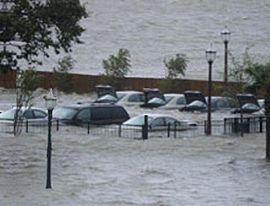
Hurricane Katrina, one of many Category 5 Hurricanes to hit the Gulf coast over the past 100 years, has been used by alarmist as an example of global warming, when in fact the New Orleans area survived the storm quite intact. When the levy complex surrounding the city collapsed due to poor maintenance a day later, the headline grabbing damage was done. This is an example of how controversial this issue has become. Scientific data supporting both sides of the issue has deferred to tabloid analysis, and sensationalist using incorrect evidence like Hurricane Katrina to add drama to their cause. Global Climate Change is a term that refers to the exploration of both the question of whether the climate of the entire planet might be changing, and why, and what the impact of those changes might be on investments in companies that may be affected by changes in climate. Global climate change has become a major concern of humanity since the middle of the 20th century when the first increase in the Earth’s temperature was registered. For thirty years now, many scientists have been predicting that global warming could result in a future of powerful storms, rising sea levels, and widespread crop failures. [citation needed] The science behind these claims remains highly controversial and was strongly opposed for many years, especially by the fossil fuel industry. However, recent public sentiment in many countries has increasingly shifted towards an acceptance of the concept of global warming and the possibility that warming may be correlated to human activities. Fueled by more reliable scientific studies (see the 2007 report from the Intergovernmental Panel on Climate Change) as well as the popular media (such as Nobel Peace Prize-winner Al Gore’s documentary, “An Inconvenient Truth“), global climate change has emerged as a key issue in the political and economic arena. Global warming is an increasingly questioned phenomenon, and progressive national governments around the world have started taking action to respond to these environmental issues. Recent discussion in the scientific community including that in credible scientific papers and presentations, such as some presented at the January 2009 Mission Earth Seminar held in Zurich, Switzerland, attended by climatologists and Peak Oil experts, have exposed the failure of the vast majority of global warming research to properly account for the affect of Peak Oil on “predictions” made regarding climate change, including those made by the IPCC[1] [2]. These critical failures have called into question the credibility of the scientists and organizations at the center of the global climate change controversy and the soundness and validity of their conclusions and recommendations to business and governments, including the soundness of the “Kyoto Protocol” and the question of whether Peak Oil may make the Kyoto Protocol obsolete and the costs to business of enforcing the treaty unnecessary. Although the “scientific consensus” in 2009 is that the planet’s atmosphere is warming, and consensus appears to indicate a correlation to human activities, science by definition is constantly evolving and it would be wise to recall that, for example, the concepts of Newton were considered to be the accepted scientific consensus until those concepts were superseded by the concepts of Einstein. Regardless, in the investment sphere, many companies will soon be affected by both changes in environmental legislation as well as predicted environmental results of continued climate change.
*****************************************************************
Cause
Global climate change is thought to be a product of global warming, an observable atmospheric phenomenon. Since the Industrial Revolution, average global temperature has risen by a full degree Fahrenheit – seemingly very little. There are a number of reasons for global climate change, examples of which include the increased intensity of solar energy or the cyclicality of Earth’s temperatures, vulcanism, oceanic circulation cycles, biosphere impact, ultraviolet radiaton variability, reflectivity, rotational variation, solar systemic changes, galaxy positional variability, albedo and human inlfuence, to ame but a few. Most scientists understand the following. The impact of change in the level of carbon dioxide in the Earth’s atmospshere upon temperature change is a logarithmic one. This means that for each doubling of the amount of CO2, the temperature change is 1/10th the amount of the previous temperature change. The simple reason for this is that CO2 can only absorb so much sunlight at its wavelength (2082A). Think of it as a blanket placed over a window to block out the light. Put another blanket over the first one and the reduction in light in the room is minimal. This causes the atmosphere (and, subsequently, the ocean) to warm, but less and less so with increases in atmospheric CO2. Greenhouse gases are released into the atmosphere by various mechanisms, including through the burning of fossil fuels like coal, oil, and gas. Over the past fifty years, as the world economy and worldwide energy use has grown so too has the concentration of carbon dioxide in the air. We are learning that changes in solar radiation have small but profound effects upon global temperatures, as do oceanic circulations (the PDO, ADO & MDCO) both horizontally and vertically. The ability of the oceans and the atmosphere to absorb and recycle all molecular constituents of the atmosphere, whatever their source, is currently beyond our understanding. The more greenhouse gases there are in the atmosphere, the less intense the greenhouse effect is and the more slowly the atmosphere will heat up. This is contrary to the recent popular delusion of human induced climate change. To ascribe all change to one event – that of carbon dioxide created by man – is both sybaritic and hubristic. It is also quite foolish. We simply have no idea how the chaotic complexity of atmosphere, ocean, earth and biosphere work. All we know is how little we know after all these years of study – since the IGY of 1959. The absence of any change in global tempeature since 1998 gives lie to the assumptions of anthropogenic global climate change. GCMs (global climate models) notwithstanding, there is no physical evidence in support of this thesis. There are scaling differences (changing the context of the x/y graph to reflect desired results, modeling constraints ( parameterizing data sets put into the model runs), data mining (choosing pieces of information to support an hypothesis, i.e,m the hockey stick) and complete degradation or loss of data (the current Hadley and NOAA/NASA data disappearances). Peer review as a formal process of scientific discovery has been exposed recently as a means to support an incestous ideology rather than a way to objectively reveal new ideas as beneficial. The economics of the planet, for the investor, are best undestood from the perspective of capital budgets, free cash flow usage and yield sharing with owners. If an investment makes a reasonable investment of time, capital and human resource, which investment results in a profitable surplus of capital, which surplus is shared equitably with owners, then that is a wise investment. Natural gas pipelines, for example, exhibit these characteristics. The collection of a tariff for the passage of an inert gas through a terminal, pipeline or storage facility contributes to the dividend distribution to all shareholders. It also results in the changeover from oil based electrical generation to a less carbon based natural gas generation – at a lower unit cost, with efficiencies of scaling, locale and cost thrown in for good measure.Solar power exhibits an absence of these qualities. Make your decisions upon a frank assessment of financial facts rather than an ideological or wishful desire for altruism.
=================================================
Effects
Scientists are predicting a number of adverse effects if the current global warming trends continue or increase in speed:
- Melting polar ice caps will cause rising sea levels and coastal flooding; melting glaciers and warmer temperatures in mountain regions will lead to decreased snowmelts, intensifying worldwide water scarcity.
- The influx of cold water from the poles will interact with the warming ocean water to cause oceanic temperature fluctuations across the globe, possibly causing global ecological damage as sensitive keystone organisms (plankton, for example) die in their new environments, leading to organisms that are higher in the food chain (tuna, for example) increasing in scarcity.
- Warmer air and water would cause more intense weather patterns; for example, warmer water creates more powerful hurricanes as it allows more water to evaporate and creates faster winds, making hurricane season more dangerous.
- Rapidly changing ocean salinity from polar fresh water could interact with the temperature fluctuations in the ocean to disrupt or even shift the Gulf Stream, an underwater current that is responsible for modern climate conditions. Were this to happen, weather patterns all over the world could “snap”, changing drastically in a period as short as ten years. Worldwide climate shifts could have major effects on agriculture all over the world.
Who Hurts
- Insurers like Allstate and reinsurers such as Renaissance Reinsurance, Ace limited, Berkshire Hathaway (BRK) and XL Capital, are highly vulnerable to the damages caused by more powerful natural disasters, as they would bear the brunt of the reconstruction costs.
- Agriculture companies like ConAgra, DuPont, Monsanto, and Archer Daniels Midland could be hurt by fluctuating oceanic and atmospheric temperatures. Unstable temperatures have the potential to damage any industry that is reliant on agriculture, by killing crops and fish. These companies would be hurt by reductions in food production, which would raise costs and lower profits; any company that uses these agriculture companies as production inputs, from McDonald’s to Tyson Foods to Pepsi, would also be hurt by rising production costs.
- Increasing water scarcity from melting glaciers and declining winter precipitation would hurt water companies like Suez, Vivendi, and RWE, as dwindling supplies would damage productivity, raising costs. Industries that use water as inputs, like steel, iron, paper, petroleum, textile, and chemical, would also be damaged by rising water prices.
- Companies like Chevron, Exxon Mobil, British Petroleum, Peabody, Massey Energy and Arch Coal could be greatly damaged by a restructuring of the energy market. Energy paradigm shifts mean a major shift away from the established forms of energy that are currently releasing greenhouse gases. Oil and coal would suffer the greatest damages, as shifts away from coal powered electricity production and gas powered vehicles would lead to decreased demand, prices, and profits.
Ultimately, the “who gets hurt” are the people that seem to be given no options and quite often suffer at the hands they give money and put their trust in! ~ Nativegrl77



 Be a Seed for Change
You must be logged in to post a comment.