PLU adjunct faculty lose union vote, say they’ll try again


Posted by

in seattletimes.org Jan.15

Adjunct faculty members at Pacific Lutheran University, who won a precedent-setting national victory last month when the National Labor Relations Board (NLRB) endorsed their right to form a union, appear to have lost a vote to unionize.

The faculty group announced Wednesday that they were withdrawing a petition to form a union, but say they’ll likely attempt a new vote later this year.

The decision comes a week after the impounded ballots from the election — which was held in October 2013  — were finally counted. The vote was 54 votes against union representation and 30 votes in favor, but 38 votes were uncounted because they were challenged by either PLU or the contingent faculty.

The uncounted ballots were impounded immediately after the election when PLU appealed to the NLRB, arguing the school was exempt from national labor rules because it is a religious institution, and because full-time contingents (as adjuncts are called at PLU) were managerial employees.The NLRB, in its decision last month, rejected those arguments.

“The election was hopelessly flawed so we decided a new vote was the best course of action,” said Jane Harty, a contingent music teacher at the university, in an email. She said there were so many challenges to the ballots that it “would be very expensive and take months to contest” the challenges to the ballot.

PLU Provost Steven Starkovich said the university would try to address the contingents’ concerns through its faculty governance committee and a task force of contingents. “As we have stated before, we believe our robust, general-assembly style of faculty governance can serve as a model for other universities,” he said in a statement.

Adjunct faculty make up at least half the higher-education workforce nationwide, according to some studies. They are not eligible for tenure and teach anything from one class each quarter to a full-time slate of courses. They usually make less money than tenured professors and often have fewer benefits.


RE: White supremacy in children’s textbooks


Wow! ColorofChange members have already helped us purchase more than 500 books for Texas schools!

We’re delivering racism fighting books like A Young People’s History of the U.S. and Roll of Thunder, Hear My Cry to Texas schools next week during Banned Book Week to emphasize that the whitewashing of slavery, Jim Crow, and the KKK in our children’s textbooks is not ok! To get the books to the schools on time we need to close out the donation window in 24 hours. Help us make a final push to reach as many schools as possible!

Click here to buy a racism fighting book for a Texas school library!

If you’ve already donated, please share this message with your friends and family!

Thanks and Peace,

–Brandi

———————————————————————————-

Texas is using textbooks to distort Black history and deny systemic racism

Hv

But we can fight back by putting books about Black history directly into the hands of children across Texas!

Donate

Schools should be a place for learning, not spreading racist ideology. But not in Texas. This fall, five million children across Texas were given textbooks that profess the same toxic and distorted view of history professed by Dylann Roof and defenders of the Confederate Flag.

These textbooks omit, sanitize, and downplay how horrible slavery was and glorify historical figures who defended slavery. All because the Texas State Board of Education has an agenda to promote a neo-Confederate ideology.

And if the Texas State Board of Education has their way, future textbooks could be even worse than they are right now.1 Future textbooks could remove altogether any references to Jim Crow, the Ku Klux Klan and the Black Codes- the foundation for modern day prison labor exploitation. The half-truths and omissions in these educational materials will teach a new generation of children a deliberately distorted view of American history and the story of race in our country.

But it doesn’t have to be this way. If we put factual and accurate educational materials about Black history in school libraries across Texas, we can give countless students access to the resources they need to learn the truth. Join the fight to get books about Black history directly into the hands of children across Texas.

Chip $16 in to get racism fighting books like A Young People’s History of the U.S. into school libraries!

The harm that these textbooks do is real. Not only are these whitewashed textbooks inaccurate and racially damaging, they even hurt the academic performance of both Black and white students. Studies have shown that both Black and white students who are exposed to negative racial stereotypes about Black people perform significantly worse on standardized tests.23

The intentional whitewashing of the story of the Civil War happens as early as grade school and not just in the books you read. Right now there are 29 schools in Texas named after generals like Robert E. Lee. There are textbooks and educational videos that glorify politicians like John C. Calhoun, who believed that owning, abusing and exploiting Black humans was key to achieving the American dream and was the architect behind the enforcement of the Indian Removal Act. Too often, the stories and truths of all the Black and Brown folks that built this country are either censored or completely left out of the books we consume from early on in life.

But by getting books like Roll of Thunder, Hear My Cry and March into Texas school libraries, we can provide the students of Texas the materials they need to learn about the generations of systemic oppression of Black people and counter the negative racial stereotypes that hinder the academic development of Black and white students.

These books are excellent stories detailing the struggle of Black Americans fighting to maintain their integrity, pride, and independence in the face of racism and social injustice throughout our shared history. These books accurately reflect the highs and lows of the Black struggle for freedom and equality, and will give Black and white children throughout Texas the knowledge they need to overcome the half-truths and racist rhetoric in their textbooks.

By clicking any of the below links and donating, you will personally be helping a whole school of children fight back against racism.

Chip $16 in to get racism fighting books like A Young People’s History of the U.S. into school libraries!

Thanks and Peace,

–Brandi, Rashad, Arisha, Evan, Brittaney, and the rest of the ColorOfChange team.
Help support our work. ColorOfChange.org is powered by YOU—your energy and dollars. We take no money from lobbyists or large corporations that don’t share our values, and our tiny staff ensures your contributions go a long way.

References:

1. “Here’s How New Texas Public School Textbooks Write About Slavery,” Jezebel, 9-1-2015
http://act.colorofchange.org/go/5278?t=8&akid=4824.1174326.pHzIVv

2. “Think Unto Others: The Self-Destructive Impact of Negative Racial Stereotypes” Ohio State University, 7-24-2000
http://act.colorofchange.org/go/5279?t=10&akid=4824.1174326.pHzIVv

3. “Stereotype Threat and the Intellectual Test Performance of African Americans,” Journal of Personality and Social Pyschology, 1995
http://act.colorofchange.org/go/5280?t=12&akid=4824.1174326.pHzIVv

 

New NMAAHC Exhibition ~~~ Permanent Collection


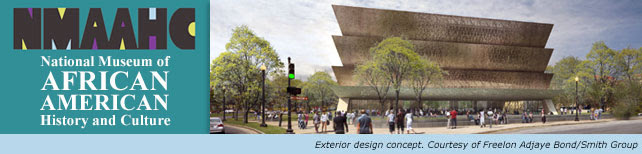
NMAAHC -- National Museum of African American History and Culture

“Through the African American Lens: Selections from the Permanent Collection” Opens May 8th
 
 
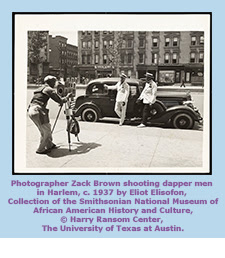
Photograph by Eliot Elisofon

Where: National Museum of American History, Level 2
14th and Constitition Ave. NW
Washington, DC 20001

When: Exhibition opens Friday, May 8th 2015

Hours: 10:00 AM to 5:30 PM

Metro: Take Orange, Blue, or Silver line and exit at Smithsonian Station or Federal Triangle Station

Admission is free!

African Americans have survived slavery, fought for their freedom in the Civil War, for the freedom of others in subsequent wars and created lives of meaning for themselves, their families and their country. Since its creation in 2003, the Smithsonian’s National Museum of African American History and Culture (NMAAHC) has been collecting items—large and small—to tell the story of expanding America’s freedom from the African American perspective. The museum’s eighth exhibition, “Through the African American Lens: Selections from the Permanent Collection,” will showcase stories of trailblazers, innovators, visionaries and history makers who helped to shape this great nation. The exhibition will open May 8 in the NMAAHC Gallery at the Smithsonian’s National Museum of American History.

“Through the African American Lens” will use the museum’s collection to show how the African American story is quintessentially an American one. This exhibition was made possible in large part by more than two dozen families of well-known and lesser-known history makers who graciously donated their family treasures, establishing the building blocks of the museum’s collection.

Visitors will see approximately 140 collection items belonging to freedom fighters, unsung activists and servicemen, sports and entertainment legends and prominent artists and designers.

James Brown Suit

Among the artifacts on display will be the following:

  • Personal items belonging to Harriet Tubman
  • Prints from “The Life of Toussaint L’Ouverture” by Jacob Lawrence (1986)
  • Uniform of a Pullman Porter worn by a member of the Brotherhood of Sleeping Car Porters, the first African American labor union established in 1925
  • School desks from the Hope School, a Rosenwald school in South Carolina
  • Dining room table owned by Lucinda Todd that was used by Brown family and NAACP Legal Defense Fund during preparation for the Supreme Court Case, Brown v. the Board of Education of Topeka
  • Dresses designed by renowned fashion designer, Ann Lowe
  • James Brown’s electric organ and red jumpsuit
  • Dresses worn by R&B musical group, En Vogue
  • Carl Lewis’ 1989 Santa Monica Track Club speed suit
  • Althea Gibson’s tennis racket

For more information, please read the press release.

Indiana and their New Reproductive Rights laws … that hurt Women


purvi


CREDIT: WNDU News Screenshot

A 33-year-old woman from Indiana faces decades in prison after she sought medical attention at a hospital as she was bleeding from a premature delivery. The case is just the latest example illustrating the real-world consequences of the harsh state laws that essentially criminalize pregnancy.

According to the charges being filed against her, Purvi Patel attempted to end her pregnancy last year by taking pills that she bought online from Hong Kong. The pills didn’t work, and Patel eventually delivered a premature baby at home. When she went to an emergency room to seek treatment after giving birth, the staff asked why she didn’t have an infant with her. She said her baby appeared to be dead, and she had wrapped it in a bag and placed it in a dumpster.

Now, Patel is being charged with both neglect and feticide, allegations that actually conflict with each other. She was initially charged with “neglect of a dependent” after prosecutors learned she left her baby in in a dumpster, a charge that won’t apply if the baby was already dead. But she’s now also being charged with “fetal murder of an unborn child” — a charge that an Indiana judge allowed to stand this week — for taking drugs that could have illegally ended her pregnancy.

As the Daily Beast’s Sally Kohn points out, the logic doesn’t exactly hold up. “The State of Indiana intends to convict and incarcerate Purvi Patel one way or another, whether the fetus she delivered was alive or not — never mind the fact that the facts necessary for filing the one charge (that the fetus have been alive) entirely contradict the facts necessary for filing the other (that the fetus have been dead) and vice versa,” Kohn writes.

On top of that, reproductive rights advocates and legal experts point out that Indiana’s “feticide” law was never intended to be applied to pregnant women themselves. It was originally written as a way to crack down on illegal abortion providers. Critics say Patel fits into a disturbing trend; similar “fetal homicide” laws are in place in at least 38 states, and they’re increasingly used to punish women who end up having miscarriages or stillbirths.

“Once again targeting a woman of color, prosecutors in Indiana are using this very sad situation to establish that intentional abortions as well as unintentional pregnancy losses should be punished as crimes,” Lynn Paltrow, the executive director of National Advocates for Pregnant Women, which tracks these cases closely, said in a recent statement about Patel’s case. “In the U.S., as a matter of constitutional law and human decency, no woman should be arrested for the outcome of her pregnancy.”

Patel is the second woman to be prosecuted under Indiana’s feticide law. The state also pressed charges against Bei Bei Shuai, a Chinese immigrant who attempted suicide while pregnant and ended up delivering a baby that didn’t survive. Shaui was imprisoned for more than a year before a plea deal was reached in April, and her case sparked international outrage. More than 100,000 people signed onto a petition demanding Shuai’s release and pointing out that “it is wrong to have a set of separate and unequal laws for pregnant women.”

The laws that allow states to arrest pregnant women for allegedly harming their fetuses actually end up undermining public health. Major medical groups like the American Medical Association, the American Academy of Pediatrics, and the American College of Obstetricians and Gynecologists oppose “feticide” laws because they ultimately deter women from seeking the medical attention they need.

Harsh restrictions on abortion, as well as unreasonably broad definitions of “fetal homicide,” have created a society in which all pregnant women are transformed into potential suspects in the eyes of the law. And since miscarriage and abortion are relatively common pregnancy experiences — and research has proven that women are going to end their pregnancies whether or not it’s legal — that means we’re also approaching a society in which desperate women may be too terrified to ask for health treatment. For instance, if Patel had known that she was at risk for being charged with fetal homicide, would she have thought twice about going to the emergency room? Would she have joined the millions of women around the world who die from botched abortions and risky childbirth?

“We cannot afford to deter a woman from seeking reproductive health care,” the Indiana Religious Coalition for Reproductive Justice pointed out in a statement released this week. “Those of us who are Christian know that when Jesus responded to the hemorrhaging woman there was no place for aggressive interrogation and punishment. It was all for healing.”

The Ad Marco Rubio Doesn’t Want On TV


Brave New FilmsWho is Marco Rubio?  We want to educate people on his real stances on important issues.But we need your help to air a 30-second TV ad, The Real Rubio, in states with large Latino populations like Arizona, California, Colorado, Texas, Ohio, Florida, and New Mexico. Here are the facts about Marco Rubio, who is running as a “Latino champion:”

Screen_Shot_2015-07-28_at_4.03.48_PM.png

Sound like a Latino champion to you? More people need to know about The Real Rubio.

Help us buy TV ads in states with large Latino populations!  Each ad costs up to $500, so we can’t do this without you.

Contribute now so together we can air The Real Rubio and educate the public on where he really stands!

Onward,

Jim Miller, Executive Director
Brave New Films Action Fund

politics,pollution,petitions,pop culture & purses