
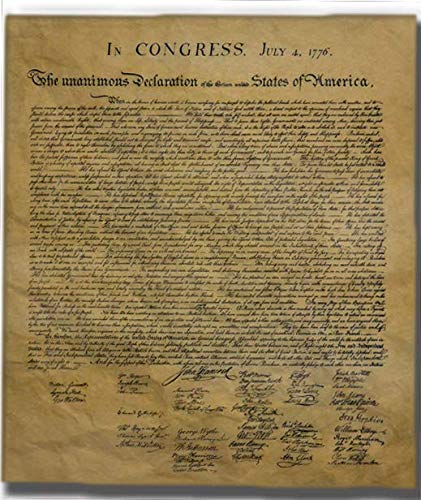
Fate of the Signers of the Declaration of Independence
The following is often published and cited concerning the fate of the Signers, but its accuracy is doubtful, and should only be taken as “traditional” rather than historical. See the end for links to other sources on the subject.
Have you ever wondered what happened to the 56 men who signed the Declaration of Independence?
Five signers were captured by the British as traitors, and tortured before they died.
Twelve had their homes ransacked and burned. Two lost their sons serving in the Revolutionary Army; another had two sons captured.
Nine of the 56 fought and died from wounds or hardships of the Revolutionary War.
They signed and they pledged their lives, their fortunes, and their sacred honor. What kind of men were they?
Twenty-four were lawyers and jurists. Eleven were merchants, nine were farmers and large plantation owners; men of means, well educated. But they signed the Declaration of Independence knowing full well that the penalty would be death if they were captured.
Carter Braxton of Virginia, a wealthy planter and trader, saw his ships swept from the seas by the British Navy. He sold his home and properties to pay his debts, and died in rags.
Thomas McKeam was so hounded by the British that he was forced to move his family almost constantly. He served in the Congress without pay, and his family was kept in hiding. His possessions were taken from him, and poverty was his reward.
Vandals or soldiers looted the properties of Dillery, Hall, Clymer, Walton, Gwinnett, Heyward, Ruttledge, and Middleton.
At the battle of Yorktown, Thomas Nelson, Jr., noted that the British General Cornwallis had taken over the Nelson home for his headquarters. He quietly urged General George Washington to open fire. The home was destroyed, and Nelson died bankrupt.
Francis Lewis had his home and properties destroyed. The enemy jailed his wife, and she died within a few months.
John Hart was driven from his wife’s bedside as she was dying. Their 13 children fled for their lives. His fields and his gristmill were laid to waste. For more than a year he lived in forests and caves, returning home to find his wife dead and his children vanished. A few weeks later he died from exhaustion and a broken heart.
Norris and Livingston suffered similar fates. Such were the stories and sacrifices of the American Revolution. These were not wild-eyed, rabble-rousing ruffians. They were soft-spoken men of means and education. They had security, but they valued liberty more. Standing tall, straight, and unwavering, they pledged: “For the support of this declaration, with firm reliance on the protection of the divine providence, we mutually pledge to each other, our lives, our fortunes, and our sacred honor.”
They gave you and me a free and independent America. The history books never told you a lot about what happened in the Revolutionary War. We didn’t fight just the British.
We were British subjects at that time and we fought our own government!
Some of us take these liberties so much for granted, but we shouldn’t. So, take a few minutes while enjoying your 4th of July holiday and silently thank these patriots. It’s not much to ask for the price they paid. Remember: freedom is never free!
I hope you will show your support by please sending this to as many people as you can. It’s time we get the word out that patriotism is NOT a sin, and the Fourth of July has more to it than beer, picnics, and baseball games.
constitution.org

 8/2/1924


You must be logged in to post a comment.