

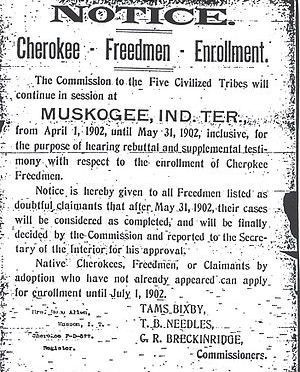
Cherokee Freedmen Facts – by Marilyn Vann – Black History
Cherokee Freedmen Facts – by Marilyn Vann – President – Descendants of Freedmen
1) Who are Cherokee freedmen and their descendants?
Cherokee freedmen are people of African descent who have rights to Cherokee citizenship since 1866 (and in some cases
prior) based under a treaty between the US government and the Cherokee nation, the amended 1839 constitution and the
present 1976 constitution. The freedmen were either former slaves of the Cherokees or were free mixed black Cherokees who
generally did not have citizenship rights prior to 1866.
******
2) Who has the right to Cherokee citizenship now?
All persons who were listed on the Dawes Rolls and their descendants, during the early 1900s have the right to Cherokee
citizenship based on the 1976 constitution. The Dawes rolls of the Cherokee nation have several sections – Delaware,
Cherokee by blood, Cherokee Freedmen, etc.
******
3) Didn’t the Freedmen lose their tribal membership and voting rights for a few years?
In 1983, the freedmen people were voting against Chief Swimmer, the registrar sent out letters canceling their tribal
membership cards and the freedmen were blocked from voting at the polls. In 1988, under Chief Mankiller, the tribal council
approved the registration policy of requiring all tribal members to have a CDIB card to keep tribal membership. A tribal
court in 2006 ruled that the tribal council could not pass additional requirements to bar any segment of Dawes enrollees from
receiving tribal membership cards or voting.
******
4) If most of the freedmen have Cherokee blood, why cant they get a cdib card?
The current BIA policy is to only give the card based on the blood degree listed on the Dawes Rolls. The Dawes
Commissioners had the sole authority to place people on any part of the Dawes rolls they wanted to. Because Congress had
decided that people listed as Freedmen would have unrestricted allotments, Commissioners were encouraged to list as many
people as possible as Freedmen with no blood degrees listed rather than as Cherokees with blood degrees even if the person
was listed on previous rolls as blood Cherokee or received payments earlier from the US government as a Cherokee by
blood. An example was Perry Ross who had a Cherokee mother and black father. Perry Ross, was listed on the 1852 Drennan
Roll proving Cherokee by blood, received a 1908 Guion Miller payment for having Cherokee blood, but yet was listed as a
freedmen citizen on the Dawes Rolls. Some Freedmen did get CDIB cards in the past based on other records, but they
stopped giving them out. The tribe never kept degrees of blood records and anything on the Dawes Roll is just guesswork so
far as a true degree of blood. To determine blood degrees for freedmen one must look at Dawes testimony and other records.
******
5) Chief Smith and Councilman Jackie Bob Martin have called for a special election to see if the freedmen people
should keep their tribal membership rights. What’s wrong with that?
Whats right about it? There something wrong about trying to take away the rights of people who have had them for more than
100 years. The court held that the people had been wronged, and now, instead of accepting that, these people are to be more
wronged? Would you not fight a president who wanted to put the US citizenship rights of Cherokee people on a ballot to the
people? Whose next to lose rights? Also, the people who are being asked to vote on the freedmen citizenship rights are not
being told that the freedmen have had rights since at least 1866, have served on the tribal council, generally have Cherokee
blood, and voted between 1971 and 1983 (between 1907 and 1971 there were no elections at all). When did Cherokee people
ever kick people out of the tribe? And why kick out only freedmen who came before Delaware and Shawnee – all 3 have
treaty rights to citizenship? Does anyone sitting here wonder if the movement to kick out the freedmen is fear that they may
not vote for some people now serving in office? Hardly any freedmen will be able to vote in such election because of the
slow process to register tribal members and even freedmen people with old 1970s membership cards must reregister. Is this
justice? Is it right for Cherokee leaders to break the promises made to these people by previous chiefs such as Lewis
Downing and WP Ross – just as the whites have broken their word to the Cherokee people time after time? What if the white
people say, if the Cherokees can break their treaty at will, we will do so too and demand back the Arkansas Riverbed money?
******
6) Won’t the freedmen take away from the rest of the Cherokees so far as benefits?
The Chief and the tribal council can request additional funds from the US government and supposedly are working hard on
economic development. Stop and think – Would you want your US citizenship rights to be taken away because white people
don’t want you to have rental assistance or such the same as them? Freedmen wont cancel medical insurance to go to I H S.
******
7) Did Freedmen get the same rights as Cherokees by blood previously?
Yes, all citizens including freedmen received 110 acres of tribal land equivalent when tribal lands were allotted, they received
the 1912 payroll, and the per capita payment given out in 1962. Freedmen held office between 1866 and 1907 – One
freedman Frank Vann even served with Redbird Smith on the council. Another freedmen councilman was Stick Ross.
Share this:

1855 Wisconsin Supreme Court declares US Fugitive Slave Law unconstitutional – Black History
n 1855, the Wisconsin Supreme Court became the only state high court to declare the Fugitive Slave Act unconstitutional, as a result of a case involving fugitive slave Joshua Glover and Sherman Booth, who led efforts that thwarted Glover’s recapture. In 1859 in Ableman v. Booth, the U.S. Supreme Court overruled the state court.
Source: wiki
Unconstitutionality of the Fugitive Slave Act : decisions of the Supreme Court of Wisconsin in the cases of Booth and Rycraft.Other TitleWisconsin reportsContributor NamesWisconsin. Supreme Court.Booth, Sherman M.Rycraft, John.Smith, A. D. (Albert Daniel), 1811-1865.Cushing, Caleb, 1800-1879, former owner.Joseph Meredith Toner Collection (Library of Congress)Created / PublishedMilwaukee : R. King & Co., printers, 1855.Subject Headings- Booth, Sherman M.–Trials, litigation, etc- Rycraft, John–Trials, litigation, etc- United States.–Fugitive slave law (1850)- Slavery–United States- Glover, Joshua

Source: Library of Congress
There are over 200 pages to read through
Share this:

1848 – The first shipload of Chinese emigrants arrived in San Francisco, CA.
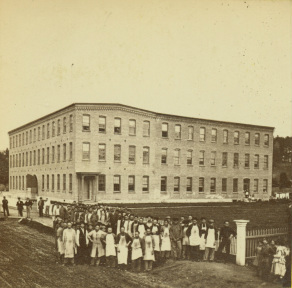
1848– The discovery of gold in Sutter’s Mill in California results in an influx of Chinese immigration into the US (China Insight). 1864- Central Pacific Railroad Company attracts Chinese men to immigrate to take part in the construction of the first transcontinental railroad (China Insight).
History of Chinese Immigration
Immigration Motives
Chinese immigrants came, and presently still come, to America for a new beginning in life. Today many Chinese Americans either settle where other family members settled or for the familiar cultural settings of Chinatown (Chinsen). The economic hardships of rural China served as push factors for many Chinese to leave their homeland and seek new opportunity in America. Many Chinese immigrants came to the US because of the abundance work opportunities mentioned by family ties who had previously immigrated. The initial pull factors that were present in the US that appealed to the Chinese were occupation-related with the building of the first transcontinental railroad and the discovery of gold deposits throughout the nation. Specifically in the greater Boston area, the initial Chinese laborer immigrants arrived as strikebreakers of the Sampson Shoe Factory. However, several first generation Chinese immigrants arrived in Boston with no family ties, and started working in the factories or anywhere they could obtain a job. As more and more immigrants arrived, they settled in enclaves which later became an established cultural community in Boston, notoriously known as Chinatown today. Though many settled in America for job opportunities, some arrived seeking refuge from the Chinese government but had fears that the strict American government would begin to represent the one they were leaving behind. To this day, Chinese immigrants still come to America with familial ties being a main pull factor.
Source: agschinese.weebly.com
Share this:


The Smithsonian & The Right’s Culture Wars …a message from Michael Keegan
So, this popped up … Things that should not be forgotten and btw he is now a former Sec of the Smithsonian but has Emeritus status at the GA Institue of Technology! ugh
The article below is revelant though mr Keegan posted it in 2011 …
I just posted the following piece to The Huffington Post and thought you might be interested:
The Battle over the Smithsonian and the Right’s New Culture Wars
This week, protesters marched on the National Mall to demand that the Smithsonian’s Board of Regents dismiss Smithsonian Secretary Wayne Clough for his role in removing a work of art from one of the institution’s museums and his continual bungling of the institution’s response in the two months since its removal. Although one Smithsonian regent openly implied that removing the art was a mistake, the board ultimately declined to rebuke Clough, effectively closing the door on the possibility of undoing the damage done by the censorship. But the bigger fight that the Smithsonian debate represented–over the efforts of a small and vocal group on the Right to define American values for us all–is just beginning.
As the newly empowered House GOP gears up to start culture wars on issues from reproductive rights for women to religious freedom for American Muslims, there’s an important lesson to be learned from what happened this winter at the Smithsonian. Institutions and individuals will continue to come under attack from the Right’s powerful extremist-to-media-to-politician echo chamber. But, as the Smithsonian’s experience showed once again, there is little to be gained by caving in to this loud and usually dishonest bullying. Clough’s attempt at compromise–instantly removing a work of art from an important exhibit–only drew louder threats to censor the exhibit as a whole, while causing some of the Smithsonian’s strongest supporters to lose trust in the institution. Despite what most might hope, the Right is not going to stop its culture war campaigns anytime soon. The only thing the rest of us can do is aggressively tell the truth, unapologetically stand on principle, and refuse to back down.
In a report last year, People For the American Way profiled what we call “the new McCarthyism“–a type of demagoguery that hinges on the idea that America and all it stands for is being destroyed by enemies within. This new McCarthyism–in full display in the paranoid tirades of Glenn Beck, in the widespread fear that President Obama is an un-American imposter–has a new foothold in Congress, where Rep. Peter King plans to hold hearings investigating American Muslims and prominent lawmakers spread myths about immigrant “anchor babies” in order to replace real efforts at immigration reform with unfounded fears about immigrants. The House GOP’s fit over “anti-Christian” and -gasp!–gay art in the Smithsonian was a small but powerful example of this dynamic in action. GOP leaders, encouraged by far-right activists, created a narrow definition of what it means to be truly American–straight and a certain type of Christian–and in doing so framed the rest of us as impostors.
The Right’s so-called “culture wars” are more than just a sideline distraction–even manufactured controversies can do real harm. The Smithsonian controversy was a flashy and media-ready story, but it set the tone for the many manufactured battles to come. In coming months, we must be ready to step up and make just as strong a defense of women’s health organizations; of American Muslims; of gays and lesbians; of judicial nominees; of science and history; and yes, of our national museums. Not all of these issues are as exciting and easily categorized as that of censorship in our nation’s capital. But it will be just as important that we all stand up to attempts to narrow the definition of what it means to be American.
It’s disappointing that the Smithsonian’s secretary and board were so quick to give in to the Right’s demagoguery and bluster. Clough’s succumbing to censorship left a stain on his record at the head of the Smithsonian and unfortunately seems to have damaged the credibility of the institution. Cloughs’s two months of virtual silence followed by the board’s effective endorsement of his action have only made it worse. But the Smithsonian’s decision is not the final word on the power of the Right’s new-found zeal for culture wars. Instead, it’s a reminder of how important it is to stand up to those who, in attempting to root out an imaginary enemy within, threaten the vibrant diversity and individual liberties of our democracy.
By The WaY – more information on Mr Clough
Gerald Wayne Clough is President Emeritus of the Georgia Institute of Technology and former Secretary of the Smithsonian Institution. A graduate of Georgia Tech in civil engineering, he was the first alumnus to serve as President of the Institute
In this era of Covid19 , Racist Hate and Death to unarmed Black Brown men and Women …
We are the Change we seek- Obama
- Nativegrl77

 Be a Seed for Change
You must be logged in to post a comment.