history… may 9


1429 – Joan of Arc defeated the besieging English at Orleans.

1502 – Christopher Columbus left Spain for his final trip to the Western Hemisphere.

1671 – Thomas “Captain” Blood stole the crown jewels from the Tower of London.

1754 – The first newspaper cartoon in America showed a divided snake “Join or die” in “The Pennsylvania Gazette.”

1785 – Joseph Bramah patented the beer-pump handle.

1825 – The Chatham Theatre opened in New York City. It was the first gas-lit theater in America.

1901 – In Australia, the Duke of Cornwall and York declared the First Commonwealth Parliament open.

1904 – The Great Western Railway Number 3440 City of Truro became the first railway locomotive to exceed 100 miles per hour.

1915 – German and French forces fought the Battle of Artois.

1926 – Americans Richard Byrd and Floyd Bennett became the first men to fly an airplane over the North Pole.

1930 – A starting gate was used to start a Triple Crown race for the first time.

1936 – Fascist Italy took Addis Abba and annexed Ethiopia.

1936 – The first sheet of postage stamps of more than one variety went on sale in New York City.

1940 – Vivien Leigh debuted in America on stage in “Romeo and Juliet” with Lawrence Olivier.

1941 – The German submarine U-110 was captured at sea by Britain’s Royal navy.

1945 – U.S. officials announced that the midnight entertainment curfew was being lifted immediately.

1946 – King Victor Emmanuel II of Italy abdicated and was replaced by Umberto.

1955 – West Germany joined NATO.

1958 – Richard Burton made his network television debut in the presentation of “Wuthering Heights” on CBS-TV.

1960 – The U.S. Food and Drug Administration (FDA) approved for sale an oral birth-control pill for the first time.

1961 – Jim Gentile (Baltimore Orioles) set a major league baseball record when he hit a grand slam home run in two consecutive innings. The game was against the Minnesota Twins.

1962 – A laser beam was successfully bounced off Moon for the first time.

1974 – The House Judiciary Committee began formal hearings on the Nixon impeachment.

1978 – The bullet-riddled body of former Italian Prime Minister Aldo Moro was found in an automobile in the center of Rome. The Red Brigades had abducted him.

1980 – A Liberian freighter hit the Sunshine Skyway Bridge over Tampa Bay in Florida. 35 motorists were killed and a 1,400-foot section of the bridge collapsed.

1987 – Tom Cruise and Mimi Rogers were married.

1994 – Nelson Mandela was chosen to be South Africa’s first black president.

1996 – In video testimony to a courtroom in Little Rock, AR, U.S. President Clinton insisted that he had nothing to do with a $300,000 loan in the criminal case against his former Whitewater partners.

2002 – In Bethlehem, West Bank, a deal was reached that would end the 38-day standoff at the Church of the Nativity. Thirteen suspected militants were to be deported to several different countries. The standoff had begun on April 2, 2002.

2002 – In Kaspiisk, Russia, 39 people were killed and at least 130 were injurde when a remote-controlled bomb exploded during a holiday parade.

2002 – In Bahrain, people were allowed to vote for representatives for the first time in nearly 30 years. Women were allowed to vote for the first time in the country’s history.

on-this-day.com

Cannabis tax revenue could help your state


It’s wild watching states slash healthcare, close rural hospitals, and struggle to keep basic services running… while turning down revenue streams that other states use to fund Medicaid, mental‑health care, and community health programs.

And the places that would benefit the most — especially in the South, where so many communities of color live — are the ones blocking it the hardest.

People need jobs. Communities need investment. Healthcare shouldn’t be treated like a political football.

At some point, voters have to ask: Why are we being told “no” to solutions that clearly work elsewhere?

Data‑driven, community‑impact, for example:

  • Southern states have some of the highest uninsured rates in the country
  • Rural hospitals are closing at alarming rates
  • Communities of color face the steepest barriers to care
  • Many of these same states are rejecting revenue models that other states use to fund healthcare

Washington directs most of its revenue into public‑health programs. Illinois uses it for mental‑health services and community reinvestment. Oregon funds treatment and prevention.

These are real, measurable outcomes.

Nativegrl77 sourced from AI

Marine biologist Richard Thompson coins the term “microplastics.”


On May 7, 2004, marine biologist Richard Thompson publishes an article in the journal Science detailing the troubling amount of microscopic plastic fragments and fibers that he and his team have discovered in the world’s oceans and marine habitats. Thompson dubs the debris “microplastics” and questions whether these particles could release harmful chemicals and pose a danger to the environment.

Thompson’s paper, “Lost at Sea: Where Is All the Plastic?,” sparked a surge of interest in both scientific and public policy circles. He and other researchers have since sought to discover just how widespread microplastics are—and how harmful.

The tiny particles of plastic, which are less than 5 millimeters in size, have been discovered in everything from Arctic Sea ice to the depths of the Pacific Ocean. They have also been found in humans and a wide range of marine life and other animals. Exposure to these tiny pollutants is believed to cause respiratory and heart issues and prove toxic to other major organs and systems in humans.

The chemicals that make plastic versatile and durable are also what make it nearly impossible to get rid of.

Source: history.com

1800 – The U.S. Congress divided the Northwest Territory into two parts. The western part became the Indiana Territory and the eastern section remained the Northwest Territory.


refer to caption

On May 7, 1800, the Indiana Territory was created by an organic act signed into law by President John Adams. It was an organized incorporated territory of the United States that existed from July 4, 1800, to December 11, 1816, when the remaining southeastern portion of the territory was admitted to the Union as the state of Indiana1.

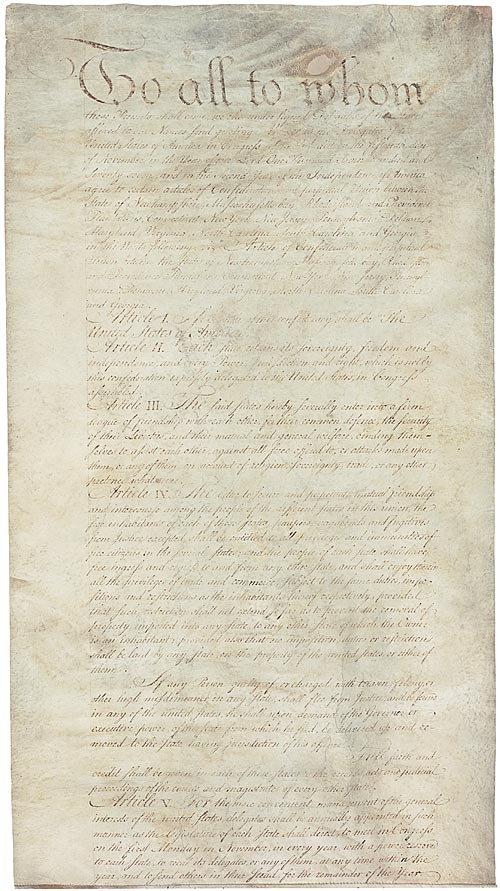
The area that became the Indiana Territory was once part of the Northwest Territory, which the Congress of the Confederation formed under the terms of the Northwest Ordinance on July 13, 1787. Articles of Confederation (1777)

The Articles of Confederation were adopted by the Continental Congress on November 15, 1777. This document served as the United States’ first constitution. It was in force from March 1, 1781, until 1789 when the present-day Constitution went into effect.

Enlarge Download Link

Citation: Articles of Confederation; 3/1/1781; Miscellaneous Papers of the Continental Congress, 1774 – 1789; Records of the Continental and Confederation Congresses and the Constitutional Convention, Record Group 360; National Archives Building, Washington, DC.

View All Pages in the National Archives Catalog

View Transcript

The Articles of Confederation were adopted by the Continental Congress on November 15, 1777. This document served as the United States’ first constitution. It was in force from March 1, 1781, until 1789 when the present-day Constitution went into effect.

Source: wiki

Thankfully, and gratefully, Congress saw the chaos and created a new

politics,pollution,petitions,pop culture & purses