
Rosa Parks Born: February 4, 1913 Died: October 24, 2005 Age: 92 years old Birthplace: Tuskegee, AL, United States Occupation: Activist Early Life & FamilyRosa Parks was born Rosa Louise McCauley on February 4, 1913, in Tuskegee, Alabama. After her parents, James and Leona McCauley, separated when Rosa was two, Rosa’s mother moved the family to Pine Level, Alabama to live with her parents, Rose and Sylvester Edwards. Both were former slaves and strong advocates for racial equality; the family lived on the Edwards’ farm, where Rosa would spend her youth. In one experience, Rosa’s grandfather stood in front of their house with a shotgun while Ku Klux Klan members marched down the street. Childhood and EducationRosa Parks’ childhood brought her early experiences with racial discrimination and activism for racial equality. Taught to read by her mother at a young age, Rosa attended a segregated, one-room school in Pine Level, Alabama, that often lacked adequate school supplies such as desks. African-American students were forced to walk to the 1st- through 6th-grade schoolhouse, while the city of Pine Level provided bus transportation as well as a new school building for white students. Through the rest of Rosa’s education, she attended segregated schools in Montgomery, including the city’s Industrial School for Girls (beginning at age 11). In 1929, while in the 11th grade and attending a laboratory school for secondary education led by the Alabama State Teachers College for Negroes, Rosa left school to attend to both her sick grandmother and mother back in Pine Level. She never returned to her studies; instead, she got a job at a shirt factory in Montgomery. In 1932, at age 19, Rosa met and married Raymond Parks, a barber and an active member of the National Association for the Advancement of Colored People. With Raymond’s support, Rosa earned her high school degree in 1933. She soon became actively involved in civil rights issues by joining the Montgomery chapter of the NAACP in 1943, serving as the chapter’s youth leader as well as secretary to NAACP President E.D. Nixon — a post she held until 1957. Life After the Bus BoycottAlthough she had become a symbol of the Civil Rights Movement, Rosa Parks suffered hardship in the months following her arrest in Montgomery and the subsequent boycott. She lost her department store job and her husband was fired after his boss forbade him to talk about his wife or their legal case. Unable to find work, they eventually left Montgomery; the couple, along with Rosa’s mother, moved to Detroit, Michigan. There, Rosa made a new life for herself, working as a secretary and receptionist in U.S. Representative John Conyer’s congressional office. She also served on the board of the Planned Parenthood Federation of America. biography.com |
Tag Archives: health care

Where Do Women Turn When Planned Parenthood Is Gone?

When conservatives made the big push to defund Planned Parenthood, they swore the issue was not about denying women health care services, but about protecting taxpayer dollars from waste. Two recent reports from the front lines of the Planned Parenthood battle show otherwise.
As Kate Sheppard reports, when officials in Shelby County, Tennessee took nearly $400,000 in state funding from the local Planned Parenthood, the Obama administration had to step in and fund the clinic directly. But instead of funding Planned Parenthood, originally local leaders directed that money to a religious organization that provides some women’s health care services. Needless to say, the taxpayer dollars were not well used.
Between July 2011 and June 2012, more than $500,000 of the $1.3 million grant the county received was not used at all. Hannah Sayle reports that Christ Community Health Services was averaging just 51 Title X visits per month in early 2012, compared to Planned Parenthood’s 841 visits in August 2011.
Amazing. When an organization isn’t interested in providing family planning services, women eventually have to turn elsewhere for that care. As Sheppard reports, the number of Title X visits in the state didn’t go down, but they did in Shelby County, meaning women had to travel outside of the county to get the care they need. The demand for health care didn’t go down, it just became less accessible.
The same is true in Texas where reporter Andrea Grimes chronicled her efforts trying to find a health care provider under the state’s Women’s Health Program for a well-woman visit. Even in a major metropolitan area like Austin, Texas trying to find a clinic to provide low-income, quality reproductive health care now that the state has excluded Planned Parenthood from its funding regime is practically impossible. In one instance, Texas officials listed a colonscopy clinic as one of the places a woman could go for a pap smear. When Grimes called to try and schedule an appointment and inquire about the services, clinic workers were understandably confused.
We can expect similar stories out of states like Ohio and Arizona as more and more hard-right legislatures set their sights on family planning services. And as these case studies develop, we are learning what we already knew: making health care services inaccessible won’t make the need for those services go away. Instead, it makes women go to greater expense and hardship to simply take care of their bodies. And when it’s too much, women will simply skip visits. In the case of well-women visits, that means a missed cancer screen. For some women, well-visits are the only time they visit a doctor absent an emergency, so that means fewer checks for other chronic conditions.
The inevitable conclusion to these developments is of course an increasingly segregated and discriminatory method of delivering health care to women. The Ann Romneys of the world will always have access to the health care they want and they need. But working women will not. This isn’t hypothetical, it’s happening.
Related Stories:
Pennsylvania Joins Rush to Defund Planned Parenthood
Read more: http://www.care2.com/causes/when-planned-parenthood-leaves-who-provides-the-care.html#ixzz26eQAPqDX
Share this:

70th anniversary of the death camp’s liberation
Share this:

time to make the dream come alive …
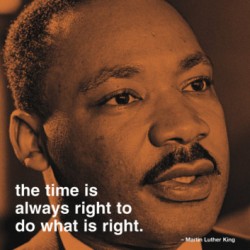
Born on 1/15/1929 ….
Inspired by the philosophy of non-violent protest, Martin Luther King Jr. led the American Civil Rights Movement and played a key role in the struggle for racial and economic equality. –
biography.com
Martin Luther King Jr.
“People are dying for the right to speak freely, for a better life, human rights in all its forms”
No one speaks to life’s struggles better than
– MLK jr.
“Human Progress is neither automatic nor inevitable even a superficial look at history reveals that no social advance rolls in on the wheels of inevitability. Every step toward the goal of justice requires sacrifice, suffering, and struggle; the tireless exertions and passionate concern of dedicated individuals without persistent effort, time itself becomes an ally of the insurgent and primitive forces of irrational emotionalism and social destruction.
“This is no time for apathy or complacency … This is a time for vigorous and positive action.”
– MLK Jr.
Share this:

In Memory: a personal story … Berlin Wall 25yrs ago 11/9
Posted by Nils Frahm, composer

Posted: 08 Nov 2014 11:47 PM PST
I was seven years old when thousands of East German signature cars arrived in my hometown of Hamburg and filled the air with odd-smelling blue smoke. I saw strangers hugging each other, tears in their eyes, their voices tired from singing. I was too young to understand it all, but I had a very strong sense that life was different now–and that different was better.A quarter-century later, it is our obligation to tell this story to all those who couldn’t be there, who could not feel the spark of the peaceful revolution and, more importantly, who are fortunate enough not to know the feeling of an incarcerated, divided existence, trapped behind concrete walls. It is a story that demands to be told today, and for generations to come.
I’m excited to have been part of making this doodle commemorating such a pivotal moment in history — to learn more about the making-of, check out the doodle team’s post here. We should all take the time to celebrate 25 years of unity.
Posted by Nils Frahm, composer
 Be a Seed for Change
You must be logged in to post a comment.