BREAKING: (more good news!)


In case you missed Meet the Press , here’s what YOU made possible:

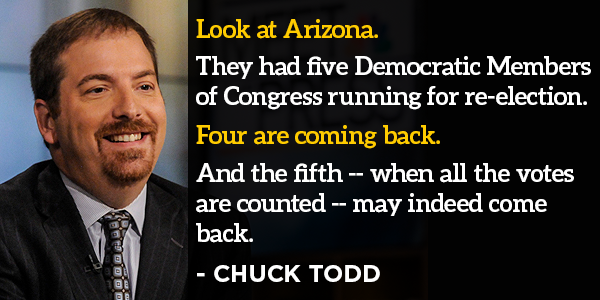
That’s right — despite the Republican wave, Democrats are 4-for-4 in deep-red Arizona.

And that fifth too-close to call race?

That’s gun violence prevention advocate and former Congresswoman Gabby Giffords’ old seat.

We were down on Election Night, but we just some great news: Former Giffords aide Ron Barber has closed the gap to 341 votes.

If this trend holds, Barber can still pull into the lead and win!

We wouldn’t have this opportunity to win without you:

Your donations and volunteer hours allowed to us reach out to key voters in this race over 133,000 times.
133,000 Door Knocks and Phone Calls

And the current margin?

341 votes

We just can’t say it enough: Your grassroots support is literally making the difference between victory and defeat in these close races.

We can’t say thank you enough for all you’ve done.

All of us at the DCCC

P.S. The single most important thing we can do right now is ensure that every vote is counted fairly and accurately. Unfortunately the Republicans are already trying to throw out ballots:

Tucson Weekly:
In what remains one of the tightest congressional races in the country, Republican candidate Martha McSally’s legal team is taking steps to toss out the ballots of voters in Pima County

Tonight’s Deadline


{UCS

Here’s what’s happened since the Environmental Protection Agency (EPA) made history by proposing to slash carbon pollution from power plants:

  • Senate opponents of the EPA rule released a report calling for the Union of Concerned Scientists to be investigated for supporting the EPA.1
  • There are multiple bills on the floor of Congress to strip the EPA of its regulatory power and slash the agency’s budget.2
  • A front group ran full-page ads in USA Today comparing the scientists behind these rules to terrorists and anarchists.3
  • And politicians who will make it their mission to stall progress on global warming will control both houses of Congress come January.

They don’t have the science on their side, so they’re going after the messengers. And we only have a few short weeks to make sure these rules receive as much public support as possible, and are even strengthened.

Carmen, we’ve set a goal to raise $20,000 in the next 24 hours to fund an all-out, three-week effort to mobilize more supporters, scientists, and hard data before the comment period on these new rules closes on December 1.

Help fight back and push the EPA to stay firm on cleaning up carbon pollution.

Power plants account for over 40 percent of all U.S. global warming emissions.4 Cutting those emissions by one-third, as the EPA has proposed, would be the most significant step the U.S. has ever taken in the fight against global warming. And we haven’t even started talking about the thousands of lives that will be saved thanks to reduced pollution, and billions of dollars in health and environmental benefits that will result from adopting the new rules.

We have 21 days to show a groundswell of public pressure and scientific evidence for these rules—and stop politicians, polluters, and industry groups like the U.S. Chamber of Commerce from undermining them.

Here’s our strategy:

Strengthen the rules. As important as the rules are, they are too modest to halt the worst effects of global warming. UCS scientists will be submitting an alternative proposal to the EPA this month that pushes for more reliance on renewable energy sources like solar and wind, which are now competing with coal and gas. If adopted, our proposal would ensure more ambitious cuts in heat trapping gases.

Show support for the measure in unexpected states. We’re rallying supporters in places where coal companies and their friends in government tend to drown out voices for change—coal states like Kentucky and West Virginia. The truth is 70 percent of Americans, people in all 50 states, support this commonsense change.5

Counter misinformation from fossil-fuel interests. Our top energy experts and in-house data analysts are constantly fact checking claims from coal companies, calling out the pseudoscience that sneaks into the mainstream media.

Connect experts with leaders at the EPA. We’ve been providing input to the EPA on these rules for months (it’s standard practice for government agencies to consult outside experts, and policymakers trust our independent analysis). We’re also getting EPA officials on the phone with hundreds of experts and activists directly.

Be part of this incredibly important campaign. Donate now to win on carbon.

I wouldn’t ask for your gift today if it wasn’t a make-or-break moment. Over the next few weeks, we can help the EPA begin to cut carbon pollution from coal and gas-fired power plants by more than the reduction proposed by EPA. Or we can leave the outcome to the climate-deniers and the fossil fuel industry.

It’s up to you and me, Carmen. Thanks for being part of this.

Ken Kimmell Sincerely,
Ken Kimmell
Ken Kimmell
President
Union of Concerned Scientists

1. http://www.epw.senate.gov/public/index.cfm?FuseAction=Files.View&FileStore_id=8af3d005-1337-4bc3-bcd6-be947c523439 [PDF]
2. http://thehill.com/policy/energy-environment/211552-house-funding-bill-would-cut-epa-rules
3. http://www.washingtonpost.com/blogs/post-politics/wp/2014/06/04/the-ad-war-over-epas-climate-rule-has-begun/
4. http://www.ucsusa.org/global_warming/solutions/reduce-emissions/new-epa-carbon-rules-for-power-plants-climate-game-changer.html
5. http://www.washingtonpost.com/blogs/the-fix/wp/2014/06/02/a-huge-majority-of-americans-support-regulating-carbon-from-power-plants-and-theyre-even-willing-to-pay-for-it/

A message from Gov.Inslee


SeattleNighttime3   

We weathered the storm

Watching the news on Tue‌sday nig‌ht, it would’ve been easy to get discouraged.

Republicans scored major upsets all over the country and took the majority in the U.S. Senate.

But here in the state of Washington, Democrats held back the wave that overwhelmed the rest of the country.

We’re still holding control of the state House as the final votes are counted, and in the state Senate, the status quo was maintained. We reelected every one of our Democratic members of Congress and made history by passing background checks on all gun sales. And we picked up wins in county elections.

Wherever we can, my Democratic colleagues and I will work with the Republicans to find real solutions to the problems our state faces to build a working Washington. If they’re willing, we’ll work with them to fully fund our schools, to repair our unsafe roads and bridges, to create new jobs, to find a solution to our climate crisis, and to build a working Washington that is prepared for a clean energy future.

I will continue fighting to push the state forward, and I’m certainly not willing to let anyone take our state backwards.

With your help, we will continue to make progress for the people of Washington.

I’m proud to stand with you. Thank you for standing with me.

Very truly yours,

Jay Inslee

The Other 47 Percent


By

A Closer Look At Tuesday’s Races Show Structural, But Also Strategic, Challenges

There’s no denying that Tuesday was a bad day for Democrats. On the morning after the election, we detailed a number of key issues at play in the race and a silver lining. Now, a closer analysis reveals that while structural obstacles were certainly a big reason for GOP gains, they were not the only reason. Public opinion and demography experts Ruy Teixeira and John Halpin explain in a new Center for American Progress issue brief that deep voter pessimism and a lack of an economic agenda from Democrats also contributed to the voting outcomes. This provides an important lesson in the path forward.

The Structural Challenge: Democrats were hurt by the fact that states holding Senate elections this year were disproportionately small and conservative. With over two-thirds of the states having elections in 2014, one might expect that about two-thirds of the voting eligible population voted in the races that determined control of the Senate. But these 34 states had just 53 percent of the total United States voting population. That’s right: 47 percent of the country does not live in the states that just determined the new Senate majority.

The political make-up of the voters in 2014 Senate states leaned Republican as well, as this graphic spells out:

maps_capaf

The Strategic Challenge: But these structural challenges don’t explain everything. Comparing the 2014 Senate state with the same states in 2012, Democrats did do worse this year. Mitt Romney’s margin of victory in these states was 2.4 percent in 2012. This year, the margin of victory for all Republican Senate candidates in 2014 was 4.3 percent. That is a 1.9 percent shift more Republican. And in governor’s races, which actually took place in states that leaned blue, Democrats did even worse: in 2012 Obama won these states by a margin of 3.9 percent, while Democratic candidates lost in those states this year by 5.5 percent. That’s 9.4 percent of voters — equivalent to 7 million votes — going toward the GOP.

In their new analysis, Teixeira and Halpin offer a critical evaluation and explanation of why this could be. After going through the exit polls and breaking down how different key constituencies voted, they conclude that “the path forward for Democrats seems straight.”

In order to maximize support among core constituencies and reach further into the Republican hold on white voters, they must develop and promote a sharp vision of economic equality and greater opportunity for those left out of the recovery. An agenda of job creation and investment; higher wages for workers; greater equality for women; college affordability and student-debt reduction; and strong family policies through paid leave, expanded child care support, and universal pre-K can attract a sizable chunk of the white working class, particularly among women and Millennials, and appeal to base voters who are economically pressed.

BOTTOM LINE: Structural challenges made this year a difficult one for Democrats. But strategic challenges connecting with voters anxious about their economic circumstances also offer lessons and provide a path forward going into 2016. Economic opportunity for all Americans, not just the wealthy few, is a message that resonates with voters. Now candidates and elected officials need to advocate for the progressive policies to make that a reality.

 

GOOD NEWS (thank goodness!)


Tuesday was a tough night. But today, we have some good news to share:

There were 14 races too-close-to-call on Election Night:

But as of 1pm today:
Democrats have won 7
Republicans have won 0

It’s another reminder of how your record-breaking grassroots support made the difference.

In the ten closest races, your donations and volunteer hours allowed us to reach out to key voters over 641,000 times.

641,000 Door Knocks and Phone Calls


And the margin in those 10 races — combined?

14,635 votes

Your grassroots support literally made the difference between victory and defeat in these races. We can’t say thank you enough for all you’ve done.

Now, we just need to make sure every single vote is counted fairly and accurately in our final 7 too-close-to-call races.
