on this day … 3/10 1924 – The U.S. Supreme Court upheld a New York state law forbidding late-night work for women.


0241 BC – The Roman fleet sank 50 Carthaginian ships in the Battle of Aegusa.

0049 BC – Julius Caesar crossed the Rubicon and invaded Italy.

1496 – Christopher Columbus concluded his second visit to the Western Hemisphere when he left Hispaniola for Spain.

1629 – England’s King Charles I dissolved Parliament and did not call it back for 11 years.

1656 – In the American colony of Virginia, suffrage was extended to all free men regardless of their religion.

1785 – Thomas Jefferson was appointed minister to France. He succeeded Benjamin Franklin.

1792 – John Stone patented the pile driver.

1804 – The formal ceremonies transferring the Louisiana Purchase from France to the U.S. took place in St. Louis.

1806 – The Dutch in Cape Town, South Africa surrendered to the British.

1814 – In France, Napoleon Bonaparte was defeated by a combined Allied Army at the battle of Laon.

1848 – The U.S. Senate ratified the Treaty of Guadalupe Hidalgo, which ended the war with Mexico.

1849 – Abraham Lincoln applied for a patent for a device to lift vessels over shoals by means of inflated cylinders.

1864 – Ulysses S. Grant became commander of the Union armies in the U.S. Civil War.

1876 – Alexander Graham Bell made the first successful call with the telephone. He spoke the words “Mr. Watson, come here, I want to see you.”

1880 – The Salvation Army arrived in the U.S. from England.

1893 – New Mexico State University canceled its first graduation ceremony because the only graduate was robbed and killed the night before.

1894 – New York Gov. Roswell P. Flower signed the nation’s first dog-licensing law.

1902 – The Boers of South Africa scored their last victory over the British, when they captured British General Methuen and 200 men.

1902 – Tochangri, Turkey, was entirely wiped out by an earthquake.

1902 – U.S. Attorney General Philander Knox announced that a suit was being brought against Morgan and Harriman’s Northern Securities Company. The suit was enforcement of the Sherman Antitrust Act. Northern Securities loss in court was upheld by the U.S. Supreme Court on March 14, 1904.

1903 – Harry C. Gammeter patented the multigraph duplicating machine.

1903 – In New York’s harbor, the disease-stricken ship Karmania was quarantined with six dead from cholera.

1906 – In France, 1,200 miners were buried in an explosion at Courrieres.

1909 – Britain extracted territorial concessions from Siam and Malaya.

1910 – Slavery was abolished in China.

1912 – China became a republic after the overthrow of the Manchu Ch’ing Dynasty.

1913 – William Knox rolled the first perfect 300 game in tournament competition.

1924 – The U.S. Supreme Court upheld a New York state law forbidding late-night work for women.

1927 – Prussia lifted its Nazi ban allowing Adolf Hitler to speak in public.

1933 – Nevada became the first U.S. state to regulate drugs.

1940 – W2XBS-TV in New York City aired the first televised opera as it presented scenes from “I Pagliacci”.

1941 – The Brooklyn Dodgers announced that their players would begin wearing batting helmets during the 1941 season.

1941 – Vichy France threatened to use its navy unless Britain allowed food to reach France.

1944 – The Irish refused to oust all Axis envoys and denied the accusation of spying on Allied troops.

1945 – American B-29 bombers attacked Tokyo, Japan, 100,000 were killed.

1947 – The Big Four met in Moscow to discuss the future of Germany.

1947 – Poland and Czechoslovakia signed a 20-year mutual aid pact.

1949 – Nazi wartime broadcaster Mildred E. Gillars, also known as “Axis Sally,” was convicted in Washington, DC. Gillars was convicted of treason and served 12 years in prison.

1953 – North Korean gunners at Wonsan fired upon the USS Missouri. The ship responded by firing 998 rounds at the enemy position.

1955 – The last broadcast of “The Silver Eagle” was heard on radio.

1956 – Julie Andrews at the age of 23 made her TV debut in “High Tor” with Bing Crosby and Nancy Olson.

1959 – “Sweet Bird of Youth”, a play by Tennessee Williams, opened in New York City.

1965 – Walter Matthau and Art Carney opened in “The Odd Couple”. It later became a hit on television.

1966 – The North Vietnamese captured a Green Beret camp at Ashau Valley.

1966 – France withdrew from NATO’s military command to protest U.S. dominance of the alliance and asked NATO to move its headquarters from Paris.

1969 – James Earl Ray pled guilty in Memphis, TN, to the assassination of Martin Luther King Jr. Ray later repudiated the guilty plea and maintained his innocence until his death in April of 1998.

1971 – The U.S. Senate approved an amendment to lower the voting age to 18.

1975 – The North Vietnamese Army attacked the South Vietnamese town of Ban Me Thout.

1980 – Iran’s leader, Ayatollah Khomeini, lent his support to the militants holding American hostages in Tehran.

1981 – The U.S. Postal Service announced an increase in first class postage from 15 to 18 cents.

1982 – The U.S. banned Libyan oil imports due to their continued support of terrorism.

1986 – The Wrigley Company, of Chicago, raised the price of its seven-stick pack of Wrigley’s chewing gum from a quarter to 30 cents.

1987 – The Vatican condemned surrogate parenting as well as test-tube and artificial insemination.

1990 – Haitian President Prosper Avril was ousted 18 months after seizing power in a coup.

1991 – “Phase Echo” began. It was the operation to withdraw 540,000 U.S. troops from the Persian Gulf region.

1994 – White House officials began testifying before a federal grand jury about the Whitewater controversy.

1995 – U.S. Secretary of State Warren Christopher told Yasser Arafat that he must do more to curb Palestinian terrorists.

1998 – U.S. troops in the Persian Gulf began receiving the first vaccinations against anthrax.

2002 – The Associated Press reported that the Pentagon informed the U.S. Congress in January that it was making contingency plans for the possible use of nuclear weapons against countries that threaten the U.S. with weapons of mass destruction, including Iraq and North Korea.

2003 – North Korea test-fired a short-range missile. The event was one of several in a patter of unusual military maneuvers.

Green Planet …info on Kenaf -Working with Nature – a Repost


    featured photo is a sunset over Mumbai

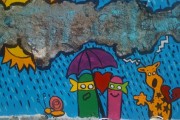
The Wall Project – Brightening people’s lives.

Posted on 25. May, 2010 by admin in India, odd stuff

The Mumbai Wall Project began with a blank white compound wall, with an intense burning of “something has to be done to it” It starting with a few enthusiastic people, it has grown to be a bigger and bigger project seemingly taking a life of its own.

It was an initiative to add visual elements of colour, form and texture to a space, to make the area more alive and generate a feeling among people who pass by it daily. Not knowing how people would react, the first onlookers came out slowly and curious to see what was happening and then slowly people and even young kids came out to help and play their part.

Dhanya Pilo, Art Director and Founder of The Wall Project, notes: “Wall art has always existed in India on temple walls, village houses or old Bollywood art, creating a personality unique to each township.” Since public art has always existed, a creative platform of this kind was the logical next step.

The Wall Project have painted in many many nooks and corners of Mumbai. Bandra is the best location – as the best way to see all the wall art you need to cycle/walk around and you will find art work all over Bandra. More recently the wall project, got permission from the city to beautify the North –South roads in Mumbai as a canvas with everything being an inspiration, art, music, nature, love, the abstract, real life and the city itself. (This road is a huge landmark) Everything is acceptable apart from adverts, religious views, political slogans, and foul language. The premise that a work of art can make a colorful difference in the lives of individuals, communities, and cities, The Founders believe that grey, ugly spaces deserve beautification.
Everybody is welcome, not just artists, and they are always looking for permission and interesting locations to paint.

They have worked with a lot of people, shop owners, hospitals, NGO’s and the Alliance Francaise, Kaos Pilot, and are being invited by more people to showcase their ideas/skills. In January ‘08 they collaborated with Fine Art students of Rachana Sansad, Mumbai and painted shops as well as some other walls.

Over the years a lot of talented Graffiti artist from all over the world have come to paint, from Swedish writer Finsta to French writers Dezer, Keflione, Migwel, Rock, Posh, Seth, Boogie & Kid etc have all come and left their designs/marks/stories in the streets of Mumbai giving locals something to smile about.

Regarding, “The Great Wall of Mumbai” – on the Tulsi Pipe Road – They had been eyeing that wall for so so long. They had painted on walls of private homes, shops, schools, etc and they wanted to paint on major public spaces but thought that the process of getting permission would be too daunting and bureaucratic. They were completely surprised when R A Rajeev, Additional Municipal Commissioner, BMC approached them. He gave them complete creative control, it was a dream come true. Around four hundred people of all ages came to help. Some were not artists, some were not. It was about being inclusive and including the local population and the turnout was great.

The Mumbai Wall Projectis bringing the streets to life, in a positive and colourful way with more than 300+ pieces all over Mumbai.

If you want to keep in loop join The Wall Project Facebook Group, they posting most information there, and you can let them know if there are any specific ways you want to be part of the group. They say even dormant members will eventually get colourful, and out of their cocoon.


“This process allows one to be more observant about the spaces we use and move within and how we can use various art forms in the public sphere to generate an interest in the minds of our daily human lives. The wall project in its own way tries to start a conversation, with no political or religious attachments.” – Dhanya Pilo & Nitya Amarnath

Fuel – A different way of thinking?

Posted on 23. Jun, 2010 by admin in mishmash

As you may or may not be aware, I don’t feel that Carbon Dioxide is the the villain at the centre of the world’s problems . I personally believe that is a convenience for Governments to generate revenue amongst other things, a distraction from other more important matters. What I do believe, is that we are extremely wasteful of dwindling resources and are polluting our planet at an alarming rate… More kids are suffering with asthma that ever before. More people have respiratory illnesses than ever before. We are killing ourselves and the planet with pollution and waste in a thousand different ways.

So I was pleased to find The Fuel Film website

A few pollution information gems to consider:

• The levels of toxic diesel fumes inside school buses are 4 times higher compared with outside the buses.

• According to the World Health Organization (WHO), about 2 million premature deaths are caused each year due to air pollution in cities across the world

• A Scottish study has shown that jogging with traffic around results in reduced blood flow to the heart. This is particularly dangerous for people with stable heart disease, because it can trigger off cardiac arrhythmia or even a heart attack

• Every year 335,000 Americans die of lung cancer, which is a direct result of air pollution

And we are not talking CO2 pollution here, just all the other nasties that get pumped into our atmosphere for us to breath.

The Fuel Film… Educational, Informative and surprisingly entertaining

The Big question from sceptics is: … That crops for bio-fuel takes away the ability of the world to feed it’s growing population, this is answered in a couple of ways in the film.

One solution of several is in using marginal land, another is algae
For those that don’t know: Marginal land is land that is difficult to cultivate and is not being used for food crops. This land could be used to grow biomass crops to be used for bio-fuels. California has apparently 1 million acres of marginal land that could generate 5 billion gallons of bio-fuels per year.

Now, while not 100% convinced that it is possible to ‘grow’ all our fuel requirements, it nice to know that there are alternative possibilities and people willing to fight to get them heard.

All it needs now is the desire from Government and vested interests to make it happen… Having said all that what is happening in the Gulf is a wake-up call for the world….

But is anybody listening? Because as sure as death and taxes we are not going to give up our love affair with the car easily

For more information click here

Photo courtesy: U.S. Department of Energy. Pretty, isn’t it? …. In case you’re wondering it’s Bio-fuel Algae

Kenaf – A 21st century crop

Posted on 21. Mar, 2010 by admin in crop

Kenaf, should be the fibre crop of the 21st century, and hopefully explode into the market place for industrial products made from sustainable natural materials. Several multinational companies already use kenaf fibre in small, but growing quantities, in newly-marketed green products such as the Toyota Lexus and NEC mobile phones to replace environmentally-damaging materials.

Crucially, the green tag attached to kenaf is gaining more importance as people, companies and governments realize that the kenaf crop removes substantial amounts of CO2 and NO2 from the atmosphere and three to five times faster than forests with its deep roots improving the soil. Trees take many years to reach a harvestable size, however kenaf grown as an annual crop will reach a mature size in just 120 to 150 days after the seeds are sown, producing the largest biomass of any agricultural crop – far more than trees.

It can clean the environment efficiently and in some Japanese cities, kenaf is planted by the Government to improve the air quality. Kenaf will also greatly reduce our reliance on wood pulp and petroleum-based products. From construction board and concrete to plastic composites for mobile phones, from paper and light-weight, high-strength surfaces in aircraft to non woven industrial fabrics, from newspaper to absorbents for the oil industry. Commerce is waiting for the sustainable kenaf fibre in large quantities.

The kenaf plant is composed of multiple useful components (e.g. stalks, leaves, and seeds) and within each of these plant components there are various usable portions (e.g. fibres and fibre strands, proteins, oils, and allelopathic chemicals). What can’t be harvested can be used as Biomass fuel and fertilizer

Exciting New Technologies

In the past kenaf fibre production has been limited by the manual processing required to extract the fibres once the kenaf crop has been grown and harvested and the non-sustainable method of retting the fibres in rivers. New methods are now becoming available to process kenaf in volume providing a distinct advantage over existing processes, taking them to a new economical viability.

Green Planets and our partners intention is not to compete with other existing kenaf producers or processors, but to enlarge the industry and provide new opportunities for kenaf fibres. In most of the countries chosen, there are existing kenaf customers, we aim to enhance those relationships and the export routes for kenaf to developed nations. While at the same time create locally-owned hubs of agricultural excellence, kenaf business and community social support for the growers.

To find out more and how you can assist us, please contact us at     www.kenaf@greenplanet.com

Kenaf is a crop of importance – to a world in need of it

Barack Obama’s Remarks in Selma – American History


This speech …

the First Family traveled to Selma, Alabama to mark the 50th anniversary of the historic marches from Selma to Montgomery. Those marchers in March of 1965 wanted to ensure that all African Americans could exercise their constitutional right to vote — even in the face of a segregationist system that wanted to make it impossible.

As President Obama explained in his remarks this weekend, the lesson of Selma isn’t an outlier of the American experience:

[Selma] is instead the manifestation of a creed written into our founding documents: “We the People … in order to form a more perfect union.” “We hold these truths to be self-evident, that all men are created equal.”

If you missed the President’s powerful speech, watch it here — and pass it on.

Watch the President's remarks in Selma.