Anniversary of Brown v. Board of Education of Topeka – remember Black History


Posted by Robin Caldwel

On May 17, 1954, Supreme Court under Chief Justice Earl Warren rendered a unanimous, landmark decision (9-0) declaring that state laws establishing separate public schools for black and white students and denying black children equal educational opportunities unconstitutional. The Brown v. the Board of Education of Topeka ruling overturned previous “separate but equal” rulings, including the 1896 decision, Plessy v. Ferguson. In effect, separation by race de jure (by law) violated the Equal Protection Clause of the Fourteenth Amendment of the United States Constitution.

In 1951, thirteen Topeka parents filed the class action lawsuit on behalf of their 20 children in the United States District Court for the district of Kansas. Leaders of the Topeka NAACP recruited the plaintiffs with Oliver Brown as the named plaintiff in the suit. The contention was that the state of Kansas, essentially, did not comply with separate but equal facilities for black and white children. Oliver Brown’s daughter, Linda, had to walk 6 blocks to catch a school bus that took her to the black elementary school 1 mile from their neighborhood, while a white elementary school was only seven blocks from the Browns’ home. Brown tried to register Linda at the school but was rejected. The Brown lawsuit was presented before the Supreme Court on appeal along with other suits representing plaintiffs in Washington, D. C., Virginia, South Carolina and Delaware.

The plaintiffs by name are as follows: Oliver Brown, Darlene Brown, Lena Carper, Sadie Emmanuel, Marguerite Emerson, Shirley Fleming, Zelma Henderson, Shirley Hodison, Maude Lawton, Alma Lewis, Iona Richardson, and Lucinda Todd.

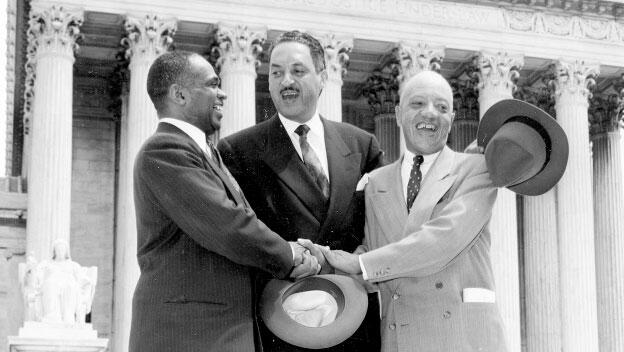
Chief counsel for the NAACP, Thurgood Marshall, argued the case before the Supreme Court.

Lawrence Guyot : a Civil Rights Leader, in memory of – Black History


WASHINGTON November 25, 2012 (AP)

Guyot was born in Pass Christian, Miss., on July 17, 1939. He became active in civil rights while attending Tougaloo College in Mississippi, and graduated in 1963. Guyot received a law degree in 1971 from Rutgers University, and then moved to Washington, where he worked to elect fellow Mississippian and civil rights activist Marion Barry as mayor in 1978.

“When he came to Washington, he continued his revolutionary zeal,” Barry told The Washington Post on Friday. “He was always busy working for the people.”

Image result for lawrence guyot

D.C. Delegate Eleanor Holmes Norton told The Post in 2007 that she first met Guyot within days of his beating at a jail in Winona, Miss. “Because of Larry Guyot, I understood what it meant to live with terror and to walk straight into it,” she told the newspaper. On Friday, she called Guyot “an unsung hero” of the civil rights movement.

“Very few Mississippians were willing to risk their lives at that time,” she said. “But Guyot did.”

In recent months, his daughter said he was concerned about what he said were Republican efforts to limit access to the polls. As his health was failing, he voted early because he wanted to make sure his vote was counted, he told the AFRO newspaper.

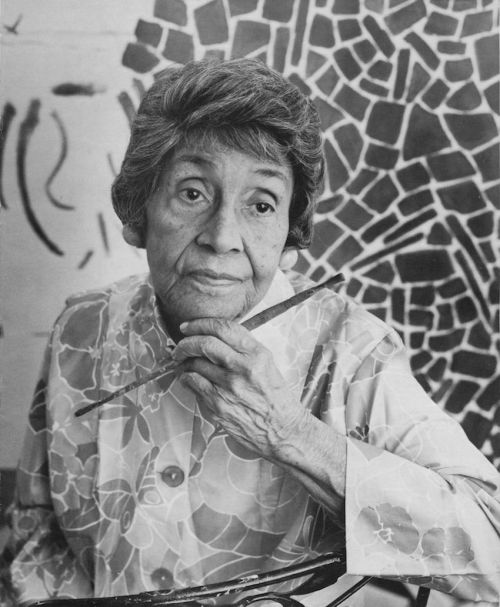
Alma Thomas, b. 1891


image

         Alma Woodsey Thomas was born in Columbus, Georgia in 1891. The Thomas family moved to Washington, D.C. in 1907 to seek refuge from racial violence in the South and to give their children better educational opportunities. In 1924, she was the first graduate of Howard University’s School of Fine Arts. After graduating, she became an art teacher at Shaw Junior High School until her retirement in 1960.

Thomas was the first African American woman to have a solo exhibition at the Whitney Museum of American Art in New York. In 1978, Thomas passed away at the age of eighty-six.

image

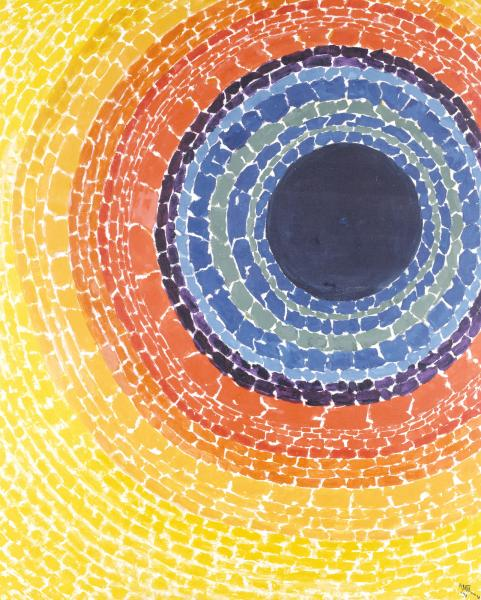
The Eclipse, Alma W Thomas, 1970, acrylic on canvas

         After her retirement, she was able to dedicate herself to what she referred to as more “serious painting.” Thomas developed her true voice as an artist at the age of 70. Her early art had been realistic and while in this new discovery her signature style of colorful abstraction arose. 

She may not be a household name, but Alma Thomas made many significant contributions in the 20th century art world with her use of color and unique style.

Alma Thomas loved children and she had an important role in art education. But, she also loved to learn. She was interested in space programs and she had an important role in art education. But, she also loved to learn. She was interested in space programs, and she often painted from satellite photographs.

Source: wiki and The Annex

image

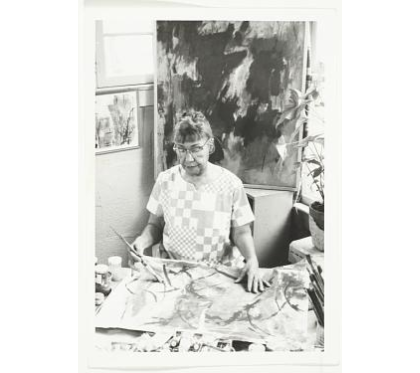
Alma Thomas working in her studio, ca. 1968

        Thomas was the first African American woman to have a solo exhibition at the Whitney Museum of American Art in New York. In 1978, Thomas passed away at the age of eighty-six. Posthumously, a retrospective exhibition of her work was held at the Smithsonian Institution’s National Museum of American Art. Her paintings have been exhibited at the White House three times and today her work can be found in many major museums.

“Through color, I have sought to concentrate on beauty and happiness, rather than on man’s inhumanity to man.” ― Alma Woodsey Thomas, Alma W. Thomas: A Retrospective of the Paintings

politics,pollution,petitions,pop culture & purses