Tag Archives: health care

Did you know… reports in 2013 were alarming what are they now?


Plasticbagsrecycle

Did you know … reports in 2013 state the following

7.3 Pounds of plastic… Mostly pvc is in artificial trees

20,  Is the number of years … We must reuse artificial trees before it lowers the carbon footprint, equal to a real tree

There are 4000 Recycle centers nationwideplease find out where you can dispose of your Xmas tree this year for compost, woodchips for gardens and or  hiking trails.

600,00 Homes …Could be powered by energy used from Xmas tree lights every year, go to holidayleds.com and find out how to recycle your incandescent lights.

A 20% reduction in meat consumption would have the same impact as switching from a standard sedan to an ultra-efficient fuel car.

5000 gallons of water … Is the amount it would take to produce 1lb of wheat.

20%  of the worlds’ population…  Could be fed with the grain and soybeans used to feed US cattle.

4.5% … Is the number of greenhouse gases produced worldwide by animal farming than by transportation.

1500 miles … Is the average amount it takes to get food on our tables, the road trip takes tons of energy, the gas used to commute pollutes, buy, use and support your local farmer’s markets and community gardens

660 gallons… Is about how much water it takes to grow cotton for one T-shirt.if the shirt is coloured, a lrg amt of dye rinses off into factory wastewater,ends up in rivers and some dyes have carcinogens.

just more good info from LYBL and Eatingwell.com

44 Women Who Have Run for President


Women Presidential Candidates

Women Who Ran for President

Who were the early women candidates for president? Hillary Clinton in her 2008 run for the Democratic nomination for US President came the closest so far that any woman has come to winning the nomination of a major political party in the United States. But Clinton is not the first woman to run for United States President, and not even the first to run for a major party’s nomination. Here’s a list of the female presidential candidates, arranged chronologically by each woman’s first campaign for the office. The list is current through the 2012 election; women running in 2016 will be added after that election’s over.

Who was the first woman to run for president?

What woman ran for US president first? And which women have run since?

73208640.jpg - Kean Collection/Hulton Archive/Getty Images

American feminist politician and radical Victoria Claflin Woodhull and her sister Tennessee Claflin attempt to assert their right to vote in New York and are denied, circa 1875. Kean Collection/Hulton Archive/Getty Images

Victoria Woodhull

Equal Rights Party: 1872
Humanitarian Party: 1892

Victoria Woodhull was the first woman to run for president in the United States. Frederick Douglass was nominated as Vice President, but there’s no record that he accepted. Woodhull was also known for her radicalism as a woman suffrage activist and her role in a sex scandal involving noted preacher of the time, Henry Ward Beecher. More »

Belva Lockwood - Courtesy of the Library of Congress. Modifications © 2003 Jone Johnson Lewis.

Belva Lockwood. Courtesy of the Library of Congress. Modifications © 2003 Jone Johnson Lewis.

Belva Lockwood

National Equal Rights Party: 1884, 1888Belva Lockwood, an activist for voting rights for women and for African Americans, was also one of the earliest women lawyers in the United States. Her campaign for president in 1884 was the first full-scale national campaign of a woman running for president. More »

Laura Clay

Democratic Party, 1920Laura Clay, a Southern women’s rights advocate who supported state suffrage amendments so that the Southern states could limit suffrage to white women, had her name placed in nomination at the 1920 Democratic National Convention, to which she was a delegate. More »

Grace Allen

Surprise Party: 1940Comedian and actress, partner with husband George Burns on the George Burns and Gracie Allen Show, Grace Allen ran for president in 1940 as a publicity stunt. She was not on the ballot — it was, after all, a stunt — but she did get write-in votes.

Margaret Chase Smith

Republican Party: 1964She was the first woman to have her name placed in nomination for president at a major political party’s convention. She was also the first woman elected to serve in both the House of Representatives and the Senate. More »

Charlene Mitchell

Communist Party: 1968Nominated by the (tiny) Communist Party in 1968, Charlene Mitchell was the first African American woman nominated for president in the United States. She was on the ballot in two states in the general election, and received less than 1,100 votes nationally.

Shirley Chisholm Announcing Her Run for the Presidency 1972 - Don Hogan Charles/New York Times Co./Getty Images

Shirley Chisholm Announcing Her Run for the Presidency 1972. Don Hogan Charles/New York Times Co./Getty Images

Shirley Chisholm

Democratic Party: 1972A civil rights and women’s rights advocate, Shirley Chisholm ran for the Democratic nomination in 1972 with the slogan, “Unbought and Unbossed.” Her name was placed in nomination at the 1972 convention, and she won 152 delegates. More »

Patsy Takemoto Mink

Democratic Party: 1972She was the first Asian American to seek nomination as president by a major political party. She was on the Oregon primary ballot in 1972. She was at that time a member of the U.S. Congress, elected from Hawaii.

Bella Abzug in 1971 - Tim Boxer/Getty Images

Bella Abzug in 1971. Tim Boxer/Getty Images

Bella Abzug

Democratic Party: 1972One of three women to seek the Democratic Party nomination for president in 1972, Abzug was at the time a member of Congress from the West Side of Manhattan. More »

Linda Osteen Jenness

Socialist Workers Party: 1972Underage for the Constitution’s requirements for the presidency, Linda Jenness ran against Nixon in 1972 and was on the ballot in 25 states. In three states where Jenness was not accepted for the ballot because of her age, Evelyn Reed was in the presidential slot. Their vote total was less than 70,000 nationally.

#Stop&Frisk – Black History


by uslegal.com

Stop and frisk is when police “temporarily” detain somebody and pat down their outer clothing when there are specific articulate facts leading a reasonable police officer to believe a person is armed and dangerous. It is not necessary for the officer to articulate or identify a specific crime they think is being committed, only that a set of factual circumstances exist that would lead a reasonable officer to have a reasonable suspicion that criminal activity is occurring. “Reasonable suspicion” is one step below “probable cause” and one step above a hunch.

A “frisk” by definition is a type of search that requires a “lawful stop”. It is best thought of as a separate act, but in practice, a suspect who refuses to answer questions in a stop may be providing the officer with sufficient justification to frisk. A frisk should not be for anything other than a dangerous weapon or contraband. However, if other evidence, like a suspected drug container, is felt, it can be seized by the officer under the “plain feel” doctrine. The test for “plain feel” is that the item’s contraband nature be “immediately apparent”.

Resource: uslegal.com

One of several problems with stop & frisk, is that most if not all Police demand name, address, question people of colour when in upper income communities and or assume gang affiliation least we talk about the percentage of Black Latino Asian or Caucasian men&women being stopped on a daily basis … is it a quota, a civil rights issue, a misuse or abuse of power ~ Nativergrl77

In Memory …. Langston Hughes – Black History


Langston Hughes

Image result for langston hughes. Size: 202 x 200. Source: blogs.cofc.edu

19021967, Joplin, MO

James Mercer Langston Hughes was born February 1, 1902, in Joplin, Missouri. His parents divorced when he was a young child, and his father moved to Mexico. He was raised by his grandmother until he was thirteen, when he moved to Lincoln, Illinois, to live with his mother and her husband, before the family eventually settled in Cleveland, Ohio. It was in Lincoln that Hughes began writing poetry. After graduating from high school, he spent a year in Mexico followed by a year at Columbia University in New York City. During this time, he held odd jobs such as assistant cook, launderer, and busboy. He also travelled to Africa and Europe working as a seaman. In November 1924, he moved to Washington, D. C. Hughes’s first book of poetry, The Weary Blues, (Knopf, 1926) was published by Alfred A. Knopf in 1926. He finished his college education at Lincoln University in Pennsylvania three years later. In 1930 his first novel, Not Without Laughter, (Knopf, 1930) won the Harmon gold medal for literature.

Hughes, who claimed Paul Lawrence Dunbar, Carl Sandburg, and Walt Whitman as his primary influences, is particularly known for his insightful, colorful portrayals of black life in America from the twenties through the sixties. He wrote novels, short stories and plays, as well as poetry, and is also known for his engagement with the world of jazz and the influence it had on his writing, as in his book-length poem Montage of a Dream Deferred (Holt, 1951). His life and work were enormously important in shaping the artistic contributions of the Harlem Renaissance of the 1920s. Unlike other notable black poets of the period—Claude McKay, Jean Toomer, and Countee Cullen—Hughes refused to differentiate between his personal experience and the common experience of black America. He wanted to tell the stories of his people in ways that reflected their actual culture, including both their suffering and their love of music, laughter, and language itself.

The critic Donald B. Gibson noted in the introduction to Modern Black Poets: A Collection of Critical Essays (Prentice Hall, 1973) that Hughes “differed from most of his predecessors among black poets . . . in that he addressed his poetry to the people, specifically to black people. During the twenties when most American poets were turning inward, writing obscure and esoteric poetry to an ever decreasing audience of readers, Hughes was turning outward, using language and themes, attitudes and ideas familiar to anyone who had the ability simply to read . . . Until the time of his death, he spread his message humorously—though always seriously—to audiences throughout the country, having read his poetry to more people (possibly) than any other American poet.”

Langston Hughes died of complications from prostate cancer in May 22, 1967, in New York City. In his memory, his residence at 20 East 127th Street in Harlem has been given landmark status by the New York City Preservation Commission, and East 127th Street has been renamed “Langston Hughes Place.”

In addition to leaving us a large body of poetic work, Hughes wrote eleven plays and countless works of prose, including the well-known “Simple” books: Simple Speaks His Mind, (Simon & Schuster, 1950); Simple Stakes a Claim, (Rinehart, 1957); Simple Takes a Wife, (Simon & Schuster, 1953); and Simple’s Uncle Sam (Hill and Wang, 1965). He edited the anthologies The Poetry of the Negro and The Book of Negro Folklore, wrote an acclaimed autobiography, The Big Sea (Knopf, 1940), and cowrote the play Mule Bone (HarperCollins, 1991) with Zora Neale Hurston.


Selected Bibliography

Poetry

Collected Poems of Langston Hughes (Knopf, 1994)
The Panther and the Lash: Poems of Our Times (Knopf, 1967)
Ask Your Mama: 12 Moods for Jazz (Knopf, 1961)
Montage of a Dream Deferred (Holt, 1951)
One-Way Ticket (Knopf, 1949)
Fields of Wonder (Knopf, 1947)
Freedom’s Plow (Musette Publishers, 1943)
Shakespeare in Harlem (Knopf, 1942)
The Dream Keeper and Other Poems (Knopf, 1932)
Scottsboro Limited (The Golden Stair Press, 1932)
Dear Lovely Death (Troutbeck Press, 1931)
Fine Clothes to the Jew (Knopf, 1927)
The Weary Blues (Knopf, 1926)

Prose

Remember Me to Harlem: The Letters of Langston Hughes and Carl Van Vechten, 1925-1964 (Knopf, 2001)
The Arna Bontemps-Langston Hughes Letters (Dodd, Mead, 1980)
Good Morning, Revolution: Uncollected Social Protest Writings by Langston Hughes (Hill, 1973)
Simple’s Uncle Sam (Hill and Wang, 1965)
Something in Common and Other Stories (Hill and Wang, 1963)
Tambourines to Glory (John Day, 1958)
Simple Stakes a Claim (Rinehart, 1957)
I Wonder as I Wander (Rinehart, 1956)
Laughing to Keep From Crying (Holt, 1952)
Simple Takes a Wife (Simon & Schuster, 1953)
Simple Speaks His Mind (Simon & Schuster, 1950)
The Ways of White Folks (Knopf, 1934)
Not Without Laughter (Knopf, 1930)

Drama

Collected Works of Langston Hughes, vol. 5: The Plays to 1942: Mulatto to The Sun Do Move (University of Missouri Press, 2000)
The Political Plays of Langston Hughes (Southern Illinois University Press, 2000)
Mule Bone (HarperCollins, 1991)
Five Plays by Langston Hughes (Indiana University Press, 1963)

Poetry in Translation

Cuba Libre (Anderson & Ritchie, 1948)
Selected Poems of Gabriela Mistral (Indiana University Press, 1957)

Translation

Masters of the Dew (Reynal & Hitchcock, 1947)

Back to the back alley? In Memory of Women’s Rights taken and a reminder


The Post below originated in 2011, it’s tough to say, but Republicans back then actually walked this “redefining Rape” Bill, but the Republicans of today, conservatives in SCOTUS have jumped their lanes from being the highest court in the land supposedly providing checks and balances to telling Society what they can and cannot do! Instead, they have taken away the Rights of Voters, POC, Blacks, and Women without so much as a blink of how their rulings impact the Nation, thus tossing it into chaos … is that their job? How many feel less safe since trump packed the Court with his Justices while the elder conservatives took a deep dive into behavior that probably needs an Ethics investigation, but conservatives seem to have tossed out their Oaths! SCOTUS should be on the side of Checks and Balances, but America is far from that perfect Union when all we see is a chaotic attempt at forcing folks to live an extremely conservative lifestyle… 

Rape has increased since the conservatives in SCOTUS and Congress decided Women basically had no Reproductive Rights 

Big news: Thanks in part to you and the 581,053 others who signed the “Redefining Rape?” petition, the Republicans are back-pedaling from their attempt to redefine rape.1 Your support made a real difference.protectwomen'shc
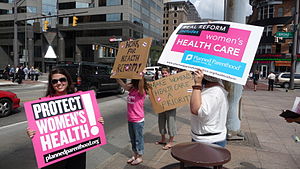
But this legislation is still terrible for women. Rep. Carolyn Maloney called it “the deepest attack on a woman’s right to choose in my lifetime.”2 Expert Jessica Arons said it would “accomplish the unstated end of making abortion as difficult to obtain as possible without actually criminalizing it.”3Womenshc

Among other things, the bill would effectively prevent women from using their own money to purchase insurance that includes abortion coverage in the new insurance exchanges. Experts warn this could lead to insurance companies dropping abortion coverage entirely.4aroomofmenscrewswomen
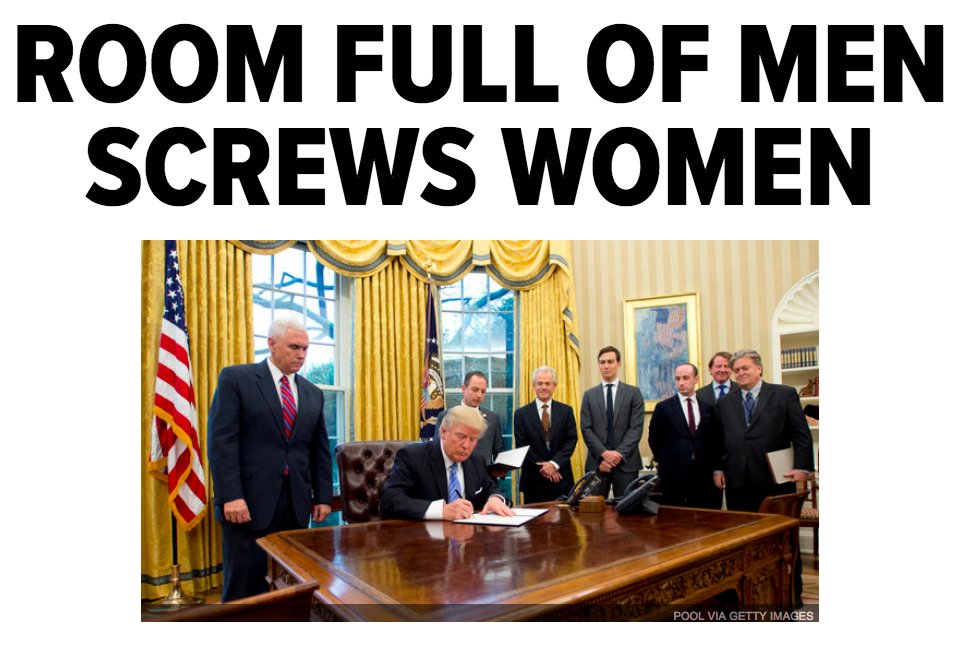
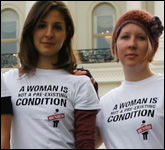
And it’s only one part of the Republicans’ attack on women’s health. A second bill would allow hospitals to let a pregnant woman die rather than perform the abortion that would save her life.5It’s reprehensible. We can’t let the GOP force women back into the back alley. You stood up against the disgusting “forcible rape” provision—now can you stand together to tell Congress to oppose these attacks on women’s right to choose by signing the petition below?Womenrpreexistingcon
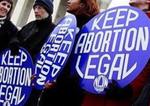
http://pol.moveon.org/wontgoback/?id=26019-17809870-opCKlFx&t=3 The petition says: “Stop the GOP war on women’s health. Please oppose the bills that would restrict abortion coverage and erode a keepabortionlegalwoman’s right to choose.”
On Tuesday, local MoveOn members in “We Won’t Go Back to the Back Alley” T-shirts will deliver your petitions during a hearing on Capitol Hill. Anti-choice activists are sure to be out in full force at the hearing, so we need a huge stack of names to show Congress and the news media that voters won’t stand for this attack.

These GOP bills are a full-throated attack on women’s reproductive freedoms. Their legislation would:6

Effectively ban abortion coverage in the new health insurance exchanges even if people pay for coverage with their own money.

Impose tax penalties on small businesses that pay for health plans that cover abortion and people who pay for abortion care.

Force the District of Columbia to impose all of the above laws, instead of letting the city decide its own laws.

Permanently ban abortion care for women insured by the government.

And a recently added provision is perhaps the most disgusting: allowing hospitals to deny a woman a life-saving abortion. If this bill passes, hospitals will be allowed to turn away a woman seeking an abortion, even if she’ll die without it—a major change from current law.7

Will you sign the petition today and stand up for a woman’s right to choose?

Don’t let the GOP send us back to the back alley. Sign the petition and share with your friends today:

http://pol.moveon.org/wontgoback/?id=26019-17809870-opCKlFx&t=4

Thanks for all you do.

–Kat, Eli, Milan, Carrie, and the rest of the team

Sources:

1. “House Republicans drop controversial ‘forcible rape’ language,” CNN, February 3, 2011

http://www.moveon.org/r?r=205960&id=26019-17809870-opCKlFx&t=5

2. “Democratic Reps. Unimpressed With New House Abortion Bill,” Talking Points Memo, February 3, 2011

http://www.moveon.org/r?r=205966&id=26019-17809870-opCKlFx&t=6

3. “Extreme Abortion Coverage Ban Introduced,” Center for American Progress, January 20, 2011

http://www.moveon.org/r?r=205961&id=26019-17809870-opCKlFx&t=7

4. “An Analysis of the Implications of the Stupak/Pitts Amendment for Coverage of Medically Indicated Abortions,” The George Washington University Medical Center, School of Public Health & Health Services, November 16, 2009

http://www.moveon.org/r?r=205972&id=26019-17809870-opCKlFx&t=8  (PDF)    

“Study: Stupak Amendment Will Eliminate Abortion Coverage ‘Over Time For All Women,'” Tal king Points Memo, November 18, 2009

http://www.moveon.org/r?r=205973&id=26019-17809870-opCKlFx&t=9

“A Quick Note on the ‘No Taxpayer Funding for Abortion Act,'” Mother Jones, January 20, 2011

http://www.moveon.org/r?r=205975&id=26019-17809870-opCKlFx&t=10 

“Extreme Abortion Coverage Ban Introduced,” Center for American Progress, January 20, 2011

http://www.moveon.org/r?r=205961&id=26019-17809870-opCKlFx&t=11 

5. “New GOP Bill Would Allow Hospitals To Let Women Die Instead Of Having An Abortion,” Talking Points Memo, February 4, 2011

http://www.moveon.org/r?r=205974&id=26019-17809870-opCKlFx&t=12

6. “Extreme Abortion Coverage Ban Introduced,” Center for American Progress, January 20, 2011

http://www.moveon.org/r?r=205961&id=26019-17809870-opCKlFx&t=13

7. “New GOP Bill Would Allow Hospitals To Let Women Die Instead Of Having An Abortion,” Talking Points Memo, February 4, 2011

http://tpmdc.talkingpointsmemo.com/2011/02/new-gop-law-would-allow-hospitals-to-let-women-die-instead-of-having-an-abortion.php.